



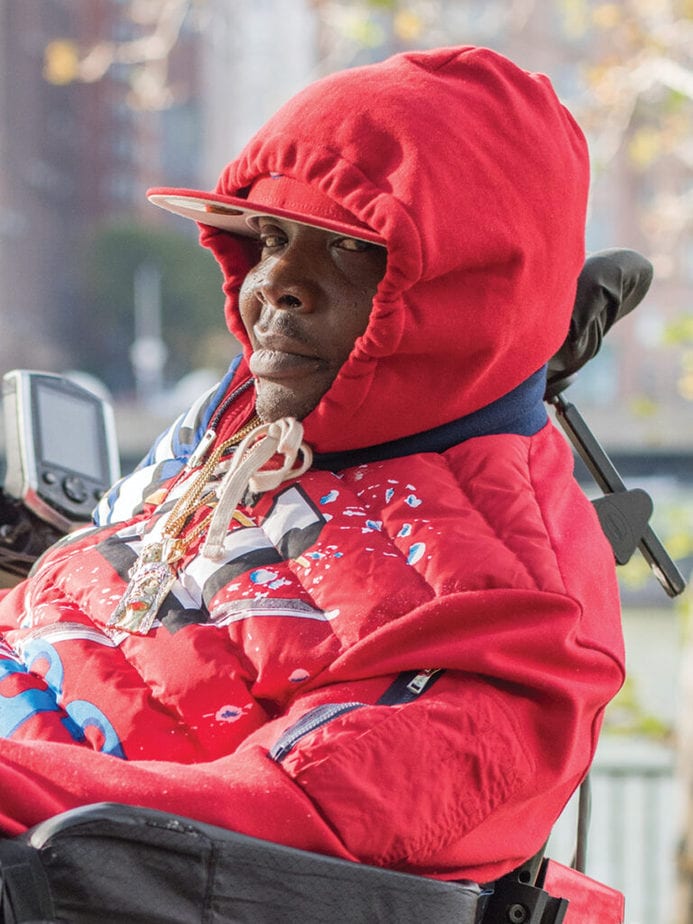
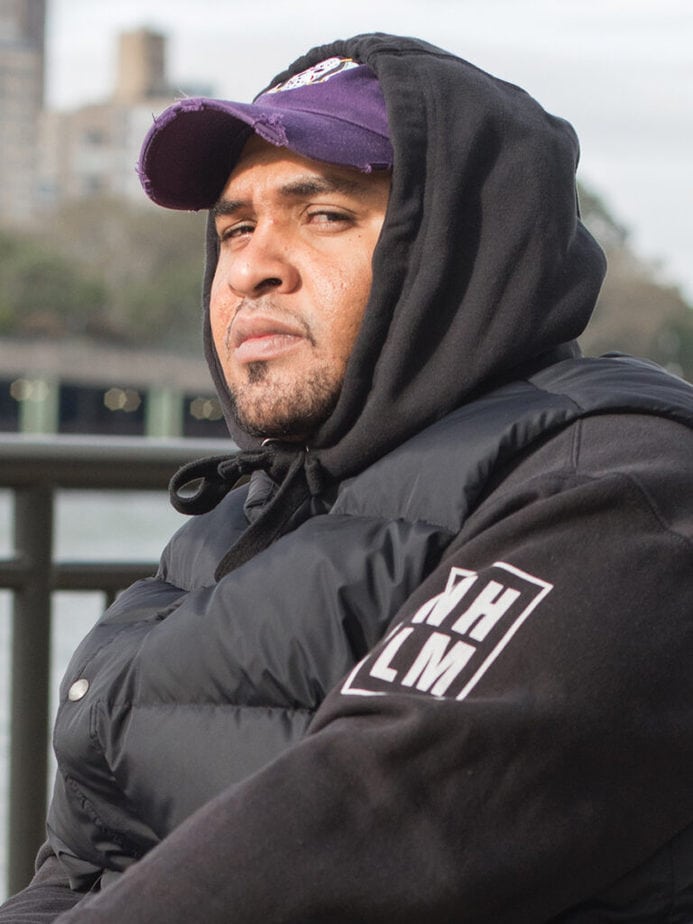



One in 10. If you were a resident in a nursing home before the COVID-19 vaccines arrived, you had a one in 10 chance of dying during the pandemic. Despite making up less than 1% of the total U.S. population, people who live in nursing homes accounted for at least 34% of COVID deaths. Those statistics are devastating, but they don’t tell the full story — of the terror, the neglect, the mismanagement and the disregard for their lives — that nursing home residents across the country experienced.
Fire through dry grass is what I experienced
– Vincent Pierce, from his poem “Fire Through Dry Grass”
but this grass was never green
Or did it ever smell like that fresh cut grass
on a summer morning
the fire was never visible
but O did it spread like a wildfire
At the Coler Rehabilitation and Nursing Care Center in New York City, one group of working-age wheelchair users known as the Reality Poets spent a year locked inside their facility, fighting for their lives. Amidst the chaos of their everyday lives, they used every tool at their disposal — from film and poetry, to social media, political advocacy and public protests — to force reforms and ultimately make Coler a safer place for its residents and staff. And while the immediacy of the pandemic has died down among the public, the Reality Poets continue the long fight to raise the voices of our most marginalized communities — black and brown, immigrant, significantly disabled and low-income.
For shining a light from the inside and showing that our “most vulnerable” can also be our community’s most powerful advocates, we are proud to recognize (clockwise from top left) Peter Yearwood, Andres Molina, LeVar Lawrence, Alhassan Abdulfattah, Ramon Cruz, Shannon Nelson, Vincent Pierce, Francene Benjamin and the rest of the Reality Poets as our 2021 People of the Year.
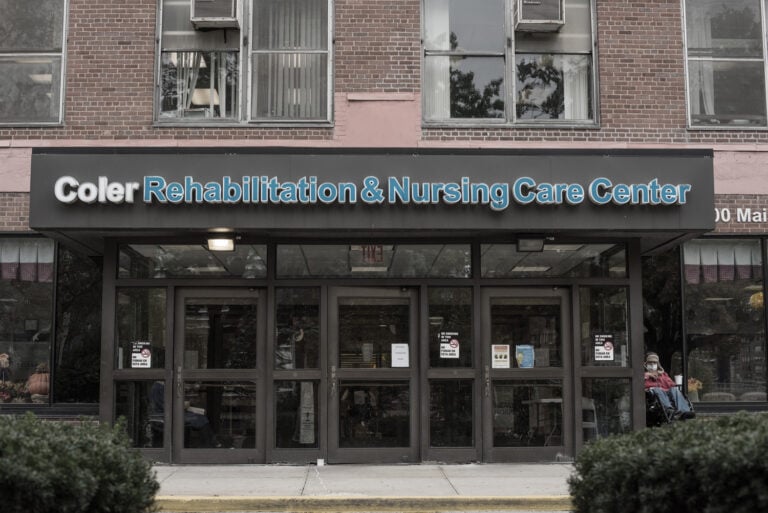
Photo by Nolan Ryan Trowe
The front entrance to Coler nursing home, located on Roosevelt Island in New York City.
It was March 2020 when Andres “Jay” Molina got a new roommate. Staff rolled a sick man into Molina’s room at Coler Rehabilitation and Nursing Care Center on Roosevelt Island in New York City one evening and put him in the next bed over, separated by only a curtain. Molina, a power wheelchair user who has a severe lung condition, diabetes, and heart and kidney problems, had no idea who the individual was or where he’d come from. The man was coughing and continued to cough throughout the night.
In the morning, Molina was able to talk to his new roommate. The man told Molina that he had COVID.
I could write about each and every time
That I made my mother cry,
Or about when I got paralyzed
And how I wished I would die.There’s so much pain inside of me
That I can express through my penWhere the fuck do I begin?
– LeVar Lawrence, from his poem “II”
He also told Molina that he’d been transferred from Elmhurst Hospital in Queens, which at the time was the epicenter of America’s first surge of the COVID outbreak. If you remember the news footage of refrigerated trucks parked outside hospitals to stow overflow bodies, Elmhurst was one of those places. Now this sick man from Elmhurst was lying in Molina’s room, in a facility run by the city of New York that housed 500 other residents, many who were elderly or, like Molina, with significant disabilities and various other health complications.
Shocked and angry, Molina got on the phone with Coler’s administration. “I told them, ‘How are you going to put a guy with COVID into my room when you know I have underlying conditions?”

Photo by Nolan Ryan Trowe
Peter Yearwood is a writer, poet and organizer for Open Doors. He contracted polio as an infant in Belize and immigrated to the U.S. with his family when he was a child.
The administrator told Molina the man didn’t have COVID.
“But he’s telling me he does,” Molina replied, anger rising even further.
Sorry, there’s nothing we can do, said the voice on the other end of the phone.
Molina hung up. “What they were telling me was, ‘If you survive, you survive. If you die, you die,’” he says.
Molina refused to go quietly. He reached out to his friends and fellow residents in Open Doors, an art and social justice collective of wheelchair users who lived or had lived at Coler. The group hadn’t seen each other in person since the pandemic began, as their respective units were locked down, but they met over Zoom regularly. The members who lived in Coler were reluctant to speak out, fearing reprisals from the administration. But it was clear it was time to do something about the increasingly dangerous situation they found themselves in.
“What was happening here
– Peter Yearwood
was happening in nursing
homes all over the country.”
An aspiring filmmaker, Molina did the only thing he could think of: He strapped a GoPro to his wheelchair and started filming — documenting the reality of what he and his friends were experiencing from the inside.
This wheelchair life is not a game
ever since I got paralyzed, my life hasn’t been the same
But I will never be ashamed
to let the whole world know my struggles and pain
Life is an adventure, I am an inventor
in the midst of chaos, I am calm in my center
Coldest than the throes of the winter,
yet so warm, I could stove up November
– Micah Harris, from his poem “This Wheelchair Life”
Open Doors
On sunny summer days a breeze often flows up the East River, cooling the grounds in front of Coler. The facility is housed in a massive brick building that spreads across the northern tip of Roosevelt Island. Most days a group of wheelchair users gathers in the yard overlooking the river and the high-rises of the Upper East Side beyond. They are Black and brown, some are immigrants, and some grew up poor. Many have been to jail, faced addiction or both, and most have been put in wheelchairs by gun violence. They still meet in the yard when the winds turn cold, bundling in puffy jackets and hoodies, stocking caps and winter gloves, so they can enjoy a bit of freedom in a schedule often dictated by the realities of needing care in a chronically understaffed institution.
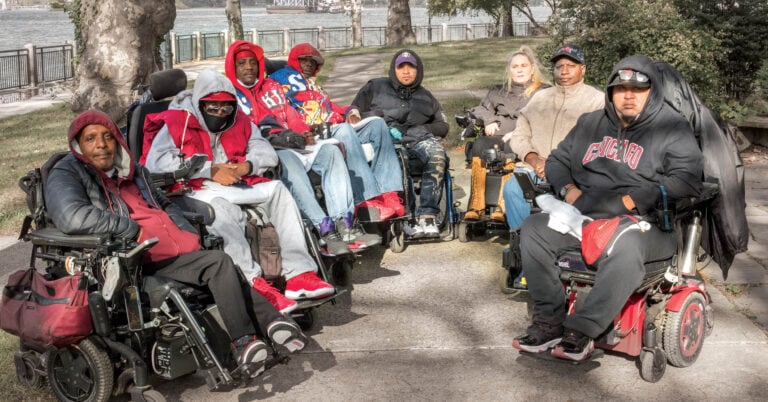
Photo by Nolan Ryan Trowe
The Reality Poets outside of Coler.
They are at Coler because Coler took them. If you are a young man of color who was shot, has a criminal record or history of drug use, many other nursing homes in the city don’t want you. Accessible housing lists can take years to work your way through and often aren’t available if you are undocumented or have a felony on your record. Coler and a few similar city-run facilities are where you go, the nursing homes of last resort (see “What Homes If Not Nursing Homes”).
Jennilie Brewster would see these men when she started coming to volunteer at Coler in 2014. She lived on Roosevelt Island, was taking a course at the New York Zen Center for Contemplative Care and had been placed at Coler as part of a caregiving assignment. Her unit was for people with nonverbal, cognitive disabilities, and she spent a year there as a companion, reading and playing games and taking residents outside. “There was a younger crowd that hung outside. Frankly, all of them kind of looked good — had cool hats, cool shoes — just hanging out, smoking, listening to music, shooting the shit. And I was like, I want to know these guys,” she says.
What Homes If Not Nursing Homes?
In New York City, people who rely on Medicare/Medicaid and don’t have the resources to pay for access modifications or accessible housing out of pocket can wait years for suitable housing. If you are an immigrant who lacks proper documentation, public housing isn’t available. Having a criminal record doesn’t technically disqualify you from getting on a public housing list, but navigating the byzantine bureaucratic systems, paperwork, hearings and appeals it adds can make the process even more interminable. Many people in these situations wind up in nursing homes like Coler.
Many of the Reality Poets fear that if they were to get out of Coler, they will wind up back in the same neighborhoods they came from, in the middle of the same issues they’ve been trying to leave behind.
Roosevelt Island is accessible compared to many neighborhoods – with wide sidewalks and easy pedestrian access – and in non-pandemic times, the residents have access to it. They have a real connection to the community. Some would love to live in an apartment on the island, but those apartments hardly exist anymore. Add to that the problems with self-managing, and paying for, sufficient care during a full-blown caregiver crisis. Some of the Reality Poets who could live in the community decided that moving out of Coler isn’t worth the fight. There are a couple of Reality Poets, Alhassan “El” Abdulfattah and Shannon Nelson, who have found apartments in the city and moved out.
The disability community often treats nursing homes as a black and white issue: we need people out of nursing homes, now. For many Open Doors members, the more pressing priority is to improve the conditions for all residents and staff, who are often poor, people of color and immigrants, just like them. As Molina said in an interview with disability advocate and author Alice Wong when she asked him about abolishing nursing homes: “We aren’t advocating for institutions like Coler to be abolished. We just want them to be changed, to be more humane.”
She eventually introduced herself and started hanging out. As she got to know them, she learned there really weren’t any programs at Coler to help residents move forward with their lives. “I saw it as this cycle of oppression — a lot of them had grown up in public housing, attended underfunded schools, and now they’re back in a city-run institution, and again [there were] no resources being put into their education, creative development or anything.”
Brewster asked what they’d like to do, and a few said they’d like to tell their stories, share them with young people growing up in similar neighborhoods, facing similar challenges. In the spring of 2016, Brewster started a writing workshop. It wasn’t an immediate hit. “Hardly anybody came,” she says. “I’d walk around trying to entice them in with snacks.”
For the guys, Brewster was still “this white lady who kept coming around,” as Molina once described her to me, and they weren’t sure what a writing workshop was going to do for them. LeVar Lawrence is one of that original crew. He drives a sip-and-puff power chair and is known to the group as the Vartist because of his talent for digital painting. When I asked him what finally convinced him to start coming to Brewster’s workshops, he doesn’t hesitate. “The snacks,” he says with a quiet chuckle.
Eventually guys started showing up, learning how to write essays and poetry. Many residents were hesitant to start attending workshops. “I was terrified of poetry,” says Peter Yearwood, a polio survivor. He didn’t know what to say or how to say it. But Yearwood says Brewster had an inherent trust and confidence in people, and that confidence eventually won him over. “She told me to just write what I feel,” he says. The process of writing, Yearwood says, “helped me to get to know myself. … It put me in touch with my humanity.”
The writing workshops continued. The group dubbed itself the Reality Poets and Brewster founded Open Doors, the nonprofit initiative that would coordinate a growing number of the Poets’ programs and projects, in 2016. They started speaking about gun violence prevention at local schools, reciting their poetry for students and telling their stories: the drug use, the crime, the consequences of the decisions they’d made.
Many of the guys felt like they had a purpose for the first time since their injuries. When they held school events, it seemed like students were really listening. When the Reality Poets spoke about gun violence and the reality of life on the streets, students’ bullshit sensors didn’t immediately sound. As one student told Molina after a talk at school on the Lower East Side, “You guys actually lived through it … what you guys talk about is the truth. It’s the way it is.”
They get to go home
We are left to fight this monster
It’s like throwing me in a dumpster
Close it
And walk away
– Peter Yearwood, from his poem “Frustration”
We Need Beds
Even in the early days of the pandemic when little was known about the virus, it was an idea that seemed to defy all medical logic or common sense: COVID patients would be sent to nursing homes to free up beds at the city’s overwhelmed hospitals. And when the city announced the emergency plan that would first bring COVID patients to Coler, it made no mention of nursing homes.

Photo by Nolan Ryan Trowe
Poet and music producer Vincent Pierce leads Nursing Home Lives Matter.
On March 16, 2020, New York City Mayor Bill DeBlasio held a news conference in which he announced a variety of measures the city was taking to combat the virus. “The Coler facility on Roosevelt Island, a [NYC Health and Hospitals] facility that was empty. It is immediately being brought back online,” he said.
But Coler wasn’t empty. It still operated as the last vestige of Roosevelt Island’s institutional past. The city acquired the island in 1825 and began construction on Blackwell Penitentiary, an infamous prison whose prisoners were used to construct other buildings on the island, including a now derelict smallpox hospital. There was the Municipal Pauper Lunatic Asylum, where inmates from Blackwell once served as staff, the Women’s Lunatic Asylum and workhouses where drunks, prostitutes and vagrants were sent to supply labor for various city endeavors. “The island has always been a dumping ground for the city’s undesirables,” says Yearwood, who now works as an organizer for Open Doors.
In the 20th century, many of the island’s most notorious institutions were shut down, and the island became the center of New York City’s efforts to create a modern public health system. The city built a nurses training school and nursing homes like Coler and Goldwater, where Yearwood and Lawrence both lived before it was demolished in 2014.
“They lied about the death counts. They lied about a lot of things. And we felt like we had to speak up and let people know what was going on.”
– Vincent Pierce
By 2020, most of the island was residential. Open Doors quickly published an open letter to the mayor stating that Coler was an active nursing home, and that, for various reasons, bringing COVID patients there was a terrible idea. Yearwood still marvels that they had to tell the mayor there were still people in Coler. He felt like they were having to yell from behind the walls of their nursing home, “Hello! Us little people are still here!”
Eventually the city backtracked, saying that they were creating a new 350-bed hospital on the “Coler campus.” There would be strict separation between the nursing home and the temporary facility. And they weren’t going to be bringing COVID patients into Coler, just non-COVID overflow patients.
You can call it bad information, or you can call it outright lies, as many of those who were living in Coler during the early days of the pandemic do. Whatever the reason, the reality in Coler was completely different from the official story. The city did set up a separate medical facility, known as Roosevelt Island Medical Center, but it was in the same building as Coler, and the new facility shared the same entrance, elevators and in some cases, hallways. They heard from nurses that the other facility, at times just a floor away, was treating COVID patients. Then, a few days after the press release, the city again changed its messaging and confirmed that they were treating COVID patients at the new facility.
It didn’t take long before the virus gained a foothold in the nursing home. Once there, it found a field of dry grass waiting to be lit.
I am the point guard
Score 30 pts per game
Soon I will be in the hall of fame
I am the drummer laying down a beat
That is sure to get you on your feet
Dream black man.
Dream
– Peter Yearwood, from his poem “Dreams”
A Community Flourishes
Open Doors started with writing and poetry, but the organization quickly expanded with new programs and projects. What holds them all together is a mission to encourage creative expression and to amplify the voices of people who don’t often have the opportunity to tell their own stories
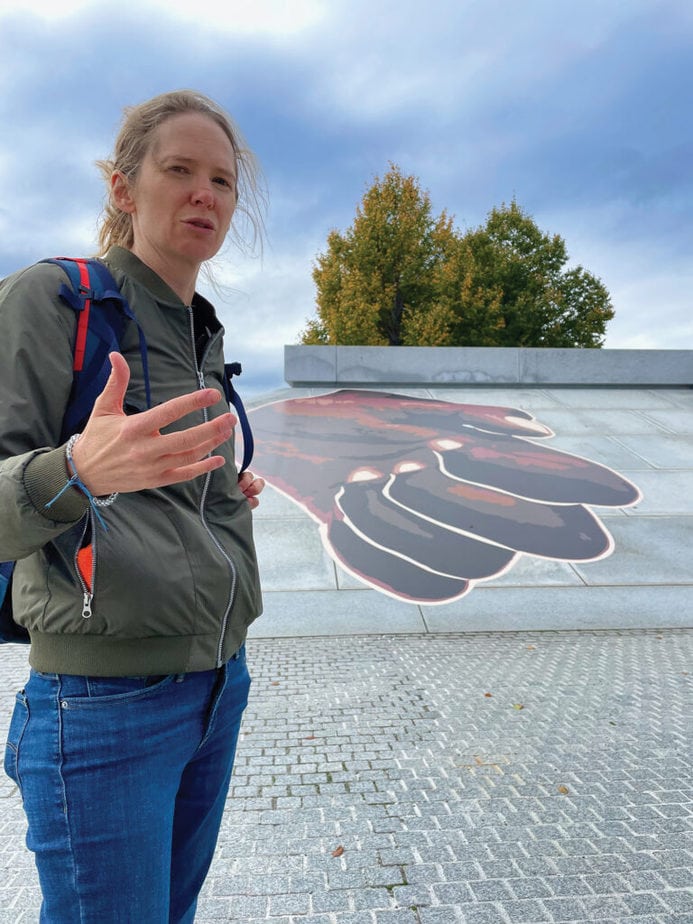
Vincent Pierce, a soft-spoken man who was shot in the neck during a robbery in 2012, enjoyed writing poems, but his real passion was for music. He wanted to learn production. So Brewster found a local music producer to come in a mentor him, and the organization helped with funding for equipment.
In 2019, Pierce produced his first album, Open Doors Reality Poets, Volume I, a mix of spoken word and hip-hop featuring himself and other Reality Poets. That same year, he received a grant from the Center for Cultural Innovation to start a program teaching music production to children who wouldn’t otherwise have the opportunity. The goal, Pierce says is “showing kids from neighborhoods like the one I grew up in that they are bigger than what their environments expect them to be.”
Open Doors published its first book in 2019, Wheeling & Healing, a poetry anthology. They performed poems from the book to a packed crowd at Bowery Poetry, a longstanding poetry and performing arts in venue in lower Manhattan. They co-wrote and produced a play, Fade, about their own lives, which debuted at a theater on Roosevelt Island.
Molina taught himself film editing and animation software. He made a short film about Lawrence visiting the site of his former home, which was now a gleaming new campus for Cornell Tech. He did a few videos for the nursing home. Then, he got a grant to allow him to bring in an experienced filmmaker, Alexis Neophytides — who grew up on Roosevelt Island and won an Emmy for a public television series documenting slices of neighborhood life in New York — to help him make a short documentary about Fade. “It was like magic. Here was this guy from my old community making a film about his new community” says Neophytides. “We hit it off right away.”
The projects were vital for their own personal and creative development. Through the work they were doing — visiting local schools, performing at local venues, working with artists and nonprofits from the island, collaborating on arts projects with professors and students at Cornell Tech — they connected with the community on Roosevelt Island in a way they hadn’t before. Prior to Open Doors, Coler’s residents felt like “we were a sore thumb to this island,” says Yearwood. “When they started getting know us, who really lived at Coler, we started bridging that gap between the community and the hospital.”
Open Doors started as a gun-violence prevention organization. Though that’s still a component of the organization’s work, now “what we really are focused on is community building,” says Brewster. The connections they made on Roosevelt Island would prove vital once the pandemic hit — they’d need all the help they could get.
Will I survive through these hard times
God only knows what your future holds
now if this is being read after my departure
just know I fought
but my soul I didn’t let the devil capture
– Vincent Pierce, from his poem “Will I Survive”
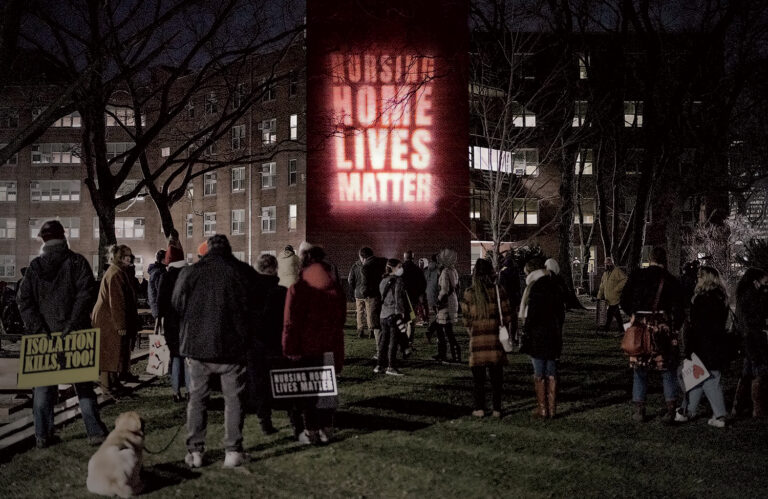
Photo by Gary Dean Clarke/@garydeanclarke
Supporters gather outside of Coler at a twilight vigil for lives lost during the pandemic.
Worse Than Prison
When COVID came to the nursing home, the Reality Poets heard about it the way they had everything else, through the grapevine of nurses, nurses’ assistants and other residents. “We weren’t getting any type of information about what their plan was or anything. It’s like no one took the time … they were only worrying about COVID patients brought in from the outside,” says Pierce.
Coler was severely understaffed, and the staff they did have lacked proper personal protective equipment. “We’d see a nurse with the same gown and the same mask on for the whole day,” says Molina. “And they treated patients that have COVID with the same gown and mask on in places that didn’t.”
The hospital was locked down. “It was hard. They stopped us from seeing our families, stopped us from going out.” says Pierce.
Then, the nursing home did something unconscionable — instead of quarantining residents who started showing COVID symptoms, they locked that person’s entire unit down together. As soon as COVID appeared, everyone in a multi-room unit would be shut inside, sometimes dozens of people, waiting for the deadliest virus in modern history to come for them. “Every day we’d wake up, we’d pray, ‘Thank you God for this day, because we don’t know we’re going to have another one,’” says Molina.
Yearwood’s unit was one of the last to be locked down. About three days later, he started feeling weird — sweating at night, chills, no appetite. Yearwood was tested, and it came back positive. “It felt like someone had dropped the Empire State Building on me,” he says. “I knew how deadly this thing was … and what was even scarier was them telling you there’s not much they can do.”
Yearwood had been estranged from his family ever since a long, dark period of his life when he was addicted to crack. He’d been clean since about 2000, but had lost touch so completely that he could no longer even find a way to contact them. One day a nurse asked him if he’d like to them to inform his family that he had COVID. He declined, there was no one to call. “If I had died in here, I’d just be a John Doe to them, I guess, buried out in Potter’s Field or something,” he says, referring to the cemeteries where people who died unknown and unclaimed would be buried in unmarked graves.
Fortunately, Yearwood’s symptoms never worsened. But Pierce and Lawrence both caught the virus as well. Each had their own brush with death that they were thankful to come out of still breathing. Others were not so lucky.
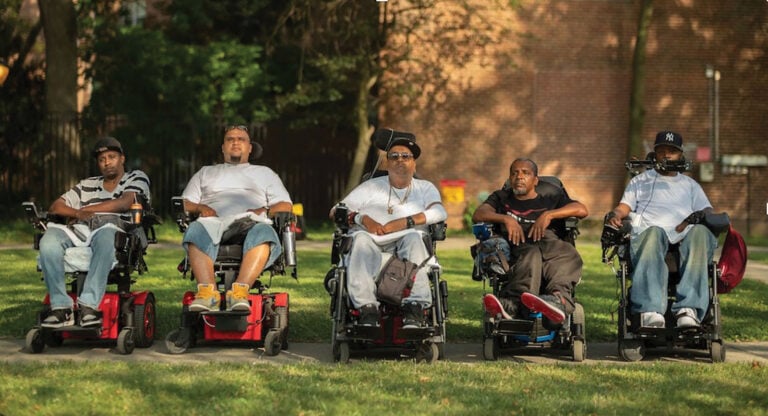
Photo by Elias Williams
Reality Poets (left to right) Vincent Pierce, Andres Molina, Ramon Cruz, Peter Yearwood and LeVar Lawrence
Roy Watson was an older member of the Reality Poets, a recovered alcoholic who was a devout Muslim. “He didn’t really write poems — he’d write more about his life story,” says Molina. Watson didn’t know anything about film editing or have any particular interest in it, but Molina remembers one day pre-pandemic when they spent an entire afternoon in Molina’s room, Watson watching Molina work, asking questions about his process. “It just made me feel like he cared about what I was doing,” Molina says.
After Watson got COVID, staff left him with minimal care for a week before they sent him to a hospital. One day, staff rolled him out on a stretcher. Watson died a few days later. “Roy died at the hospital from, they said, COVID and complications of a pressure sore — from having been left in bed for a week because people didn’t want to move Roy because they were scared of getting the virus,” says Brewster.
Nursing aides told Pierce that they’d been directed to leave residents until the last minute because they were preserving the hospital beds for other people. “I was shocked,” says Pierce. The implications were clear: There are people whose lives are worth saving — but you are not one of them.
Up until then, the guys who were living at Coler were afraid to speak publicly. But Watson’s death, along with policies that they believed showed a complete disregard for their safety, left the group feeling like they had no choice. “We didn’t give a shit anymore,” says Yearwood.
Separating families killing old, young
doesn’t matter who
We have something for you
It’s called solidarity
When our way of life is threatened we all unite
To fight the fight
– Peter Yearwood, “Message to Corona”
Fighting Back
The Reality Poets were ready to fight back, but they realized that talking to Coler’s administration wasn’t going to do anything. Molina’s call had made that clear. Through their weekly planning calls with Brewster and other members and staff of Open Doors, they strategized what was essentially a three-pronged attack: documenting and publicizing their conditions inside Coler, connecting with local politicians who could put pressure on New York Health and Hospitals, the city organization that ran Coler, and staging public protests outside the nursing home.
Fortunately, the press had already caught onto the story. Mother Jones, the New York Post, NY 1 and ProPublica all published stories that poked holes in the official story and exposed some of the deplorable conditions that residents were subjected to.
Fire Through Dry Grass
The documentary Fire Through Dry Grass takes viewers behind the scenes of the devastation experienced by nursing home residents during the onset of the COVID-19 pandemic. Instead of sitting back while their lives were jeopardized by poor policy and half-truths, Coler residents fought back.
Co-directed by Coler resident Andres “Jay” Molina and Emmy-winning filmmaker Alex Neophytides, this feature-length film shares the stories of many of the Reality Poets you’ve met in this story and explores the community they’ve built at Coler. The film centers on video footage recorded by Molina and other Reality Poets, and features art, poetry, and music from the group. It’s emblematic of a new style of documentary filmmaking in which the subjects of the film are integral to the process, rather than having their story told by outsiders.
The film is supported by ITVS, which funds and presents documentaries on public television, and the producers are working with the impact team for the ground-breaking documentary Crip Camp. The team expects Fire Through Dry Grass to be shown on PBS. For updates and to see a trailer for the film, visit firethroughdrygrass.com.
When COVID first hit, nobody at Open Doors knew any politicians, but, as Yearwood says, “We knew people who knew people.” They tapped the community connections they’d made on Roosevelt Island and found politicians who were willing to hear their stories. Manhattan Borough President Gale Brewer and State Assemblywoman Rebecca Seawright immediately understood the gravity of the situation and began a sustained advocacy effort for Coler’s residents.
On April 17, 2020, they sent a letter along with State Senator José Serrano asking the president of NYC Health and Hospitals, Dr. Michael Katz, for clarification on the situation inside Coler. On May 4, with pressure from the press and politicians mounting, the NYC Health Department performed an official inspection of Coler.
The report confirmed many cases where COVID-positive patients weren’t separated from patients without the virus. The health department issued a citation that forced Coler to change some of its policies, mandating better testing procedures and quarantining COVID-positive patients. “I don’t know that the health department would have responded to us at all if we didn’t have the Manhattan borough president and the assembly members breathing down their necks,” says Brewster.
As the first wave receded, residents settled into a grim purgatory. The entire facility remained locked down and residents could only go outside into a gated yard at set times, with supervision. Somehow, they couldn’t be trusted to follow the same protective measures, like masking up and social distancing, that staff were expected to. Pre-pandemic, many of the Reality Poets regularly traveled out into the city to visit their families. Pierce had a 12-year-old daughter, and Lawrence had children too. It would be over a year before they were allowed to see them in person.
Throughout it all, Molina, who had been working on a documentary about Open Doors, kept filming. Neophytides had stayed in touch when the facility was locked down. When Molina and Brewster floated the idea to her of focusing his film on what was happening inside Coler during the pandemic and invited Neophytides to co-direct, she was all in. “There was never a question of whether or not I was going to do it,” she says. “It just felt really important.”
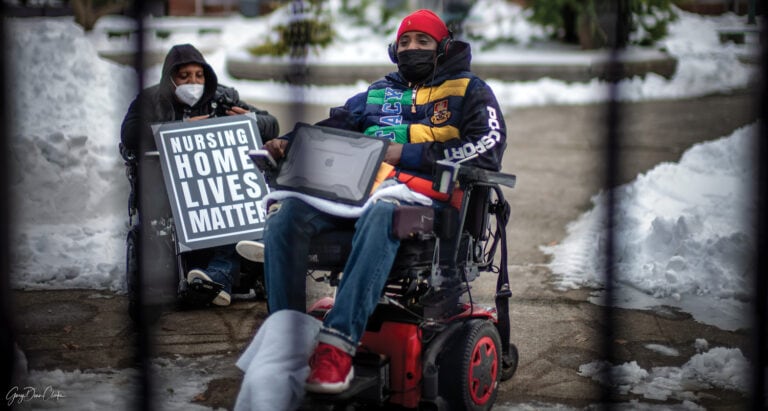
Photo by Gary Dean Clarke/@garydeanclarke
Vincent Pierce and Peter Yearwood protest from behind a locked gate at Coler during a December 2020 Nursing Home Lives Matter Protest.
Molina filmed with a GoPro and DSLR while other Reality Poets recorded what they were experiencing on their cell phones. Molina interviewed residents, and the team recorded Open Doors’ Zoom meetings and collected the pieces to tell their own story of the pandemic. Molina and Neophytides began meeting regularly over Zoom. “She would send me a list almost every week — can you film this, can you film that?” says Molina. They would review footage with the film’s editor, and Neophytides would make a new list. As she collaborated with Molina on the project, her perspective proved invaluable, not only because of her experience with filmmaking, but because she had some distance from the unfolding tragedy. “If it were up to me, I would have just been filming people in their beds almost dying,” Molina says.
On Dec. 20, 2020, nine months after residents had first been locked down, Pierce, Molina, Yearwood and a few other Reality Poets rolled into the snowy yard at Coler to protest the conditions inside. Press and a crowd of community supporters were gathered on the other side of a wrought iron fence — the comparisons to a prison were unmistakable. The men and supporters in the crowd held signs emblazoned with Nursing Homes Lives Matter, a protest movement that Pierce had started over the summer after seeing the racial justice protests in the wake of George Floyd’s killing and drawing parallels with their own struggles at Coler.
Reporters stuck long microphones through the bars to ask the men questions. They talked about the isolation, the lies, the disregard for their lives. They demanded change. If decisions were being made that affected them, they want a seat at the table. They wanted this change not only for themselves, but for residents of nursing homes across the county. As Pierce said after that first protest, “This is only the beginning.”
At that moment he spoke and said, “You’re special to me.
I have more in store for you
Just wait you’ll see.”
I told him that I didn’t want to hear that shit
Unless he’s giving me the ability to walk
He said, “My child, I just gave you back the ability to talk!”
– LeVar Lawrence, from his poem “Something About Me”
Rising From the Ashes
For the Reality Poets, like the rest of the world, this pandemic has no happy ending. So far, it has no ending at all. In January 2021, not long after the Nursing Home Lives Matter protest, Pierce spent weeks on the observation side of the quarantine wing set up at Coler because his roommate tested positive for COVID.

Photo by Nolan Ryan Trowe
LeVar Lawrence is known to the group as the “Vartist.”
Now I’m praying to God that he saves my life
So I can be around to watch my kids grow
And teach my sons things about the streets that they
don’t know
To make sure that my daughters
don’t end up with the wrong man
Let them know what they’re worth
and that they need a ring on their
hand
Well, remember me God?
The one that got shot in the Head?
I’ve changed my mind
Because what use am I to my kids if
I was dead
– LeVar Lawrence, from his poem “Change of Heart”
Things slowly got better when the vaccine came. Starting in March they could finally go outside and see their families. They could hang out front of the building and feel the breeze blowing up the river. They’d successfully helped force changes at Coler — testing and separation of COVID patients, increased scrutiny of PPE supply and practices — that made the facility safer for both residents and staff. They no longer woke up every day feeling like they’d been thrown in a lion’s den. They could focus on the hard work of sustaining their efforts now that the fire, and the energy and attention it brought, had calmed to a smolder.
Pierce continues to lead Nursing Home Lives Matter, which held a public vigil for the lives lost in Coler in the spring of 2021. That summer he spoke at a virtual roundtable that brought nursing home staff and residents together to build solidarity for their parallel fights for better working and living conditions.
Help Leaving a Nursing Facility
If you live in a nursing facility and would like to live in the community instead, the best place to start is usually your local Center for Independent Living. There are over 400 CILs in the United States. Helping people leave nursing facilities and other institutions is a core service of all CILs. Find your local CIL at ilru.org/projects/cil-net/cil-center-and-association-directory.
Additionally, you can contact United Spinal’s Resource Center. “We can point you to state and local resources that are available, as well as connect you with a local United Spinal chapter in your area, as they may be able to provide additional support to help you transition out of a nursing home,” says community advocacy manager Jose Hernandez, a C5 quad who lives in New York City. Visit unitedspinal.org/ask-us or call 800/962-9629.
Molina continues the multi-year effort to produce their feature documentary, Fire Through Dry Grass. It recently received funding and support from ITVS, a primary funding organization for public television projects, and they’ve started working with the impact team for the award-winning documentary Crip Camp, trying to build momentum for the film’s release.
In the past year, Open Doors expanded both its staff and its members. They continue their quest for creative expression, amplifying the voices of those who don’t often have the opportunity to tell their own stories. To that end, they launched a new project, Pandemic Island, in June 2021. They’re collecting and archiving stories and art from people who lived and worked through the pandemic on Roosevelt Island. “It’s so important that we do this and we do it now, while the memories are still fresh in people’s minds and we can get the stories from the people who actually lived through these experiences,” Yearwood says.
As Open Doors grows, they seem to always circle back to the structure of the writing workshops where their work began: Take your turn to speak, then be there for the next person. They have truths to tell too.
Support New MobilityWait! Before you wander off to other parts of the internet, please consider supporting New Mobility. For more than three decades, New Mobility has published groundbreaking content for active wheelchair users. We share practical advice from wheelchair users across the country, review life-changing technology and demand equity in healthcare, travel and all facets of life. But none of this is cheap, easy or profitable. Your support helps us give wheelchair users the resources to build a fulfilling life. |


Love it!!!
Deep bow to you all, my friends! What a journey, I’m so glad the world gets to witness what you’ve created, how you have surmounted every obstacle. Thank you for sharing your story!