


By Trisha Stevenson
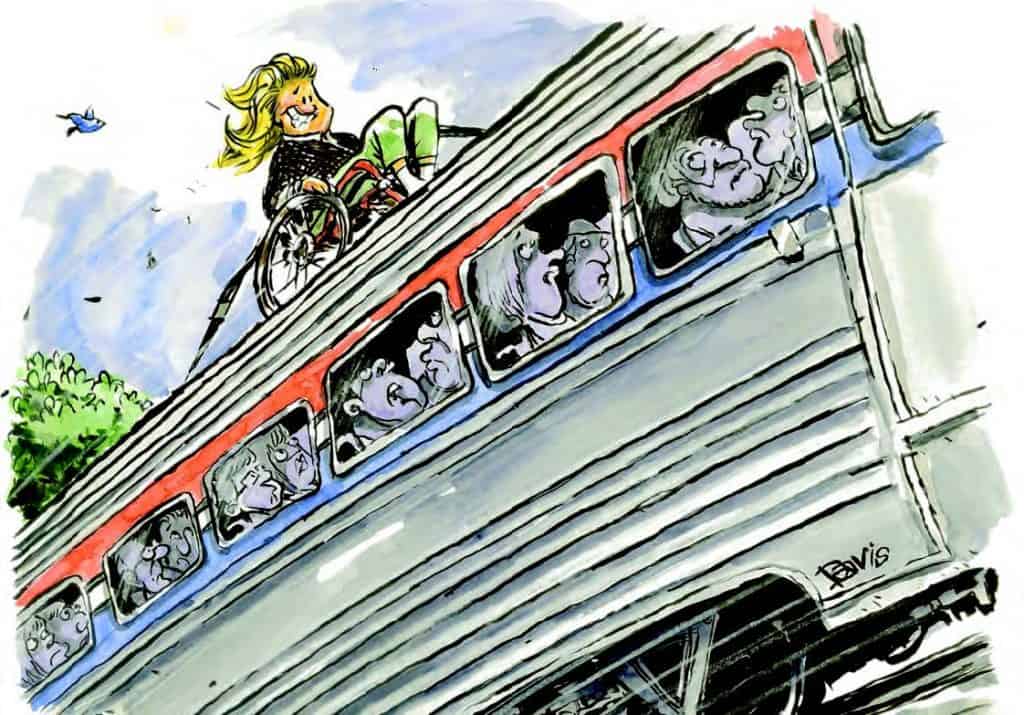
When it came time to bring my daughter to college to start her freshman year, I called Amtrak to buy tickets for my family. We have been regulars on the train, and I thought I knew the routine. ♦ “Hi, there,” I said brightly to the agent who answered. I explained which train and date we needed. “And one more thing – I use a wheelchair, and I need to reserve a wheelchair space.” ♦ “I’m sorry, ma’am, but there are no wheelchair spaces available on that train.” ♦ I was surprised. That train is never crowded. I wondered if there was a mistake, but she assured me that she was correct.
“Don’t you have eight wheelchair seats in every car?” I asked.
“Yes, ma’am.”
“Well, how many passenger cars are in this particular train?”
“Four cars, ma’am.”
From years of unfortunate homework experiences, my children will be the first to tell you that math is not my strong point. But even I could do this calculation. “But that’s … 32 wheelchairs!”
“Yes, ma’am.” Her voice had not changed one bit; she remained perfectly professional, detached and pleasant.
“You’re telling me that there will be 32 wheelchairs on that exact train that afternoon?”
“Yes, ma’am.”
I was taken aback, but decided to roll with it. It meant we wouldn’t have Amtrak’s disability discount, but I figured we’d just pay full price.
“OK, then I’ll just get a regular ticket and figure it out somehow.”
“I’m sorry, ma’am, but I can’t sell you any ticket at all, because we won’t be able to accommodate your wheelchair. All the wheelchair spaces will be full.”
“You mean you won’t even sell me a ticket and let me fold up my chair and take my chances on a regular seat?”
“That’s correct, ma’am. All the spaces to accommodate wheelchairs have been sold.”
“So there are absolutely no seats left for someone who has a medical need for a wheelchair?”
“That’s correct, ma’am.”
“And you don’t keep even one in reserve on the entire train in case someone with a medical need has to travel last-minute? Even if they pay full price? Even if they were willing to pay more?”
“That is correct, ma’am.” She remained completely calm, cheerful even.
Now I was curious. “How do people indicate that they need a wheelchair space? Do they need to give you their DMV placard number?”
“No, ma’am. They just ask for the special space and disability discount when they make the reservation on the phone or at the station.”
“And you don’t have any way of checking this?”
“That’s correct, ma’am.”
“Do you ever check at the time of boarding?”
“No, ma’am.”
“But what if someone has a true medical need for a wheelchair space and it’s been sold to someone else who doesn’t have the same need?”
“We suggest passengers make travel plans as early as possible, especially if they have a special need.”
“Can we just pretend we haven’t had this conversation and you can sell me a regular ticket anyway? This is the only train that will work for us.”
“I’m sorry, ma’am. I can’t do that. There are no wheelchair spaces left on this train.”
“I see. Well. Thank you.”
After hanging up, I counted to five and called back. I did not mention wheelchairs to the new agent who answered; I just bought regular tickets for my family. There were ample spaces available.
After I hung up the second time, I pondered the situation. Thirty-two wheelchairs? All on one train? My first reaction was utter disbelief.
But then again — what if it were true? I remembered that years ago, in downtown Chicago, I had seen one visually impaired pedestrian near the Wrigley Building. I turned the corner and saw another, then another, and suddenly there were dozens of visually impaired pedestrians, everywhere I looked. Wow, I thought, is there a convention or something? In fact, there was.
So although the cynical part of me wondered if at least some of the 32 people might be simply taking advantage of the disability discount and might not in fact have a verifiable medical reason for the space, I was willing to believe there was a chance, however small, that I could encounter 32 wheelchairs on the platform on the day of my Amtrak trek.
I began to look forward to meeting my fellow disabled travelers.
“Maybe it’s a political group,” I mused. “Or a northern travel adventure. It could be a social group. Or college activists, all heading to New England at the exact same time.”
The day of our trip, I could hardly contain my excitement. We arrived at the station early.
Yes, there we were, bright and early, on the platform.
My children, me, and my chair.
Alone.
My children were relieved; they didn’t want there to be any chance I could be left behind. But I was deeply disappointed.
“How ya doin!” exclaimed the steward when the train arrived. The crew knows us well from previous trips. They automatically headed toward our favorite wheelchair seats, right by the dining car.
All four seats were empty.
The train, which had originated south of us, continued north, taking on the occasional passenger. We ate. We slept. We read. But from the start I couldn’t contain my curiosity.
“I’m sending you on a quest,” I told the children. “Please, count the wheelchairs on this train.”
They were as eager as I was to find the chairs. Periodically they performed a thorough sweep of the entire train.
And the answer was always the same. Zero, zilch, zip, nada, the big fat goose egg.
What’s more, apparently even the 32 people who had purchased space in the wheelchair seats didn’t want to sit in them; my investigative crew reported that on every sweep, virtually every wheelchair seat was vacant. And there were no folded up chairs anywhere, no crutches, no oxygen, no assistive devices. No one wheeled onboard at stops who needed assistance.
Not even one other chair besides mine.
From the train’s opening rumble in the south through its long crawl north; even after the crowded Baltimore station; even after the hustle of Union Station in the nation’s capital; even after the masses of Penn Station in New York; I was the first chair, I was the last chair, I was the only chair.
I was sad. I wondered about the 32 people who had taken the discounts. And I really had been looking forward to that adventurous group.
Amtrak is proud of its disability policies. In fact, strangely enough, the onboard magazine that day featured an editorial about disability access on Amtrak. But I might suggest that the disability discount feels a little too accessible. Anyone is free to disagree with me and come up with a better approach, but I would suggest that Amtrak, and other companies offering any benefit based on “disability,” look for objective measures in order to help ensure that the people who need the service actually receive it. As a precedent, Amtrak already has a student reward program that requires registration and an ID. They could add a similar registration and ID for riders with disabilities, who could follow a one-time objective qualification just like other discount programs.
Of course, I want to believe that someday, I actually will encounter an Amtrak with 32 wheelchairs going my way. That would be a delightful experience.
Wouldn’t it be great to truly be the 33rd chair?
Support New MobilityWait! Before you wander off to other parts of the internet, please consider supporting New Mobility. For more than three decades, New Mobility has published groundbreaking content for active wheelchair users. We share practical advice from wheelchair users across the country, review life-changing technology and demand equity in healthcare, travel and all facets of life. But none of this is cheap, easy or profitable. Your support helps us give wheelchair users the resources to build a fulfilling life. |


Recent Comments
Dick Crumb on Adapting Recreation To An Aging Body
Karen on The Everlasting Saratoga Cycle
Ted Kilroy on Handcycle Gear Guide