



Erik Kondo has a secret he’d like to let you in on: Manual wheelchairs don’t have to be expensive. Manufacturers love to talk about advanced frame materials, precision engineering and redesigned components. But when it comes to being able to push around independently in relative comfort, an optimized seating position and frame geometry are going to do far more for you than advanced frame components ever will.
Kondo is a T4-5 para and the winner of United Spinal Association’s #StrongWheeled Together Award for Entrepreneurship and Innovation. He got an idea for creating an inexpensive, simple wheelchair while working with and supporting the Dubel Disability Foundation, a micro-nonprofit that provides resources, equipment and support to spinal-cord-injured Nigerians. There’s no mobility equipment industry in Nigeria — what wheelchairs are available are imported, and usually cheap hospital ones. In many places across the world, people lack access to wheelchairs at all, let alone ones that facilitate independence. Nonprofits try to fill the gap, but their scope is limited at best. And even if foundations had a greater reach, people with disabilities would still be dependent on some well-meaning foreigners providing them with equipment that may or may not suit their needs and is usually difficult to repair locally.

What if people with disabilities could make — or have friends, family or a local mechanic make — a wheelchair from inexpensive, locally sourced materials? Kondo wondered. “If you created a design that takes advantage of locally produced materials, it can be built and fixed locally. Then if it breaks, it’s not that big of a deal,” he says.
As a proof of concept, Kondo recently designed and built a wheelchair in a few days using PVC, a steel bar, some pipe clamps and a heavy-duty caster — about $150 in materials (excluding rear wheels). He chose PVC because it’s cheap, easy to work with and available at any hardware store. Depending on where you live in the world, many substitute materials would fit the same criteria: lumber, square metal tubing, bamboo. Best is what’s available and what you or someone you know can work with. Kondo’s point wasn’t to create a wheelchair that would work for everyone, but to show that with a good design, building a wheelchair is a lot more DIY-friendly and achievable than most people realize.
In the month since Kondo first posted the PVC-X on his Facebook page, it has already been shared over 3,000 times. “I think it just shows that people are really interested in getting wheelchairs to developing countries,” he says.
The Rough Rider
Erik Kondo isn’t the first North American wheelchair user with the idea for an inexpensive manual chair designed for developing countries that could be built and repaired using local materials and labor. Ralf Hotchkiss, a para from Berkeley, California, developed the Rough Rider wheelchair in the late ‘80s — an estimated 60,000 of which have been fabricated throughout the world over the past 30-plus years. For more on Hotchkiss and his foundation, Whirlwind Wheelchair, visit whirlwindwheelchair.org.
The Design
Kondo calls the chair the PVC-X. The X is because he views it as a cross between a trike-style chair and a traditional caster wheelchair. A trike-style chair has several advantages. Most important for DIYers is that a chair with a single front wheel will still roll reasonably straight and smooth if the frame isn’t perfectly true. There’s a lot more room for error. Also important: A larger, single front wheel navigates dirt, gravel, sand and other off-road surfaces more easily than a chair with two smaller casters.
There are drawbacks. You have a wheel sticking out in front of your feet, which can make maneuvering indoors or in tight spaces difficult. “My answer to that was to make it as close to the chair as possible, with the wheel as small as I could,” Kondo says. He used a 6.5-inch by 2-inch caster set as close to his feet as possible. The total length of the chair is about 3.5 feet. “I can fit in my 4-foot elevator. It’s still small enough that I can get around my house.”
One benefit of a traditional wheelchair frame is that the frame rails extend beyond your seat, keeping your knees contained and protected, while creating handholds that many manual wheelchair users rely on for transfers. Trike-style chairs typically don’t have these. So Kondo designed the PVC-X to use the same style of upper frame rails, extending down to a foot bar. Those rails bolt to a lower frame that supports the front caster. The PVC-X design creates a series of boxes that reinforce and stiffen the frame, compensating for the inherent flex of the PVC tubing. The frame, excluding rear wheels, weighs about 24 pounds.
The axle is a 1/2-inch steel rod held on with round collars — two on each side connect the axle into PVC Tee Sockets, two more hold the rod in place side-to-side, and two on the outside of each hub hold the wheels on. “No quick release axles,” Kondo says. “But quick release axles are expensive. I have what I call, ‘Release.’”
The seat pan, sideguards and backrest are made from 1/4-inch sheet PVC plastic. For comfort, use a cushion, plus padding and fabric on the backrest. Add it all up, and despite the fact that it’s made from white PVC tubing, it looks like … a wheelchair.
Stress Testing
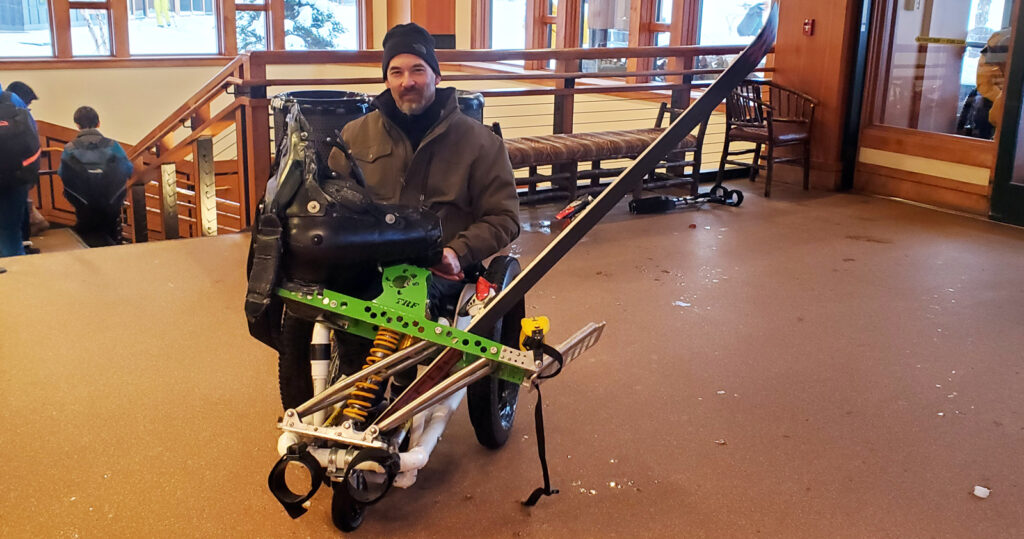
It pushes like a wheelchair, too. Kondo has been abusing the chair in a variety of environments for over a month. He’s rolled up and down stairs, dropped off curbs and ramps at the skate park, wandered on dirt trails and gravel paths, and even rolled into the ocean with it for an annual New Year’s Day polar bear plunge. He took it to the ski resort for an adaptive ski day. It pushed well enough in the snow, and just as cool, he realized that the frame design created a platform for carrying stuff. “We had like an eighth-mile trek back to our cars, where the parking was, and I was able to put my mono ski on the front frame. Nobody else was able to do that,” he says.
Kondo designed the PVC-X with the developing world in mind, but the idea of a simple, cheap, utilitarian wheelchair makes sense anywhere. “Isn’t it nice to have an extra chair sitting in your garage that’s already setup and you can use to go on adventures or maybe just go in the yard, do some gardening, make a mess and not have to get your everyday chair dirty?” he asks.
So far the PVC-X has held up to every test Kondo has thrown at it. He’s sure it’ll break sooner or later — everything does. But the nice thing about simple chairs is they have simple solutions. No need to wait months for a service technician or a specialty part from the manufacturer. “I’ll just fix it.” he says.
For more information on the PVC-X — including build photos, a parts list, computer–assisted designs, videos of Kondo’s stress tests, and even a test model made from scrap 2-by-4-inch lumber — go to redpillinnovations.com/pvc-x.
Support New MobilityWait! Before you wander off to other parts of the internet, please consider supporting New Mobility. For more than three decades, New Mobility has published groundbreaking content for active wheelchair users. We share practical advice from wheelchair users across the country, review life-changing technology and demand equity in healthcare, travel and all facets of life. But none of this is cheap, easy or profitable. Your support helps us give wheelchair users the resources to build a fulfilling life. |


I wonder if Erik Kondo is aware of the Freedom Chair manufactured by GRIT? Please go to GOGRIT.US
I’ve had mine since 2017. It may not be for everyone, but it’s definitely worth considering.