



The time is 7 a.m. on a weekday morning and I’m being tapped on the shoulder by my attendant, just as I requested her to do. Today I’m a little bit tired because I read late and my body isn’t sure that 20 more minutes of sleep wouldn’t be a good idea. My brain calculates my first day’s work obligation and the amount of time it will take to get through my morning routine and out of the house. I request she return in 10 minutes. My first negotiation of the day is with myself.
At 5:30 p.m. that day I am hungrily devouring my New Yorker, anxious to complete another essential piece in the jigsaw puzzle of my personal development, and anticipating how I will drop this fascinating new information into the dinner conversation that evening. Meanwhile, my wife is reminding me that she would like to leave the house by 6:15 p.m. and wants me to take care of whatever I need to do now to make that happen. She knows (as I do, but routinely disregard) that, as with many high-functioning quadriplegics, there are more things to do that will take me longer than I anticipate to do them.
“I’m just finishing this page. I’ll be through in five more minutes,” I say.
“Honey, I don’t want to be late.”
“I know. All I have to do is wash up.”
“Did you Mapquest the directions like I wanted you to?”
“Oh yeah, that too.”
I drop my reading glasses on the magazine as a bookmark. Negotiations closed.
As a transactional attorney (I go to court), I do a lot of negotiating to resolve the disputes I’m handling. I like negotiating so much that I am now also a professional mediator — attorneys and their clients pay me to negotiate for and with them to resolve their cases.
I do not like to argue. Negotiating is much different. When I negotiate, my goal is not to “win,” but to find a meeting ground that is acceptable to everyone involved. Sometimes, this means getting everyone to agree on what is fair. Quite often though, this means getting everyone to agree on something that stinks less than the other stinky options.
Focus on the Goal, Not the Ideal
So much of our daily interactions and activities are absorbed with negotiating that we hardly notice what we’re doing. But the art of negotiating cannot be underrated and often determines whether we get what we want in life, or in that moment, or end up spinning our wheels (or tapping our feet) to someone else’s tune.
Negotiating is not a contest between “good” and “bad” positions. Obstacles are almost never a personal affront. They are just someone else’s short-term agenda conflicting with our own agenda.
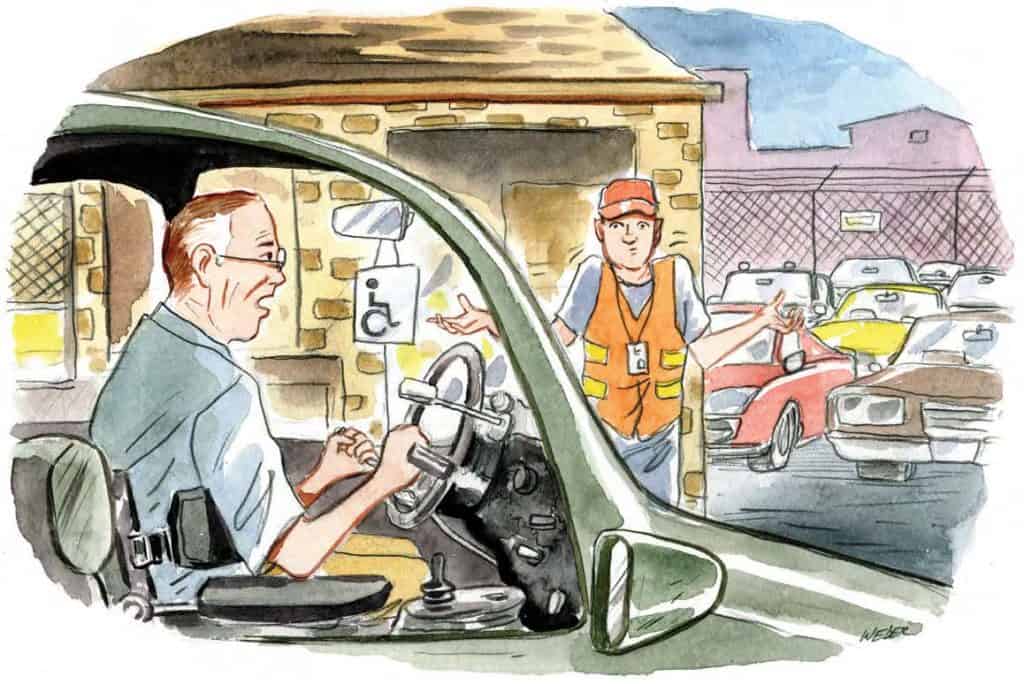
Let’s say you are going to a play. Right next to the theater there is an open parking lot that is just what you need for your modified van. Immediately, the parking attendant tells you the parking lot is full. Your agenda is to park as close to the theater as possible. His agenda is to fill the parking lot, which he believes he has accomplished. It’s not personal — his agenda is not to prevent you from parking there.
One approach would be to tell the parking attendant that you are disabled and it is discrimination not to provide accessible parking. If the parking attendant is savvy about the ADA and has a few cars parked in the accessible parking spaces without a placard, this might motivate him to make room for you. But it could just make him walk away angrily, or just agree with you, and still walk away: “You’re right. But I’m just doing what the owner told me to do.” If this were an argument, you would have won! Hooray for nothing. You’re gonna miss the opening act.
It’s essential that you keep your eyes fixed on the goal — parking — and not get absorbed by the personality or lack of understanding that you encounter. You want to help this person to help you. You can do this best by appealing to something that is important to him. So, for instance, by threatening a lawsuit, you are appealing to his fear of losing his job. But threatening the livelihood of a low income worker isn’t terribly nice — you certainly make no friends this way and you could find a key scratch on your car days later.
My suggestion would be to appeal to the person’s goodwill or to his desire to wield power.
The first approach might involve letting the attendant know that you have a disability, and it is difficult for you to park at a distance from the theater. Could he please help you find a spot? Appealing to his generosity of spirit enables him to feel good about helping another human being. And you don’t have any objection to him feeling that way, right?
The second approach that works particularly well with people in the service industry who don’t have much control, except over their small domain, is to say, “Wow, I see it’s really tight here. What do you suggest I do?” — while casting your eyes about meaningfully for a solution (it helps if there are cars behind you waiting to park). This serves to recast him from antagonist to trusted problem solver. The parking lot is something he knows better than anyone else. If he initially comes up with a suggestion that’s not workable (like finding street parking), just explain why that won’t work and ask for another solution. Then wait patiently. Let him fill the silence. Eventually a solution will be found that likely involves his moving a few cars around. So you get your space. He exercised control and helped someone in the process. That’s a good result, right?
Perhaps you are bothered by the need to engage in this back and forth at all. Shouldn’t people just do what they’re supposed to do in the first place? Yes, of course, in that ideal world where death, disability, taxes and bad service don’t exist. But in this world, even when people can agree on what the right thing to do is, they may not agree on when or how it is to be done. That’s why focusing on your goal, not your ideal, can take you a long way and make for a much saner life.
Here’s my best advice for negotiations: Approach every situation with faith that a deal can be made and that everyone will act reasonably and respectfully. The best you can do is to search for opportunities for peace and mutual satisfaction in every transaction and know that if a fight is required, it’s not because you missed an opportunity to negotiate.
When to Hold and When to Fold
Be cautious when a deal looks too good to be true.
It usually is. Whether it’s a squeaky clean attendant working at a rock-bottom price, or a “never used” wheelchair, get answers to the essential questions up front and don’t fill in the blanks with wishes. With some variations, these questions are: what is the product, what is the price, what are the terms of payment, what is the method of payment, when is everything supposed to happen (i.e., dates), what happens if it doesn’t work out, who is responsible for accomplishing anything that needs to be done.
Unless it’s a one-of-a-kind item, be prepared to walk away from a deal if you’re not getting what you want (your goal, not your ideal).
Sometimes walking away is your greatest strength in a negotiation. Walking away is different from waiting, because waiting shows that you have an expectation that progress will be made, in time. Walking away shows you have no further expectations and it underlines your seriousness about getting what you want. It’s a strategy that should be used sparingly and only when necessary to avoid making a deal just to make a deal.
Many times I was not satisfied with a proposal after long negotiations and informed the other party that I appreciated their efforts, but a deal just wasn’t possible. It sometimes took several days or months, but I usually found the same deal waiting for me on the table where I left it, with more added. All I had to do was be willing to not make a deal. Note that this negotiation strategy can only work when you have something that the other person really wants.
There are times when this strategy fails — people do have their limits and it’s possible to stretch someone to their breaking point. So don’t try to extract every drop of blood you can in your negotiations unless you really don’t care if the deal goes through.
There are times when negotiations and compromise are not an option.
If the issue is important enough, you may have to resort to a letter to someone higher up, a phone call to customer service, or even a lawsuit. Since you’re the one who has to live with the outcome, and your efforts will be required to pursue the matter, you’re the only one who can decide whether it’s worth it or not. Is it simply a difference of opinion or perception that reasonable minds can disagree on? Is it just a one-time thing? Or is it a situation that needs changing so that you and perhaps others don’t have to suffer the same way again?
The important thing is to decide, not let it bounce around in your head plaguing you. If you really just want to let it go, then let it go and be done with it. The likelihood is the other side isn’t thinking about it anymore, so why should you? Don’t feel guilty that you don’t fight every battle that comes your way. Be smart about conserving your energies for the right battles, and letting go of the ones that don’t matter as much, or that cannot be won.
Keep a paper trail. It’s essential to document your efforts and track your progress.
If you decide to pursue a battle, do what that takes like any other important project that needs getting done. Make notes, find out who to contact, follow-up promptly. And remember, the written word still carries a lot of weight. Though a phone call is far easier, writing a letter still works wonders because letters lie around demanding a response, and letters (not phone calls) can be brought into court.
Support New MobilityWait! Before you wander off to other parts of the internet, please consider supporting New Mobility. For more than three decades, New Mobility has published groundbreaking content for active wheelchair users. We share practical advice from wheelchair users across the country, review life-changing technology and demand equity in healthcare, travel and all facets of life. But none of this is cheap, easy or profitable. Your support helps us give wheelchair users the resources to build a fulfilling life. |


Recent Comments
Dick Crumb on Adapting Recreation To An Aging Body
Karen on The Everlasting Saratoga Cycle
Ted Kilroy on Handcycle Gear Guide