


Failure is a Chance to Grow: Lessons from 35 Years as a Disabled Farmer
June 5, 2025
Tim Gilmer
Six years after moving from California to Oregon in search of our dream of living on the land, my wife and I took a gamble — we purchased a small farm with no prior farming experience. Our married journey together has always been about discovering ways to overcome our fears, shortcomings and lack of experience, working at making small changes over the years to fully embrace our circumstances, and not giving up — the same behaviors that adapting to life with a SCI and paralysis involves.
For me, taking the farming risk meant learning to live with occasional failures. We began with a one-acre U-Pick plot, which made sense given my limited mobility and working ability. But we soon found we were too far off the beaten track. No one came. My bad.
That led to a year of using friends, neighbors and unreliable teenage boys to frantically pick our produce, which meant I had to sell it or give it away. On a whim, I called a restaurant in Portland we liked and asked the chef-owner if he’d like a free sample box of pea pods, Romano beans and lettuce. A week later he gave me a list of six other restaurants he suggested I call. A month later, we had seven eager customers. I had found my calling, literally. Calling.
My wife became a picker-deliverer extraordinaire. I hired a couple of migrant workers, bought a small Kubota tractor and had hand controls installed. I had my workers build up two earthen loading ramps so I could transfer from my all-terrain four-wheeler to the operator’s seat. Voila! — instant farmer.

We gradually added customers with my cold-calling and free sample boxes. Now we had not only a small produce farm but a connected delivery business. As fate would have it, the very first minivan came out in 1984, so I purchased a 1984 Plymouth Voyager with a 2-liter motor that just barely got us over the mountain pass separating Oregon from California on family visits. Nearly as important, we could toss several boxes of produce in the back for delivering to Portland restaurants.
Then one day, eager to give our basil and romaine crops a break from voracious cucumber beetles, I sprayed an organic insecticide. Two weeks later both crops were dead. I had inadvertently killed them off when a small residue of non-organic herbicide in the bottom of the spray tank mixed with my organic insecticide. My bad again.
We were devasted. But just as any complication from SCI seems overwhelming, farm disasters require one critical action: keep moving forward.
We decided to grow strictly organic and get certified from that moment forward. The failure turned out to be a godsend. We added customers and charged more for our produce. I hired a full-time delivery employee. Once again, our farm business grew.
Learning to Adapt, Not Overcome
The farm also had two small pastures and a creekbed border with mixed trees, good for cattle grazing. We started by renting out the pasture to a neighbor and fell in love with the baby calves. We decided to buy cows and heifers and use the neighbor’s bull to breed and raise calves.
Now we had two businesses, both small with modest profit margins. Ambition has a way of creeping into these kinds of bootstrap ventures. So I decided to by a purebred Simmental bull that had excellent genes and a promising future — a 2,000-pound, gentle, well-muscled giant who stood taller than my wife, Sam, who led him around like a pet. We named him Bud.
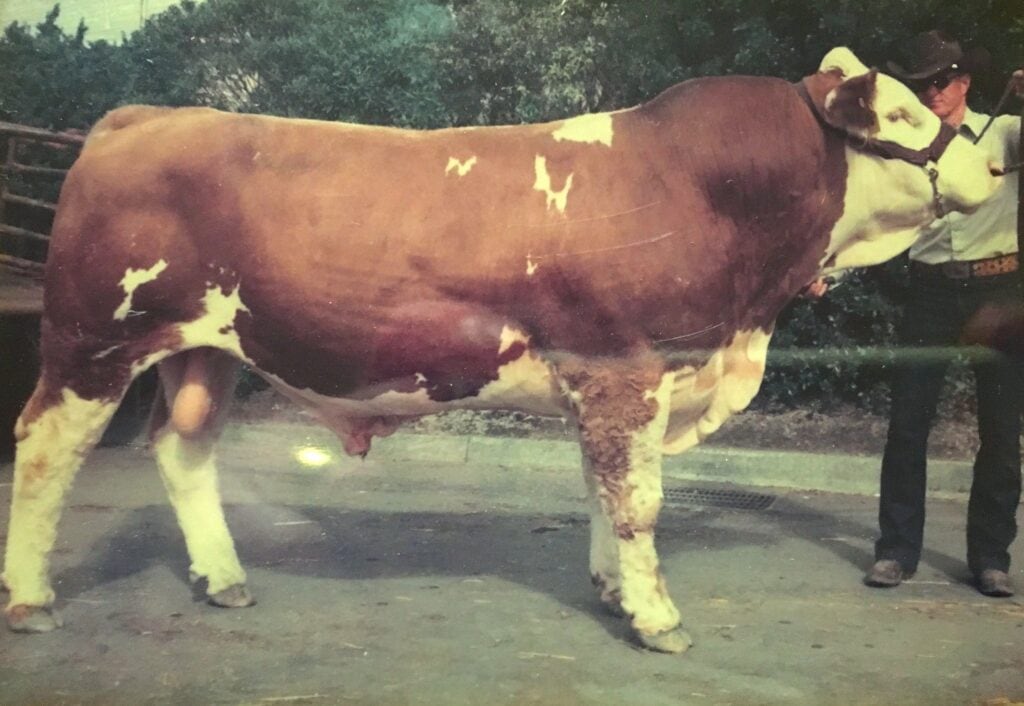
At this time Sam and I were growing together, doing things we never thought possible. She learned how to artificially inseminate cows while I was driving tractors with hand controls, racing around on my latest 4-wheeler, and crawling through cowshit to pull newborn calves into the world with obstetric chains.
Then came the hardest lesson of all. On one weekend, we had two prize cows go down in the back pasture trying to give birth to oversized calves. The impossible births ended up paralyzing both cows. That’s right, paralyzed cows. Like farmer, like cows. Add another failure — this one deeply personal. My response was right out of the SCI Playbook. I built a sling for my Kubota, which had a bucket. Sam attached the sling to the bucket.
We had created a bovine treadmill walking device.
For two weeks, each day, twice a day, we loaded up our supplies — a bucket of grain, a large bottle of water and a pan, a syringe filled with dexamethasone — and drove down to the creekbed where my favorite cow, Beebee, lay paralyzed. With great difficulty, Sam pushed, prodded and pressed her entire 115-pound body against Beebee to roll her on one side, then wrestled the sling underneath her belly and rolled her upright. From the operator’s seat, I very gradually raised the tractor bucket until Beebee reached a standing position.
But how to get her to take a step when her back legs and rear end were paralyzed? We needed a strong, well-trained physical therapist to move the cow’s hooves. Of course there was no such animal. So I inched the tractor forward, trying to get Beebee to move her rear legs.
Try as we might, for two weeks and 28 treadmill walking sessions, we could not get my favorite cow to take a step.
In the world of agriculture, there is only one solution for a non-ambulatory cow. We had to have Beebee and the other cow, Heartface, put down. Sam became a surrogate mother to Heartface’s newborn calf. Beebee’s calf had died in the birthing process.
I fell into a depression that seemed like it would never end, but three weeks later, the demands of the farm called me back to the land of the living.

I found it hard to accept, but there it was: a classic case of overcompensation involving my own paralysis. I had to have the biggest bull on the block to make up for my own inability to sire children. Bud ended up siring huge calves that caused birthing problems. By this time, we had adopted a daughter, but I was still insecure about how others saw me — an emotional obstacle many of us eventually face, male or female, para or quad, married or single.
As humbling as it was, that failure turned out to be another opportunity for growth. Put bluntly, I had to grow up, leave behind my childish fantasies, and embrace reality. Even though it may not have been a direct cause, I decided to give up my nightly routine of smoking pot, often mixing it with a drink or two, and concentrate on raising our daughter and family matters instead of being obsessed with overcoming my disability.
The truth is, none of us with paralysis can literally overcome our disabilities. But we can learn how to manage and adapt. And part of adapting is getting real.
Learning to Let Go
We sold Bud at the Cow Palace in San Francisco, downsized our herd and concentrated on using smaller bulls that threw smaller calves. Our produce business grew to upwards of 30 customers. In 2010, our farm was featured on the award-winning PBS educational program “Chefs A-Field.” We had been recommended by a James Beard award-winning chef I had been doing business with for over 10 years. The day he came to the farm with the camera crew filming, we met each other and shook hands for the first time. During that entire 10-year period, he had never known I was a wheelchair user.
As pleased as that made me, it didn’t last long. I still had another failure to endure.

In 2016, after 35 years of farming, I logged way too many hours on my warn-out, compressed sheepskin seatcover riding my 4-wheel Kawasaki during a six-month process of buying and moving a double-wide manufactured home to the farm and hooking it up to a septic system, electricity and water. That project put me in the hospital for a complicated flap surgery that ended my active farming life. But I did it for the right reason — to bring our grown-up daughter and her children to the farm. Since then, we’ve been leasing our cropland to farmer-renters.
Being an armchair farmer is now my greatest challenge, and it’s more difficult than you might imagine, like entrusting your children to a new babysitter each month. You can’t stop worrying that something will go wrong. True, at base level, it is only dirt, but sometimes that dirt is a favorite plot of soil that you’ve nurtured for years. There hasn’t been a square foot of land on this farm that doesn’t have a personal history. Like the meadow near the confluence of two creeks that our cattle loved to graze on every spring until fall came and the grass died down and we’d converted it into a campsite for our daughter’s birthday gatherings.
The hardest thing of all is learning to let go — whether it’s letting the latest farmer-renter have his way with the soil you have built up over the years or accepting that your children now have lives of their own. Stepping aside to allow a younger generation take control requires admitting that your best years are behind you while holding tight to hope for a future you may never see.
We only get a handful of opportunities for real growth that come our way in our lifetimes. Fear not. Take the risk. The gamble is not about winning or losing, succeeding or failing. It’s about doing the best you can and growing in the process.
Support New MobilityWait! Before you wander off to other parts of the internet, please consider supporting New Mobility. For more than three decades, New Mobility has published groundbreaking content for active wheelchair users. We share practical advice from wheelchair users across the country, review life-changing technology and demand equity in healthcare, travel and all facets of life. But none of this is cheap, easy or profitable. Your support helps us give wheelchair users the resources to build a fulfilling life. |


An eloquent personal essay about a spirited life. Thank you, Tim!
I well recall Tim’s many years as the editor of New Mobility. Just as his longtime customer did not know about his other life as a wheelchair user, I did not know about his other job as a farmer.