


Testing Two New Seat Designs That Will Let You Fly in Your Wheelchair
April 21, 2026
John Morris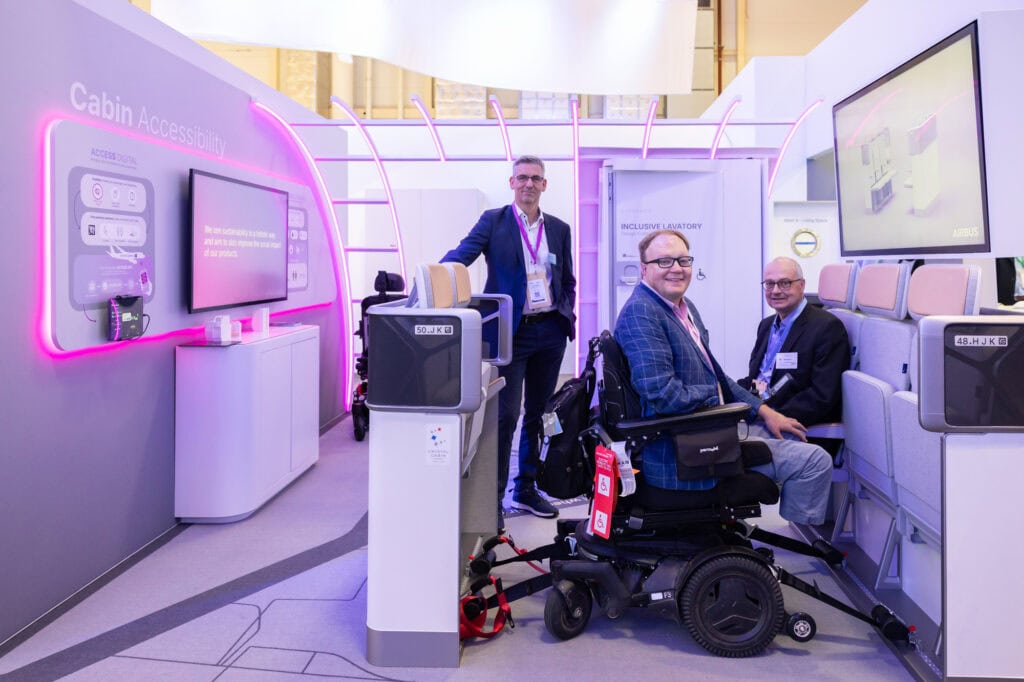
Two of the leading aircraft designers stole the spotlight at this year’s Aircraft Interiors Expo in Hamburg with full-scale, testable mockups of their wheelchair securement concepts, bringing the long-held dream of flying in your wheelchair that much closer to reality.
AIX is the world’s largest trade show and marketplace dedicated exclusively to aircraft cabin interiors and the passenger experience. In recent years, much attention has been paid to solutions that would permit personal wheelchairs to be secured in the aircraft cabin.
Delta Flight Products stirred excitement within the accessible travel community when it introduced its Air4All solution in 2023. Delta Flight Products did not exhibit this year, but two companies showed solutions that may be much closer to reality. Aircraft manufacturer Airbus and aircraft interior supplier Collins Aerospace each brought full-scale mockups of their wheelchair securement concepts to the show floor, and I tested both of them from my Permobil F3 power wheelchair.
Airbus Airspace U Suite
The biggest accessibility news at this year’s AIX was unquestionably the public debut of the Airbus Airspace U Suite. The seating solution was developed over several years by Airbus engineers Hans-Gerhard Giesa and Dirk Meiranke, who investigated both the technical feasibility and business viability of the concept. The U Suite allows passengers with reduced mobility to remain in their personal wheelchair throughout a flight, secured directly to the aircraft cabin floor via a specialized restraint system.
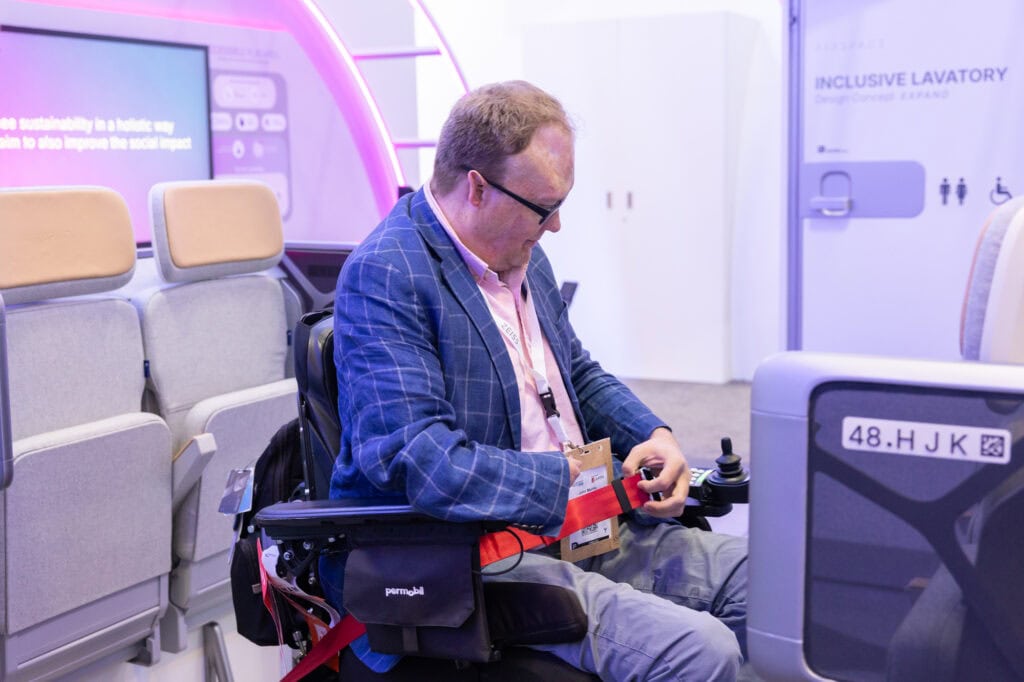
At the Airbus stand in Hamburg, I rolled my Permobil F3 directly into the U Suite mockup and experienced the securement system firsthand. The compartment is designed to be versatile and can accommodate either a wheelchair user in their own chair (plus a companion), a traveler resting in a lie-flat position or a group of up to five passengers who desire a shared space. Airbus is positioning the U Suite not as a wheelchair space forced into the existing aircraft cabin, but as a premium multi-use area that has the ability to welcome a wheelchair user.
The concept reached a new milestone in early March 2026 when a passenger with reduced mobility flew during the cruise phase of an actual flight seated in their own wheelchair. That passenger was Dirk Thalheim, a design engineer at Airbus who uses a wheelchair and whose lived experience shaped the U Suite’s design and development.
The U Suite was also among the finalists in the Accessibility category at this year’s Crystal Cabin Awards, the annual awards program that recognizes aircraft cabin innovation. Airbus projects to have the U Suite ready for a first delivery in 2032, but aviation authorities and regulators must still agree on a certification path.
Collins Aerospace Prime+ Accessibility Platform
Collins Aerospace was back at AIX for the third consecutive year with its Prime+ Accessibility Platform, and the evolution of the concept since its 2024 introduction has been substantial. This year’s mockup was presented in an economy class configuration, showcasing the potential for a wheelchair securement space on both legacy and low-cost carriers.
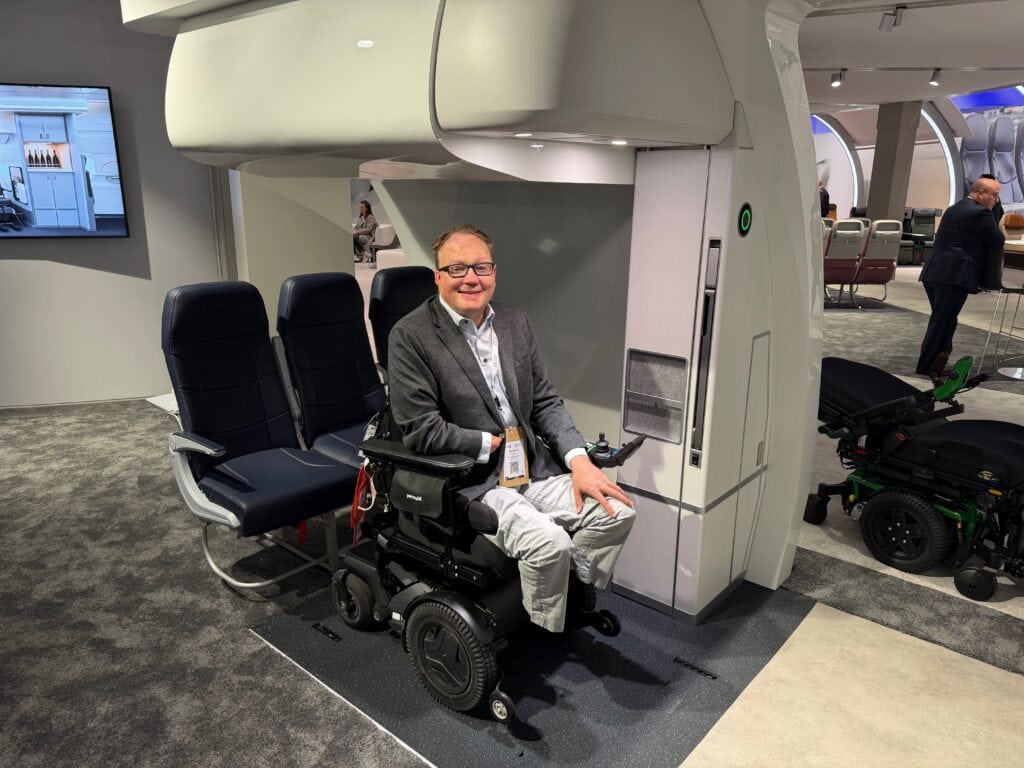
The Prime+ platform resembles a more traditional wheelchair space and is large enough to accommodate complex rehab power wheelchairs. While Prime+ has not been tested in the air, Collins is further along in its development of the holistic product, incorporating features like a height-adjustable tray table, USB ports, reading lights and an air conditioning nozzle.
How Long Until Wheelchairs Will Be Secured In-Cabin?
Wheeling about the show floor in Hamburg and having tested both concepts from my own wheelchair, what struck me most was not the differences between the two systems, but the fact that they exist at all. Not even five years ago, conversations around bringing a wheelchair securement space into the aircraft cabin was written off as a pipe dream. Today, it is serious business and a genuine competition between engineering teams with mockups, flight testing, airline interest and regulatory engagement.
Hurdles do remain, and there is still much work to be done before a wheelchair space is bookable on a major airline. Questions around government regulation, time to certification and which airlines will act first still lack answers. Airbus is the first player to publicly share a goal; it has targeted a delivery date of 2032 for the Airspace U Suite, but a first delivery would represent one wheelchair securement space on a single aircraft. Even so, the significant investments made by Airbus and Collins Aerospace suggest that the momentum around wheelchair securement in the aircraft cabin is sustainable.
John Morris is the proprietor and author of WheelchairTravel.org and one of the leading experts on and advocates for accessible travel.
Support New MobilityWait! Before you wander off to other parts of the internet, please consider supporting New Mobility. For more than three decades, New Mobility has published groundbreaking content for active wheelchair users. We share practical advice from wheelchair users across the country, review life-changing technology and demand equity in healthcare, travel and all facets of life. But none of this is cheap, easy or profitable. Your support helps us give wheelchair users the resources to build a fulfilling life. |


Thanks for the report, John! It’s actually unbelievable how long it takes before you can fly in your own wheelchair. As wheelchair users, we know only too well a) how annoying it is to transfer using an aisle chair and b) how risky it is to have your own wheelchair loaded into the hold.
I am not sure if this is a good idea. this will ensure that the chair won’t be damaged, it seems there are no reclining room. This is concerning for long trips, especially when traveling from Seattle to London, which usually takes about 10.5 hours.