


Flipping Accessible: The People and Devices Tilting Pinball Toward Access
December 4, 2025
John Mohler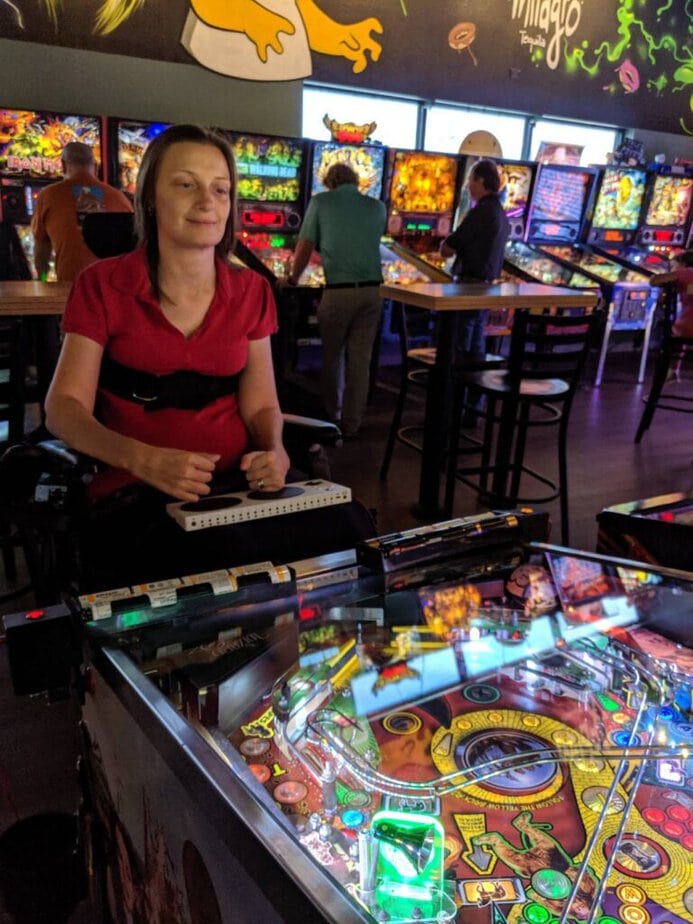
When I was an arcade rat in the 1980s, my idea of heaven looked just like what I discovered when I attended the 41st Annual Pinball Expo this October in Schaumburg, Illinois, outside of Chicago: a massive, pulsating convention hall lined with hundreds of pinball machines, manned by merry pinballers of all ages, colors and families. It was noisy; it was flashy; it was fun. Rolling up to the entrance, I took a deep breath of excitement. Yes, these are my people … and I don’t need quarters! I launched myself into a carnival-like day I’ll never forget.
What I didn’t see, however, were many wheelchair users, because the pinball world isn’t very accessible. But that’s changing fast, thanks in part to Project Pinball, a Florida nonprofit that has donated and maintains pinball machines in 82 children’s hospitals and Ronald McDonald Houses across 29 states. The donated machines are more than a recreational diversion: They’re an incentive for patients to get on their feet and out of their rooms, and provide quality playing-time with visiting family members and others.
Part of bringing pinball to children’s hospitals is making sure its spark is accessible and felt by all. So, Project Pinball and its founder/senior director, Daniel Spolar, have expanded their mission into promoting access in the pinball community. “I never want to think about people just sitting on the sidelines, not being able to play,” Spolar says. “We’ve got to do better.” Part of that push was taking place behind us at Project Pinball’s expo booth, where its third annual Freedom to Play Pinball Tournament was being played. In 2024 the event attracted over 100 entrants, disabled and nondisabled alike.
Contestants played on four pinball machines, each with an accessible controller. The controllers are colorful, hexagon-shaped cylinders of 6-inches-by-3-inches, with a row of three large buttons on one side, and a cord connecting them to their machines so you could take the controllers in your hand or lap. All contestants, regardless of ability, had to use the controllers made by tournament cosponsor Inclusive GameWerks. The IG controller is a great example of access spreading to the pinball world, with a number of adaptive devices hitting the market in the last few years, even — I would happily discover — ones for complete quadriplegics.
Changing Attitudes About Pinball
“I’m a fairly bold person,” says IG co-founder Zack Christofferson, a 35-year-old married father of two who uses a power wheelchair due to muscular dystrophy. One evening in 2022 he and his wife, Alysha, were kicking back with good friends — three married couples in all — enjoying some beers while gathered around a pinball machine. “At one point I go, ‘I really don’t care about the pinball machine,’” Christofferson says. “It’s not something that I can do … I can’t reach around the cabinet. I can’t access the buttons.” It started a conversation that led to an interesting proposition: What if they could bring the buttons to Christofferson, so he could play from his lap?
Taken with the idea, the group began working on the electronics, wiring and current so as not to harm the pinball machine. They came up with a portable control unit, housed in a bent Plexiglas casing, with a couple of holes drilled out for the buttons, plus a wiring harness to connect the controller to the pinball machine. Their prototype worked for Christofferson, and the group and their families reveled in a couple nights of truly inclusive pinball. Christofferson was still so moved by the experience that he sent a group text in the middle of the night, saying, “Hey, this is more than just a game. … How many other people could we help with this?”
So began Inclusive GameWerks. Through testing and design improvements, they came up with a 3D-printed hexagonal cylinder as the most versatile and functional shape for differing abilities, allowing users to hold, press or manipulate the unit from all angles in the lap or on another surface, like a chair or on top of the pinball machine. The controller does everything that machine flippers do, without lag, and even has a launch button to begin play. First, a pinball machine must be fitted with a harness, which a layman can do in 10-20 minutes without drilling or hurting the machine. After that, the same controller can be used on all harnessed machines. The machine’s original controls remain active.
They placed a controller at Chain Reaction Brewing Company, the Denver microbrewery that Christofferson co-founded and co-owns. Soon other local breweries were trying it in their spaces. It wasn’t long before the IG crew learned about Project Pinball and contacted Spolar. The next time Spolar came to Denver, they invited him to bond over pinball and shared experiences: Christofferson had spent considerable time at children’s hospitals during his childhood, and Spolar’s son also got successful treatments for a rare blood disease as a child. “[There is] this really cool natural connection we have with him,” Christofferson says. Only a couple weeks later, the whole IG team turned out to hook up the first donated controller with Project Pinball at Children’s Hospital Colorado in Denver in 2023.
“How cool is it to see a kid that’s never got to play pinball in a wheelchair, come with his mom or dad or sibling and just get to be part of the fun?” Christofferson says. “How important it is for them to feel included and doing the thing together.”
Currently, they have shipped over 100 controllers to 19 states, Canada and Europe, including placement in the Dutch Pinball Museum in Rotterdam. Through Project Pinball, the controller is in 15 hospitals and Ronald McDonald Houses, and will be included with all newly donated machines and, eventually, all previously donated ones as well.
The team is proudest about pushing the bounds of their design to accommodate more disabilities. They have put Braille on their controllers for visually impaired players. They can vary the size of the unit and buttons and how they are spaced. “Nothing is ever one-size-fits-all,” Christofferson says. “There’s a lot of conversation that happens [before] getting all that to work for the individual to make sure it’s right for them.” They have even adapted the unit with knobs, goalpost joysticks, and sip-and-puff controls. Typical controller models cost $375 and include a harness.
Being Her Own Team
For 43-year-old C5 quad and United Spinal member Angie Hulsebus, a round of pinball used to look more like a game of Twister. She had to parallel park her power wheelchair almost touching the front of the machine. “I can push one of the flipper buttons with one hand, and then almost always my husband has to control the other flipper while leaning over my lap,” she says. “We are in each other’s space.”
In 2024, Hulsebus and her husband made the trek from their home near Des Moines, Iowa, to the Pinball Expo, to try the IG controller at the Project Pinball booth. Laying the unit on her lap, she hit the buttons with her pinky knuckles — and pinball was played. “I was excited,” she says. “It was great.

“Having the controllers, … we can play two-player games, and we can actually compete a little bit and have more banter, more fun, right?” she says. “I mean, I love my husband, I love playing with him, [but] just being able to go and play with more of our friends, I can be my own team.”
She has met with members of the IG team both in person and on Zoom, and is now ready to purchase a controller of her own. When she played the standard unit, her opposing knuckles kept mashing into one another, so she’s ordering a customized unit 2.5 inches wider to give her more space, plus her choice of colors for the buttons and shell.
Hulsebus also got to play with another adaptive device, the Crazy Flipping Finger, designed to assist one-armed players. She used two such units together and was able to run them through an Xbox Adaptive Controller, to take advantage of its large touchpads. “It felt totally good,” she says. “That was the first time playing pinball by myself.”
Hulsebus looks forward to the portability and convenience of the IG controller, which she can throw in her backpack and go. But she rates both the IG and CFF systems playable and fun. “Pinball machines are not accessible and it’s awesome that people are trying to make them more friendly and inclusive,” she says.
There are at least seven companies offering various access controllers, each with its own strengths and weaknesses. For example, the palm-sized Adaptive Flipper Control makes accessible over 100 pinball machines at two The Game Preserve locations in the Houston area. Designed by an electrical engineer who uses a cane because one side is affected by a stroke, the harness/jack sells for $15 and the controller for $20, but it does not offer launch button capabilities. The controller was also featured by Project Pinball at a previous Pinball Expo.
The Pinball Tables Are Turned
“Have you visited the Hexa Pinball booth? It’s right behind ours,” said Spolar. “I want you to see this.” In his role of access facilitator, he introduced me to Alexandre Mak, cofounder of Hexa Pinball, based near Bordeaux, France. Mak worked two years designing Space Hunt, billed as the first mass-produced pinball machine for the disabled, debuting in France in 2023 and now available in the U.S. and Canada.
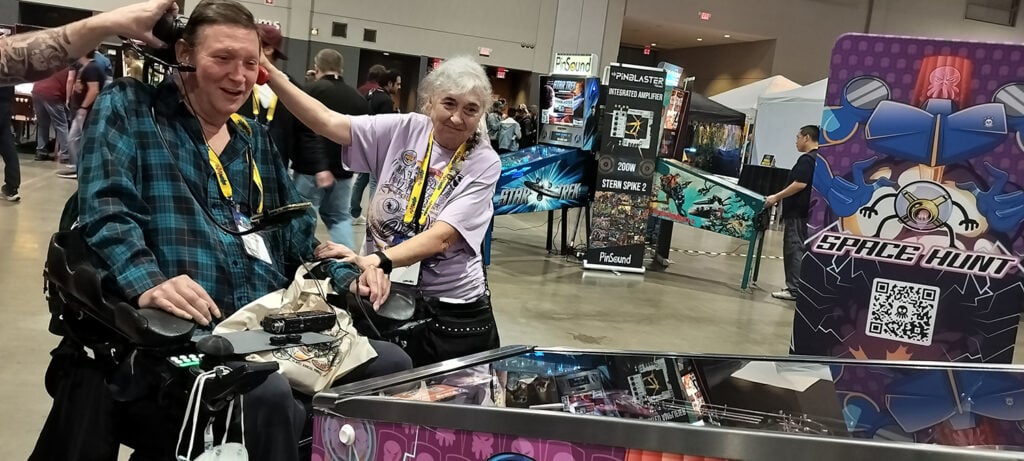
“Since the very beginning, we have been in contact with associations in France with the same objective as [Project Pinball],” says Mak. “We listened to them to understand their expectations, and they say if you could work on a system that will allow disabled people to use this, that would be great.” Mak responded by designing a free, optional front panel with conveniently accessible 3.5 millimeter mono jacks for adaptability inputs — no drills or screwdrivers required. A variety of input devices will work, and the Hexa team had on hand the Logitech G Adaptive Gaming Kit, available online for $79.99. It’s as easy as plugging into a game console. Hexa is including the same features on its next game, The Three Musketeers, rolling out next year.
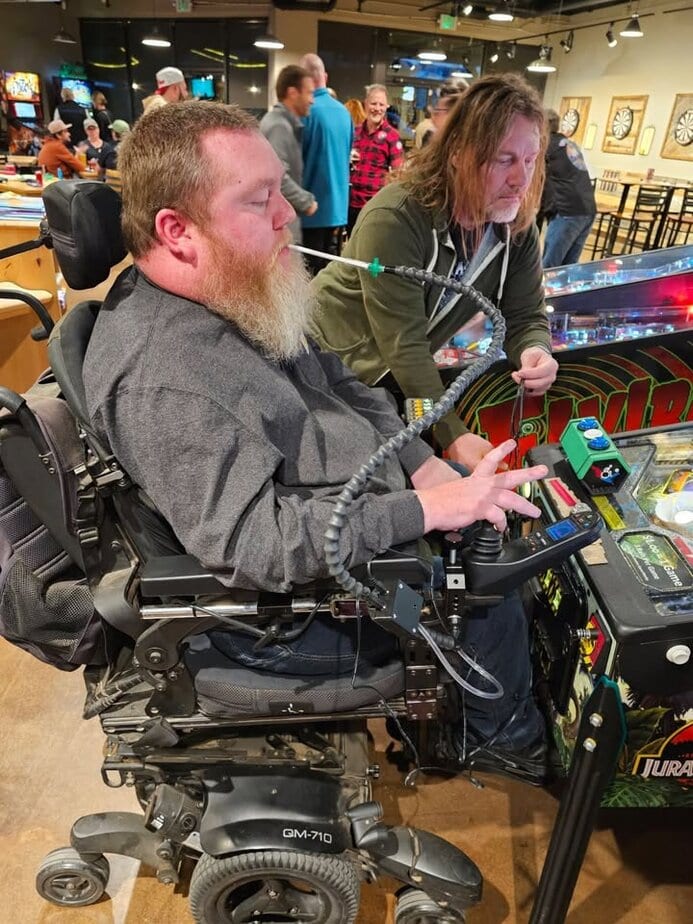
Access is very much an international language and it unfolded during our interview. I function at C4-5 from multiple sclerosis and operate my chair by head array, driving by tapping sensors in my head rest. Spolar called to Project Pinball volunteer and occupational therapist Sandy Czernik, who joined a pit crew that included the Hexa team and my wife, to mod my head array for Space Hunt using switches from the Logitech kit. On an audio recording, my conversation with Mak gets drowned out by some 90 seconds of crosstalk before my voice breaks in again, saying, “Thank you. Oh man, I’m going to be here all day. … They got me going, Daniel. … Thank you so much, guys.”
I wish I could say I came out with paddles blazing, but I played my first game or two like Rip Van Pinball. After all, I was working out 40 years of rust since I last played. What was surprising, though, was how quickly the arcade portion of my brain sprang back to life, probably covered by an inch of dust, but cranky as ever: “Dude,” it scolded, “you know you have to stagger the paddles or the ball will drop down the middle!” If right then the house P.A. had started playing Pet Shop Boys or Take on Me by Aha, I wouldn’t have been surprised.
The controls were seamless, no lagging, and it wasn’t long before I was capturing the ball with an upraised paddle, and passing it from one paddle to the next. After my second game or so, I was already feeling the competitive juices flow. At Mak’s prompting I started besting previous score after previous score.
At one point, one of the guys was asking me questions and part of my mind said, “Hey, I’m chasing personal high game over here!” — before the other side of my mind reminded me that I was the interviewer. Look out, I’m in Gamer Mode again.
What a plot twist. I expected to be a writer and observer, and voila, ended up a player. You don’t want to be in the game room — you want to be gaming.
Support New MobilityWait! Before you wander off to other parts of the internet, please consider supporting New Mobility. For more than three decades, New Mobility has published groundbreaking content for active wheelchair users. We share practical advice from wheelchair users across the country, review life-changing technology and demand equity in healthcare, travel and all facets of life. But none of this is cheap, easy or profitable. Your support helps us give wheelchair users the resources to build a fulfilling life. |


This is so cool!!! I’ve played pinball for years as a T-12 para but in order to see the entire table I would have to lock my wheelchair brakes and then sit on my right wheelchair wheel in order to get enough height
I am a C5/6 quad and just want to express how cool this is.