


From ‘Roughing It’ to Glamping: Adaptive Camping for Wheelchair Users
September 5, 2024
Bob Vogel
As the first rays of dawn illuminate the inside of my tent, the chirping of birds complements the wind whispering through the forest. The air smells of the ocean and redwood trees. I’ve only been here since yesterday afternoon, but I already feel mentally refreshed, unplugged from the daily grind. This moment reminds me why I love camping.
The cool thing about camping is that there is no “right” way to do it. It’s adaptable to your budget, level of function, time constraints, and how adventurous you’re feeling. Here’s how four wheelchair users camp at various levels of comfort, from basic “roughing it” to car camping and glamping.
Roughing It
One of the main attractions of basic camping, also known as roughing it or minimalist camping, is that it can be done on a whim because it involves a minimal amount of gear and packing. With more prep, it can also provide a base for adventure trips like handcycling, rafting, kayaking or cross-country skiing.
“Basic camping is my favorite — it’s a great way to recharge my batteries and retune with nature,” says Topher Downham, 55, a C6-7 quad and accessibility outreach manager for the city of Boulder, Colorado. Some of his most memorable short trips involve driving out into the Canyonlands desert in Utah. “I sleep outside without a tent and there are millions of stars overhead, and [in the morning] I can watch the sunrise from my cozy sleeping bag,” he says.
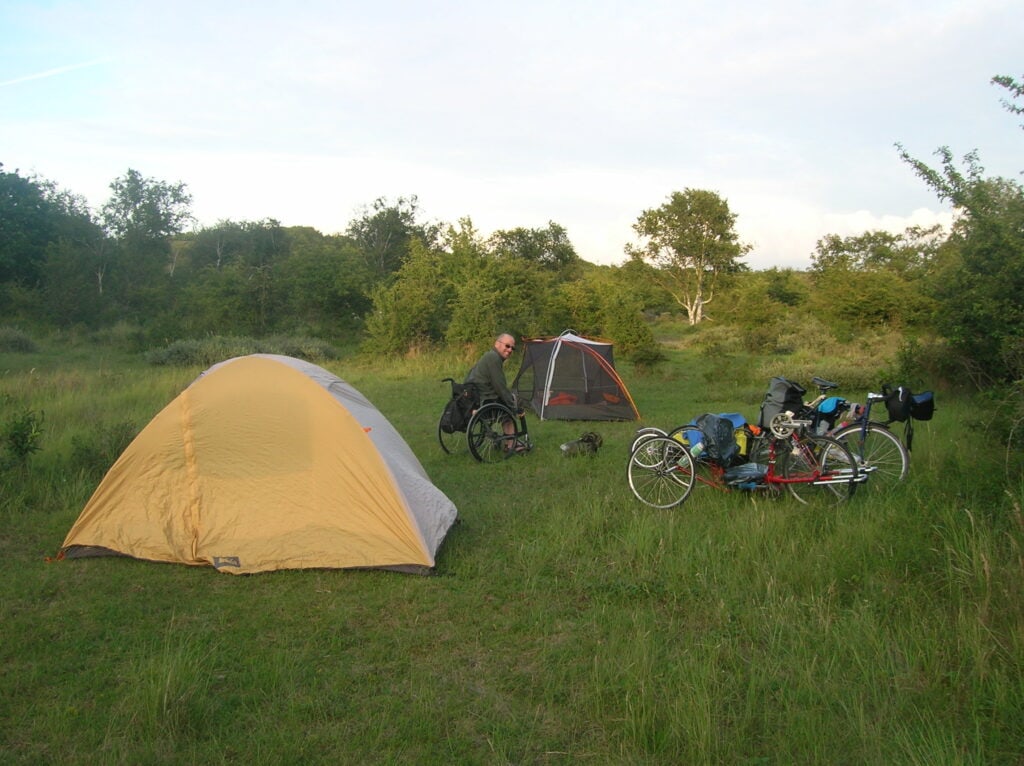
Of course, roughing it is on the low end of the comfort spectrum. “A camping trip usually involves a little bit of misery that is not fun at the time, but in hindsight makes the trip more memorable,” says Downham. “[On] several different occasions, I have gotten wet and cold during the night, which is really rough because as a quad it is impossible to warm up, but in time it will be the story I remember.”

This brings up an important gear tip: Invest in a warm sleeping bag. Paralysis tends to make it more difficult to stay warm. Everyone I spoke with for this article has a sleeping bag rated to minus 20° Fahrenheit. “I bought one because I get cold so easily and being cold is miserable,” says Kristi Grotting Hruzewicz, 49, a T9 para who employs minimalist camping skills for multiday sea kayaking and cross-country ski trips. “I went cross-country sit-skiing with a friend in the Sierra Nevada mountains and followed a packed snowmobile trail. I pulled a sled with my gear, which included a tent, sleeping bag and pad,” she says. “It was a fun adventure, but it was really cold and we skied back the next day.”
When it comes to sleeping bags, treat the rated temperatures — which seem to be geared toward survivability rather than comfort — with a grain of salt. When Grotting Hruzewicz camps in warmer weather, she still brings her minus 20° bag. “I just unzip it and put a sheet over me,” she says.
Like Grotting Hruzewicz, everyone I talked with for this article enjoys combining basic camping with other outdoor activities. Matt Howard, 33, a T10 para and outdoor recreation coordinator for Oregon Spinal Cord Injury Connection — a United Spinal Association chapter — has roughed it on adaptive mountain bike trips. He shoves all his gear in a dry bag and puts it on the back of his bike, leaving his chair behind for an overnight trip. He sits on the ground while setting up his tent and hanging out around camp, and uses a yoga mat and low-profile ROHO cushion to keep his skin safe.
When I’m out of my wheelchair at camp, I use a Vicair AllRounder O2, a cushion that straps to my butt like a climbing harness. Downham prefers just a Purple Simply Seat Cushion.
Downham has completed several monthlong handcycle touring trips, including one with a nondisabled buddy through Holland. They camped wherever they wound up at the end of the day, be it in backyards or open fields. He towed his wheelchair behind him as an improvised trailer, strapping his gear in the seat. He did another monthlong handcycle trip in France, staying at campgrounds along the Loire River.

Whether you’re camping for a month or a single night, everyone agrees that a good sleeping pad is another crucial piece of basic camping gear. “I’m extremely careful about skin care because I’ve had a pressure ulcer and skin-flap surgery,” says Howard. “My pad of choice is a Big Agnes Divide sleeping pad. It’s 3.5 inches thick, and wider than most sleeping pads. When I’m lying on my side, I don’t have to worry about my hip going through the pad and creating a pressure sore.”
Grotting Hruzewicz prefers self-inflating pads with a combination of foam and air. If the pad loses air, you still have foam to protect your skin. Her sleeping pad of choice is the LuxuryMap self-inflating sleeping pad by Therm-a-Rest.
For protection from the weather, Howard’s tent of choice is a Marmot Tungsten one-person tent. Grotting Hruzewicz also likes the Marmot brand. However, she chooses the Limelight two-person model. Downham currently uses a Mountainsmith Morrison tent. “I like it but I can’t set it up myself, so I have my eye on a Hilleberg one-person tent. Although they are pricey, they are designed for [Mount] Everest climbers to be able to set up with gloves on, which makes them ideal for quad hands,” he says.
Car Camping
In my younger days when ground-to-chair transfers were a snap, basic camping was my preference. But with aging shoulders, chair-to-ground transfers have become difficult, and sleeping on ground pads is less than comfortable. I thought my camping days were over until a couple of years ago, when I attended an adaptive camping event and realized how some additional equipment could make camping a whole lot more accessible again for my aging body. Though extra gear takes more time to pack, it enables the back-to-nature rejuvenation I crave.
My wife and I recently joined friends for a three-night campout at Russian Gulch State Park on California’s Mendocino coast. Our campsite was nestled among the redwoods, and we enjoyed falling asleep and awakening to the steady babble of a stream beside our tent. We filled our days kayaking with sea lions and mountain biking through fern-lined trails in the forests. In the evenings, we shared meals and stories around the campfire.
For sleeping, I’ve found that car camping is more accessible and enjoyable with a generously sized tent. I prefer the Big House 4 by Big Agnes. For those who need a more budget-friendly option, the New York Times’ product review site, Wirecutter, picks the Coleman Sundome 6-Person Dome Tent for the best budget-friendly family-size tent. You can find it for $100 or less. Be aware that when it comes to tents, more money often does buy you better protection and stability in bad weather.

A major benefit of a large tent is that it has room for a camp cot. My favorite is the Coleman ComfortSmart Deluxe Cot. It’s 15 inches high, which makes chair-to-cot transfers easy, and at 30 inches wide, it’s easy to change sleep positions and to dress on. When I need to cath in the middle of the night, I don’t want to leave the warmth of my sleeping bag and endure a frigid push to the bathroom. So I use a Coloplast SpeediCath Flex Set, which is a closed system where you cath into a bag and screw on a catheter seal when you’re done. To avoid spillage, you can also make a closed system with your intermittent catheter of preference, some extension tubing and a standard leg bag.
Although rustic, our campsite was an easy 40-yard roll to an accessible bathroom with a roll-in shower and foldout shower bench. Pushing around camp and on trails, I use a FreeWheel Wheelchair Attachment, which makes it easier to navigate uneven terrain. Safer too, as it avoids caster-catching forward tumbles. To protect my skin on the hard shower bench, I brought a ROHO ADAPTOR Pad.
“After a day of camping, I get a great feeling of healthy tiredness where I just zonk out and sleep really deep.”
Matt Howard
Under the Americans with Disabilities Act, campgrounds are to have at least one or two accessible campsites, and some state parks are adding bare-bones cabins. In Howard’s experience, accessibility can be hit-and-miss, and it pays to do some checking in advance. “We went to a campground that was supposed to be all ADA yurts, but the ramps going up to the yurts were way steeper than ADA standards,” he says. “Other times I’ve stayed at an accessible campground and the bathrooms were really accessible, but the path between the campground and the bathrooms was gravel that was tough to roll on, which is something else to ask about.”
Howard suggests calling ahead and asking a ranger if they will text you a photo of what the site currently looks like, in case seasonal flooding or other hazards have changed the site. Or if you are going out camping and not sure about accommodations, call a local office of the U.S. Forest Service and ask for recommendations. Tell them what kind of vehicle you have and what kind of wheelchair you use, and ask what places would be good for accessible camping.
Most of Howard’s car camping revolves around hunting or fishing. He and his girlfriend prefer a six-person dome tent so there is room to wheel around. That, or his girlfriend’s Toyota Tacoma with a shell attachment on the back. “If we are just going to be out for a night, we will sleep in the back,” he says. Howard also enjoys camping in groups because when everyone detaches from electronics for a few days, they really get to connect with each other. “After a hard day of camping, I get a great feeling of being tired, but not stressed,” he says, “a healthy tiredness where I just zonk out and sleep really deep.”
Additional Adaptive Camping Tips
- Bring a headlamp, to light your way in the dark while leaving your hands free to push.
- A selfie stick combined with a cellphone enables skin-checks without having to carry a mirror.
- For bowel programs, use a cloth camp chair with a whole cut in the middle and put it over a bucket lined with a plastic trash bag.
- For those with limited hand function, put lanyards on everything — phone, zippers, you name it.
- An anorak — a pullover jacket without a zipper — makes staying warm easier if you have limited hand function.
- Bring antibiotics for urinary tract infections, and a fully stocked first aid kit.
- Bring a backup supply of catheters in case your primary supply gets misplaced or damaged.
- Try maps on Gaia GPS or onX to check out campsites — and where campsite bathrooms are — in advance of a trip.
- Bring heavy wool socks and/or down booties for keeping feet warm and protected in camp.
Glamping
Glamping is the fun of being in nature without having to plan and pack a carload of camping gear, and often not having to cook, clean or worry about bathroom access.
Going with an adaptive program or one that has already worked with adaptive camping is a great way to start, because they have the experience and equipment and usually include a packing list of what to bring.

Grotting Hruzewicz’s favorite glamping trips have been with Environmental Traveling Companions, an outfit that offers guided adventures for people with disabilities. Grotting Hruzewicz has joined them three times for fully supported sea-kayaking trips to Isla Espiritu Santo, a remote, uninhabited island off the coast of Baja California, Mexico. ETC ferries you by powerboat to the island, where everything — tents, cots, kayaks and all — is already set up.
“It’s an awesome five-night trip. We were camping on the beach, but they [laid] out carpets from the tents to the kitchen area and the porta-potties,” she says. “They have cooks [who] make all the meals, and staff to carry you if you want to go over the soft sand into the ocean to swim. So all you have to do is take care of your personal needs. I could focus all of my attention on enjoying the beauty of the place, paddling and swimming in the warm ocean and enjoying the starry nights.” Her favorite part of the trip was swimming with baby sea lions. “It was absolute magic,” she says. “It was a little like swimming with puppy dogs.”
Save Money with Disabled Parks Passes
Before you go on your next camping trip be sure to apply for an America the Beautiful National Parks and Federal Recreational Lands Access Pass, a free lifetime pass available to U.S. citizens with a permanent disability. The pass waives entrance fees to national parks and provides a 50% discount on campsites. You can get the pass in person at Federal recreation sits or online, though a $10 processing fee applies. Some states also offer a state park disabled discount pass.
In a similar vein, though closer to home, I was fortunate to experience Yosemite National Park through Rock ’n Roll Yosemite, a three-day, two-night experience put on by the City of Sacramento Access Leisure. We stayed at Yosemite Housekeeping Camp, which has permanent tent-type units with accessible-height beds, a table, mirror, electric lights and outlets. Meals were catered, so all I needed to bring was my sleeping bag and personal supplies. Be aware, though, that campground beds tend to run on the firm side. It’s a good idea to put an extra pad — either an eggcrate or camping pad — on top of the bed for extra skin protection.
It was the joy and awe of camping in Yosemite that I remember — minus the days of planning, packing and unpacking. Better still, every day we got to go on handcycle trips around the valley, guided by adaptive big-wall climber and United Spinal member Mark Wellman. Yosemite’s sights, sounds and smells were amazing, and made even better through sharing them with other wheelchair users, some of whom I’d known a long time and others I’d just met. We spent evenings around the campfire, retelling stories of the day, cracking jokes and sharing life hacks. It was the kind of experience that friendships are built on.
If you aren’t looking for socialization, or if you simply want your glamping to include more rest and less activity, there are countless options around the country for self-serve glamping stays. These include everything from yurts to tree houses, vintage trailers, tiny homes, cabins, canvas tents and more. The more luxurious options are set up like a fancy extended-stay hotel room — complete with en suite bathroom and kitchenette — plonked in the forest, desert or whatever landscape you choose. Glamping exists in a regulatory gray area, so accessibility is highly variable, from great to nonexistent.

New Mobility Editor-in-Chief Ian Ruder says glamping offers a blend of nature and convenience that appeals to him as a C5 quad. “When you rely on an attendant, any type of travel requires another level of planning and expense,” he says. “If I’m going somewhere beautiful or exotic, I want to minimize possible access issues and maximize comfort.”
Ruder enjoys seeing the creative hacks others use to get off the paved paths and closer to nature, but he says he is fine as long as he has his spacious roll-in shower in paradise. “If I can’t enjoy a lengthy shower in the privacy of my own accommodations,” he says, “count me out.”
Adaptive camping allows you to unplug from your daily life while getting a recharge from nature. Whether you want that experience to include the cabin of your dreams or a sleeping pad on the ground and nothing between you and the stars, it’s up to you.
Support New MobilityWait! Before you wander off to other parts of the internet, please consider supporting New Mobility. For more than three decades, New Mobility has published groundbreaking content for active wheelchair users. We share practical advice from wheelchair users across the country, review life-changing technology and demand equity in healthcare, travel and all facets of life. But none of this is cheap, easy or profitable. Your support helps us give wheelchair users the resources to build a fulfilling life. |


Recent Comments
Tim Gilmer on Could Paralympian and ‘Prairie Populist’ Josh Turek Be Iowa’s Next Senator?
Caroline Whalen on Adaptive Products Roundup: May 2026
Tim Ripley on The Right Wheelchair Seating Setup Can Change Your Life