



Getting Away
Let’s take a boat to Bermuda
Let’s take a plane to St. Paul.
Let’s take a kayak to Quincy or Nyack,
Let’s get away from it all.
— By Matt Dennis; lyrics by Tom Adair, 1941
It’s a long ways from 1941 to 2009, but not that much has changed. People still feel the need to get away from their mind-numbing routines, even if only for a few days — and that goes for New Mobility’s editorial staff as well. So, we decided that the economic tenor of the times dictated one ironclad rule: one tank of gas, no more. Keep it thrifty, even cheap. Since we all work from our homes and are separated by large distances, each of us carved out a small territory in our respective region for our weekend getaway …
In the Shadow of Lewis and Clark
By Tim Gilmer
The torrential deluge pummeled us as lightning flashed everywhere and fierce winds swirled from all directions …
My wife Sam and I just wanted to get away, but it turned out to be an encounter with history.
We had decided on the Oregon coast because it was only a two-hour drive from our Willamette Valley farm. Our destination was Astoria, perched on a hilly outcropping at the mouth of the Columbia, the endpoint of the Lewis and Clark Expedition and the oldest permanent settlement west of the Mississippi. What we found was a town steeped in history yet depleted by economic malaise, and not only because of the latest national crisis. Valuable Northwest fisheries and timber resources have been diminishing for decades.
We were tempted by a luxury boutique hotel — a replica of the now defunct Union Fish Cannery intended to lure in tourists — but instead opted for the Holiday Inn Express at less than half the cost. A wise choice. Our newly renovated wheelchair-accessible room with king bed was spacious and had a perfectly configured roll-in shower. But when we drew back the curtains to a view of the engineering wonder that connects the Oregon and Washington coastlines, we slipped into a 19th-century time warp.
The Astoria Bridge, 4 miles long, spans some of the most treacherous waters on the globe. Since 1792 over 2,000 vessels have sunk attempting to navigate the Columbia River bar. A ferocious brew of heavy rain, shifting sandbars, wind, fog and towering waves that can reach 40 feet in height collides with 150 billion gallons of water pouring out of the mighty Columbia each day. Mariners know it as the “Graveyard of the Pacific.” Over 700 seafaring souls have perished here.
After marveling at the bridge, we drove to the top of the hill and the Astoria Tower. Scenes of Lewis and Clark’s journey in search of the Northwest Passage spiral around the tower’s exterior, while inside, 164 steps climb to the observation deck for panoramic views of Astoria, Young’s Bay, and the mouth of the Columbia. Afterwards we freelanced a driving tour of the historic Victorian homes that line the hills, a kind of mini-version of San Francisco. Definitely not wheelchair terrain.
For dinner we gambled on the Silver Salmon Grille, a bygone classy restaurant stuck in the 1960s. Black and white photos of the building of the bridge as it was in 1967 evoke the past, while classic Sinatra and Eartha Kitt recordings filter into the dining area. I wanted to order the special — Young’s Bay wild Chinook salmon, a legendary fish now threatened — but the price tag nearly choked me. As per our plan to spend frugally, Sam had a bowl of chowder while I picked at a crab and shrimp Cobb salad.
Back in our room, we slept OK for two oldtime hippies addicted to a waterbed, grabbed a couple of free cinnamon rolls the next morning and drove through the Kick Ass Koffee shack for lattes, then went exploring across the Astoria Bridge. The bridge arcs gracefully, then dives into the water and glides more than two miles just above sea level. Midway across the river, we disappeared into a steady light rain and eerie fog.
On the Washington side, we discovered a rest area commemorating a small rocky cove — Dismal Nitch — so named by Lewis and Clark when they were trapped there for six storm-tossed days as they navigated the final stretch of the Columbia in November 1805. The stormy north Oregon coast is known for similar features — Cape Foulweather, Devil’s Churn, Cape Disappointment.
We returned to our digs, checked out and headed for Pier 39, site of the now-abandoned Bumblebee Tuna Cannery, for the state championship BBQ chili cook-off. The aroma of chili and tri-tip beef mingled with the memory of a once-thriving fishery. On the way we pulled in to the parking lot of the Comfort Inn on Pier 37 and listened to the raucous sea lions, whose incessant barking drives scores of bleary-eyed “Comfort Inn refugees” to the Holiday Inn in search of rest.
At the Columbia River Maritime Museum, one of the best of its kind, we lingered among scale-model ships, life-size dioramas and memorabilia retrieved from shipwrecks, then headed homeward. But first, a fish market stop. For the cost of one menu special at the Silver Salmon Grille, I could buy two pounds of Young’s Bay wild Chinook salmon and grill it for my daughter and son-in-law, baby grandson Cooper (well, maybe in a few years), Sam and me.
Twenty minutes from home, at the junction of I-5 and I-205, a late spring storm of rare magnitude suddenly descended on us. My hands gripped the steering wheel as I strained to see beyond the torrent of wind-driven rain, hail and lightning. “Don’t stop, don’t stop!” yelled Sam. “Someone will rear-end us!” But in no time we were stopped dead in our tracks, trapped in a frozen river of cars. The deafening roar and shifting winds seemed tornado-like. Dozens of vehicles crowded beneath overpasses for protection. Ten minutes later we were free of the tempest, safely driving toward home and BBQ Chinook on our sunny back deck.
The next morning The Oregonian reported the brief storm as having capsized two boats, toppled trees and knocked out power to tens of thousands. One person died when a tree fell on his car.
Imagine what such a storm would have felt like trying to cross the Columbia bar in an open boat — or being stuck in Dismal Nitch for six days.
A Bite of the Big Apple
By Josie Byzek
I don’t like to cry, especially not in public. Yet, being surrounded by some of the world’s most famous paintings while visiting the Museum of Modern Art moved me to tears. Perhaps if there had just been one or two iconic paintings I’ve known from childhood, I’d have been just fine. But every corner I turned there was yet another wall-sized canvas of such masterpieces as Matisse’s Dance or Rousseau’s The Sleeping Gypsy. I felt rich, even blessed, to be there.
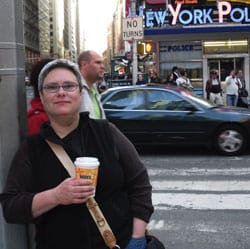 My partner Ginny and I, traveling with my family from Harrisburg, Pa., had saved MoMA for the last day of our three-day weekend in the Big Apple, which turned out to be a fitting conclusion. Besides well-known works of art, MoMA has collections which all but scream only in New York! Like the wooden cage performance artist Tehching Hsieh built in his Manhattan apartment and then lived in for a year back in the ’70s. At first I just shook my head and muttered, “ridiculous.” But I still think about that exhibit, wondering what sort of “cages” we all build for ourselves.
Between great art and thought-provoking strangeness, MoMA was well-worth the $20 admission price.
Chilling inside an air-conditioned museum also seemed like a good way to accommodate any MS fatigue that might crop up. To be blunt, if the fatigue kicked in, then I would be OK with being ditched on one of the floors while my family perused to their hearts’ content — until my brain clicked back on.
We planned well for any MS-related mishaps because I’ve just come off a nasty batch of relapses and had a new, untested baseline. The good news is that not counting random spasms, blurriness and some funny cognitive crap that only Ginny and I caught (like, how can she hand me the couch if I’m sitting on it), I did all right.
And yes, we really did make it to New York City from Harrisburg and back on one tank of gas.
OK, I confess we did have to stop at a gas station on the way home. But that’s only because we listened to Sheila, instead of our map and common sense. Sheila is my sister’s new toy, a GPS, and she just wouldn’t shut up. Following Sheila’s directions, we did an hour-long loop around Allentown, Pa. It turns out Sheila is easily confused by such variables as clouds, curves and places where highways merge. Once we figured out how to use her properly, she was great — especially when we wanted to find places to eat. We plan on getting our own Sheila, but we’ll keep a map handy, too, just in case there’s a cloud overhead.

We stayed in Newark, N.J., and took the Path train to Manhattan. Building a trip around Path is probably the easiest way for Big Apple newbies to navigate the city without feeling too overwhelmed. It’s affordable and accessible, and has stops near most major attractions in Manhattan.
We did the pilgrimage to Ground Zero at the World Trade Center that I hope most Americans get to do. The scale of devastation is clear when you look down at least two stories from the sidewalk to the bottom of the hole left where the twin towers fell. We saw the Statue of Liberty from Battery Park, too. We wanted to go over to her island, but the lines were too long, so we just sent Lady Liberty an air kiss. We saw the Empire State Building. Not that we’re cheap or anything, but it would have cost $20 each plus an hour’s wait to ride the elevator, so we just took pictures of the lobby.
That’s the thing about New York. It’s incredibly fast-paced. People there walk as fast as folks in other places jog. And now I know why. Everything worth doing or seeing comes with a long line, and if you don’t move quickly, you have to wait even longer.
We soaked up the neon colors of Broadway, where my sister and nephew watched Wicked. Ginny and I watched a dry British comedy right next door because we didn’t want to pay over $400 for tickets.
Back home in Harrisburg a man at our church told us about a kiosk in the theater district where we can take advantage of cancellations and score cheap tickets for big-name shows. Just ask for directions, he said, someone will tell us how to find it.
Which brings up another thing. Where did New Yorkers get the rep for being tough and rude? Everyone was incredibly nice and polite with the dumb tourists who couldn’t read maps. Some people, especially those who didn’t speak English, would actually lead us to where we wanted to go, or at least close enough that they could point us on our way.
There are so many foreign accents in New York. Being the proud progeny of 20th-century immigrants, I enjoyed reflecting on how this city is a foundry in which our nation is constantly being reforged. There are still signs of my people — storefronts bearing Slavic names ending in “ovich” and “inski” abound. And bustling by these well-established businesses were streams of the newest seekers of the ethereal “American Dream.”
I have the ship log for my great-grandma, Yela Gosdonovich, who at age 19 disembarked at Ellis Island, showed proof that she had $10, and thus became an American citizen. We make it a lot harder for people these days, and yet they keep coming. I feel like I’m related to each and every one of them, whether they speak Spanish or Cantonese, and I can’t wait to see how they change us. Like their children, I also have roots in the Big Apple.
Escape From Paradise
By Douglas Lathrop
Los Angeles’ new Trader Vic’s is in a downtown section that the city is somewhat desperately trying to transform from Skid Row into yuppie enclave. The last time I ventured into this part of town, about 15 years ago, “valet parking” meant paying some crack addict $20 not to break your car’s windows and steal the radio.

Nowadays the area has been taken over by an entertainment/retail development with the glitzy title, “L.A. Live.” It’s all concrete and aluminum, spindly palm trees and strobing lights, cold and sterile and suffering from a bad case of bling overload — exactly the sort of disposable, instantly dated architectural monstrosity that seems to thrive in L.A. Tonight the whole area is in gridlock, the combined result of an NBA playoff game at nearby Staples Center and the taping of this season’s finale of American Idol.
Oh, L.A. How I haven’t missed you.
But as I near Trader Vic’s and see the Tiki gods guarding the entrance, my mood begins to lift. The ultramodern metal and concrete give way, once inside, to bamboo, thatch, soft lighting, and an overall mood of relaxed primitivism. I feel my urban angst get swept out to sea and I know one of those famous Mai Tais (many think Trader Vic’s is the birthplace of the Mai Tai) is but moments away.
People often ask me, “You already live in San Diego. Where do you go when you want to get away from it all? Why not stay home — you already live in paradise.”
It’s a good question, though it misses the point. The very word “vacation” implies escape from one’s routine. And, there’s no such thing as paradise, really. The closest we mere mortals can come is an approximation of it — a place we visit for a short time, then leave before familiarity has a chance to breed contempt. I’ve found versions of paradise in quite a few places — Scotland, Munich, the Pacific Northwest, the Big Island of Hawaii — but I know that if I took up permanent residence in any of them, I’d become as cranky and fed-up with their respective flaws as I am with San Diego’s traffic jams, sucky sports teams and corrupt city government. The saying, “It’s a nice place to visit,” can be applied to almost anywhere. Even I need to get out of town sometimes.
It can be hard, though, to find a destination less than a three-hour drive from here — especially if you’re a wheelchair user. The mountains aren’t exactly wheelchair-friendly, and the inland deserts are unbearably hot for nine months out of the year. Traditionally, San Diegans escape their daily grinds by roadtripping to Baja, but these days, the four-hour waits to cross back into the U.S. at the end of your trip make it more of a chore than it used to be.
Which is why I decided to stay close to home and spend a few days indulging my love of Tiki culture.
Literally, a tiki is a wood or stone carving found on many South Pacific islands — usually representing a god, an ancestor figure or some other spirit — that is designed to bring good luck, provide protection, or otherwise invoke the spirit’s power. To American TV viewers of a certain age, the most famous tiki is probably the medallion that caused all sorts of trouble for the Brady clan when they went to Hawaii.
In a broader sense, “Tiki” — also known as “Polynesian Pop” — refers to a cultural phenomenon that first took root in the 1930s and endured throughout the mid-20th century. At its peak, Tiki encompassed architecture, fashion, music, mixology and cuisine (with Trader Vic’s and Don the Beachcomber the two most enduring names in the restaurant world). For a country whose isolation had been broken by two world wars and just recently elevated to superpower status, Tiki represented an oasis of calm in a scary and fast-moving century.
Like all such trends, Tiki eventually ran its course. From the 1980s onward — as piña coladas and margaritas replaced Mai Tais as the tropical drinks of choice — most of the old-style Polynesian Pop palaces either fell to the wrecking ball or were remodeled beyond recognition. Yet traces of Tiki still remain. Polynesian-styled motels and apartment complexes still dot the countryside, vintage tiki mugs draw large sums on eBay, and many original tiki bars still serve drinks to this day. And in recent years, the culture has seen something of a revival, with new restaurants appearing and annual conventions for Tiki aficionados held around the country. The largest gathering, Tiki Oasis, draws several hundred people to San Diego each year.
For more on tiki culture, visit www.tikiroom.com, or pick up a copy of The Book of Tiki by Sven A. Kirsten, or Tiki Road Trip by James Teitelbaum.
Here are the places, old and new, that I visited on my own personal Tiki road trip:
Trader Vic’s, Los Angeles
The Trader Vic’s chain includes restaurants across the globe. The new L.A. location opened this April after the original, in Beverly Hills, closed in late 2007. It has already acquired a devoted following of L.A.-area tikiphiles — www.tradervicsla.com.
Don the Beachcomber, Huntington Beach
A bitter rival to Trader Vic’s, the original Don the Beachcomber closed decades ago. This new venue — occupying the site of another Polynesian restaurant called Sam’s Seafood – offers a reasonably authentic tiki experience. I could have done without the hip-hop and techno music that was playing the night I ate there, however — www.donthebeachcomber.com.
Bali Hai, San Diego
One of the last of the original Tiki palaces still standing. Occupying one end of San Diego’s Shelter Island — itself a well-preserved enclave of Poly-Pop architecture — the Bali Hai has a waterfront view that can’t be beat on a summer’s evening. The food can be spotty, but what you’re really there for is the sunset, anyway — www.balihairestaurant.com.
I may not be tan from my brief vacation — other than the tan you get on your left arm while driving — but I’m definitely rested. Now, off to throw my Hawaiian shirt in the laundry. Aloha!
My Big Backyard
By Roxanne Furlong
It’s not easy for me to stay overnight in a hotel. I have to bring along a lot of equipment, and even then I have trouble sleeping in a bed other than my own. For our low-cost vacation, my husband, Bill, and I opted to tour our own city like we tour other destinations while on vacation.
I planned our trip with bargains I found online; in Minnesota parking is free with a disabled placard, and on a half tank of gas we had two full days of fun for $60.
We first toured Minnesota’s State Capitol in St. Paul. We were school kids when we last stepped foot inside the building designed by Cass Gilbert.
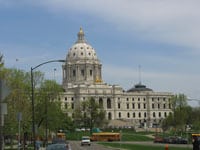
The Capitol is ornate with huge, showy Italian marble columns that provide no architectural support (Minnesota granite does the job), decorative Minnesota pipestone and original furnishings from 1905 that mimic carved interior details. The only inaccessible area is the steep spiral staircase to the Quadriga. Though I’d seen it in grade school, I would’ve loved to see as an adult the golden horses and chariot glimmering atop the rotunda, and view downtown St. Paul and the Mississippi. Surprisingly, the stairs didn’t stop one sixth-grade wheeler from climbing up to the golden icon.
After grabbing lunch downtown, we headed to the University of Minnesota St. Paul campus and its Raptor Center to learn about the birds in our new backyard. Last year, we moved into a new home — our backyard butts up against a lake and national park preserve that contains some of the last remaining undisturbed forest in the state.
The preserve provides habitat for a variety of wildlife. One late winter Saturday, while having our morning coffee in our bedroom, we watched as 11 deer tiptoed out from the woods. On another evening, as Bill and I sat in our living room observing our deck feeder, a red-winged blackbird suddenly flew into our patio door and fell to the floor. In an instant a large hawk pounced and grabbed the injured bird in its talons and flew away.
Since May, a wild turkey took up residence in our flowerbeds. His gobbling wakes us at 5 a.m., and he works it all day long into evening. We constantly see eagles, owls, herons, Mallards and geese fly overhead.
At the Raptor Center, we learned that ours is a Cooper’s hawk, that the turkey is guarding eggs, that Minnesota has the most bald eagles in the lower 48 states (Florida’s second, Wisconsin’s third) and the cooler the weather, the larger the raptor — our eagles’ wingspans average 8 feet.
All Center raptors are disabled, including a bald eagle, injured when hit by a car; a hawk shot in the wing; a peregrine falcon (they dive 200 miles per hour!) and golden eagle, both blind; and a merlin, which had a spinal cord injury.
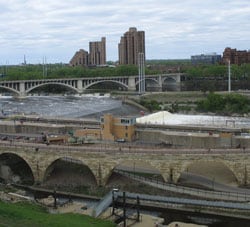
After touring St. Paul, we took on Minneapolis. We parked in front of Guthrie Theater and walked next door to Mill City. Both buildings rest along the Mississippi’s St. Anthony Falls and are flanked by million-dollar condos.
In Mill City, we got to see antiques of milling and baking and learned how water ran the mill. At the gift shop, we bought our favorite souvenirs: Bill, a T-shirt, me, a cookbook. Neither of us knew that Minneapolis took shape around the Falls and mills.
The power of the Falls drew Dakota Indians to its raging waters, and compelled C.C. Washburn, John Crosby and John Pillsbury in the 1870s to build their flour mills on the river: Washburn-Crosby (later named General Mills) on the South, Pillsbury on the North.
The Washburn “A” mill became a technological wonder in flour processing — automated grinders instead of stone mills — changing milling history. Until 1930, Minneapolis was known as the flour milling capital of the world.
The mills closed in 1965 and the buildings and area became vacant havens for vagrants, one of whom started a fire during a freezing winter night in 1991. Several buildings burned to the ground, including “A” — and in 2002, the Minnesota Historical Society received $35 million to build a museum within its ruined walls.
The accessible Mill City features the movie Minneapolis in 19 Minutes Flat, narrated by Minnesota’s own funnyman and historian, Kevin Kling, who is disabled and who succinctly explains 300 years of Minneapolis history while inserting himself in period dress, into the footage.
The highlight of the museum is the Flour Tower, a freight elevator that seats 35 people stadium-style and rises nine stories. Seven floors reveal authentic “rooms” of the mill; the ninth floor is an outdoor observation deck offering views of the Mississippi, the Falls and the 126-year-old Stone Arch Bridge. It is stunning. After immersing yourself in the history of the place, you appreciate the view even more. After the tour, we walked under the new, more beautiful, stronger and safer I-35W Bridge.
I learned in two days that disability awareness is present and vital in Minnesota history and our surroundings: Had the sixth-grader toured the Capitol with me in 1966, he wouldn’t have made it very far into the building, certainly not to hoist himself up to the Quadriga. With its disabled tenants, the Raptor Center teaches about behavior, dangers and care of birds, and the need to fight for conservation of the species. Though “A” Mill was devastated by fire, it literally rose from the ashes to teach us by allowing a man to insert himself, scars and all, into 300 years of history. And even after the shock and devastation of having a bridge fall down, injuring over 100 and killing 13, a new and better bridge was built — in record time — as a symbol of survival, perseverance and change.
God, how I love Minnesota!
Support New MobilityWait! Before you wander off to other parts of the internet, please consider supporting New Mobility. For more than three decades, New Mobility has published groundbreaking content for active wheelchair users. We share practical advice from wheelchair users across the country, review life-changing technology and demand equity in healthcare, travel and all facets of life. But none of this is cheap, easy or profitable. Your support helps us give wheelchair users the resources to build a fulfilling life. |


Recent Comments
Stefan Schönfelder on Testing Two New Seat Designs That Will Let You Fly in Your Wheelchair
Robert on A Malpractice Case Against ParkingMD
Robert on A Malpractice Case Against ParkingMD