


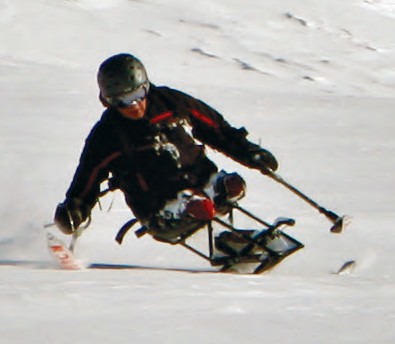
 The last time Jim Martinson had been in a helicopter was in Vietnam — June 29, 1968 — fighting for his life after a landmine blew off both legs above the knee. This time he was in Alaska, aboard a helicopter loaded with ski gear and mono-ski rigs. As the chopper left the ground, his excitement soared when he passed over the emerald blue ocean and rose toward pristine, snow-covered mountain slopes. This flight was a celebration of life, friendship, adaptability and adventure.
Each spring elite skiers and snowboarders from around the globe make a pilgrimage to Alaska’s vast coastal mountain ranges, using helicopters instead of chairlifts to access remote peaks. The massive, steep, snow-covered mountains are the ultimate playground and proving ground for skiing’s top athletes. Heli-skiing Alaska earns bragging rights and initiation into the elite tribe of “big mountain skiers.”
In March Martinson joined his son Jeremy, nephew Jeff, stepson Travis Sims, cousin Patrick Kongslie and longtime friend and wheelchair sports legend Brad Parks for a week of skiing with Alaska Powder Descents, based near Juneau.
Prior to their injuries, skiing was an all-consuming passion for Parks and Martinson. Parks, a T12 para, was injured in 1976, a decade before the invention of the mono-ski. Both agree that losing the ability to ski was far worse than not being able to walk. Winters became painful reminders of that loss.
In the late ’70s they each channeled their focus into wheelchair racing. They raced on the same relay team and formed a strong friendship. Competitive to the core, each earned gold medals in wheelchair racing at the 1980 Paralympics.
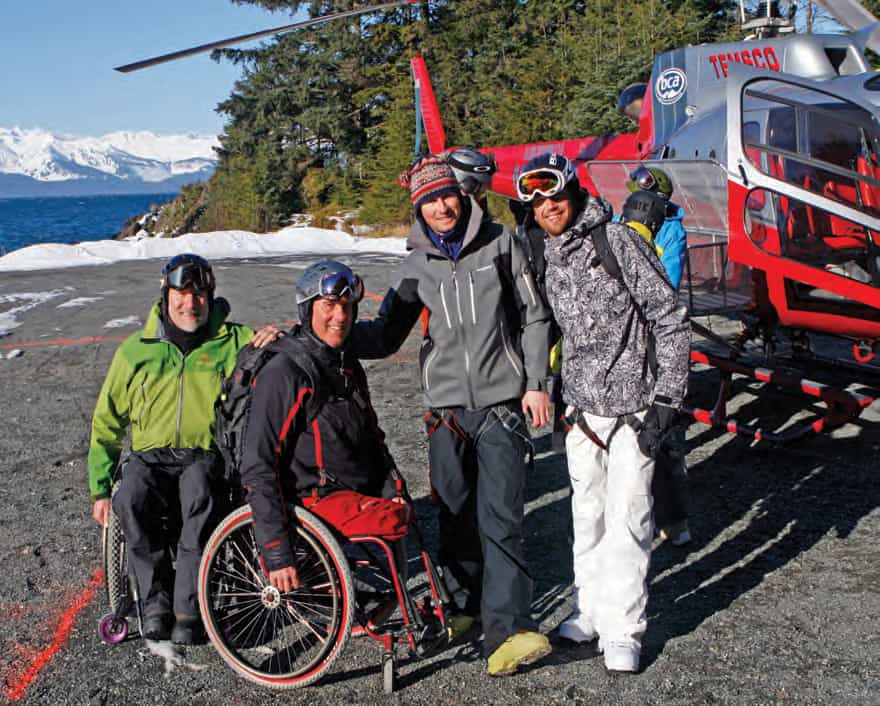
They lost touch over the next two decades as their careers took separate paths. Parks founded and dominated the sport of wheelchair tennis, earning a place in the International Tennis Hall of Fame along the way. Martinson continued racing and founded a company that made sports wheelchairs and adaptive sports equipment.
In 1986 Martinson designed and manufactured one of the first high-performance mono-skis, the Shadow. “The first time I mono-skied, I was so happy I had tears in my eyes,” he says. “Skiing was something I thought was lost forever. And it enabled me to join my sons on the slopes, something I’ll cherish forever.” Martinson went on to win a gold medal in the downhill at the 1992 Paralympics.
Parks’ first mono-skiing experience — in 1996 — was powerful as well. “Halfway through my first day on the slopes, I thought, ‘I’m really skiing!’ I was back doing a sport I tried not to think about for 20 years and had missed so much. It was an answer to prayer. I was overjoyed at being able to ski well on intermediate runs with my wife, Wendy, and my twin daughters.”
Skiing also reconnected the two friends. They started taking ski trips together — skiing on a “Black Diamond” mono-ski rig that Martinson designed. Martinson has a reputation for hard-charging aggressive skiing on the steepest expert runs a resort has to offer. Soon Parks was stepping up his game and skiing with Martinson on the super-steeps on quests for skiing’s holy grail — untracked powder snow.
“Powder” is light and fluffy. Skiing a slope blanketed with un-skied powder is like a weightless flight, floating in a dream. Time seems to slow down. When powder gets deep, it blows over a skier’s head during each turn — called a “face shot”— and feels like diving in and out of a cloud. Finding a run of un-skied powder at a ski area is rare. Helicopter skiing offers powder skiing on every run!
Jeff, a ski guide for Alaskan Powder Descents, had skied with Martinson on visits to the Lower 48 and knew his ability was up to Alaska’s demanding terrain. Jeff and the owners of APD sent Martinson an enthusiastic invite to come up and ski. He was intrigued but hesitant and phoned Parks to ask his opinion. “Jim,” replied Parks, “we’ve got to do this. I’m 54 and you’re 64. If we don’t do it this year, we’ll be another year older when we do.” They booked their trip.
Into the White Wilderness
When they arrived in Juneau, their timing was perfect. Heavy snowstorms had prevented the helicopters from flying the previous week. They were greeted by blue skies and a forecast of clear weather.
They settled in at the APD lodge — nestled between the ocean and the base of the mountains — and joined the guides to go over procedures and safety. Each skier was fitted with a two-way radio and an avalanche beacon. The helicopter would shuttle four groups of five skiers back and forth to different peaks. Guides would pre-ski every route for avalanche danger. In order to safely navigate the labyrinth and potential dangers of each run, it was crucial to ski close to the guide’s tracks.
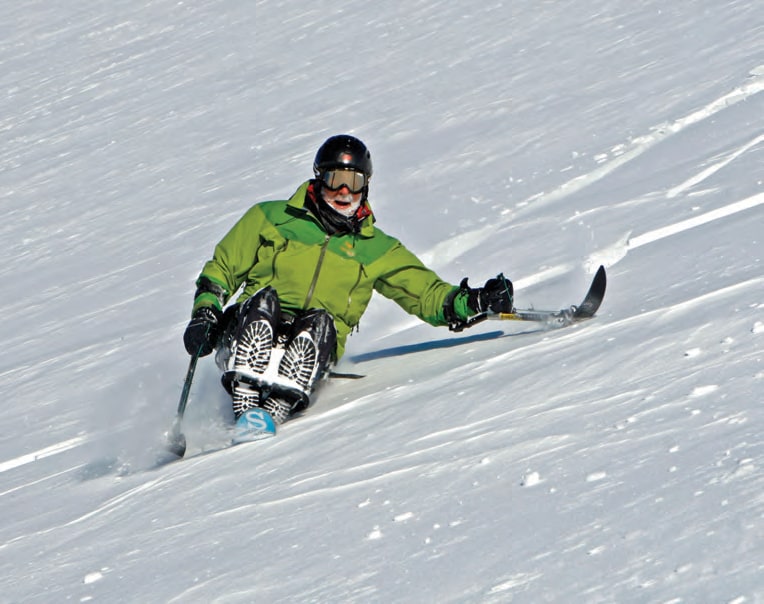
With over a million acres of mountains at their front door, APD guides choose routes based on a group’s skiing ability, from intermediate through expert. Jeff would be leading Martinson and Parks to steep big mountain runs that only the elite of the sport are capable of skiing — terrain where the penalty for a mistake could be dire and would test the limits of their skiing ability and mental focus.
The folks at APD graciously allowed the group to go with three paying clients instead of the usual four in order to make room for the mono-skis. Parks’ rig was strapped to the seat next to him, and Martinson’s sat on the floor in front of him. “It’s a good thing I don’t have legs or we wouldn’t have all fit,” says Martinson, laughing.
Within minutes of liftoff, they were flying among a vast expanse of rocky peaks blanketed with white snow under a brilliant blue sky. Ten minutes later the group was dropped off on their first mountain peak. Jeff and Jeremy grabbed ski gear while Martinson dropped down into the snow and attached a ski to each mono-rig and held Parks’ rig while he transferred from the chopper into the ski. Then Jeff held Martinson’s rig while he hopped into it. “At 64 Jim has the endurance and enthusiasm of a 21-year old!” Parks says. “Plus I always felt secure knowing he had properly attached my ski.”
The chopper lifted off and they were alone on a freezing peak in the Alaskan wilderness. For Martinson it was a real eye opener. “I was still in the mindset like I was getting off the top of a chairlift. I had my jacket open and one glove off and I nearly froze. That’s when it hit me. You have to listen to every word the guide says or you’re in big trouble. I got real humble real quick. We are in a place where there is no room for error.”
Down the Steep Chute
For avalanche safety, one skier at a time descended a run while the group waited for the radio signal to send the next person. When Parks’ turn came, he was reminded to stay close and to the right of the guide’s ski tracks. He headed down, confidence growing, snow getting deeper with each turn, finding his rhythm — one beautiful turn followed by a face shot, then the next turn. Like Icarus flying down the slope, he momentarily forgot about following the tracks that had taken a sharp veer to the right.
Realizing his mistake, he stopped on a very steep section just before a big cliff. “I said to myself, ‘Brad, you blew it!’ What am I going to do now? I can’t just hike up the hill!” On his radio he heard, “Brad, where are you? Are you OK?” The hill was so steep he had to keep his outriggers in the snow for balance and couldn’t reach the radio to respond. After what seemed like a long time, Jeff skied down to Parks and radioed for Jeremy to ski down and help. They tied a safety rope to Parks and spent close to an hour pulling him up to an area where he could ski across to the designated run. “The event really humbled me,” says Parks. “I realized this is the real deal and I couldn’t afford to make a mistake like that again.”
Parks skied into the designated run and down to Martinson at the helicopter pickup zone 2000 feet below. Waiting for the helicopter to land and take them to the next run, they basked in the thrill and awe of being in a remote mountain wilderness and sharing the experience with friends and family.
As the week progressed, phenomenal skiing was intertwined with demanding situations that called upon all of their abilities and focus. One of these occurred while skiing in the Chilkats, a mountain range across the bay.
The guides were excited because they would be making first descents on un-skied runs.
At the top of the first run of the day, the skiers had to traverse across and down an extremely steep icy slope to a narrow mountain-top spine, then do a quick turn to get to the run on the other side of the mountain. The guide went first and radioed back, “Go fast enough to make it over the ridge, but control your speed—not too fast. Oh, and don’t fall!”
Martinson went first. “You can’t imagine the butterflies in my stomach — it was within my ability, but looked like if you made a mistake and fell, you’d die.” He made it to the run, stopped and radioed to Parks, who was now quite nervous, “It’s no problem, Brad, you will be fine.” Parks focused, pushed off and made it across to the group.
The reward for the technical crossing was a phenomenal run — a steep long chute outlined by rock cliffs rising up on each side. The snow was superlative. Each skier got face shots with every turn. When they reached the bottom, they were giddy with the excitement of skiing such a long steep run of perfect snow. As they waited for the helicopter, Brad whooped. “Yeah! That’s what I’m talking about! That’s what I hoped and dreamed about. We’re skiing Alaska!”
That evening their guide explained the “Don’t fall!” statement: The area below the steep icy traverse was a 3,000-foot drop. “I’m glad I did it,” says Parks. “And I’m really glad I didn’t know about the dropoff or I would not have skied that traverse. Now I realized that what we were doing here was really dangerous!”
Initiation
Their confidence grew as the week progressed, but they were careful not to get overconfident. As lifelong competitors, the feeling of being “on edge” was familiar to Parks and Martinson. Being on edge creates a surge of adrenaline, makes colors more vibrant, experiences more intense — being on edge feels great.
The last run of the last day would require every bit of adrenaline gained by being on edge. From the helicopter they looked down at the run they planned to ski. At the bottom was a very steep chute lined with towering cliffs. Although steep, it didn’t look very long, maybe one or two turns, nothing to be concerned about. But in Alaska everything is so big, and from a helicopter things start to look really small.
The snow on the upper part of the run was perfect. The angle of the sun hitting the snow crystals created the illusion that they were skiing through a sea of diamonds — an amazing and surreal experience.
They stopped at a flat area above the steep chute.
It turns out it was extremely steep — 50 degrees in pitch — much steeper than anything Parks had ever skied before, and also extremely long. Parks recalls thinking, “OK, this is way tougher than I thought.” Martinson offered to go first and dropped over the edge and out of sight. Parks was getting more nervous by the minute. After what seemed like a long time, Martinson reappeared, looking like a small dot on the flats at the bottom.
Martinson radioed back: “No problem, Brad. You’ll be fine.” Parks says whenever Martinson did this on the trip, it always helped reassure him.
Parks pushed into the chute and traversed across, looking for a place to make his first turn, thinking, “Don’t think too hard. Just stay in control and don’t stop until you get to the bottom.” With each turn he would rocket down the near vertical run, finish the turn, and the deep powder billowing over his head would help slow him while he looked for a place to make his next turn. The run was so steep, each turn was more of a freefall through the air, accelerating him to scary speeds before approaching the rock cliffs on the other side. Using every ounce of strength and all of his ability, he kept at it. He made it to the lower section, which wasn’t as steep, and was able to relax and make some easier powder turns to the bottom. With the run flattened out, nearing Martinson and the group, he threw his arms in the air and yelled, “YES!”
The group high-fived. “That was amazing,” said Martinson. “I’ve never skied anything so steep!”
Back at the lodge they thought back to the years when this would have seemed an impossible dream, a dream made possible by ability, determination and adaptive equipment — from the mono-skis that enabled them to ski again to the multimillion-dollar helicopter that made the massive peaks accessible.
Most of all they were grateful that after three decades of friendship they were able to share this amazing experience. They were now in the tribe of big mountain skiers.
Resource:
Alaska Powder Descents Helicopter Skiing: www.alaskapowder.com.
Support New MobilityWait! Before you wander off to other parts of the internet, please consider supporting New Mobility. For more than three decades, New Mobility has published groundbreaking content for active wheelchair users. We share practical advice from wheelchair users across the country, review life-changing technology and demand equity in healthcare, travel and all facets of life. But none of this is cheap, easy or profitable. Your support helps us give wheelchair users the resources to build a fulfilling life. |


Recent Comments
Dick Crumb on Adapting Recreation To An Aging Body
Karen on The Everlasting Saratoga Cycle
Ted Kilroy on Handcycle Gear Guide