


If You Want to Get Back on the Water as a Wheelchair User, this Adaptive Sailing Center in Maryland is Worth the Trip
August 17, 2023
Jean Waverka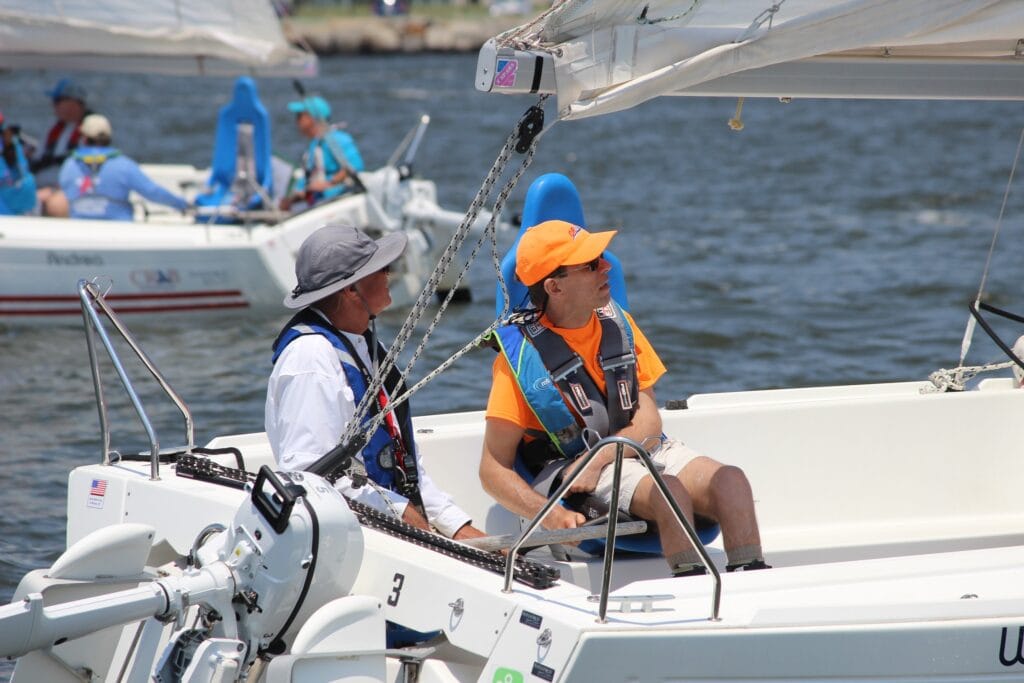
Nearly six years after embarking on the project, the nonprofit Chesapeake Region Accessible Boating has christened a premier adaptive-boating center that it believes sets the standard for organizations looking to expand access to therapeutic recreation for people with disabilities.
Located on less than an acre of land on Chesapeake Bay in Annapolis, Maryland, the fully accessible facility is the first of its kind dedicated solely to adaptive sailing. Family sails — offering visitors and their families the opportunity to sail on an accessible boat with a trained skipper and crew — are free of charge for any person with a disability, and their families and caregivers. “We’re not a community boating center open to everyone, and part of it being for the disabled,” says Paul Bollinger Jr., CRAB’s executive director. “We’re 100% focused on guests with disabilities, the recovering warriors and children from underserved communities.”
Building a Better Boating Facility
In early 2017, CRAB’s board of directors realized they had reached the limits of what they could offer at their original home in Sandy Point State Park in Annapolis, Maryland. So began the search for a site for the premier adaptive-boating center that they envisioned. Although they identified the location of their future home and signed a letter of intent to purchase the property within six months, it still took nearly three additional years to secure the necessary funding from state and local governments. In the end, the city of Annapolis acquired the property and leased it back to CRAB. In November of 2020, after raising over $6 million — $3 million public and $3 million in private funding — CRAB signed a 40-year lease to build, operate and maintain the facility.
From the outset, CRAB’s goal for the project was a property that was fully accessible and also environmentally sustainable. To be a model for the country, CRAB set out to exceed the construction requirements of the Americans with Disabilities Act. The center’s 16-slip marina has room for six new Beneteau First 22A customized sailboats, a Martin 16 sailboat with a “sip and puff” steering system that allows a quadriplegic skipper to adjust the sails and move the tiller, and space to expand the fleet.

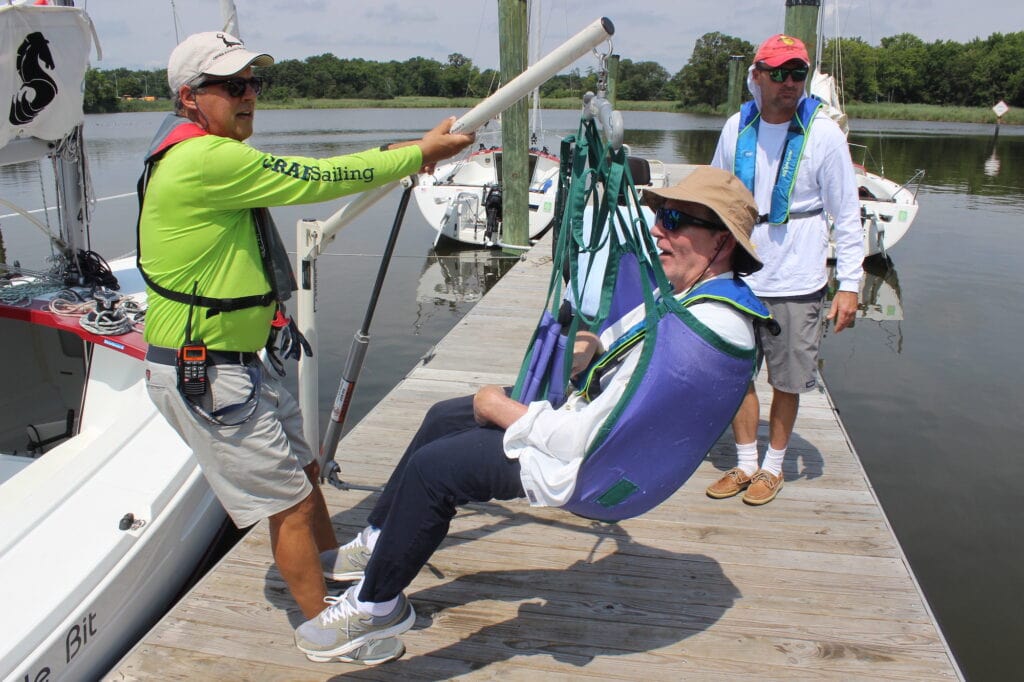
Instead of the required 3-foot-wide floating docks, CRAB opted for 8-foot-wide docks. These wider docks make it possible for wheelchair users to drive out onto the pier, get hoisted with a custom-made Hoyer Lift and placed in a sailboat or in the center’s newly acquired Gemini Freestyle 399 Power catamaran that accommodates five wheelchair users and guests. “Guests who don’t want to leave their wheelchairs can enjoy the Chesapeake Bay without getting out of their chair,” Bollinger says. “The boat has almost 130 square feet under a hardtop. It’s like a giant patio with a sunroof.”
If someone wants to use their own boat, they can make a reservation to have trained staff help with the boarding and disembarking process. With over 150 volunteers, including skippers, dockhands and support staff, CRAB goes above and beyond simply teaching people how to sail. “Guests don’t go by themselves. They go with an expert skipper with decades of experience who is trained to sail our boats and to teach people with disabilities,” says Bollinger.
Accessible Amenities
On land, the newly constructed 2,600-square-foot learning center features an 18-foot glass wall overlooking the creek and marina, as well as classroom and office space designed with an open, door-free design that makes it ideal for wheelchair users. Outside the center, the large lawn is ready for anything from sitting volleyball to outdoor movie nights. A concrete path ensures that wheelchair users can enjoy the space without getting bogged down in grass.

“People are amazed by our boats that have been customized to accommodate our guests, but when they come see this facility, they will feel like they died and have gone to ADA heaven,” Bollinger says. “My father-in-law said our trouble will be that people won’t want to leave.” Bollinger and his team have built in extra time between the sailing courses they offer, in the likelihood their guests decide to stay and enjoy lunch at one of their accessible picnic tables.
By paying close attention to the details, CRAB has made the adaptive boating center a place that its guests will want to return to again and again, according to Stephen Ritterbush, a CRAB board member and wheelchair user. “[Sailing] is an activity that we hope gets something going inside of them, and they want to continue,” he says. “From a personal point of view, it’s a way for me to put what little mobility I have to an activity that’s outdoors.”
Ritterbush, who grew up on the Chesapeake and had his first boat at 8, was devastated thinking he’d be unable to fish or sail after he was paralyzed over eight years ago. “The water has always been my church. I’ve loved being out there from the time I was a kid,” he says. “This has enabled me to go back to what I remember so fondly, feeling the wind on my face, tiller in my hand. I’ve found a way to grasp it and do a little bit of steering. I love that feeling.”
Despite the challenges they faced along the way, Bollinger envisions a bright future and serving an increasing number of guests from around the country. “Last year we did 1,200 guests in six months. We expect to double and then triple that in the near future,” he says. “We draw from the whole region, including Maryland, Pennsylvania, Delaware, North Carolina, Virginia, D.C.”
CRAB’s unmatched new facility, and the determination that brought it to life, are providing a template to emulate for adaptive sailing advocates like Jamie McArthur. McArthur started the KMAC Foundation in Southern California to honor the memory of his late son, Kyle, a passionate sailor. McArthur toured the new digs this spring. “Hands down, the best adaptive sailing facility I’ve ever seen,” he says. “They’re organized, knowledgeable, and they have great boats. I was duly impressed. We’re trying to build something in San Diego, but we’re a long way from that.”
Looking back on the lengthy and sometimes trying road to bringing the new facility to life, Bollinger says he found strength in focusing on the end goal. He shared his own personal mantra that carried him through. “It is going to get built. It will open. We will be serving people soon from this site who never, ever thought they’d get on a boat, never thought they’d be sailing a boat, never thought they could, but they do.”
Support New MobilityWait! Before you wander off to other parts of the internet, please consider supporting New Mobility. For more than three decades, New Mobility has published groundbreaking content for active wheelchair users. We share practical advice from wheelchair users across the country, review life-changing technology and demand equity in healthcare, travel and all facets of life. But none of this is cheap, easy or profitable. Your support helps us give wheelchair users the resources to build a fulfilling life. |


Thanks for the coverage of a great organization. The only time I was ever paid for writing something was an article in the fall issue of BoatUS magazine around 2012. Friends say sailing saved my life after my childhood Polio came roaring back in the form of Post-Polio Syndrome.