


Life With Spinal Cord Injury
We asked four wheelchair users at different points in their SCI journeys to reflect on where they are and what they’ve been through.
September 1, 2022
Ian Ruder
No one can tell you what lies ahead when you roll out of rehab. You are thrust into life with SCI with minimal instructions, and every decision you make impacts your future in ways you can barely understand. It all seems overwhelming. Over 33 years of covering life with SCI, we at NEW MOBILITY have come to believe that the best strategy for navigating the journey is to listen to others who have rolled before us. To that end, we reached out to a diverse group of wheelchair users at different phases of their personal journeys so they can share what they’ve been through, what they’ve learned and what they see ahead.

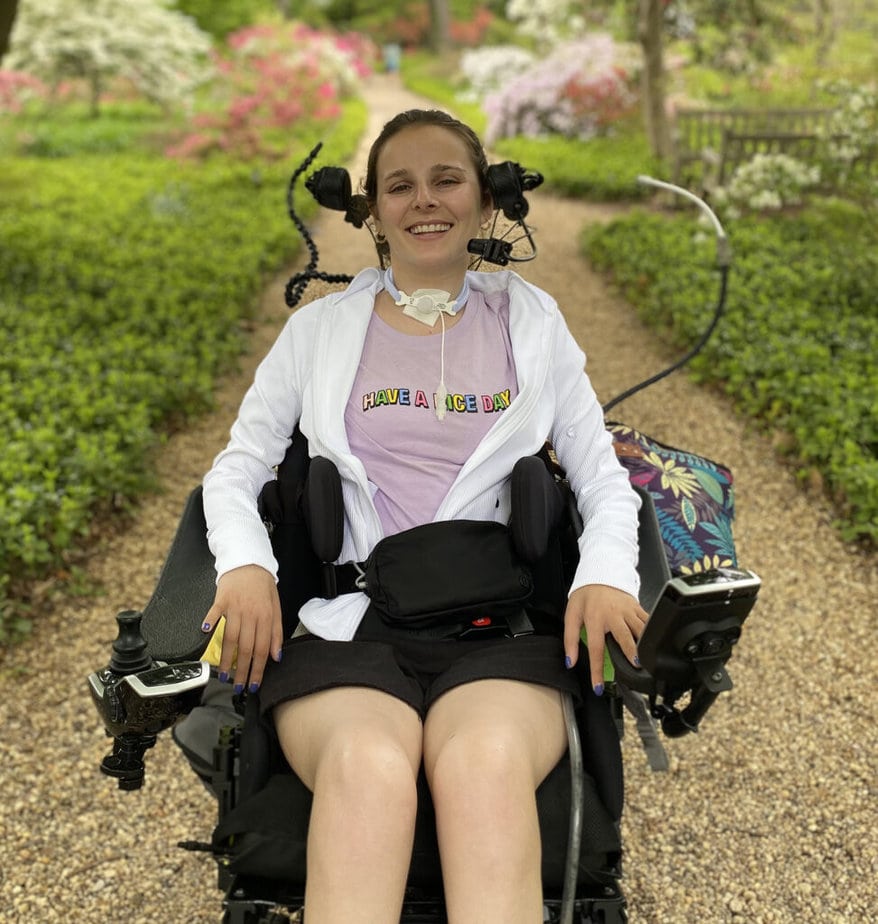
Rebecca Koltun
Age: 22
Injury: C1-2
Years with SCI: 1.5
Artist, TikTok Creator
“I’ve always been an optimist and a positive person, and being paralyzed didn’t change that.”
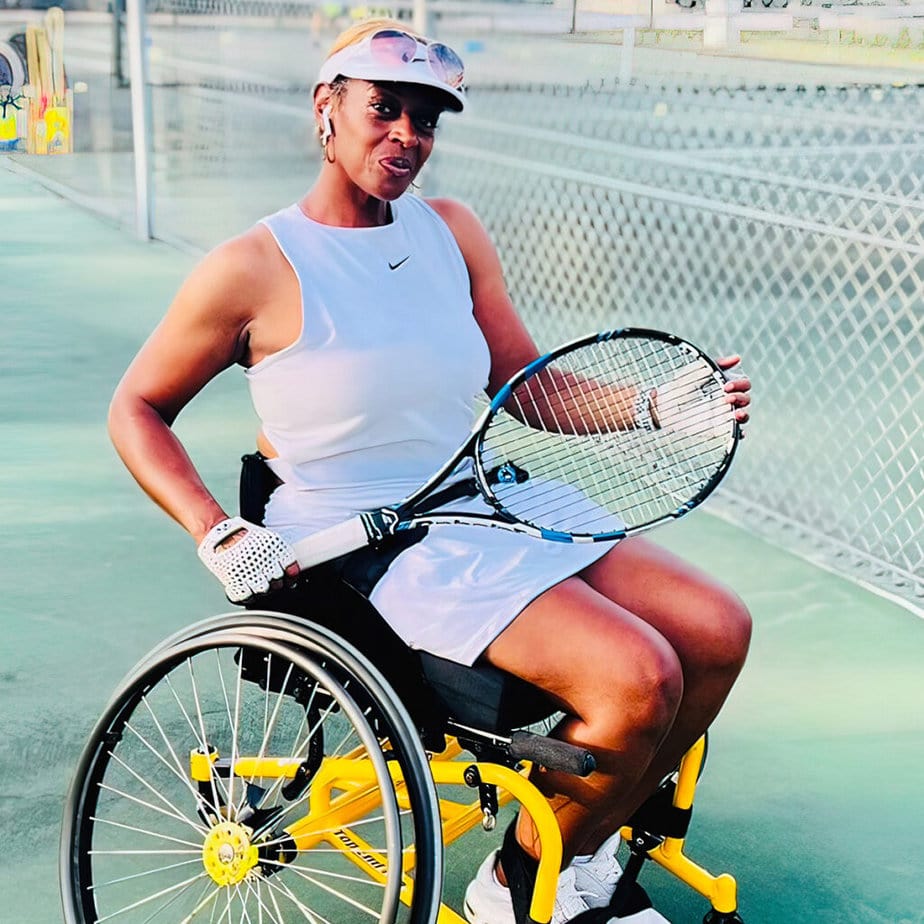
Melissa McRoy
Age: 51
Injury: T2, L4-5, S1
Years with SCI: 8
Mom, Student
“It’s been an up-and-down eight years, but I’m happy where I am and excited for the future.”
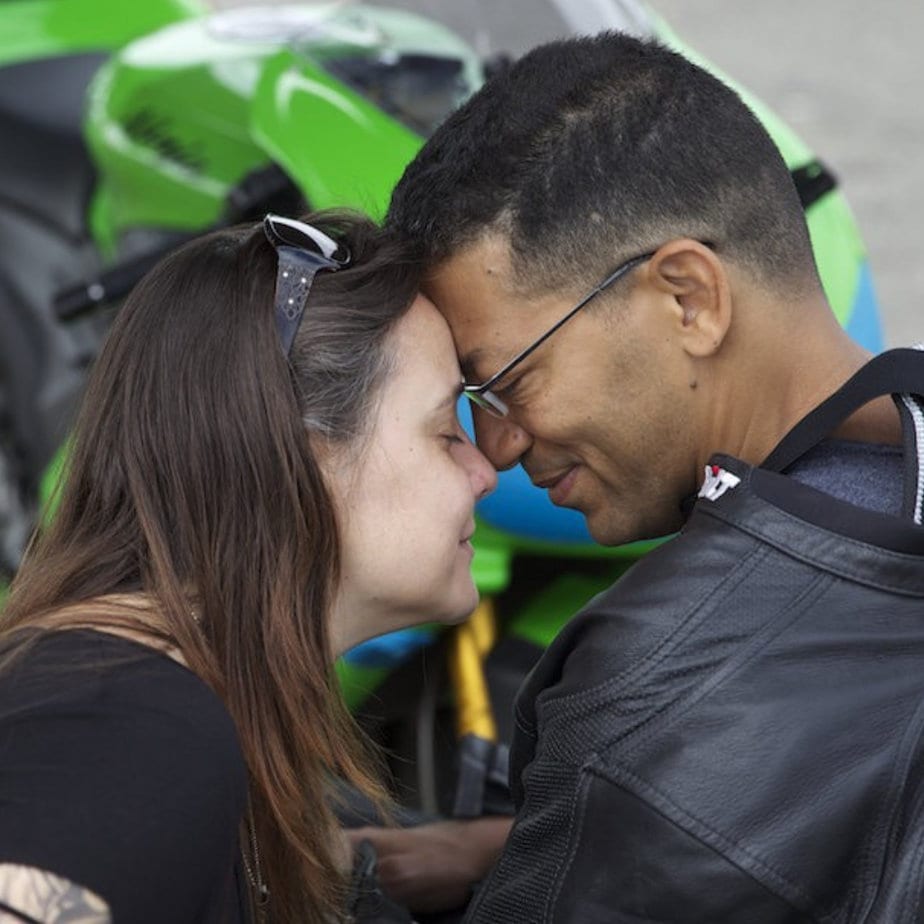
Jemal Mfundshi
Age: 53
Injury Level: C6-7
Years with SCI: 28
Mobility Equipment Rep
Motorcycle Racer
“I’ve worked hard to accept that my life is the
way it is and not let the little things stress me out.”

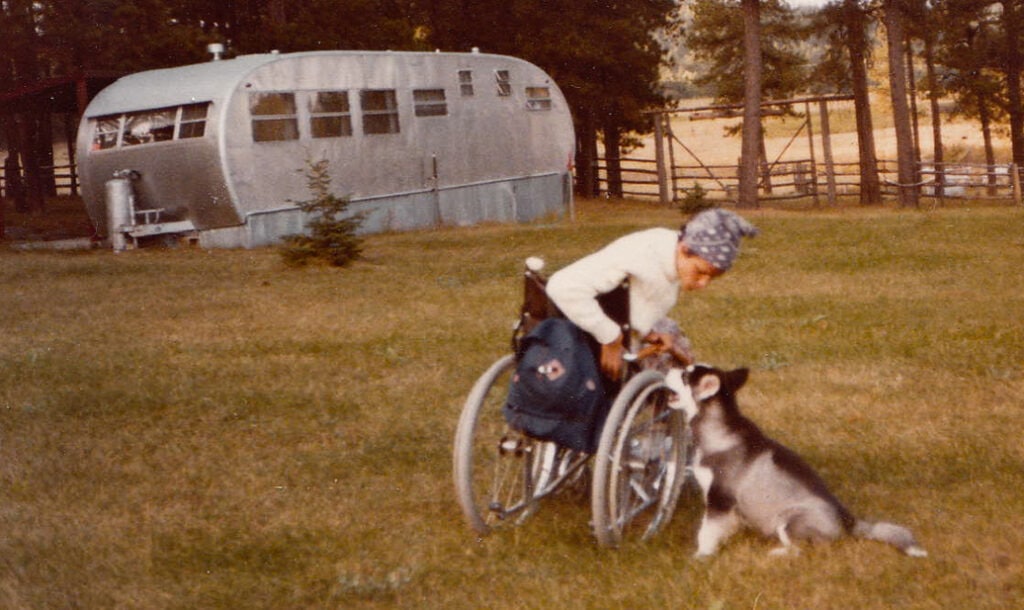
Chris Benson
Age: 62
Injury Level: C6-7
Years with SCI: 46
Photographer
Entrepreneur
Grandmother of Twins
“I’ve climbed out of a deep hole and I’m moving forward on my terms.”
PHASE ONE
WTF Happens Now?
Adjust. Adapt. Accept.
Rebecca Koltun
Plainview, New York
C1-2 for 1.5 years, Age 22
Rehab: Four and a half months at
Spaulding; four months at Glen Cove Center for Nursing and Rehabilitation
Timeline
March 2021: Paralyzed at age 21
December 2021: Finished rehab, moved to assisted living
February 2022: Returned home
After almost nine months in hospitals and rehab following my injury, I was nervous about leaving. I’d grown used to being around trained staff and having easy access to the medications and equipment I needed. What would I do if I had an emergency and all these things weren’t readily available? I was also worried I was going to be really bored without the hours of therapy I’d grown used to. On top of all that, the home I grew up in was still being remodeled, so I’d be temporarily moving into an assisted living facility.
I made it through a six-week stay in assisted living and returned to a freshly remodeled home courtesy of the NBC show George to the Rescue. There was a ramp, elevator, and widened hallways and doors I could navigate independently using my sip-and-puff head array. They even redid the deck and made a sweet outdoor patio space with a firepit where I can hang out.
My friends and community have been incredible. My parents and I launched a fundraising page and raised a ton of money. There have been so many events, I can’t even count them: a 5K, softball games, a comedy show, even people just selling stuff. On top of that, a lot of people, including some I don’t even know, have stepped up and offered to help in any way possible. Honestly, the outpouring of support really surprised me.
Even with all that support, managing my caregiving situation and finding the full-time assistance I need has been stressful. In part because of the pandemic and the nursing shortage, at one point I had almost no outside caregivers. My parents are amazing and have sacrificed a lot for me, but I feel guilty relying on them for stuff like night care. I hate having to call them because my neck hurts or I need some water.
Thankfully, I’ve found more consistent help. I posted the jobs everywhere and my parents both got the word out wherever they could. The situation now is still complicated — with some caregivers coming from an agency via Medicaid and some private aides covering shifts the agency can’t cover — but it’s way better. Seeing my parents able to live their lives and not be responsible for so much of my care makes me happy. It took some time, but after 16 months, I feel I have a pretty good handle on my health and how to manage it.
I was wrapping up my senior year of college and in the midst of interviewing for medical school when I was injured. I still want to go back to school and maybe get a master’s degree, but I definitely don’t want to be a doctor anymore. I don’t want to treat patients if I can’t use my hands. More than that though, I’m just not interested in being a doctor.
I still scramble to find things to keep me busy, but right now I’m really enjoying making art and TikTok videos. I was never that into art before my injury — I was more into sports and athletics — but I started mouth painting during rehab and have grown to enjoy it. I’ve sold a few paintings and I really want to start selling more. There seems to be a demand, so I’m looking at opening my own Etsy shop.
I got into TikTok because it was fun, but I’ve gained over 42,000 followers, and I’m making a little money now. My videos are very much me and embrace my dark humor. Sometimes my friends help me edit my videos, but I’m able to do it independently using my GlassOuse head mouse. I love seeing people’s reactions to what I create. It’s crazy to think 15.5 million people viewed something I made.
Beyond art and TikTok, I’m finally getting back to doing lots of the things I enjoy. I’ve got an adapted Chrysler Pacifica that makes going places easy. I’ve become a regular at the beach. I saw The Kite Runner on Broadway, and I just snagged front-row seats at a OneRepublic concert. Not only were the seats unbelievable, the lead singer pointed at me twice.
I’ve always been an optimist and a positive person, and being paralyzed didn’t change that. In a relatively short period of time, I’ve weaned myself off the ventilator (I use a diaphragmatic pacer 24/7), learned to manage my caregiving, found new hobbies and generally healed from my injury.
Melissa McRoy
T2, L4-5, S1 for 8 years; Age 51

When I got out of rehab in 2015, I was lost. A few weeks earlier, I didn’t even know what Guillain-Barré syndrome was. Now I was paralyzed and headed home in a wheelchair that didn’t fit me after a shortened two-week stay in rehab at TIRR. I had no clue how to do most of my care, and I’d only been out in public once in my chair. I was a single mom, and with no family or support system in the area, I had to get home to my teenage daughter and two young sons. I had no choice.
My nerve pain was unbearable — a single touch could make me cry. I still hadn’t gotten any of my strength back, and I was an emotional wreck. On top of that, my house lacked any adaptions, forcing me to rely heavily on caregivers to access the bathroom and get in the front door.
Home therapy visits helped, but most of my learning and improving was trial and error. I watched a lot of videos and learned from people sharing online. Trying to regain control of my body was physically tough, but watching how it impacted my two younger kids and trying to make sure they were OK was even harder. I tried to be as independent as possible, but inevitably ended up asking them for help.
One time, during the period I was teaching my youngest how to use the restroom by himself, I asked him to grab me something so I could use the bathroom. He looked at me, puzzled. “Mommy, you’re a big girl, you shouldn’t do that.” It kind of crushed me, but eventually I had to laugh because I could see he was just trying to process my new disability.
Jemal Mfundshi
C6-7 incomplete for 28 years, Age 53
I left rehab focused on regaining my independence and getting back to work. Despite my C6-7 injury, at that time I functioned more like a C5, with no triceps and limited wrists. I had a tenodesis splint, a dig (dil) stick, a sliding board and a loaner chair. I could dress myself in sweats and a T-shirt, transfer and I didn’t need too much help — as long as it was a good day.
I moved in with a woman I’d been seeing for about a month before my injury. She lived up a flight of stairs in an apartment. I had to be carried up to get in, but once inside I could get to all the important places. Alone at home, I missed the structure of rehab and being around other people in chairs.
I’d started attending quad rugby practices during rehab and made a point of going every week. I became great friends with another rugby player who happened to live a half-mile away from me. He’d drive his stock Dodge Grand Caravan to my place, and I’d transfer through the sliding door onto the floor (he’d had the seats removed) and we would drive to a local bike trail and push. Every time, we got a little stronger. When we started, I could barely push a half-mile. At the end of the first year, we completed the Portland Marathon together in racing chairs.
I knew getting physically stronger would make me more independent, but I hadn’t anticipated how it would help me emotionally. Learning to transfer from the floor to my chair gave me a huge psychological boost and the confidence to get out and do things without having to worry about what would happen if I fell out of my chair.
Around a year after my injury, I’d regained decent triceps and some hand function. I figured this is what I have to work with. I focused on continuing to get stronger and building my endurance so I could go back to work full time.
Chris Benson
C6-7 for 46 years, Age 62
By the time I left rehab at Craig Hospital in 1977, I already had a fierce desire to live independently. I adjusted to my accident and my new life in a chair.
I returned home to finish high school, then moved back to Denver for the summer to live with my Craig roommate, Sharon. She had an amazing energy and attitude about life, and that helped me get a good start in my wheelchair journey. We shared an apartment and worked out at Craig but spent more time having fun. We transferred into her two-door Monte Carlo and took in all the scenery, tourist traps, fairs and concerts we could.
From early on, I promised myself I wouldn’t miss out on any awesome experiences because of my disability. A good example is when Sharon and I saw the Grateful Dead at Red Rocks. Back then the only accessible seating was all the way in the back — miles above the stage. We were not having any part of that. We asked some big guys if they’d help us get down to the stage, and they agreed. Those guys turned out to be the Isley Brothers. They gave us tickets to their upcoming show, but more importantly we ended up in the front row for a Grateful Dead show.
The following year I moved to Tucson to start a new chapter in my life. I met a new crew of friends, lived on a ranch with 12 cabins on five acres. No one really worked too hard. We were young and just wanted to make art.
PHASE TWO
Back in the Driver’s Seat
Exploring Options for #WheelchairLife

Melissa McRoy
Houston, Texas
T2, L4-5, S1 for 8 years, Age 51
Rehab: Two weeks at TIRR
Memorial Hermann
Timeline
2014 Guillain-Barré syndrome at 43
2015 Rehab at TIRR
2016 Peer support, adaptive sports
2017 Took classes
2019 Anaphylactic shock
2021 Attended community college
and joined University of Houston
adaptive tennis team
2022 Developing clothing brand
After a year or so of struggling to get back to living my life the way I wanted, things started to improve. I started attending the Metropolitan Multi-Purpose Center, and when I saw a flyer for their adaptive offerings one day, decided to give them a try. The center had a gym, pool and a bunch of different adaptive classes and teams, but it was the community that really helped me. When I first went, I didn’t know anyone — not only in the disability community, but in Houston. I’d only lived here a few years and didn’t have family around.
Some of my new friends encouraged me to try wheelchair basketball. I’m a girly-girl, so I opted for tennis. I went to a weekend tennis camp and actually liked it. On top of the exercise, I knew getting out and socializing was good for me mentally and emotionally, so I joined the adaptive tennis team at the University of Houston.
Now I attend Tabata Tuesday workout classes at the Multi-Purpose Center every week in addition to working out on my own and attending other social events there. Through the center, I got involved with two great support groups, and the friends I’ve made there have been key to regaining my independence. One took me out in her car to teach me how to drive with hand controls. I still don’t have a vehicle I can use independently, but I’m confident in my abilities.
Eight years after acquiring my disability, I’ve regained a lot of the strength I lost and some of the function. I’ve recovered full use of my fingers and hands. My core is strong, and I’ve even gotten some ankle function back. I’m a lot more independent around the house, but still need assistance regularly as my strength comes and goes. My kids are old enough now that they can help me and get paid by the state, but for a while, managing caregivers was a nightmare. One time, my son caught an attendant swapping out my two-ply toilet paper for one-ply rolls she got from a gas station. I told her I would have just given her a roll if she had asked!
My biggest physical setback came in 2019 when I went into anaphylactic shock from a bad interaction with one of my medications. I blacked out and ended up spending a week and a half in the hospital. That led to dysphagia, a swallowing disorder that made it much harder for me to eat. For a while I pureed everything, and to this day have to be careful about what and how I eat. I’m a big juicer now and enjoy a lot of soups.
As I became more confident and figured out the day-to-day stuff, I started working on other goals like finding work. I took some classes at the local community college in 2017 and 2018, but none of the job opportunities worked out.
I’ve always loved fashion and modeling and wanted to launch my own fashion business but lost my self-confidence after I was paralyzed. I couldn’t put pants on by myself, so I wore nothing but dresses for a year. My feet were too swollen to wear any of my fancy shoes, and on top of that I had foot drop.
I still remember my first trip to the mall when I started to get my fashion confidence back. I dressed up like I was going on a date — a real head-turner! Some stared at me. I went right up to them and said hello. People tell me I have a great spirit and contagious smile, and if I can use those to disarm some people, I’m all for it.
As I got my sexy back, I returned to the idea of launching my own fashion company and started working out what I needed to do to make it happen. I knew I’d need some marketing skills, so I enrolled in a marketing class at Houston Community College.
Around the same time, I started competing with the University of Houston adaptive tennis team. I go to practice every Thursday, and earlier this year I won my first tournament. I had never imagined that was even possible. I was even prouder to see my kids’ reaction and pride.
It’s been an up-and-down eight years, but I’m happy where I am and excited for the future. I wish I had started my clothing line a long time ago, but I feel closer to where I want to be than I have been in a while. I’ve taken the keys to my life back! I’m bold now. I want to do my thing. I notice now that people latch onto me in the support groups that I’m in, and I want to encourage them to realize they can do whatever they want.
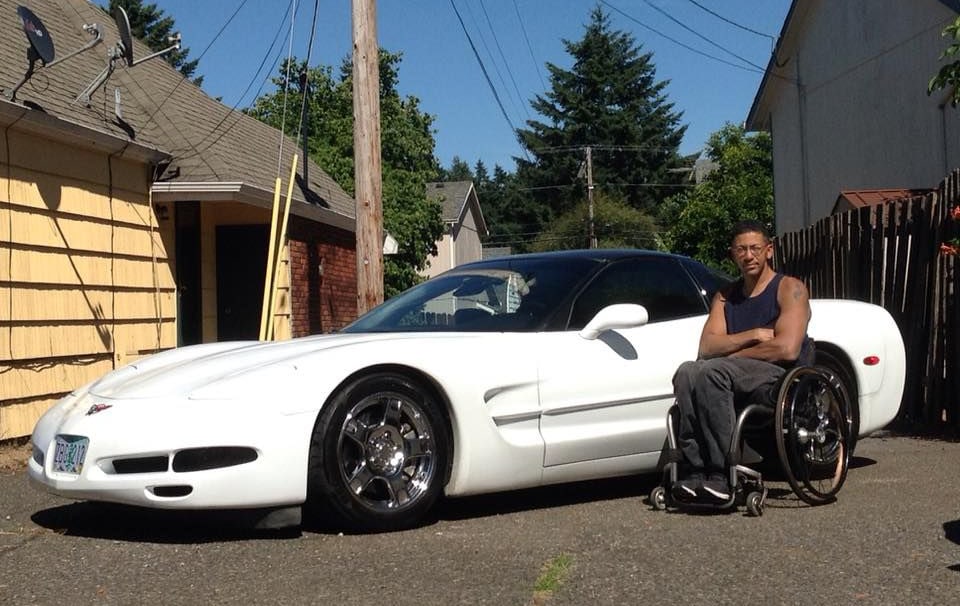
Jemal Mfundshi
C6-7 incomplete for 28 years, Age 53
About 14 months after my injury, I returned to work. Voc rehab helped me modify my car so I could drive, and the semiconductor manufacturing company I’d worked for came through on their promise that there would be a job for me when I was ready. I wasn’t able to physically do the job I had before, so I went into human resources. I was just happy to have a job and not be dependent on SSI.
Returning to work wasn’t easy. I’d worked with those people for five years before my injury, and they all knew me as a fit 24-year-old. Now I used a manual chair and had a quad gut. I was very self-conscious. Additionally, everything I had known was different now — doors were heavy, things were out of reach, the bathroom was tricky — it was a challenge.
Thankfully, everyone was super supportive and over time it got easier. The conversations shifted from all being about the wheelchair to normal, everyday topics. People realized I was still the same guy.
Outside of work, things kept getting busier. I married the woman I had moved in with. We lived together for five years before divorcing. I don’t really attribute the split to anything wheelchair-related, more just lack of compatibility.
I kept playing rugby and building my strength and stamina. In 2000, my rugby friend and I completed the Midnight Sun Ultra Challenge in Alaska — 267 miles over six days. It was the most physically demanding thing I’d ever accomplished, and while it pretty much broke me of ever wanting to do wheelchair racing, it also showed me I could do anything.
Around the same time, I quit my job and started working for a local mobility dealer owned by a paraplegic friend. I’d pushed my limits, seen what was possible and was ready for something new.
Chris Benson
C6-7 for 46 years, Age 62
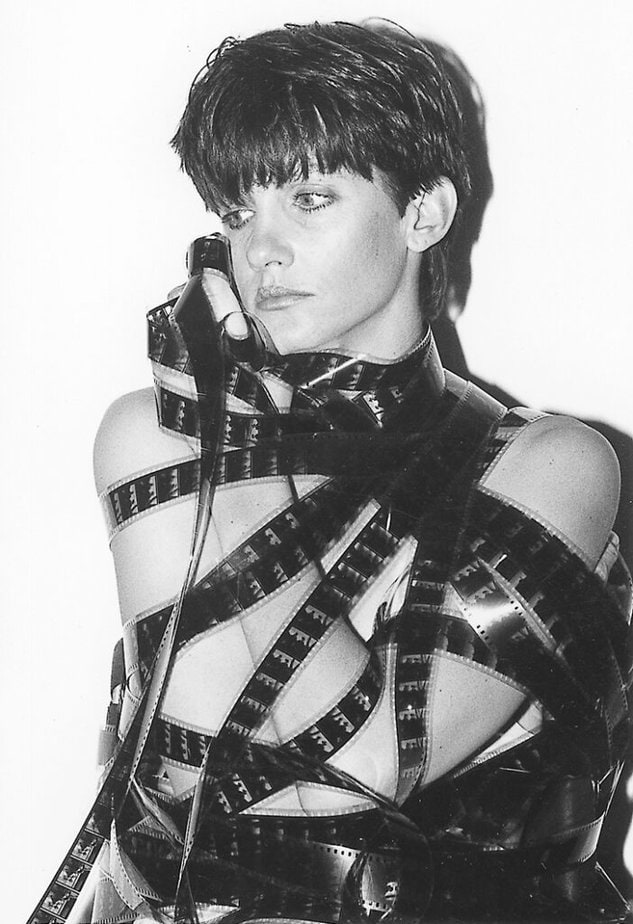
My 20s consisted of school, travel and photography. Life seemed easy and carefree.
One of my friends gave me a 35 mm camera for my birthday and I fell hard. It was all I thought about and all I wanted to do. I enrolled in community college to learn the technical bits and lived in the darkroom. I started with makeshift studios and a lone 35 mm camera. As a wheelchair user, I knew I would never get hired as a photographer’s assistant, so I had to work twice as hard. I couldn’t get a bank to believe in me. Instead I focused on finding mentors I could follow around. I was constantly learning and made lots of mistakes, but I became established and worked all the time.
I built my portfolio by convincing boutique owners to let me shoot their clothes and accessories at scenic resorts, old adobe towns and the docks and beaches in Mexico. I loved organizing these events. I took all of it very seriously and yet was one of the best and funnest times in my life.
Ten years after my injury I broke my neck for the second time. I was getting out of a car with my dog’s leash around my wrist. She bolted and took me with her. I fell right on my neck and broke it at the same spot. I had fusion surgery and a halo for four months, then healed up and got back to life as usual.
I went back to school to make myself more marketable and eventually moved back to Denver in search of opportunity. That opportunity came in the form of a chance to shoot for the disability resource book Spinal Network (from which New Mobility was developed). After years of shooting models, I discovered a new love for focusing on real people and disability. The next thing I knew I was on a plane for the West Coast to photograph people for the book.
PHASE THREE
Living Life on Our Terms
Joy and Hardship: Adulting Does Not Discriminate
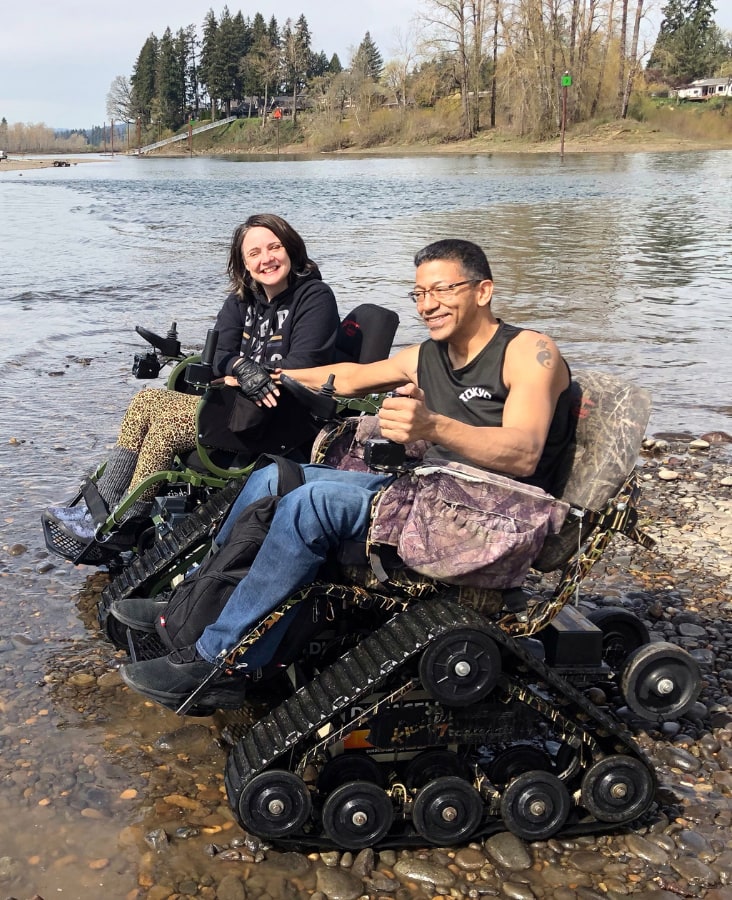
Jemal Mfundshi
Portland, Oregon
C6-7 incomplete for 28 years, Age 53
Rehab: Two months at Legacy
Rehabilitation Institution of Oregon
Timeline
1994 Paralyzed at age 24
1995 Returned to work
1999 Started job with mobility dealer
2000 Completed Sadler’s Midnight
Sun Ultra Challenge in Alaska
2001 Back injury in quad rugby
2009 Bought a house
2011 Married longtime partner
2013 Rode a motorcycle
2022 Repping Action Trackchair
Coming off my divorce, I wasn’t looking for a new relationship, but through my peer mentoring at the local rehab hospital, I met a new quad who had also just gone through a divorce. We talked about everything, including our mutual struggles with self-image as quads, and we became close friends. We ended up moving in together, and 10 years later, marrying.
One of my other passions had been racing bikes. After getting injured in a racing accident, I didn’t think I’d ever again feel the way I did when I was racing. But my new boss at the mobility dealership loved racing cars and introduced me to autocross, timed racing on a set track. He had built his own custom hand controls for clutch and shift and had more dexterity than I did, but he got me racing stock cars with an automatic transmission. That really rekindled my passion for speed.
I’ve owned and raced in a ton of cool cars and currently roll in a C5 Corvette. Eventually, I started thinking about what it would take to get back on a motorcycle. I’d gotten more hand function and upper body strength, but I still didn’t have enough trunk or tricep strength. But when I saw a video of a para on a motorbike, I figured if he can do it, so can I.
I bought an old bike, then I fabricated retractable landing gear and put on a push-button shifting system. I took it to the same track where I had my accident and rode for the first time in 19 years. It was the scariest thing I had done since being in a chair, but also one of the coolest. Being able to overcome the fear while feeling the thrill of being on a fast sport bike again was one of those paramount moments in life.
Racing also helped fill the gap left when an unfortunate rugby accident brought an early end to my time playing. An illegal hit resulted in back damage, two surgeries and severe neuro pain I deal with to this day. Outside of that, I’ve been pretty fortunate when it comes to health. I haven’t had any pressure sores and just a few urinary tract infections here and there.
Accepting the way I look has always been a struggle. I still hate my posture, my quad gut and my skinny legs, but over time I’ve learned that appearance doesn’t matter that much and I’ve adapted. I’ve also learned to find silver linings, like my skinny legs making it easier to transfer.
Keeping things in perspective is key. In my job as a mobility dealer, I see a lot of people who’ve given up or let themselves go. I try not to judge, because I know how hard and complicated life can be, but I do make a point of reminding myself to keep working my ass off and keep pushing.
That’s the message I’ve always tried to instill when I’m mentoring people with new injuries or anyone in the community. Every once in a while I run into people I mentored years ago and it’s so rewarding to see how far they’ve come and the people they’ve become.
After almost a decade of living in apartments together, my wife and I bought a house in 2009. It didn’t need too much work to accommodate both of us, but we fixed up the bathroom and ripped out some carpet. Our house is our own little secluded cave with our three cats.
As I head into my 28th year in a chair, my main focus is maintaining my health. Every day I see other chair users with different medical issues, and my family has issues of its own. After trying some different diets, I settled on a high-protein diet and at 53 I’m in better shape than I have been in the past 15 years. A few years ago, I was sure I was going to need rotator cuff surgery and that scared the shit out of me. How could I take care of myself — much less help my wife — with one arm? I tried a low-carb diet and miraculously, within two weeks my joint pain was gone. I never tell people that what works for me will work for them, but I do say you need to figure out what works for you. It’s about working smarter, not harder. I’ve worked hard to accept that my life is the way it is and not let the little things stress me out.
Chris Benson
C6-7 for 46 years, Age 62
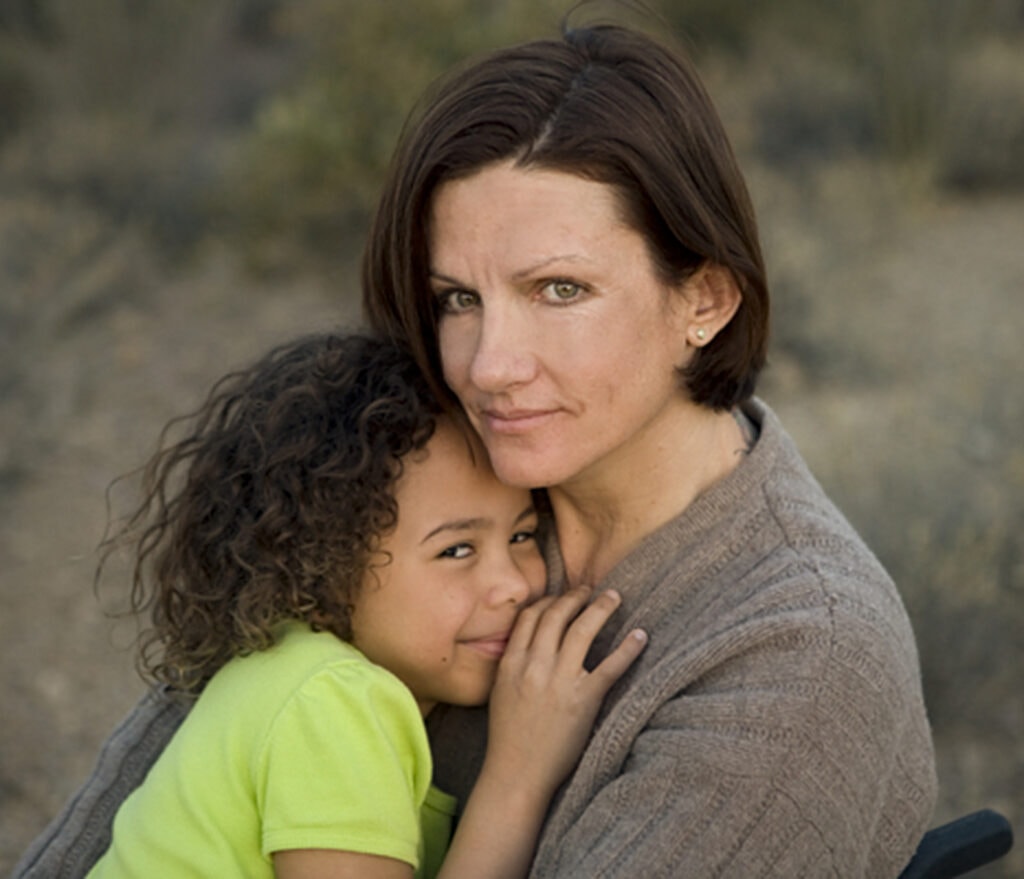
Eventually I moved home to South Dakota to be closer to family and open a photography studio. After years of being a little fish in a big pond, I was ready to try being a big fish in a little pond. I renovated an old auto shop and started Chris Benson Photography. Finally I was making serious money. It felt great. I bought more equipment, hired an assistant and expanded my marketing. I channeled my love for dogs into fundraisers for the Humane Society. In 22 years, I helped raise over $50,000 photographing families with their pets.
Everything changed in 2002 when I adopted a daughter. She had stomped into my studio a year earlier as one of many foster kids who came for professional photos to show prospective parents. I knew at that moment I wanted to adopt her. After asking a caseworker what to do, I completed a 10-week class and had a home inspection. Being a single quad didn’t seem to matter to them.
But, honestly, nothing really could gave prepared me for what was ahead. Everything moved so fast, and two months later she was living in my home. I was a foster parent for a year before I adopted her. They told me she had a diagnosis called Reactive Attachment Disorder, or RAD, a condition where children don’t form healthy emotional bonds with their caregivers, often because of abuse or neglect at an early age.
A little shell-shocked, I vowed to help this little person who’d had every adult fail her. Being a single mother is difficult, but being a quad single mother adds a whole other dimension. Managing my business and taking care of my daughter proved too much, so after 14 years I closed my photo studio to spend more time with her. It was a rough ride. Life was very difficult for us, but we made it through.
Around the same time, in my late 40s, I decided to try online dating. I had always been a little unsure of myself in the dating department. I was aware of my insecurity back when I lived with Sharon, who always had guys around, but I never would have guessed it would follow me throughout life. I’ve had several relationships and a few serious ones, but had never put myself totally out there.
I posted a picture of me in my chair and was very open and honest in my dating profile — I didn’t want there to be any surprises. I wrote that I used to think I wanted a guy who made me feel like I didn’t have a disability, but really I wanted one who makes me feel like it’s OK to have a disability. I had quite a few responses and many dates. It was fun, but nothing long term came out of it.
PHASE FOUR
Keeping it Together
Healing as a Way of Life
Chris Benson
Rapid City, South Dakota
C6-7 for 46 years, Age 62
Rehab: Four months at Craig Hospital
Timeline
1977 Paralyzed diving at 16
1978 Graduated from high school
1979 Attended college
1980 Moved to Tucson, lived on a ranch
1987 Broke neck again
1990 Returned to school
1994 Pursued photography in Denver
1996 Moved to South Dakota
1997 Started CB Photography
2002 Adopted foster daughter
2010 Closed CB Photography
2015 Opened a used clothing store
2016 Tore rotator cuff
2020 Ileostomy, reversal, pressure sores, broken femur, amputated leg
2021 Started ChrisCooks
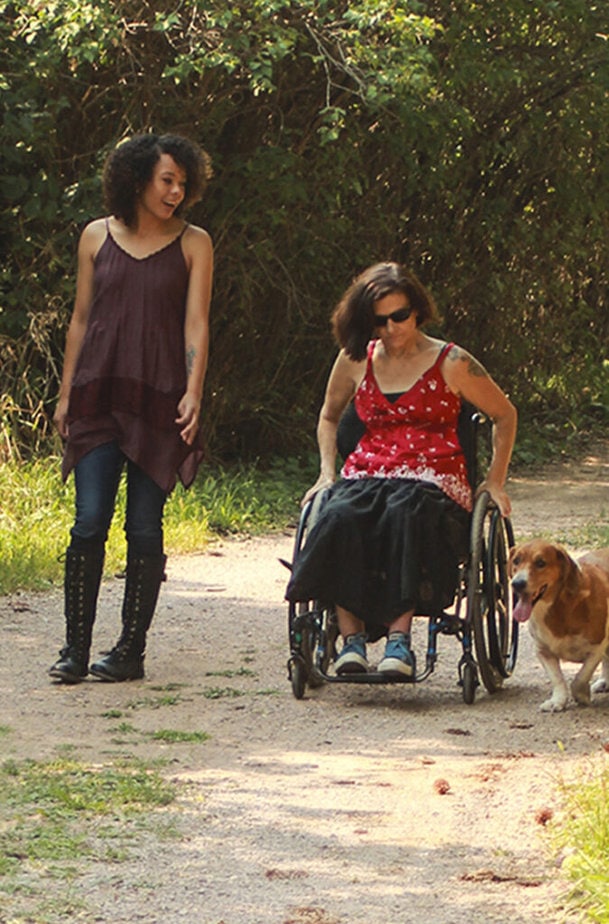
For as long as I can remember, I’ve derived a big part of my self-worth from being busy. That started to change when I tore my rotator cuff in 2016. The surgery and recovery slowed me down physically and mentally.
Needing assistance with everything drove home how central my independence — and living independently — is to my identity. I had grown so used to filling every minute of every day, that it was difficult to find a new healthy balance. I had to learn to stop pressuring myself and realize I don’t need to prove anything to anyone, or put myself out of my comfort zone to feel like I’m thriving. It’s OK that instead of going out, I’d rather garden and spend time with my dogs. My family and close friends are what matter most to me, and while I still have a passion for photography, it doesn’t define me.
All of this has been tested over the last few years as I’ve endured an unprecedented series of physical setbacks. More than 40 years of a slow-moving gut and lengthy bowel programs at last took their toll when I underwent emergency surgery on my small intestines in 2019. I woke up with an ileostomy, a 10-inch incision and no belly button. Months later, what was supposed to be a five-day hospital stay for reversal surgery turned into a six-week hospital ordeal. I got a feeding tube because my body refused to accept food. I also developed pressure sores that took months to heal.
“I feel good — my body and soul feel more connected. I’ve climbed out of a deep hole and now am moving forward on my terms.”
When I finally recovered from pressure sores, I promptly fell while transferring and broke my femur. I tried every way to heal the bone, but years of sitting had made it fragile. Meanwhile a bad infection was stirring. Less than a year after the intestinal surgery, I had my left leg amputated.
That was the lowest point of my life. I was in a dark place, waiting for the next thing to go wrong. I felt defeated and thought my body was done. I was tired, and worried that my time on wheels had caught up to me. Taking care of this body felt like a full-time job. I avoided going out at all costs.
But my time as a wheelchair user has shown me a funny thing about a strong mind: Given time, it can heal. I started feeling stronger, and eventually everything healed. My doctor suggested ketamine treatments to help my anxiety. I had a 45-minute session every week for five months. I’m still not sure if it helped, but they were nice trips to la-la land. I am still battling anxiety and probably always will to some degree, but I began to get my motivation and creativity back.
Going through this has forced me to reconsider my perspective on inspiration. I have always been confused about that word. I didn’t know I would ever need inspiration: I was the one to be doing the inspiring. It’s only in these later years that I’ve searched for it to help me through tough times. Now I find inspiration all around me.
I’ve reestablished a healthy life balance. When I was in the hospital and not able to eat, I watched all the cooking shows. Something inspired me to launch my own home chef biz. I started ChrisCooks in 2021 and now I plan meals, shop, prepare and deliver food to several clients weekly. I get great satisfaction in people enjoying what I create, same as making pictures.
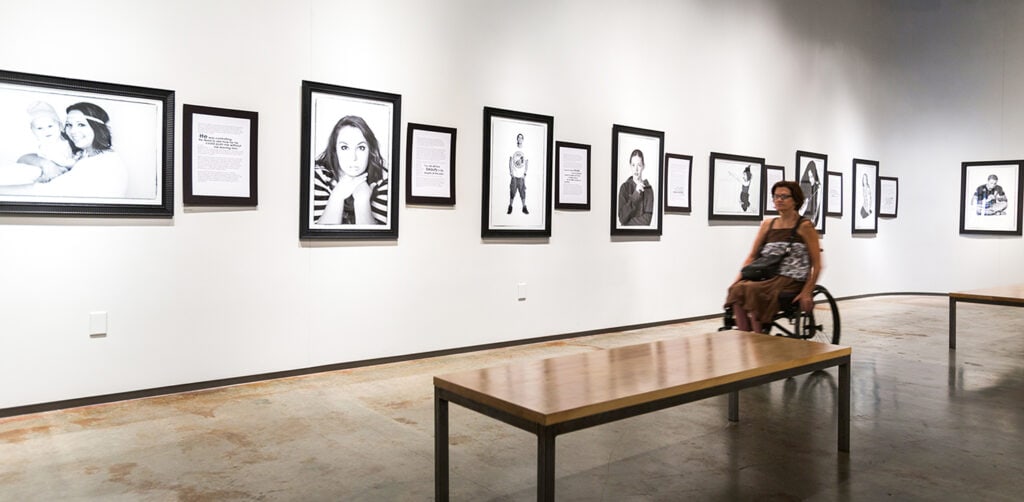
I still love photography and continue to shoot pictures, and to top it all off, I’m a grandma. It’s the best! My daughter has grown to be an amazing person and mother. I couldn’t be prouder. I feel good — my body and soul feel more connected. I’ve climbed out of a deep hole and now am moving forward on my terms.
Setbacks seem to be a part of my life, the hardest part. Now I am getting major work done on my teeth. All the years of taking meds that kept my mouth nice and dry, and opening tops with my teeth (not to mention serious grinding), have ruined my mouth.
When people ask how I get through everything, my response is the same: What is my choice? To me there is no choice — you just move forward.
Support New MobilityWait! Before you wander off to other parts of the internet, please consider supporting New Mobility. For more than three decades, New Mobility has published groundbreaking content for active wheelchair users. We share practical advice from wheelchair users across the country, review life-changing technology and demand equity in healthcare, travel and all facets of life. But none of this is cheap, easy or profitable. Your support helps us give wheelchair users the resources to build a fulfilling life. |


Chris I am so in awe of you! You always reinvent your world! Your daughter is amazing and beautiful and Grandma rocks! Love you my friend.
You are amazing my friend!❤️