



Ben Clark didn’t expect to find himself stuck at home with nothing but a broom handle, a few resistance bands, and some puny weights to stay in shape. However, that’s exactly the predicament he found himself in as a wheelchair user during the pandemic.
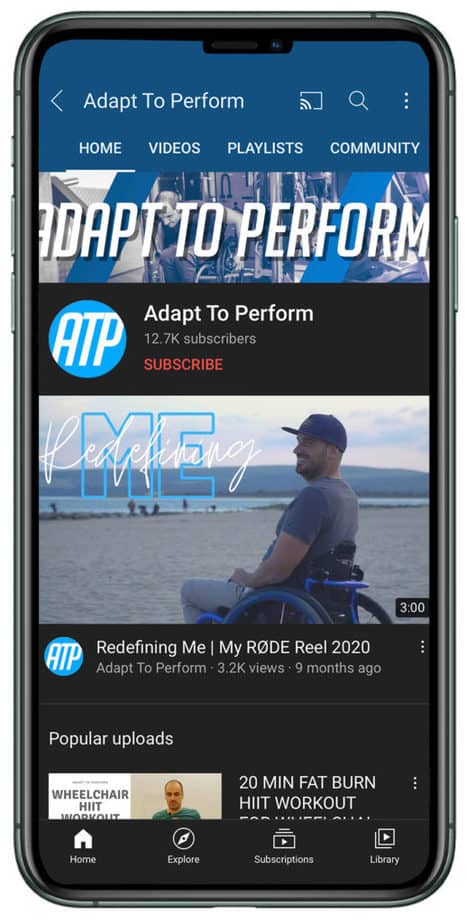
Clark runs Adapt to Perform, a YouTube channel dedicated to fitness for those with disabilities. The United Kingdom-based former professional swimmer goes live to his 12,000-plus subscribers twice a week and says he enjoys finding ways to make routines accessible for those with all kinds of access needs.
“What I really like about the live stuff is the interaction between me and the audience, having that feedback immediately, and being able to help people,” says Clark. “Also, I like the sense of community it creates. I go on the YouTube chat, start recognizing the same people and get to know them a little bit better.”
Clark started the livestreams at the beginning of the pandemic as a way to build community, lessen isolation, and provide one hour a day where people could be together on their respective fitness journeys.
Gyms Don’t Care
Clark’s focus on digital accessible fitness solutions came from his own experience as a wheelchair user. Before a 2010 spinal cord injury, he had been a high-level athlete — hopeful to land a spot on the Great Britain swimming team for the 2012 Olympics. But when he tried to get back to fitness after his accident, he found the options lacking.
Clark isn’t alone. Statistics show that disabled people are far less likely to engage in regular physical activity. The Centers for Disease Control acknowledges several factors that contribute to a lower rate of physical activity for those with disabilities, including a lack of access to facilities and trained professionals that can provide proper support.
This often leaves disabled people looking for options outside of the gym environment. Dannie Ocasio, who has CP, is one of those people. When he put on weight during the pandemic, a combination of dieting, workout videos from Beachbody, and a CrossFit routine with a trainer brought him back on track. Ocasio chose the gym he did because of ease of access from his house. He kept adaptability front of mind and says he chooses his trainers based on how they approach his disability from the start.
“I always ask the trainer, ‘Hey, what do you mainly focus on?’ If it’s just to have me lift bigger weights, then we’re a no go and I’m very upfront about that,” says Ocasio. “I care more about proper form than I do about the heaviest weight. The last thing I need to do is to pull a leg or arm muscle or hurt my back, because it takes me just that much longer to heal compared to everybody else.”
The extra barriers to exercise faced by people with mobility disabilities led many to simply stop trying. According to the CDC, almost 50% of American adults with disabilities go without aerobic physical activity. More concerning, its data suggests that disabled people are three times more likely to have heart disease, stroke, diabetes or cancer than adults without disabilities. If the data is representative, that means approximately 9.4 million disabled adults in the U.S. don’t exercise daily.
Lack of access and gyms’ refusal to change are barriers that Clark has repeatedly faced. He thinks the standard gym owner is focused far more on money than they are on helping people in need of additional support. “I have tried and tried and tried to get into the mainstream gyms to change their opinions and convince them of why it’s important for them to make their spaces more accessible,” he says.
Frustrated with the options available, Clark began experimenting with his own home fitness routine. He found that a gym wasn’t necessary to create a quality fitness routine as a wheelchair user. All he really needed was a little creativity and a few pieces of inexpensive equipment.
He started his “Adapt to Perform” YouTube in 2017 to help other wheelchair users along on their fitness journeys, and he’s now looking to take the concept further. Clark will soon be launching what he calls “Netflix for adaptive fitness,” a website dedicated to on-demand accessible fitness. “We’re bringing it to people’s homes so they don’t need to have a car to get to the gym, they don’t need to have a gym that has a ramp or an accessible toilet or the right equipment,” he says. “They can just be in their own home, doing it by themselves sort of thing, but still getting that community feel and enjoyment from it.”
He isn’t the only one working in that space.
Our Resident Curmudgeon Tries Some Online Fitness Offerings
Let me start by saying that I am not a fitness class kind of guy. Don’t get me wrong, I love working out — but I find chipper instructors shouting encouragement at me grating at best. But I also have a brand-new baby and I recently moved to the country where there’s no gym close by. In order to stave off the dreaded dad bod, I decided to open my mind and give an Adapt to Perform video and a Kakana class a go.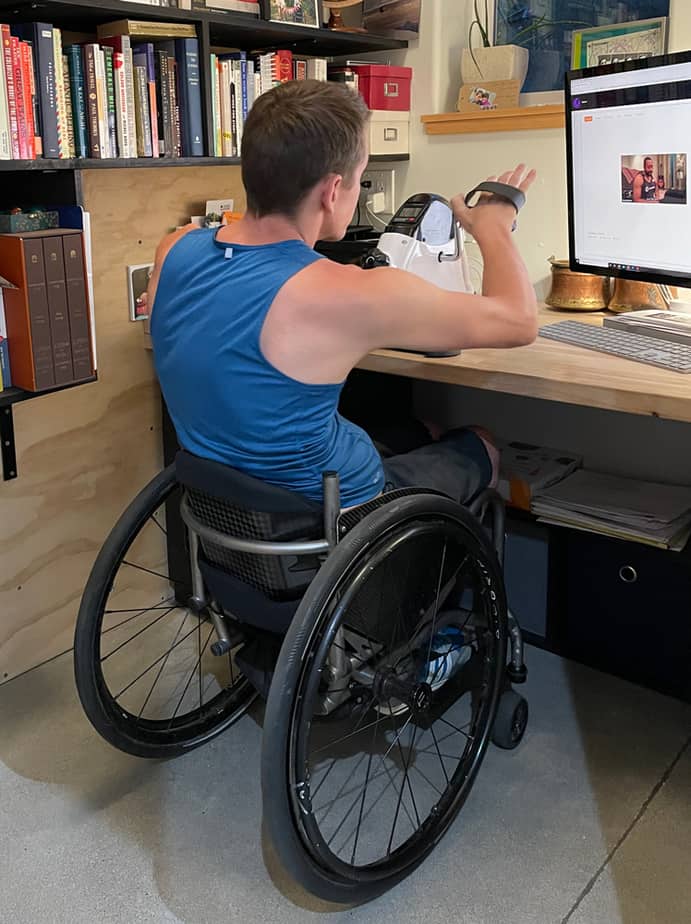
Broom Handle Throwdown
On the Adapt to Perform YouTube channel, I chose a video titled “Tough Wheelchair Cardio // At Home!” because the image showed Clark holding a broom handle, and I was intrigued. The video starts with a montage of a few of the moves you’re going to be doing, which is nice when you’re trying to quickly discern whether you have the function to be able to complete a workout. The good video and audio production quality is immediately noticeable. Clark then hops on and gives a brief explanation of the workout and what you’ll need — in this case it’s just the broom handle, which he dubs the “cardio pole.”
The workout itself is five different movements including a paddling motion, a series of karate chops, a push out and then up and a couple of twisting maneuvers, all of which I could complete in my everyday wheelchair with no straps or core function. Each move is done for one minute, with no rest in between. At the end of the set there’s a one-minute rest before repeating for a total of five sets. It took approximately 20 seconds before my shoulders started burning, which made me feel bad about myself.
Midway through the first set, my heartrate was up and I was breathing hard, and I have to admit that if I was doing this workout without a video, I probably would have snuck a few quick rests in. But having Clark there doing it — complete with a quad belly and looking kind of fit, but certainly not in-your-face muscley — was motivating in a way I hadn’t expected.
Through the workout Clark is encouraging and relatable, saying things like “Just do the best you can do … don’t worry about everybody else or what I’m doing, which is getting tired pretty quickly …” while fighting through muscle spasms and finicky brakes on his wheelchair and apologizing to his plant, Clive, for whacking it with his broomstick. By the end of the workout, I was whooped, my arms felt noodly and I didn’t want to punch Clark in the face.
Verdict: Definite win.
Kakana Cross Cycle
Kakana is a subscription-based service that costs $14.99, but they offer a seven-day free trial that doesn’t require a credit card to enroll, so you don’t have to worry about getting charged if you don’t like it but forget to cancel. They offer live classes throughout the week and have a range of previously held classes archived online. I was curious about their “Cross Cycle” classes, as they’re arm-ergometer-based, and I was shocked to find that you can buy a desktop ergometer for as little as $30 on Amazon. I ordered a $60 version that looked like it would work better for me, and two days later I had it at home. Assembly took maybe 15 minutes, even with quad hands. I was ready.
Firing up a previously held class with a wheelchair-using instructor, Adrien Burnett, I immediately noticed that the production quality wasn’t as high as on the Adapt to Perform videos — more like a webcam inside of Burnett’s home. Nevertheless, whether guiding you through a warmup or high-tempo intervals, Burnett was a solid instructor. There was upbeat music that made it feel like a spin class, which wasn’t a good thing for me but might be for some people.
The biggest problem I had was with the ergometer. I’m used to using the multi-thousand-dollar ones you find at a gym, and this was definitely not that. The resistance mechanism was stiff and jumpy and the crank arms were short, which made me feel like a Tyrannosaur. Plus, when I upped the RPMs, the whole unit started to wander around the table. I found myself more focused on the equipment than the actual workout. But even with my wandering ergometer, by the end of the workout I was flushed and gulping air, and I suppose that’s the whole goal.
Verdict: Somewhat annoying, but still got a good workout.
— Seth McBride
Digital Accessible Fitness Fills a Need
Matt Ney got involved with the adaptive fitness scene after seeing how people with disabilities were left on the sidelines when he worked for a company that created fitness videos for teachers and students.
“Students didn’t want to do it, or they weren’t able to do it and it had nothing to do with them, or the teacher — it was my fault,” says Ney. “I created the content that was inaccessible. So, I went home and just started researching the terms ‘adaptive fitness’, ‘accessibility and fitness’, and ‘inclusive exercise’ and I found nothing.”
Ney self-funded his company, Kakana, mid-pandemic, in October 2020 after a beta run during that previous summer. Its instructors are trained in the mold of SoulCycle or Peloton trainers but, instead of requiring an expensive membership or a large piece of equipment, the cost is a $14.99 membership and a hand ergometer, available for as little as $30 on online retailers. Kakana offers courses in yoga, strength, crosscycle, meditation, stretching and cardio. Ten adaptive fitness instructors — including five wheelchair users, an arm amputee, a below the knee amputee, a little person, and one with chronic pain — offer classes across the week, with on-demand options also available to subscribers.
Ney, who is not disabled, reiterates that for him, this wasn’t a charity case. He saw a need and wanted to fill it. He also acknowledges that the economics of the move made sense. As many have pointed out in recent times, the collective spending power of disabled people is both underappreciated and underexplored.
“It really started with identifying that at best I was naive and at worst I was an ass,” he says, laughing. “And realizing that what I had created previously was just only for 70% of the population, and that wasn’t good enough.”
Ney believes that the future of digital accessible fitness is bright. In addition to Kakana and Clark’s offerings, a number of disability organizations have begun offering their own online fitness classes covering everything from strength to cardio to yoga to dance and more [see sidebar]. On the corporate side of things, Ney points to the success of adapted Tommy Hilfiger clothing as an example of what happens when human-centered marketing meets the market realities of businesses such as his own in a positive way. “The disability community can wield serious power. And when that is realized, the bigger companies out there that are not accessible will see that is a reason, not just a feel-good reason, but an economic reason, to make their products accessible early.”
Dom Kelly, a former dance teacher and Kakana subscriber, was drawn to the platform by the adapted exercises. “I wanted to be able to have exercise options that would be understanding of the fact that some things are not accessible,” says Kelly, who has cerebral palsy. He points to dance classes that teachers adapted for him as a child and says that a similar level of care feels lost to him now in most gyms. “As an adult, most fitness instructors don’t know how to adapt to folks with disabilities. My experience has been that I don’t feel as comfortable in an environment now where I’m with other people in a class because it’s oftentimes not as easy for me to participate.”
Online classes and other digital offerings can provide a valuable service for people like Kelly who don’t have access to a quality adaptive instructor or for anyone else who struggles getting to a live class or accessible gym. When asked what he tells someone who is contemplating digital accessible fitness but isn’t quite ready to take the plunge, Clark says, “I totally understand that fitness isn’t for everyone, in terms of wanting to do it, but fitness is definitely for everybody in terms of what you can benefit from it. That doesn’t necessarily mean that you have to become a Paralympian. You don’t have to be doing all these crazy heavy weights or loads of distance.”
To reap the health benefits of a fitness regimen, all you need these days is a computer, an instructor who knows what they’re doing and maybe that old broom handle in your closet.
Other Online Adaptive Fitness Options
A number of disability organizations, some spurred by COVID precautions, have begun to offer online adaptive fitness classes. Options include:
• DPI Adaptive Fitness: Affiliated with Medstar National Rehabilitation Hospital, DPI offers a variety of live online adaptive fitness classes, including strength, boxing, high intensity interval training, a class specifically for people with multiple sclerosis and more. Cost: free to $15 per class.
• The Axis Project: This New York City-based disability org has been offering in person adaptive fitness classes for years and since the pandemic they’ve begun hosting free, live adaptive workouts — including strength, stretching and even seated Zumba — on their Facebook Page. Cost: free. Visit:
• Bay Area Outreach & Recreation Program: The Oakland-based program now offers online adaptive fitness classes to everyone. Weekly classes include dance, functional strength training, Rumba, Tai Chi, yoga and more. Cost: free.
• Yoga Anytime: This online yoga studio features a high-level, in depth yoga program for wheelchair users hosted by Quinn Brett, a para. Cost: $18 monthly, 15-day free trial available.
For the most comprehensive list of online fitness classes and resources we can find, please visit BORP Online Fitness Options.
Support New MobilityWait! Before you wander off to other parts of the internet, please consider supporting New Mobility. For more than three decades, New Mobility has published groundbreaking content for active wheelchair users. We share practical advice from wheelchair users across the country, review life-changing technology and demand equity in healthcare, travel and all facets of life. But none of this is cheap, easy or profitable. Your support helps us give wheelchair users the resources to build a fulfilling life. |


Recent Comments
Dick Crumb on Adapting Recreation To An Aging Body
Karen on The Everlasting Saratoga Cycle
Ted Kilroy on Handcycle Gear Guide