


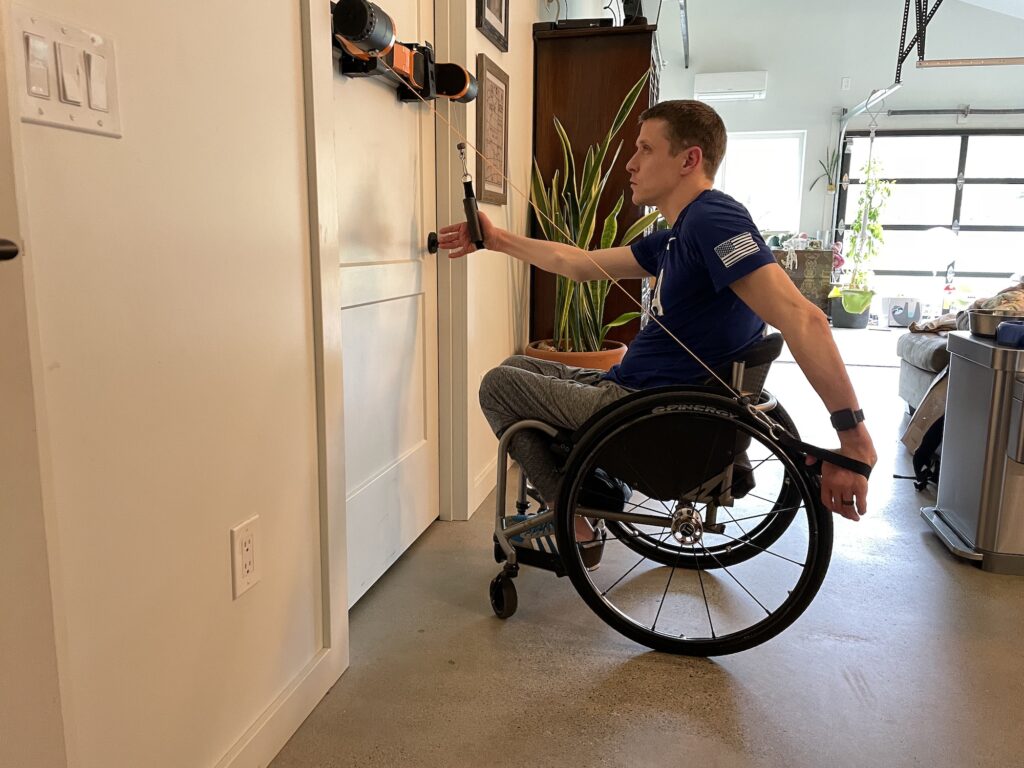
Once upon a time, I used to go to the gym five or six days a week. But then I became a dad — looking at you, Ewan. And then I got a job. Then a pandemic came and my wife, Kelly, gave birth to a second, equally-adorable energy suck — hi, Lou! Now it’s 2022, and I haven’t been inside a gym since 2019.
Between dumbbells, kettle bells, fitness bands, a handcycle trainer and a pull-up bar, I’ve mostly figured out how to get my workouts in at home. But there’s one piece of gym equipment I’ve been missing: a cable machine. I’d looked at home cable machine options, but they all took up huge amounts of space or cost thousands of dollars — or both.
Fortunately, earlier this year, a rep from MAXPRO reached out. MAXPRO makes a fitness machine aimed at the general public that mimics the action of a gym-based cable machine, but in a tiny 10-pound package. I’d seen it online and been intrigued. Most fitness products are crap though, and I wasn’t willing to shell out almost $1,000 for the MAXPRO just to see if it would work for me (the price has since been lowered to $879). When the rep offered to send a unit to review, I was excited.
After two months of testing the MAXPRO, my excitement hasn’t faded. Despite a few quirks, it has quickly become my most versatile and most used piece of fitness equipment.
Setup
The MAXPRO is marketed as a portable machine — their videos have bronzed, muscly bodies working out with the unit attached to trees and park fences — but setting the thing up was difficult enough that I haven’t wanted to change the height of it, let alone take it to the shores of a scenic, alpine lake.

The unit comes with some ratchet straps and plastic mounting plates that let you attach the MAXPRO to a door. I’ll admit that some of my difficulties came about because I did the guy thing and neglected to read the directions before I started. But even after I figured out proper protocol, there was no way I was going to be able to attach it to the door at a functional height on my own. Even with Kelly helping, it was a bear trying to hold the unit at the right height while she fed the straps through the door protectors, positioned them and tightened them down.
I’ll likely invest in their wall track ($318 on maxprofitness.com), which screws into a stud and allows you to slide the unit from floor level to over your head with the push of a button. They also have a foldable bench under which the unit attaches, but I likely wouldn’t use that for much more than chest presses so it doesn’t seem worth the expense or the space.
Workout
Once the MAXPRO was secured on my utility room door, I realized what a unique piece of equipment this is. I started by rolling up facing the unit and locking my brakes. The unit can deliver 5 to 300 pounds of resistance, which you control with two dials that go from 1 to 25. With the dial set on 1, it did feel similar to 5 pounds on a cable machine. I have no way of verifying the upper end of the range, but even performing one of my strongest movements (a high row), I was barely able to budge the handle with the dial set on 20. For most users, it will have plenty of resistance.

I went through one of my standard back workouts — single-arm rows, reverse flys, straight arm pull backs and side pulls — and hot damn, I had the functionality of a cable machine again. The resistance was so easy to adjust that I could do it with a single quad finger.
I’m more than satisfied with the strength workouts I’m getting with the MAXPRO. That’s because building and maintaining balanced strength — including all those antagonist muscles that don’t often get worked during daily life as a wheelchair user — has been one of the keys for keeping my shoulders healthy over 20-plus years with a spinal cord injury. But it can be difficult to get a quality back workout with a home gym setup. No more, thanks to the MAXPRO.
There were a few quirks, though. One is that the cable pull isn’t entirely smooth like a gym machine. This is likely due to the operation of the clutch plates, which provide the resistance. There are ticks in the line as you pull, but they are a mild annoyance and don’t impact functionality. After a few workouts, I stopped noticing. The other thing that takes some getting used to is that the unit only provides resistance as you pull the cable out, not as it retracts. At first this felt a little weird, but I quickly adjusted to it.
MAXPRO Connected
MAXPRO does have smart features that allow you to connect the unit to your smartphone so you can use an app to track and log your workouts, participate in virtual classes and view training videos. I’m not really a connected fitness guy, but for those who are, the app is full-featured and easy to use. Even being a fitness Luddite, I found the feature that automatically tracks reps and resistance to be useful.
There aren’t any adaptive workout videos yet, but I talked with the founder, Nezar Akeel, and he says they are working with a wheelchair user to integrate adaptive fitness coaches and training examples into the app within the year.
Versatility
Once I’d done a strength workout, I started playing around to see what else I could do with the unit. With the resistance lowered, I realized that I could do cardio workouts similar to a row machine or a ski erg that many adaptive athletes use. Or I could do circuits — switching between rows and straight arm pull backs, alternating or not — getting my heart rate up and my chest heaving without having to go out in the nasty weather we’ve been experiencing. I could do a solid cardio routine — and one that targeted my back no less — in the time it took Ewan to watch an episode of Wild Kratts. “Baba, did you know the pileated woodpecker has shock absorbers around its brain?!” “That’s fascinating bud — I’m gonna keep working out.”
For anyone with kids or familiar with the frequent, unexpected disruptions of disability life, starting a workout with minimal hassle, and thus being able to come back to it whenever you have time again, is huge. It means that dad life and all, I actually use the MAXPRO.

I also appreciate the unit’s ability to deliver some more advanced training methods. Plyometric training is often used by athletes who want to increase power and explosiveness. But you have to be careful with plyometrics. If you do a rep fast enough to make the weight jump, it inevitably falls back down, and a momentary lapse of form can easily tweak a muscle or joint. The MAXPRO’s concentric-only resistance means that you can be as explosive as you’d like and you never have worry about the impact of the weight coming back down.
The instantaneous resistance adjustment meant that I was better able to do some of the muscle-building workouts like pyramids that I used to perform back in my athlete days. You can start with a heavy weight and once you reach exhaustion, quickly dial back the resistance, and continue to exhaustion again, and again. I was able to obliterate my triceps, which sometimes is what you need. Sadly, I didn’t have any cans of protein powder on hand to really get the full “bro” experience.
The Takeaway
If you can afford it, buy it.
If you can’t afford it, I get it. Back when I was an athlete, my monthly social security checks were less than the MAXPRO. It’s worth researching grant opportunities, as many organizations provide funding for fitness equipment. MAXPRO also offers financing that works out to around $37 a month for a base unit.
Normally I’d have a hard time recommending a piece of fitness equipment that costs almost $900, but I’ve yet to encounter anything else that offers anywhere near the versatility and functionality of the MAXPRO. If you’re looking to maintain a functional strength and cardio routine as a wheelchair user, you can get by with this single piece of equipment. Plus, it takes up almost no space. That’s hard to beat.
Support New MobilityWait! Before you wander off to other parts of the internet, please consider supporting New Mobility. For more than three decades, New Mobility has published groundbreaking content for active wheelchair users. We share practical advice from wheelchair users across the country, review life-changing technology and demand equity in healthcare, travel and all facets of life. But none of this is cheap, easy or profitable. Your support helps us give wheelchair users the resources to build a fulfilling life. |


If there is no resistance when returning the weight, isn’t that an issue? Part of the workout is the reverse resistance.
With all the issues of the install and the price,, you really belive its worth $1000?
In comparison, you could use planet fitness for over 8 years and they have SCIFIT equipment.
‘Eccentric’ contraction (contraction as the muscle lengthens) is indeed good exercise, but some people claim that it is more likely to cause injuries than ‘concentric’ contraction. I don’t know whether this is true, but in more than fifty years of weight training, my worst injuries have occurred during eccentric contractions. In addition, think of all the olympic lifters who essentially drop the bar after completing a lift (even in training). And we *do* call it weight *lifting*, not weight *lowering*! 🙂
I’ve been looking for a workout machine for a while – it’s really hard to get your heart rate up and keep it up in a wheelchair (Damn, but I miss my bikes!)
I’ve ordered one from Amazon. What app do you use to track fitness? I’m seeing a bunch of them in the Play Store, and most have subscription fees and no special programs for wheelchair users.
I had a really good look through the site and watched the Shark Tank clips. It appears to be a very good machine especially if you have limited space. If I move out of my home to a condo then I would certainly consider this unit. Fortunately I have and use on a daily basis a BowFlex Versa Trainer for wheelchairs. They do not offer them anymore, so as long as I have the space I will keep using it.
An update! My machine arrived, and it’s working really well for me. Thanks for letting us know about this.
My only complaint is that the free app is almost useless and spends most of its time asking you t upgrade to the deluxe app, which bills at a ridiculous $300 a year.