


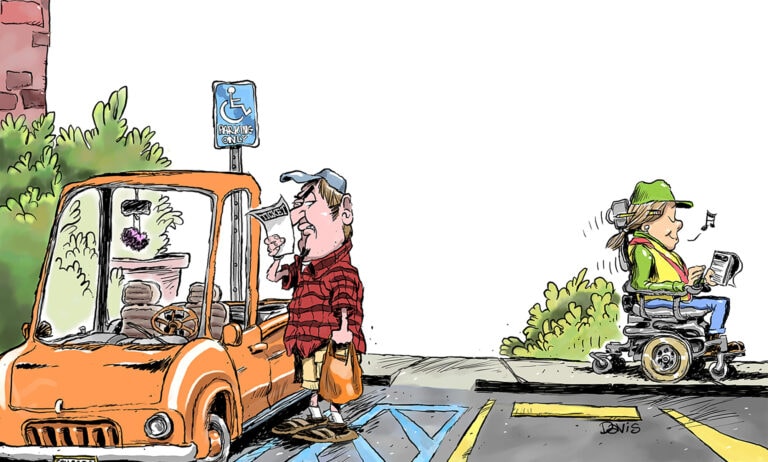
Illustration by Doug Davis
If you polled people with disabilities on what superpower they’d choose, the ability to enforce disability parking would likely be near the top of the list. Eighty-five percent report having problems finding accessible parking, according to the International Parking & Mobility Institute. Sixty-two percent say they’d be more likely to go out if accessible parking were more available.
Telling this to New Mobility readers is preaching to the proverbial choir. But what if you could skip the hassle of calling the police and hoping they show up? What if you could write the ticket yourself? Or snap a few photos on your phone and file a ticket wirelessly? In some cities across the United States, you can.
Houston, Austin, Omaha, Portland, Oregon, and Onondaga County, New York, have volunteer parking enforcement programs that train people with disabilities and their allies to become avengers for access. The parking protectors are people with disabilities, family and friends, seniors, veterans, retired doctors and lawyers and anyone else who knows the importance of access. “They have a passion to want to make those parking slots available for disabled people,” says Chuck Slaney, head of the Portland Police Bureau’s Disabled Parking Enforcement Unit.
Jacob Wacker, a C5 quad from Portland, jumped at the opportunity to volunteer and be a part of the solution. “There are very few situations where someone in a wheelchair can volunteer on the police force to make a difference in something that directly impacts them,” he says.
Parking enforcement volunteers typically have no minimum hours or scheduling requirements. Each city has different rules for where enforcers can give tickets. “We don’t do anything on the streets,” Slaney says. “We have tons of private lots. We fill that gap.”
Maria Irshad, assistant director of ParkHouston, that city’s street parking agency, is thankful for the extra “eyes and boots on the ground.” “There are hundreds of thousands of ADA parking spaces,” she says. “I’ve got 35 [paid ParkHouston] officers. Police do enforce … but they have other priorities that they need to be focused on.”
Richard Armor, 73, is one of 57 fully trained volunteers in Austin’s enforcement unit. Armor has a neuromuscular disorder and is on dialysis, but he checks ADA spots on his daily runs to supermarkets, Walmart or Home Depot. “I do not have a lot of time to do the job as often as I would like to because dialysis takes a lot of time, but I do love doing it,” he says.
“All the people with disabilities that I know who are on the program do find it fulfilling,” says Nancy Crowther, 63, who has participated in ADA parking enforcement since 1993. She checks around Travis County, where Austin is located. “They’re enforcing what should be enforced in the first place, but it’s awesome.”
As a chair user with spinal muscular atrophy, her stake is personal. But she’s a happy warrior, and along with her diligence comes a playfully pointed sense of humor. “I get in trouble, but I say, ‘Look, vengeance is mine,’” she laughs. “Do you know how many times I’ve been cheated out of a parking space because some yahoo has their grandmother’s parking permit placard on the mirror?”
“Having a disability myself and having earned the disabled placard, I certainly find it appalling that people would cheat that much,” she says. “I’m really excited when I find some that have been altered to change the dates on the placards.” It’s fairly common, she says, to find the placard with expiration dates changed from threes to eights, besides all those that are expired, stolen or misused. “I want to help enforce the rules, but I also want to educate the community to let them know it’s not right.”
Ticket Writing Boot Camp
In Austin and Houston, volunteers complete a state-required four-hour training. In Austin, two of those hours are spent in the field with a parking enforcement officer. Volunteers are given a ticket book, reflective safety vest and identification badge, all required when patrolling.
Portland’s training under Slaney is broader, stretching over weeks. In addition to proper filing of citations and photos, there’s a moot court to prepare for testifying. “We want to make sure that not only does the volunteer feel safe, but also the volunteer is understanding what the law is, and they’re able to explain it to the citizens as well as be able to explain it to a judge.”
Founded in 1991 by officers Clyde Harmon and his brother Stanley, who sustained a spinal cord injury in an on-duty shooting, Portland’s Disabled Parking Enforcement Unit varies from 20-35 volunteers, many over 50 years of age, more than half of whom are veterans. Three use wheelchairs.
“Do you know how many times I’ve been cheated out of a parking space because some yahoo has their grandmother’s parking permit placard on the mirror?”
Volunteers submit monthly worksheets recording their time, mileage, spaces checked and citations written. Slaney uses the metrics to identify problem areas and times to tell volunteers about. In January 2020, pre-pandemic, they checked over 9,590 slots and issued 139 warnings. “Our basic job is to educate the public. It’s not to write citations,” Slaney says. “I mean, we will write citations, but we want to educate the public first what the spots are for, right?”
Wacker appreciates the emphasis on education. “There’s a human element to where [the people we ticket] learn these accessible areas are there for a reason,” he says. “A lot of people can’t get out of their vehicles and may end up having to park blocks away. We all have been there, so it’s nice to be able to educate someone face-to-face with a hopeful outcome that they don’t park in a wheelchair accessible spot again.”
Houston’s Disabled Parking Volunteer Program, established in 1995, is one of the largest in the country, training more than 400 people who issue on average 8,000-9,000 tickets a year, each costing drivers $500. Irshad puts active volunteers at 120, many with “a huge personal stake in it,” having disabilities themselves or loved ones who do.
One is Tina Williams, 53, who uses a chair due to transverse myelitis. She’s been volunteering since 2009, and soon she’ll start keeping her ticket book in her bag again for her trips around town, including meetings of the Houston Commission on Disabilities, where she’s a commissioner working on access issues like parking. “Some people just directly go out to write tickets,” she says. “My schedule is too crazy for me to do that.”
In over 10 years of volunteering, Williams says, “I’ve never had negative feedback,” which echoes volunteers in all cities. “Ninety-nine percent positive,” Crowther says. “People understand what we’re doing and why we’re doing it.”
“They just come out of the woodwork all over and say thank you for being out here doing this. I bet you I get 10 a day, and I hear the same from the volunteers,” Slaney says. Often people bring up somebody in their lives affected by the issue. “We’ll get stuff on the phone calls saying, ‘You know, I really appreciate you guys being out there.’ They’re always surprised that we’re volunteers because I think they think we’re getting paid.”
An App for Giving Tickets
Parking Mobility is a free app available on all platforms that guides smartphone users to snap photos and fill out ADA violation reports that are reviewed daily by staff and forwarded to authorities. Mack Marsh, of Austin, Texas, developed the app because he knows that parking access can be a matter of life and death.
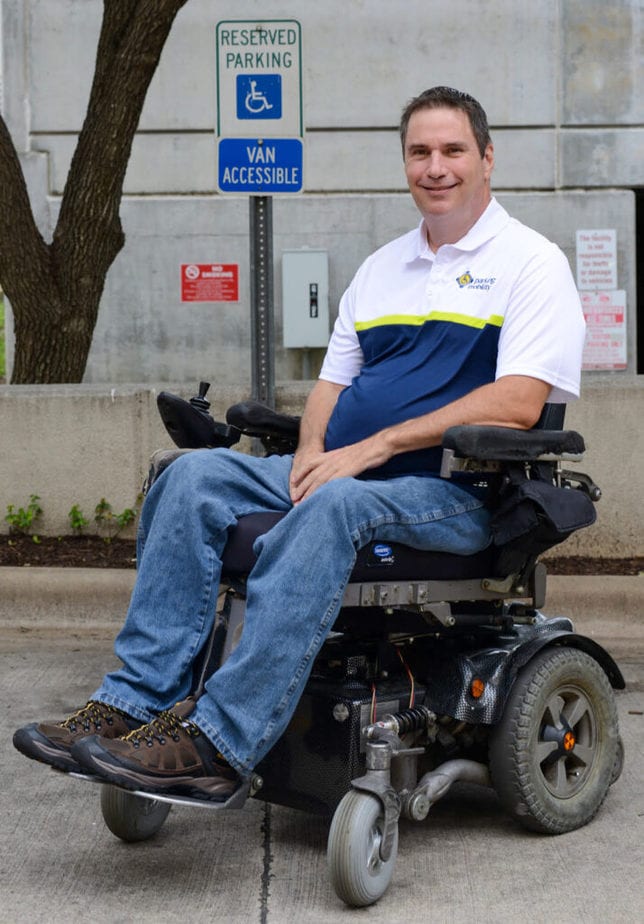
Blocked from entering his parked vehicle after his son’s ballgame, Marsh, 53, passed out from heat stroke. “It was early on after my spinal cord injury, and I didn’t realize that I didn’t sweat, that my body didn’t regulate its temperature,” he says. He and his son were whisked away by ambulance so quickly that “the violator never even knew it happened.” That is why his data-driven app focuses not only on ease-of-use but also education.
Travis County, Texas, and the city of San Marcos, Texas, accept Parking Mobility reports, and Marsh says the model could be expanded to more areas as users generate enough data of local violations. Currently it has over 100,000 users around the globe.
Users can find disability spaces by checking the locations of violation reports, all vetted for accuracy by staff. From a volunteer’s point of view, especially one with limited hand function, a phone-based system eliminates the need to handwrite paper tickets or to reach and place them on vehicles (usually under windshield wipers). “I use a power wheelchair,” he says, “and if I tried to put a ticket on somebody’s windshield I’d scratch their car.”
Parking Mobility is also part of an offender-education program that Marsh helped put in place, offering reduced penalties to offenders if they attend a class about access. It was an educational alternate for prosecutors who were seeing most cases dismissed because judges were reluctant to impose heavy fines. “They didn’t want to punish people, they wanted to change their behavior,” says Marsh. He adds that of 15,000 who have gone through the class, only six have reoffended.
The other advantage is its covert nature, reducing the chance of a confrontation. Marsh says average recording time with photos is 43 seconds. The app’s undercover appeal is a favorite feature of fellow Austin enforcer Nancy Crowther. “People are kind of like, why are they taking a picture of my car?” she says. “Sometimes they ask, and I go, ‘It’s a nice car, yeah, I like it.’”
Parking Mobility is available via Google Play and Apple’s App Store.
Conflict
But in tens of thousands of contacts, rare confrontations have happened. In 2019, two Houston volunteers suffered minor injuries in separate incidents. A car pulling away from one scene made contact with a volunteer, and a Texas woman was indicted for allegedly slapping another.
“Probably less than 1% are just plain not happy they’re getting a citation and say, ‘I’ll see you in court,’” Slaney says. He says he’s never had anybody attacked.
Houston volunteer Williams doesn’t stress about it. “It’s actually done so fast that you’re gone by the time they come out of the store,” she laughs. “I write fast.”
Volunteers are trained to cite unattended vehicles and to walk away from uncomfortable situations. “If you’re gonna ticket someone, don’t talk,” Crowther says, “and if you’re gonna talk, don’t ticket.” But there is another strategy: app-based ticketing (see above).
With America reopening, the parking protectors are getting out there again. “I went out today already. You know, it becomes an automatic thing,” Crowther says. “You just develop the awareness how you’re always kind of looking. … Because I can’t not look.”
Asked why she’s going back to it, Williams hesitates to call the work fulfilling. “I think that the work is needed.” Her voice sets with determination. “I think that it’s important, because it’s not a victimless crime. For me, it’s necessary — it has to be done.”
Support New MobilityWait! Before you wander off to other parts of the internet, please consider supporting New Mobility. For more than three decades, New Mobility has published groundbreaking content for active wheelchair users. We share practical advice from wheelchair users across the country, review life-changing technology and demand equity in healthcare, travel and all facets of life. But none of this is cheap, easy or profitable. Your support helps us give wheelchair users the resources to build a fulfilling life. |


Amazing article, amazing volunteers!! It’s a crying shame this even necessary, but God Bless you all!
Unfortunately, the “Terms & Conditions” associated with the Parking Mobility app leave a lot to be desired. I don’t want to get sued by someone who violated the law and parked in a spot for people with mobility challenges – I am shocked that judges don’t prosecute more people found guilty as the fines increase revenue for their community and discourage further offenses.
Thats because you peeps in wheelchairs are not even en considered in everyone elses daily routine. I watch it all the time. My wife was hung up in her lift at walmart parking lot getting into her truck. No one, not even an employee would help her. Another floppy girl came along in her van at the right time. Stopped and helped my wife. No one even batted an eye. Would have left her hanging in the Az heat.
There are several reasons judges and prosecutors dismiss at a high rate. Chiefly they believe fines are too high and are punitive which doesn’t change behavior.
The T&C in Parking Mobility are a requirement of law enforcement and community partners. We would certainly be happy to discuss the particulars.
I love this! It’s much better than, say, Facebook Shaming, which has little to no effect. I usually take a photo of the offending vehicle anyway, I now have a productive outlet to submit my photos to. This is VERY MUCH NEEDED! Thank you so much for the article and app. The app is downloaded and ready to fire up!
I’m glad this service works for some. I was a peer ombudsman for 8# years in IL, and when I retired and moved to Las Vegas, NV, I signed up for the same job. The state employee who I trained with kept telling me that I knew more than she did! Anyway, I was assigned to a facility and worked there (happily) for two months. Then I got a phone call from a higher-up in the state who told me not to show up for work anymore. When I asked why, she said that the staff (not the residents) said that I made them “uncomfortable.”
This state is not the place to live, especially if you’re handicapped.
When I was younger and fully capable I would NEVER park my car in a designated handicapped space. My parents taught me how to respect others and sympathize with those that have become handicapped through no fault of their own (usually). Be respectful. Do not be a selfish j##k.
To improve education of the public- someone should do Tic Toks. They reach alot of people!