


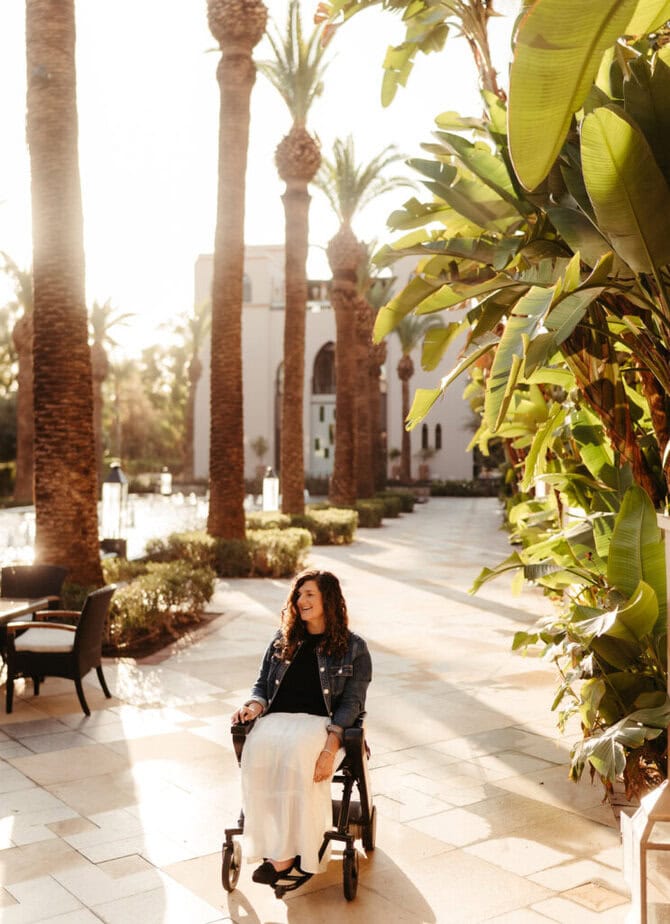
A 10 p.m. reservation at Roscioli in Rome is coveted, and when you’re coming in at that hour with two teenagers, hot off a golf cart tour in a heat wave, patience isn’t flowing freely. We rolled up and immediately took in the scene. A big stone step. A tight entrance. Tables packed shoulder to shoulder, with waiters turning sideways to squeeze through. I quietly braced myself.
As a wheelchair user, this is the moment I brace for. When it feels hard and I’m tired, I want to give up before I even start. Before asking anyone to meet me halfway, I often decide it’s easier not to ask at all.
As I approached the host and began to say that we had a reservation and would leave, he was already in motion. He smiled, waved us forward, and before I could finish my sentence he made clear there was no universe where we weren’t getting to our table. Without hesitation, he began moving shelves and diners out of the way, carving a narrow path through the restaurant so my chair could get through. All of this happened before he even paused to lift the large Grit wheelchair up the step and into the dining room.
It was late. There was commotion. But there was no fear. No annoyance. No tension.
Instead, we were met with warmth. Immediate offers of wine. Appetizers. A patient walk-through of the entire forty-page menu of Italian specialties. No one rushed us. No one apologized. No one made it feel like a problem to be solved.
I remember thinking: this is the way accessibility should be.
It isn’t about having the perfect entrance. It’s about finding a way to make it work when someone arrives. The world is inherently imperfect. It is never perfectly built for everyone. I don’t mind when it isn’t built for me, especially when people are willing to lean in and make space where there was none before.
That night changed how my body felt in the world. I relaxed. I laughed. I ate. I wasn’t an inconvenience or a liability. I was a guest.
To understand why that moment mattered so much, you have to know who I was just a few years earlier.
A Pandemic Casualty
My journey with limb-girdle muscular dystrophy started in 1998, but my life-altering moment came during the April Covid surge of 2020. I was rushing to get multi-layer cookie bars out of the oven while my elementary-school-aged kids avoided online school. The rug (the one that shouldn’t have been there but was) slipped beneath me. My knees buckled. I sank, unable to support myself on legs that had been slowly weakening for years.
After a weekend of pain and uncertainty, I finally got an appointment with my orthopedic doctor. I’d broken one foot and one ankle. An air cast on one side. A boot on the other. And, by some grace, an MCL that might heal on its own.
I came home raw, defeated, and suddenly unsure of a lifelong belief I had passionately carried. Maybe the faith I had in my body’s ability to heal was wrong.
For me, devastation began with Covid’s homebound isolation, not from the virus itself. The conditions surrounding the pandemic — prolonged isolation, reduced movement and social distancing — accelerated my decline. A fall ended my mobility, and months of sitting introduced new challenges I never expected. Covid didn’t just change my world. It took my independence.
After that, I could no longer leave the house alone. Even when I could bear weight again, I was terrified of falling. And with that fear came darker thoughts about who I had become. Divorced. Self-employed. Alone. A full-time wheelchair user. Unable to go out without help. Gaining weight, no matter what I tried. This version of me felt far from the life I had once imagined.
What scared me most wasn’t my body breaking. It was my life shrinking.
I’ve lived with this neuromuscular condition since I was nineteen. When I was first diagnosed, just before a Dave Matthews concert, I was indignant. With the confidence of a college co-ed, I looked a room full of neurologists in the eye and told them they had until I was 40 to cure me.
The Internal War
For years, I lived as if I could outrun what was coming. I hid my illness. I recalibrated constantly. I managed stairs, chairs, desks, and long days by pushing harder. I wasn’t ashamed. I was afraid that if people knew, they would limit me.
What I couldn’t admit then was that I was the one limiting myself.
The real war wasn’t physical. It was internal.
When I transitioned to life using a wheelchair, that internal war gained a new front. I did what I thought was responsible. I fought for wheelchair coverage. I fought a terrible insurance system. I fought an entrenched network that seemed designed to exhaust already broken people into giving up.
Getting a chair dragged on for more than a year and drained me emotionally in ways my illness never had. I had lived through real trauma before, but this bureaucratic grind nearly broke me.
An industry leader at an independent living center finally said to me, “I hear your fire. But fighting insurance and policy will kill you. Use your fire. Just find a different source.”
I didn’t know what that meant. I only knew I was deeply exhausted enough to know he was right.
Living, Not Fixing
Embracing adaptive skiing helped me start to see a way forward. I went because I missed moving through space without fear. I missed speed. I missed winter activities with friends and kids. I missed cold air on my face and the feeling that winter could bring momentum instead of stuck in the house dread.
Sitting in a sit-ski, I realized how long it had been since my body felt free. I wasn’t calculating stairs or scanning the ground for risk. I wasn’t planning an exit. I was just moving. Laughing. Letting my nervous system remember something it hadn’t felt in years. That day didn’t fix anything. But it reminded me that joy was still available (in fact, it might be better than standard skiing, truly), and that mattered more than I understood at the time.
Travel widened that opening forward.
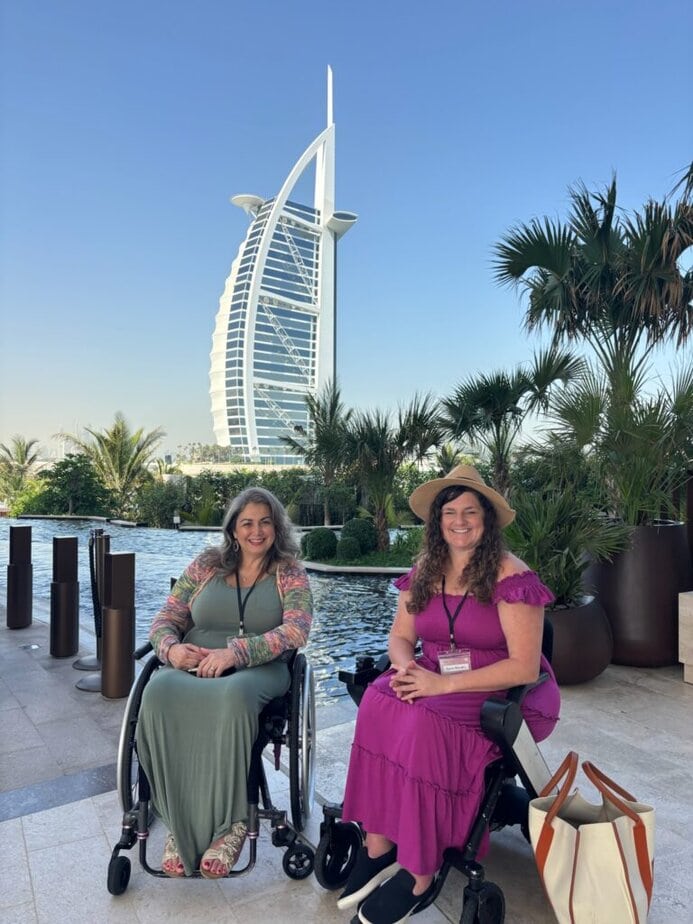
The first trips terrified me. Airports. Hotels. Being seen in a chair. I worried about being a problem, about slowing things down, about the looks that sometimes come when you don’t fit the expected definition of a wheelchair user.
Instead, I was met with something quieter. Ease.
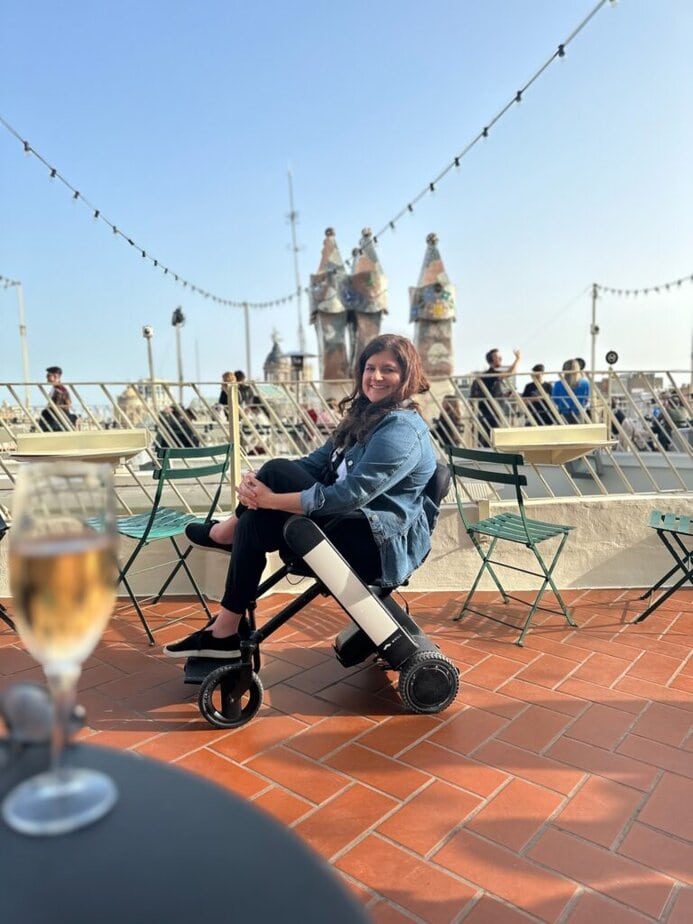
I was traveling again. The Bahamas. France. Rome.
The greatest gift travel gave me was a shift in where I placed my energy. For so long, my focus had been on fixing my body, on forcing it back into compliance, on waiting for healing to arrive before life could continue. Traveling asked something different of me. It invited me to live inside the moment as it was.
Instead of praying for this to go away or bracing myself against the medical system, I poured my energy into joy, curiosity, and new experiences. When I stopped fighting both the system and my own body, I felt lighter rather than drained. That was new. And it changed everything.
I have not healed my body, but I have strengthened my relationship with it. As I began opening doors to accessible travel for others, my body stopped being my enemy or my project. I am learning to live well with reality rather than fight against it.
That, too, is a real kind of healing. Not a full reset, but a genuine shift. When I no longer felt trapped in daily survival mode, I could finally relax. Life began to feel radically different, even without my diagnosis disappearing.
I learned it was okay to grieve the earlier fantasy. It had served its purpose. And I found a way to heal that did not require waiting for a cure to start living. That path is not smaller. In many ways, it is harder and more durable.
A Fresh Start in a Start Up
It was around the time I was spending all my energy on creating memories, that I heard about Fora Travel. They were a startup travel agency, wanting to bring more entrepreneurial travel agents into an industry that was dying. They had a vision of helping those of us who have been unpaid travel planners our whole life, become paid ones. I had a vague idea that someday, with enough sales, I may be able to impact the industry. What I didn’t expect was that this nimble startup would make that happen so quickly.
In a few weeks of joining, the founding team heard my story and my passion for accessibility. They opened doors for a small group of us to train the team and then, together, we started building tools to help all of our agents be as inclusive as possible.
Fora was small then. Curious. Unafraid of conversations other companies avoided. It felt like a place where opportunities were pushed forward instead of brushed aside. And in just under two years, we quietly showed the market that accessibility matters: delivering $75M in sales to our mainstream suppliers in 2025 alone. With positive stories and market momentum, big brands are listening, leaning into the conversation that is about hospitality, not compliance.
We were going to market in a new way, not by lecturing, but by sharing the stories that demonstrate how little changes can go such a long way. And by reframing the conversation to building loyal fans, and backing it up with the market data, the travel industry is listening differently.
Sometimes it was small, like a beach club owner quietly buying a beach wheelchair so I could get closer to the water, or a valet parking attendant waving the parking fee without being asked. Sometimes it was simply kind. A rooftop hotel restaurant offered to comp dinner because the roof was inaccessible, then bringing the entire taco pop-up downstairs so we could be part of it anyway.
When I visited Amilla in the Maldives — widely praised for accessibility — I proved once again that better infrastructure is not the only magic. Here on the island it was not the buildings that welcomed, it was the spirit of hospitality.
Beyond the sling that gets you on and off a seaplane or the one bungalow with threshold ramps, what mattered was training, attitude, and willingness. A butler told me she preferred working with accessible guests because they were more grateful and more fun.
That stayed with me.
That’s what builds an accessible universe. Not perfection. Not designing everything for everyone at all times. But the willingness to go a little further because you care. And to find work arounds when you can.
By then, I could see the pattern clearly.
Reframing the Conversation on Access
In life, when accessibility is framed as compliance, conversations stall. When I began to see it framed as hospitality, hotels suddenly and proactively leaned in. They called. They asked for training. They wanted to be included — not because they were forced, but because they wanted to participate in something they could already see had potential. It’s not as scary to make changes when you make the happier ending clear and the starting step easy enough to follow.
When the focus stays only on what is broken, systems get defensive because they are overwhelmed. Nothing moves not because of lack of care, but out of systemic overwhelm.
I recognized that pattern immediately because I had lived it myself.
For a long time, I thought my inability to start a morning workout routine was a discipline problem. I beat myself up for it. What I eventually realized was that the system was overwhelmed. I was starting every day by opening my email, stepping straight into urgency and noise. By the time I considered movement, my nervous system was already feeling behind, and I certainly wasn’t going to start a new habit on an already packed day of other people’s needs.
When I changed one thing — no email or phone before 9 a.m. — the morning opened. Exercise became a welcome option when it wasn’t being proposed in the chaos of daily work chaos.
I’m not saying fixing complex systems is simple. I am saying that sometimes adding one workable element creates flow where force never could.
I saw the same thing in a Massachusetts Commission on Disability meeting, where pain and overwhelm filled the room. Momentum didn’t come from naming everything that was wrong. It came when each group identified one doable action and people leaned in to help to the only thing that actually felt clear.
What I eventually realized was that my focus on healing has always been a doorway, not a destination.
I wasn’t discovering how to fix my body. I was discovering how change actually happens.
I didn’t find peace by fighting harder. Things shifted when I added more space to allow something better back in.
When I stopped trying to subtract disability from my life and started finding possibility alongside it, everything changed.
I don’t know what this body will do next. But I know it can only regenerate from balance, openness, and care. Spending my days helping others expand their worlds, stamp their passports and create memories that go beyond limitations feels less like a career shift and more like the discovery I was always moving toward.
And today I am at peace with knowing that perhaps this body was just a tool to get me to open doors for more travelers worldwide. And that was the healing I always searched for.
Karen Morales is a travel entrepreneur and accessibility advocate working at the intersection of hospitality and inclusion. She helps mainstream travel brands integrate accessibility as a growth strategy rather than a compliance obligation.
To find out more about Fora, visit foratravel.com.
Support New MobilityWait! Before you wander off to other parts of the internet, please consider supporting New Mobility. For more than three decades, New Mobility has published groundbreaking content for active wheelchair users. We share practical advice from wheelchair users across the country, review life-changing technology and demand equity in healthcare, travel and all facets of life. But none of this is cheap, easy or profitable. Your support helps us give wheelchair users the resources to build a fulfilling life. |