



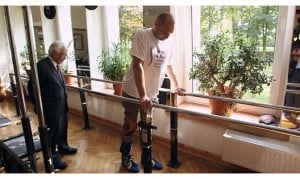
In 2010 Darek Fidyka, a man from Poland who was 36 at the time, was attacked and stabbed repeatedly with a knife, which partially cut his spinal cord and left him a paraplegic. Two years after his injury he underwent an experimental therapy transplanting olfactory ensheathing cells (OECs) — stem cells that form the sense of smell — to his spinal cord, and he has since recovered some function.
According to a BBC News Health article, the surgery was followed up by two years of extensive physical therapy — five hours per day, five days a week. Three months after the surgery Fidyka first noticed a change. According to the BBC article, “his left thigh began putting on muscle.” Six months after the surgery he was able to ambulate, using leg braces, parallel bars and the support of a therapist. He is now able to ambulate using a walker and has regained some bladder and bowel sensation as well as some sexual function.
The procedure consisted of two operations led by Dr. Pawel Tabakow from Wroclaw Medical University. In the first operation, a type of brain surgery, one of Fidyka’s olfactory bulbs was removed and used to produce additional OECs. In the second surgery four strips of nerve tissue taken from Fidyka’s ankle were placed across an 8 millimeter gap in the spinal cord, and 100 micro injections of OECs were made above and below the damaged area of the spinal cord.
Although the scientists involved are excited by the results, they emphasize that this is just one person, and the success will need to be repeated to show definitively whether it really does stimulate spinal cord regeneration. Their next step is to try the treatment in another 10 people with spinal cord injury in Poland and Britain.
Support New MobilityWait! Before you wander off to other parts of the internet, please consider supporting New Mobility. For more than three decades, New Mobility has published groundbreaking content for active wheelchair users. We share practical advice from wheelchair users across the country, review life-changing technology and demand equity in healthcare, travel and all facets of life. But none of this is cheap, easy or profitable. Your support helps us give wheelchair users the resources to build a fulfilling life. |


Recent Comments
Dick Crumb on Adapting Recreation To An Aging Body
Karen on The Everlasting Saratoga Cycle
Ted Kilroy on Handcycle Gear Guide