



On a sunny afternoon the steady wind, with help from large following seas, pushed the GPS knot indicator to 5 knots, a good speed for the small cruising sailboat and a welcome reprieve from the barrage of storms. During the past two months the voyage had been a challenge for Kristi Grotting Hruzewicz and her husband, Alex — auxiliary engine problems, conditions ranging from becalmed to gale force winds, huge seas. They were wet, cold, exhausted, and at times seasick. But for Hruzewicz, a T4 complete para, this was the first leg of a dream come true — exploring the world by sailboat.
“There were times when I thought, ‘What am I doing here? I’m never doing this again!’ But overcoming adversity is what makes for a real adventure,” recalls Hruzewicz, now 40.
How she came to love affordable adventure is a story in itself.
Although nobody in Hruzewicz’s family sailed, her parents instilled in her a love of adventure and the outdoors and how to incorporate it into a modest lifestyle. She grew up in Morgan Hill, Calif., at the southern end of the Silicon Valley. Her dad became a volunteer ski patrolman at Bear Valley 170 miles to the east, so Hruzewicz and her siblings could get ski passes for a dollar. Every weekend in the winter the family would make the four-hour drive to the mountains to ski.
“Growing up I loved skiing, and later, snowboarding,” says Hruzewicz. “Then in my early teens I read The Cruise of the Snark, by Jack London, and it kindled the dream of exploring the world on a sailboat.” It remained a dream while she attended college.
In 1995, at age 20, she injured her spinal cord as a passenger in a motorcycle crash. After rehab at Craig Hospital in Denver, she quickly returned to outdoor adventure — from riding and racing downhill mountain chairs and volunteer guiding at riding clinics to promote the sport, to organizing adaptive sports festivals on a limited budget. She also found time to earn her bachelor’s in English literature.

Hruzewicz started volunteering at adaptive sports programs in trade for learning sports she was interested in, which eventually became paying gigs — winter sports in Crested Butte working at the Adaptive Sports Center; summers in Berkeley, Calif., working at the Bay Area Outreach and Recreation Program, where she started a handcycling program. Volunteering at Environmental Travel Companions in San Francisco, she learned how to sea kayak, then became a volunteer guide on several sea kayak trips on the Sea of Cortez in Baja, Mexico.
In 2006 Hruzewicz went back to school for a year to study graphic design. On free weekends she volunteered for the Bay Area Association of Disabled Sailors in San Francisco — an adaptive sailing program — and finally fulfilled her dream of learning to sail. “I quickly got hooked and decided that one day I would purchase a sailboat and explore the world.”
Falling in Love, Casting Off
At BAADS she met Alex Hruzewicz, a volunteer who had extensive sailing and cruising knowledge, and they started dating. “It’s an age-old story — I fell in love with a sailor,” says Kristi. Like Alice falling down the rabbit hole, the relationship fast-forwarded her plans to buy a boat. She worked on improving her sailing skills and downsizing her life — in order to sail to warmer latitudes.
The couple started looking at used boats that fit a small budget. In late 2008 Hruzewicz purchased a 27-year-old Contessa 26 for $12,000. Although small, the design is known for seaworthiness. She spent another $4,000 in upgrades to get the boat ready for cruising. By comparison, average cruising boats in the mid-30 to 40-foot range sell used for $50,000 to well over $100,000. They christened her “Fjordmus” — meaning Fjord Mouse in Norwegian, Hruzewicz’s heritage.
The couple devoted their time to outfitting the boat for cruising. Alex’s father had recently returned from 10 years of cruising and generously donated a great deal of gear. They scoured Craigslist and sale bins for used or discounted gear to outfit the rest of the boat within their means.
A big challenge for wheelchair users on a cruising boat is getting from the cockpit to the living quarters below — often a 4-foot-drop or more that can require a powered lift. To solve this problem they fashioned a raised floor throughout the cabin and covered it with cushions so there was only a one-foot difference from cockpit to cabin. This also left storage space below. For skin protection in the cockpit Hruzewicz sat on her Supracor wheelchair cushion.
The couple wed in the spring of 2009. The voyage, scheduled for a fall departure, would be an extended honeymoon.
Early Thanksgiving morning during a small weather window between storms, they cast their dock lines and sailed out of San Francisco Bay and headed south. “It was exciting and emotional when we sailed under the Golden Gate, knowing we were really on our way,” says Hruzewicz.
Their plan was to harbor hop down the coast. “In hindsight it was a crazy time to leave because winter is storm season, and it turned out to be a big storm year,” she says. They made their first anchorage at Half Moon Bay late that afternoon, which started a comedy of errors over the next several days — a small fire in the cockpit while cooking, the auxiliary engine wouldn’t start, and the marine head started leaking stinky human waste into the bottom of the boat. Within a couple days they had the head repaired, boat cleaned up and the engine running — although sporadically.
The Sailing Adventure
Over the next two months they worked their way down the Pacific Coast. “We would sail to a harbor, then get pinned down by storms and wait until the next weather window,” says Hruzewicz. At some harbors they would drop anchor and at others, because they were BAADS members with reciprocal yacht club privileges, they could tie up at a slip and use the facilities at luxurious yacht clubs. “One of my biggest struggles onboard the boat — before getting to warmer waters — was getting enough exercise to keep my back muscles strong. A yacht club had a pool and hot tub so I could get a week of swim training,” she says.
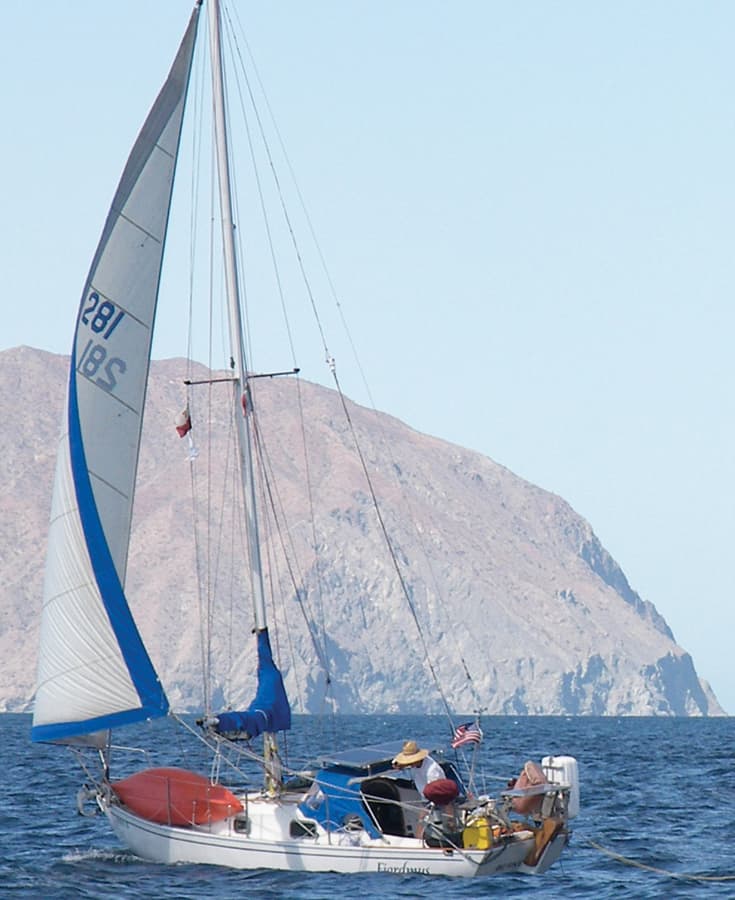
They sailed passages that ranged from a day to a week in conditions that went from idyllic to severe, including a four-day passage out of San Diego where they got slammed by heavy seas and gale force winds. “I would get seasick here and there, but this storm made it so bad that Alex had to take the helm for almost three days. But he was loving it, at times surfing the boat down huge waves.”
The couple knew the trip would be challenging, but sailing down the coast was the toughest as they sorted out problems with the engine, storage in small places, cold nights and seasickness. By the time they made harbor in Cabo San Lucas — at the tip of the Baja Peninsula and the entrance to tropical waters of the Sea of Cortez — they were exhausted, set anchor and fell fast asleep. A short time later they were awakened by a boater shouting there was a tsunami warning. They headed back out to sea for about eight hours until it passed.
When they finally re-set anchor, they paddled to shore. “When I got into my chair on dry land after being on the boat for two weeks,” says Hruzewicz, “I felt ‘land-sick’ — as if my chair was on a floating dock, undulating back and forth.”
Leaving Cabo they sailed into the gentle winds and warm clear waters of the Sea of Cortez, working their way up the peninsula, day sailing to beautiful anchorages at small islands and idyllic secluded bays with white sandy beaches. “This was the honeymoon cruise we had been looking forward to,” says Hruzewicz. Entertainment and sense of time was measured by the tides, sun and stars. “We would enjoy every sunrise and sunset, and the night sky, with no light pollution, was amazing.”
At night the ocean took on an other-worldly form as bioluminescence — light created by millions of living organisms in the water — created underwater light shows. Passing a paddle or hand through the water left bright green trails. A passing seal became a green comet. “My favorite was small schools of fish that would congregate under the boat and leave light trails.”
Another form of entertainment was the wildlife — egrets, herons, pelicans and osprey above, while sea lions, dolphins and whales with their babies were common companions in the water. “On one leg we were accompanied by jumping manta rays,” says Hruzewicz. “We call them firecrackers, since at night you can’t see them but you hear the loud slap when they hit the water.”
The couple got their water from an onboard electric desalination system. They would stock up on fish and fresh vegetables at remote fishing villages. “Being at sea makes you appreciate the little things — fresh fruit and vegetables are a delicious luxury. At sea I could get excited about the juice from a can of peaches or pineapple.”
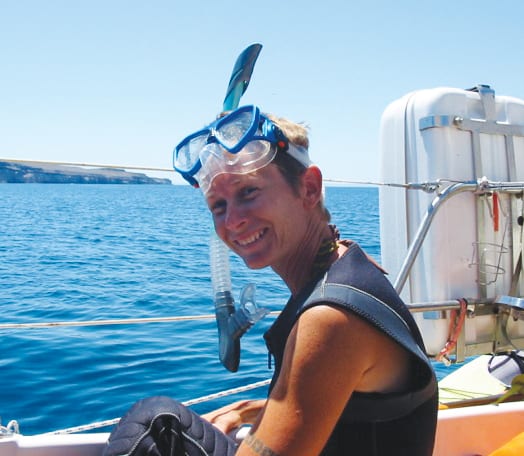
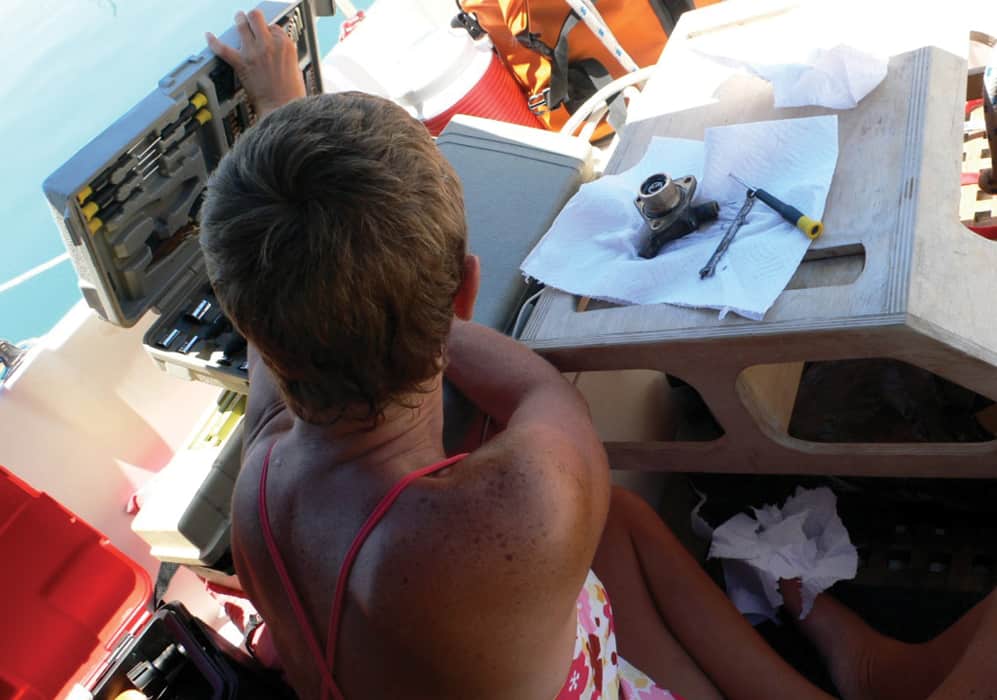
Non-sailing days started with a few hours of boat maintenance — scrubbing, cleaning and rebuilding. Afternoons were spent swimming, snorkeling, paddling and exploring. “On one of my swims I saw a huge shark fin about 100 feet away,” says Hruzewicz. “I swam to the boat as fast as I could, hoping the shark wouldn’t eat my legs while I was trying to climb aboard.” Fortunately it turned out to be a whale shark — beautiful, harmless filter feeders. Alex quickly donned a snorkel and swam with it.
The Unexpected Adventure
About five months into the cruise Hruzewicz started getting increasingly worse leg spasms. “I was on the boat and out of my chair for weeks at a time, and I would sit crosslegged, which is comfortable and stable, but it didn’t help me know whether I was tilting to one side the way sitting in a chair does.” She had always had a slight scoliosis. When she finally got to shore, she kept thinking something was wrong with her cushion because she was tilted to one side. “I learned sitting in my chair every day was a reminder to work muscles to keep straight. I thought the leg spasms were due to sitting crosslegged too much and not stretching.”
In June, 2010, seven months into their cruise, the couple made a 300-mile crossing to Guaymas, Mexico, put the boat in dry-dock for hurricane season and flew back to their home in Santa Rosa, Calif. Their plan was to return to the boat in late fall and cross the Pacific to Asia.

In Santa Rosa Hruzewicz visited her doctor. An MRI showed a large syrinx on her cord, and X-rays revealed her scoliosis had gotten worse. Her leg spasms had gotten so bad that her legs wouldn’t stay straight. She could no longer sit in her handcycle and had to strap her legs into her chair.
Their sailing departure was put on hold while Hruzewicz consulted with doctors. Then came a surprise that put syrinx surgery and the voyage to Asia on hold — Hruzewicz was pregnant — something the couple had tried unsuccessfully to achieve for two years prior to the trip.
Her pregnancy went smoothly, despite adding 50 pounds to her usually petite 93-pound frame. It also came with an unexpected benefit. The pregnancy produced a hormone that reduced her spasms to almost nil — a natural side effect that remains to this day.
In August 2011, Hruzewicz gave birth — six weeks early — to a healthy 5.5-pound boy named Luca. Hruzewicz credits the sailing adventure as providing training for her first few months of motherhood, where sleep deprivation and getting up to feed and change an infant every few hours is the norm.
However, the voyage had provided another challenge the couple hadn’t anticipated. Being on a small boat — often sleep-deprived yet having to be ready to deal with an emergency — is sometimes more of a pressure cooker than a relaxing vacation. It can bring relationship issues to a boil. Raising a child is even more intense, says Hruzewicz. Sadly, the couple found they had irreconcilable differences and filed for a divorce a short time after Luca was born. Now they are raising him as co-parents.
These days Hruzewicz is a freelance graphic designer, working on her masters in English literature. Fjordmus was trailered home and back in her slip in the Berkeley Marina. Luca is now 3, has already been sailing and kayaking, and in January Hruzewicz and her dad took him cross-country skiing.
“All the adventures I’ve done before Luca were fun, but also selfish,” she says. “My adventure now is being selfless and providing Luca a stable environment, and at the same time passing down the family tradition of love of the outdoors and an appreciation of this amazing world we live in.
“It is by far my most rewarding and challenging adventure.”
Resources
• Crested Butte Adaptive Sports Center: www.adaptivesports.org
• Bay Area Outreach and Recreational Program: www.borp.org
• Bay Area Association of Disabled Sailors: www.baads.org
• Syrinx and Pain: www.newmobility.com/2011/01/paramedic-syrinx-and-pain/
Support New MobilityWait! Before you wander off to other parts of the internet, please consider supporting New Mobility. For more than three decades, New Mobility has published groundbreaking content for active wheelchair users. We share practical advice from wheelchair users across the country, review life-changing technology and demand equity in healthcare, travel and all facets of life. But none of this is cheap, easy or profitable. Your support helps us give wheelchair users the resources to build a fulfilling life. |


Recent Comments
Dick Crumb on Adapting Recreation To An Aging Body
Karen on The Everlasting Saratoga Cycle
Ted Kilroy on Handcycle Gear Guide