



Director Sharon Greytak Brings Disability Perspective to New Film
Photos courtesy of Sharon Greytak
Sharon Greytak’s latest film, Archaeology of a Woman, starts out with a scene that’s painfully familiar in so many of our families. Maggie, an older woman, wanders a mall parking lot searching for her car, but cannot find it. The sun beats down. A security officer asks if she’d like help, but she declines. Later she accepts, saying she cannot find her keys. The officer asks which car is hers and she looks out on the sea of automobiles and says, oh, one of those. Hours pass, the sun has gone down, they drive her home, where she discovers her car has been in her driveway the whole time.
Kate, Maggie’s adult daughter, is called and is pulled away from the bed of her lover to go home and help mom, much to her chagrin. She’s a busy person — a chef who’s done so well that she’s on the cusp of opening her own upscale restaurant.
Stop.
This is where similar movies veer into Hallmark Channel territory: It becomes a heartwarming tale of how the selfish, professional daughter overcomes her desire for career and freedom and gives it all up to care for her sweet, dear old mother who has dementia. She discovers that living her life for someone else is just the best reward ever.
It could have been a movie like this. But then, it wouldn’t be a Sharon Greytak film.
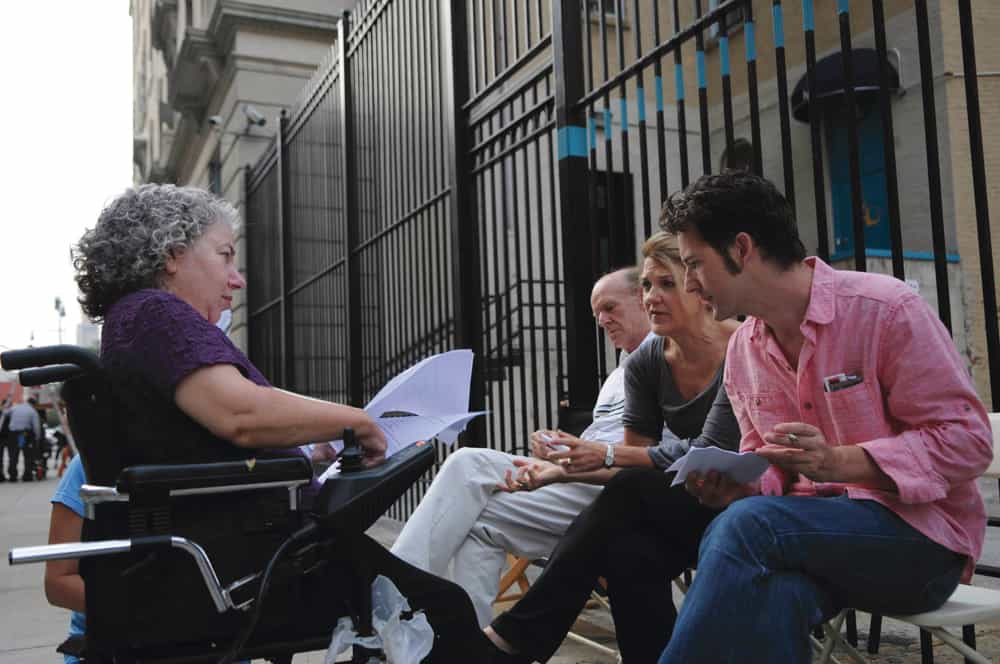 Greytak, unlike most film directors, has a physical disability — rheumatoid arthritis — and has used a wheelchair since she was 15. Also, her own mom has dementia. So, she says, there was no way she was going to write and direct a sappy movie portraying a person with a disability — dementia — as being two-dimensional.
“People think of people with dementia as being really out of it, fragile, with this terrible tragic disease,” says Greytak, who is also a professor at School of Visual Arts in Manhattan MPS Live Action Master Program. “But I was interested in the type of character who is still functioning OK, then there are these incidents that happen, but you still have a very full person original to their character that they’ve been all their life.”
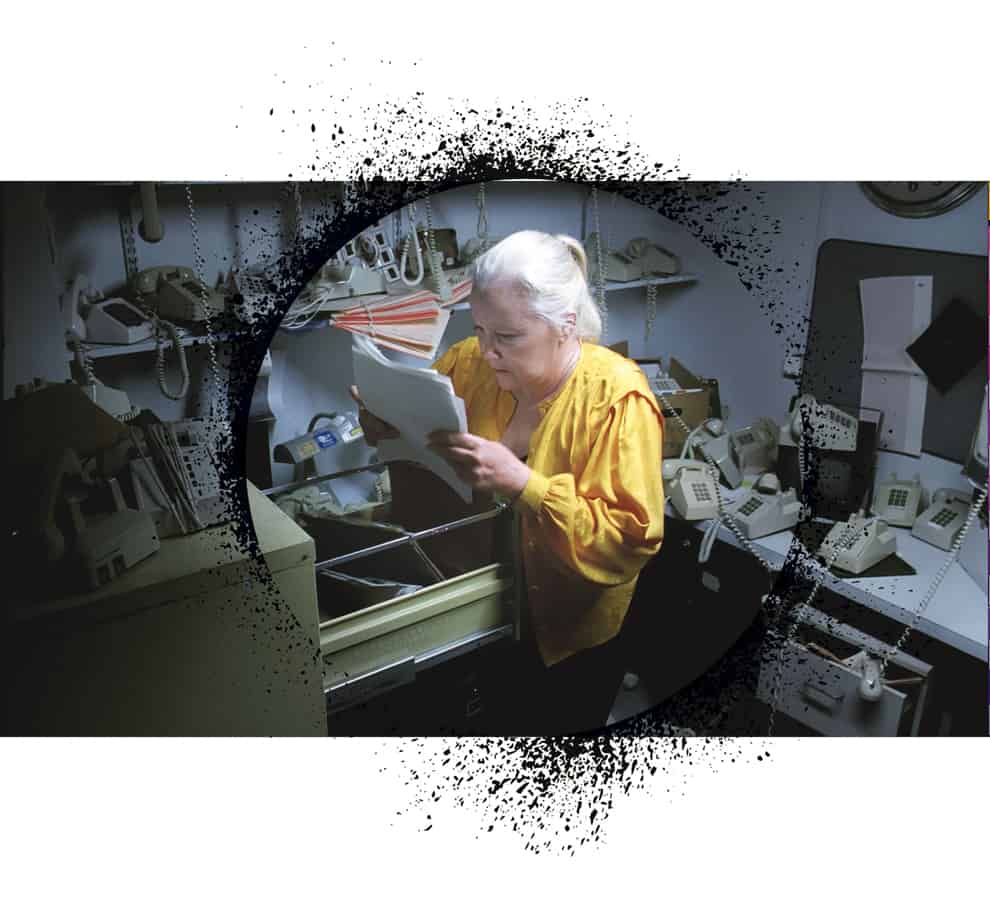
Maggie, played by Oscar nominee and Golden Globe winner Sally Kirkland, is fierce, obstinate, sexy and brilliant in her moments of lucidity. She dresses well, is well-coiffed in public, and speaks with a patrician accent. We learn that she may have been involved in a crime 30 years earlier that has its roots in lust and longing, a story that may be real or imagined.
There are harrowing scenes of the woman desperately excavating her past while still trying to protect her secrets at, it is insinuated, any cost. She is not a sweet little old lady. And the movie insists on keeping the viewer off-kilter for many of the scenes with Maggie. We are put inside her mind, we are experiencing the world as she does, and it’s confusing, we don’t know what’s really happening, it whirls, and the scenes with her daughter, Kate, come as a relief.
It is more comfortable to identify with the younger Kate, an up-and-coming chef in her 40s played by Tony-winner Victoria Clark — after all, each of us is someone’s adult child. We know what it’s like to worry about our aging parents and yet struggle to maintain our current lifestyle.

And what a life Kate has! Men begging to be with her, tables of jubilant diners excited to meet the chef, all bright lights and big city. Having to leave all of that and come back to her mother’s rambling house to deal with dementia is not a sacrifice Kate is willing to make — although she does allow concessions. She goes with her mom to doctor’s appointments and gets her into an elder day care program at a senior center. She comes home more. She secretly installs a camera in her mom’s house, so she can monitor her and know she’s safe.
And then she goes back home. “Kate’s the reluctant daughter,” says Greytak. “You feel like there’s mother-daughter strain for some reason, but she comes back, does what she needs to do, tries to get her situated. Then she’s out of there. I don’t think we’ve seen a daughter like that in film. I pulled a layer off of that relationship.”
It’s an angle to the aging mother-adult daughter relationship that viewers are hungry for, says Gretytak. “Every time this film shows somewhere, people come up to me and tell me private stories. This film elicits this every time, every person wants to tell me something — so I think that’s very valuable as a filmmaker.”
That scene where Kate takes her mom to a dementia support group starts as the funniest and ends as one of the most powerful in the movie. Maggie, a retired reporter, knows everyone’s dirty secrets and voices them out loud to the others in the group, who cringe as she maliciously and gleefully waves their dirty laundry in the air. The social worker tries to get her to stop, which elicits this passionate monologue that is punctuated with clenched fists: “I am desperate to recall details!” Maggie says, insistently and angrily, “for pieces that fit together easily like they used to … real pieces. Ugly. Dirty. Rotten. I don’t care!”
“You have to stop,” says the social worker, in an effort to protect the other group participants.
“Ha!” exclaims Maggie.
Who says disabled people like Maggie should be portrayed as weak and compliant? Certainly not Greytak.
 “I’m sure my disability is informing me,” she says. “Margaret is not a victim in this movie. It’s tragic what’s happening to her, but she’s belligerent, fights like hell, selfish. A writer/director who hasn’t experienced disability firsthand, they’re looking as an outsider. My film is a disjunctive narrative, there are times where it is uncomfortable. You don’t know if she did something or not, but you have a sensation of what it might feel to be in the mind of Margaret. So there are places in the film where I give that to the audience. You can’t do that the whole time, it’d be a mess. But that’s something I made sure I stayed honestly true to. I didn’t want them thinking ‘oh this poor woman.’”
The Wheelchair Factor
Greytak is aware there are not many directors or filmmakers with visible physical disabilities. Putting our heads together we came up with only a handful: Greytak, Jenni Gold, Jason DaSilva and Ben Lewin. She recognizes the difficulties of being a woman who uses a wheelchair in a mostly male, nondisabled field, but says her disability gives her an edge in some ways.
For starters, living with a disability taught her to just do what she wants to do, rather than wait around for someone to encourage her.
“I was on a panel recently about diversity in this industry, and I said to the audience, really, I don’t ask for permission to do what I want to do. If I had waited around for a spark to go off and someone to say, ‘You should direct,’ I’d still be waiting. Really, who in the industry would look at me and give me a job as a director if I didn’t just take it and do it myself?”
Perhaps, she told the audience, her attitude has nothing to do with having a disability, but rather is simply in keeping with the indie film community — “We don’t wait, we just do.” Or it’s American — “I travel and people in other nations say the idea of having little money but getting a camera and pulling a crew of friends together to make your film is so American,” she says.
 “Perhaps I just got lucky and jumped into that stream at the right time, but it mirrors what one with a visible disability has to do,” Greytak told them. “Don’t wait for permission or for someone to give you a chance. Jump in. People will start to notice what you’re doing, it can snowball after that. But you have to do it yourself, start it yourself, because your life will go by before times change, before society changes.”
You could hear a pin drop when she said this to the audience. But it’s real. “Who in the industry would give me my first job, really? I’m petite, I’m female and use a wheelchair. Who is going to put a budget and entire film project in my hands before I proved myself? My ideas drive what I need to do,” she says.
Also, who she is and how she lives — wheelchair included — play a part.
“If I look at topics I’m interested in and don’t see that character being portrayed, it drives me to say the way I know life is not out there. I’m not seeing it.” So she makes a film about it. “That’s worth doing this work and it’s a long process. That’s worth getting my vision out there to have that kind of discussion in the mix.”
The critics agree. The Independent named Greytak one of 10 filmmakers to watch in 2014. Archaeology of a Woman was awarded two Gold Remi awards at the 45th WorldFest-Houston International Film Festival, including Outstanding Independent Film and Lifetime Achievement for Sally Kirkland, who portrayed Maggie. It was honored with a CINE Golden Eagle Award, and was also an Official Selection of the Woodstock Film Festival as well.
Archaeology of a Woman opened on Sept. 12 at Village East Cinema in New York City, the Los Angeles theatrical release will be announced soon, and plans for digital distribution are in the works. Follow the film on Facebook to receive updates.
Support New MobilityWait! Before you wander off to other parts of the internet, please consider supporting New Mobility. For more than three decades, New Mobility has published groundbreaking content for active wheelchair users. We share practical advice from wheelchair users across the country, review life-changing technology and demand equity in healthcare, travel and all facets of life. But none of this is cheap, easy or profitable. Your support helps us give wheelchair users the resources to build a fulfilling life. |


Recent Comments
Dick Crumb on Adapting Recreation To An Aging Body
Karen on The Everlasting Saratoga Cycle
Ted Kilroy on Handcycle Gear Guide