



So Far, So Good!
The Saga of a Broken Neck, and the Good Life that Can Follow
by Lee D. Goldstein
Untreed Reads ebook (2013), print (2015), 199 pages.
Available at store.untreedreads.com, or anywhere ebooks and print books are sold.
Reviewed by Tim Gilmer
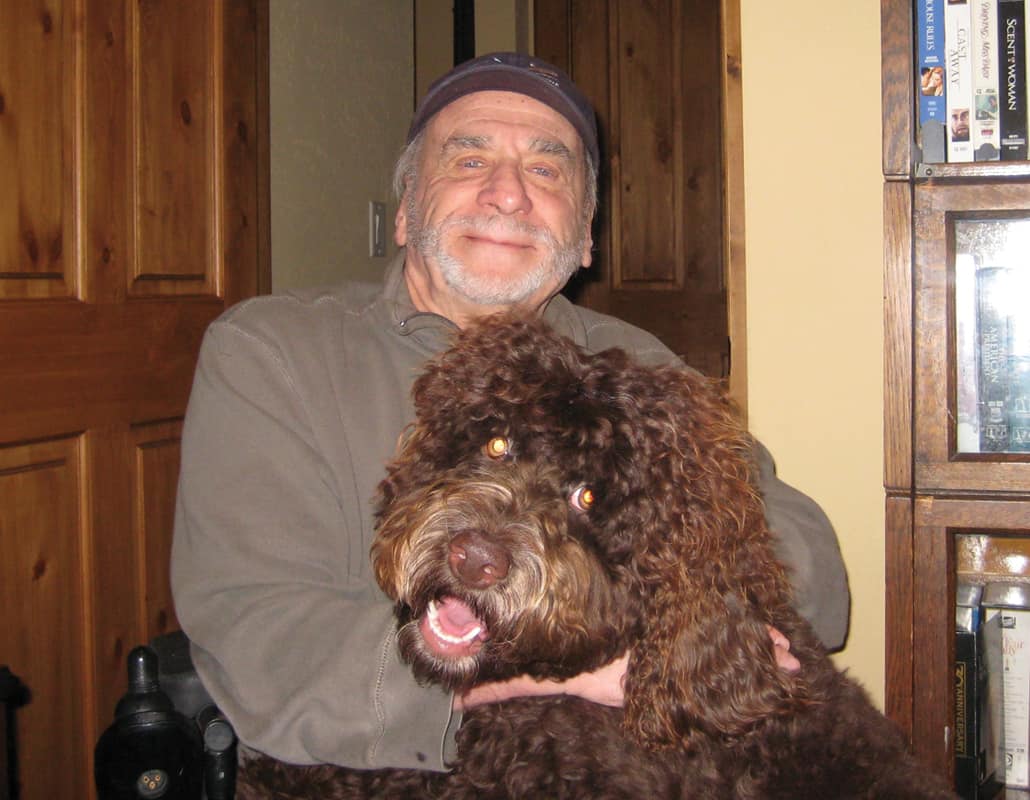
The subtitle of this book is “The Saga of a Broken Neck, and the Good Life that Can Follow” — an apt description of a well-written, focused autobiography of a (now) 82-year-old quad who was injured in the 1940s and is living a truly remarkable life.
Lee Goldstein first contacted NEW MOBILITY several months ago, pitching his book on the claim that the Guinness Book of World Records now recognizes him as the oldest living quadriplegic. Putting my natural skepticism aside (who’s keeping records?), I started reading, and from the first page I knew I was in the hands of a skilled writer and engaging storyteller, someone who had distilled valuable lessons, useful information, and uplifting humor from a life rich in relationships, crises and successes.
In his introduction, Goldstein praises his family for their dedication and support from the day he was injured in a diving accident at the age of 14. At the time, treatment and rehab of SCI was in its infancy, and quads were likely to die within a year from injury: “They
[his family] made my recovery an achievable goal in my eyes, and carefully constructed the recovery to be an enjoyable journey. … And because they broke the tasks into these palpable, achievable segments, the whole picture of eventual recovery became simplified and visible, rather than complex and unattainable. I will always cherish and hold as a model of family cohesiveness the example established for me by the Goldsteins that summer of 1946 and all the years to follow.”The author credits his father, Moe, with conducting and orchestrating “this unfinished work,” referring to his life, not the book. It was Moe who found the best SCI doctor in the nation at the close of WWII to take his son as a patient. With optimum medical care and a supportive family, Lee could not have gotten a better start in adjusting to his new body. Dr. Loyal Davis was the head of rehabilitation at the gargantuan Hines VA Hospital in Chicago, the chair and president of the American College of Surgeons and a founder of both the American Board of Surgery and the American Board of Neurosurgery.
Davis’ greatest asset was his wealth of experience dealing with many hundreds of returning war veterans with SCI. Under Davis’ stern direction, young Goldstein, a teenage civilian, received the latest and most effective treatments for nearly seven months. And while the specific protocols and equipment seem primitive by our current standards, the underlying principles were sound and worth remembering. By the time Goldstein was discharged to the family’s three-story home in Winnetka, an affluent village on the north shore of Lake Michigan about 15 miles north of Chicago, he was well on his way to recovery, although still weak and understandably inexperienced.
His parents’ financial position helped greatly. His dad arranged for his hospital physical therapist, Helen Steinour, a demanding but beautiful and motivating taskmaster, to come to his home daily for PT. The plan was to build his upper body strength to its maximum potential. At first he had to be carried from floor to floor, but soon his father hired people to widen doorways, put in an elevator, install air conditioning in his bedroom (overheating is every quad’s enemy), and turn the better part of an entire floor into a gym-like space with a billiard table for recreation.
Functionally, Goldstein’s level of injury was C5-6, but taking into consideration various clues and descriptions in the book, it seems the injury was incomplete in some ways. His legs were paralyzed, but in time he actually gained the ability to stand and shuffle a few steps with braces and crutches. That was never useful in the practical world; a manual wheelchair became his only efficient way of getting around. He may have had some sparing that allowed him to develop some stomach muscles, but his grip was weak and his fingers ineffectual. Regardless of his injury level, he became a high-functioning quad.
He returned to high school and did well, but he carried his greatest embarrassment with him: a urinal that he wedged between his legs and kept covered with a towel. To modern paras and quads, this would be a nightmare, especially for a teenager, but it was the best that SCI urologists had to offer at the time. Despite having to adjust day by day, he made good grades, graduated, and was accepted to UCLA, mainly on the strength of his school’s superlative national reputation. True to his propitious beginnings, in his first year on campus he met two men who established a new gym and encouraged him to continue building his upper body strength.
Now on his own, his attention turned to girls. The tales of his dating and eventual relationships, his learning to live independently, first with an attendant, then alone, are rich with humor and insight and lead the reader to a new era in his life, where marriage, business acumen, and stories of building a family become the focus rather than his challenges as a quadriplegic. His first marriage — to a remarkable woman whose love for children (they raised many foster and adopted children) was as strong as his desire to provide the best for his family — lasted 26 years. Their union was a shared model of willpower, devotion, and creative enterprise, but it eventually ended in a crisis that is certain to elicit strong emotion in the reader.
Then came loneliness and learning hard lessons. Here the author, who had been successful by any standard, faces his own personal shortcomings and mistakes, but never becomes maudlin or morose. He keeps his grace, his style, his sense of humor, and after many years of living alone or with the wrong woman, he finds the right one, again.
The story concludes with his marriage and second life with Ellen, another remarkable woman whose competency and devotion to her husband is matched by his growing love of her and gratefulness for the unique life he has led. After dual total shoulder replacement, Goldstein gets his first power chair, and the couple stays busy with their many homes and real estate venture-businesses, eventually landing in Prescott, Ariz., where they now reside.
So Far, So Good! is worth reading for the story itself. But it is also packed with useful information for quads and paras and others who must face the daily annoyances and major obstacles of disability — hopefully like Lee Goldstein has — with grace, good will and humor.
EXCERPTS
Small Victories
Now that I could transfer, Helen’s next priority [as his physical therapist] was to help me escape from the capricious whims of my own bowel system.
Up until then, my bowel tract filled up, and when it was good and full, it simply emptied itself, any time, anywhere — at dinner, at a party, or quite often in bed, during the night. Usually it happened at the most inopportune and embarrassing times. When the bowel was full, peristalsis was triggered, and the bowel emptied. Period. The big question was, how to prevent bowels from overfilling and emptying in this uncontrolled manner.
 Again, Helen had answers. First, before I start this story, you must remember that Helen was beautiful to look at. She had the movie star looks of a combined Elizabeth Taylor and Claudette Colbert. Everyone thought so. She had an engaging laugh that made all work seem like play. She was bosomy and shapely and would throw her head back and laugh when we had trouble performing some exercise together. It was difficult, yet exciting to be wrestling this lovely, lively, educated, insightful woman on a mat or bed four or five times a week as she stretched my limbs and pushed her legs or even her body against mine. Of course I had a crush on her. What robust young teen wouldn’t? So imagine my surprise and embarrassment when she decided we were going to work on bowel movements together!
It must be said that it was as though Helen knew by some inner gift exactly how to handle any needed therapy, even if she hadn’t done it before. Up until that point, my bowel movements were hit or miss — mostly miss. I yelled for the bedpan whenever I heard or felt one coming. I had only just learned to sense the onset of a bowel movement by the pins-and-needles flush in my upper body. This flush of the skin, sometimes producing goose bumps, is called a “sympathetic reaction.” Para/quads learn to make excellent use of it to sense many conditions of their lower body. However, whether it is bowels, urination, or pain — each produces its own level of pins-and-needles flush, and I hadn’t learned the difference. So usually I messed my pants or the bed, wherever I happened to be.
Now this lovely goddess-therapist asked me to sit on a toilet and experiment with her to purposefully initiate a bowel movement. We went into the bathroom, and she assisted me in making the transfer to the toilet for the first time. There I sat, totally nude, trying to look mature and cool, desperately attempting to keep my balance by pushing my hands on the toilet seat to prevent myself from falling left or right or forward. I stared into the beautiful Helen’s face as she kneeled down and spread my buttocks on the seat so that my rectum wasn’t encumbered or blocked.
I’ll be honest: I didn’t think that this would work. Aside from my profound, terminal embarrassment at the situation, I didn’t believe you could randomly sit on a toilet, with no ability to have feelings of bowel urgency, and expect a bowel movement to magically appear. Helen rocked me from side to side as she separated my buttocks on the seat. Then, as I sat there watching this amazing happening and trying desperately not to fall off the toilet, she firmly stroked my lower abdomen in the direction she said the bowel tract takes toward the rectum. In an instant, I produced a large bowel movement: my first into a toilet since my accident! It was the beginning of freedom from the embarrassment and disgrace of uncontrolled bowels.
I didn’t know whether to laugh or cry or kiss Helen for this newest miracle she created. Instead, we both hollered for my mother to come in and witness the triumph. I forgot I was nude on a toilet with Liz Taylor squatting between my knees. My flabbergasted mother kissed Helen. Then we all linked arms and laughed and realized that another major milestone in my rehabilitation had just taken place. It was a celebration in a bathroom with a nude young boy on a toilet and two crying adult women, with the proof of the miracle still floating in the bowl.
*****
Small World
Maria Finaldo entered my life [at UCLA] and also produced a mystery — the mystery of everyone’s “Isn’t it a small world!” story. Each day Maria walked to school from her apartment nearby. She crossed Gayley Avenue and passed my parked car before walking across the grassy acres that surrounded the school itself. Many days we smiled hello as I got into my car on the way to classes.
Maria was a beautiful, Italian girl with a dark complexion, who walked with grace even though she often carried a huge satchel of books. Her long black hair came almost to her waist.
She had doe eyes that somehow were soft and yet vibrant and flashing. One day she stopped to talk as I pulled my wheelchair into the car. I offered her a ride to campus. Thereafter she frequently knocked on the door of my apartment, and we drove together to the school buildings.
I had a special parking permit that allowed me to park anywhere on campus. It got us to school early, and we began to have coffee together on a campus patio. We started to date and became “steadies” for more than a year.
One of our excursions was to Palm Springs, about three hours away from campus, where we stayed for a long weekend. In those times it was considered unusual and risque for two unmarried people to vacation together, so of course I signed the register as The Goldsteins. We didn’t want anyone we knew to learn about such a trip. The beautiful hotel we chose had a huge pool and a view of the gorgeous mountains around Palm Springs. Maria sunned in her very brief bikini, and I read in the shade of an umbrella table.
A heavy-set man joined me at my umbrella the second morning. He was wearing shorts and a Hawaiian shirt, so I thought he was another hotel guest. He talked for a long time to both of us, and then bought us a round of fruit drinks.
“Where are you from?” he asked.
“I’m from the Chicago area,” I said.
“Does your father own a business there?”
“Yes.”
“Where?”
“West Adams Street, number 312.”
“312 West Adams Street?” he shouted. “Is your father Moe Goldstein?”
I was astounded. “Yes!” I answered. “How did you know that?”
To my amazement he said, “I recognize that address. It’s the same as mine. I have a business upstairs from your father’s. In fact, I’m having lunch with him tomorrow. I own this hotel, and I fly back and forth weekly.”
A week later I received a very normal letter from my dad about how his business was, how our neighbor Mr. Rohan’s infected leg was doing, and how hot it was in Winnetka. The usual things. There was a P.S. It read, simply, “By the way, I hope you and Mrs. Goldstein had a nice time in Palm Springs.”
Support New MobilityWait! Before you wander off to other parts of the internet, please consider supporting New Mobility. For more than three decades, New Mobility has published groundbreaking content for active wheelchair users. We share practical advice from wheelchair users across the country, review life-changing technology and demand equity in healthcare, travel and all facets of life. But none of this is cheap, easy or profitable. Your support helps us give wheelchair users the resources to build a fulfilling life. |


Recent Comments
Dick Crumb on Adapting Recreation To An Aging Body
Karen on The Everlasting Saratoga Cycle
Ted Kilroy on Handcycle Gear Guide