


Testing the Strutt ev¹: A Glimpse into the Future of Power Wheelchairs
December 16, 2025
Seth McBride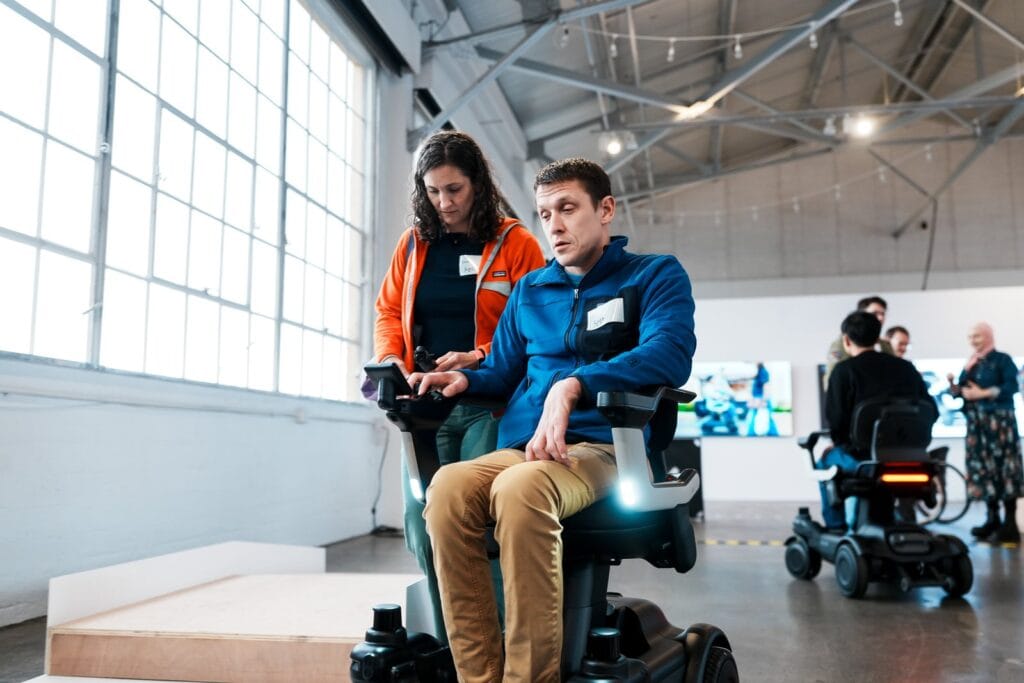
I was a bit skeptical of the Strutt ev¹ when I first heard about it in a press email announcing “a Tesla-level innovation in personal mobility.” I’m all for innovation, but smart wheelchairs have been talked about for decades, and recent advancements in power wheelchairs usually feature similarly soaring language with few true changes in user experience.
My skepticism was two-fold. One: Would a company with no prior experience in the personal mobility space be able to build a wheelchair that functions well for full-time wheelchair users? Two: Would “advanced sensor systems” and semi-autonomous drive technology be useful for someone looking to navigate their world independently, or would they make you feel like a passenger in a robotaxi — along for the ride but with little say in how you get from A to B?
I took a trip to “Strutt Day” in San Francisco to find out.
The Important Part of “Semi-Autonomous”
It didn’t take long for our taxi driver to illustrate my concerns about autonomous wheelchair systems. My wife and I were on the way to our hotel, and the streets of downtown San Francisco were flush with Waymos, Google’s autonomous vehicles. Our driver clearly wasn’t happy with them, and not just because they were out to steal his job.
We watched a white sedan with no one inside zip across three lanes of heavy traffic, accelerate into a gap, then cross back again. “They are always changing lanes!” our driver exclaimed. “Left, right, left, right. They don’t stop. They just turn on the signal and go. What can you do? Nothing. You can’t honk at them, ‘cause there isn’t anyone in there!”
Maybe I’m as old-school as the taxi driver, but I worried that the Strutt ev¹ would face similar issues. As a wheelchair user, I don’t want to passively ride along to my destination. I want to have a say in how I get there. The Waymos were like an aggressive cousin to the Whill autonomous wheelchairs I’d seen elderly people riding in at some airports. Every time someone walked in front of the chair, the Whill would stop, wait for the obstruction to clear, then keep going. If the obstruction didn’t clear, they kept waiting. No thanks.
So this was my headspace as I entered the warehouse building where the Strutt team was unveiling the ev¹. But as I rolled inside, it was immediately apparent that this chair had learned some things. A couple of driverless ev¹s rolled laps around the space as a few dozen people milled about. The ev¹ s didn’t stop when someone walked in front of them. They subtly course-corrected, went around the person, and kept going.
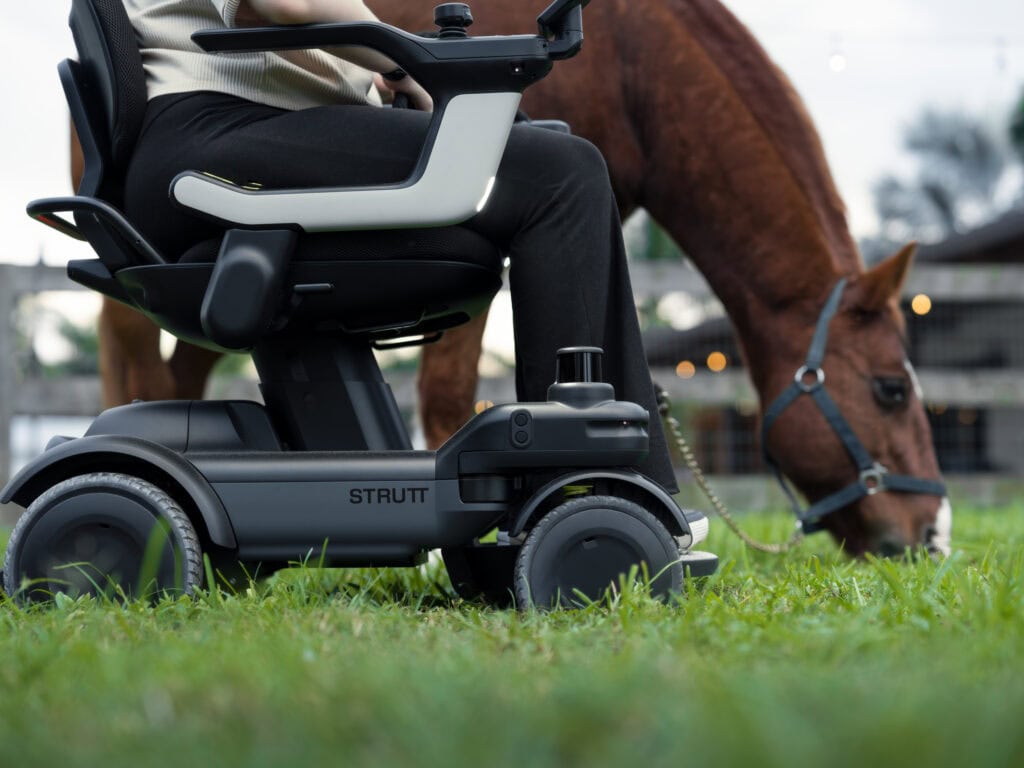
The chairs certainly looked smart. They are all curving lines and hidden systems, like you would expect a sleek consumer product to look, rather than the rods and wires aesthetic common among power wheelchairs. You can break the ev¹ into three pieces for transport, and the lithium iron phosphate battery is easily removable.
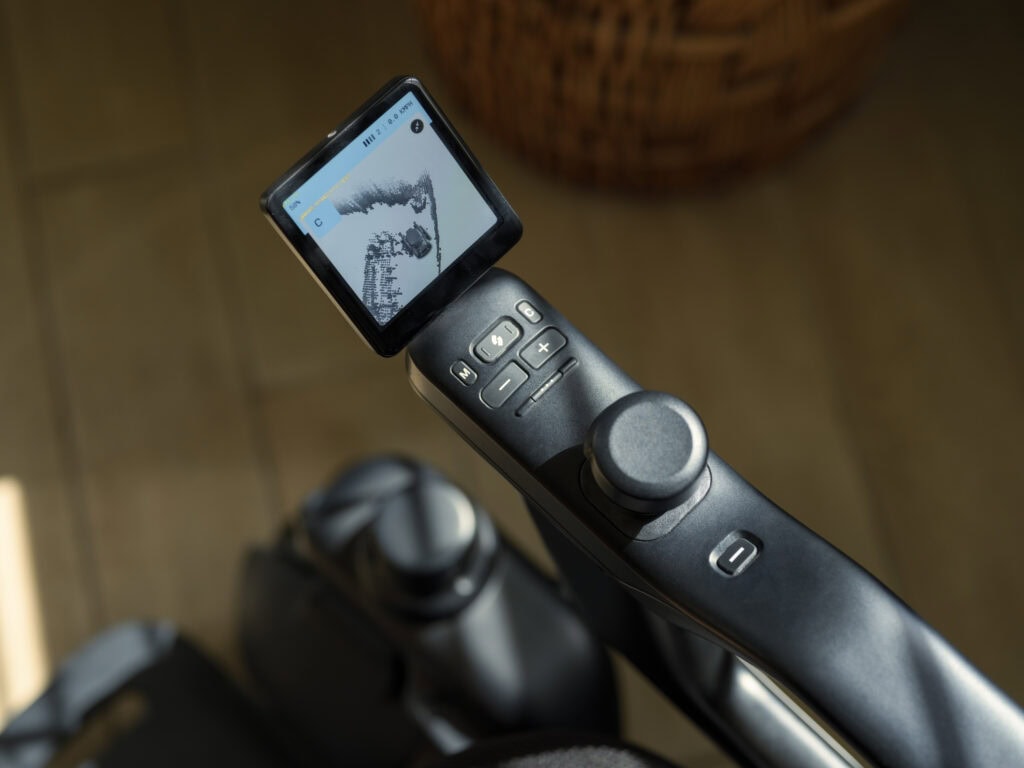
The seamless exterior hides an array of tech: LiDAR, ultrasonic, light-based and camera-based sensors all combine to create a continuously updating 3D map of the world around the chair. A display above the joystick lets you see that map, which looks like a more basic version of the maps you see on Tesla, or other advanced EV, displays.
Over the course of the event, I learned that the ev¹ has three drive modes. The least assistive means you have near-full control of the chair, but the sensors won’t let you run into anything (or anyone) or drive off a curb or other drop-off.
The next level up lets the wheelchair route-find for you. You press the joystick forward or back and it will find the best route to continue in that direction. Imagine sitting near a door in a cramped room, but not exactly in line with the door. You hit reverse and the chair turns and shimmies and backs you into the next room, no paint scraped or door trim damaged.
In the third assistance mode, you touch a location on the display map, and the wheelchair navigates to it with no joystick input required. A video showed the founder, Tony Hong, setting waypoints inside his house and then operating the chair via voice control: “Let’s go to the fridge.” “Take me to the couch.”
Strutt’s head of design, Barney Mason, told me the name nods to both the structural strength of a support beam and the confident gait with which the team hopes their technology allows users to move through the world. Or, as Hong put it, “Personal mobility isn’t just about transportation — it’s about confidence, independence, and joy.”
Sounds great, but I still didn’t know if the ev¹ operated as smoothly as the videos made it seem, or how confidence-inspiring it would be for a quad.
Testing, Testing
The Strutt team had set up an obstacle course inside the warehouse: a ramp to a platform with a curb, a curving plywood path with a significant sideslope, a curved barricade you were to navigate blindfolded, a series of small speed bumps.
Transferring into the chair was easy. It sits low, like a travel power chair, and one armrest lifts up to offer a clear path to the seat. The demo chairs were outfitted with simple foam cushions, but you can use whatever works best for you. The backrest is basic and not super supportive for full-time power chair users with higher-level injuries. But the team assured me they had a modification on the way that would allow the chair to be fitted with any 3rd-party backrest for those with more complex positioning needs.
I hit the joystick forward toward the curving side slope, which was at enough of an angle that I’d have trouble navigating it in my manual wheelchair. The ev¹ handled it easily, wheels gripping, steering consistent, not trying to dive toward the bottom of the ramp. I simply steered around the curve. The same thing happened with the curb drop: I tried to drive over the edge, and the chair came to an easy stop a couple inches from the ledge.
Next, I tried the mode where you tap the screen to navigate. I hit a corner of the map where the next obstacle — the series of speed bumps — began, and the ev¹ navigated around chairs and people, depositing me right where I’d asked it to. I clicked it back into joystick mode and the ev¹ traversed the speed bumps smoothly. Next up, the blindfolded curve.
To enter the driving mode where you hit the joystick forward or backward and the ev¹ does the route-finding itself, you have to hold a button on the front of the joystick. With my limited finger function, I had to use two hands to hit the button and operate the joystick, which was awkward. Once I got it rolling, the chair handled the curve easily, but the button situation made me wonder if that mode would really be helpful for me, or how the chair would do for anyone who needed alternative controls.
I spotted Hong milling around, so I rolled over and asked him if the controls could be adjusted so you could do a double-tap to enter route-finding mode instead of having to hold the button. “Absolutely,” he said. “It’s already something we’ve thought about. Holding the button might be the most intuitive for most users, but for anyone with grip problems, a secondary control option would make more sense. That’s a simple software update.”
His response made me think of advanced electric vehicles. The Tesla or Rivian you buy today can receive updates and performance improvements without you ever having to take it back to the dealer. As Hong put it, “We hope our users can benefit from a product that keeps getting smarter over time, without needing new hardware.”
The launch version of the ev¹ may be more geared toward higher-functioning powerchair users — people with multiple sclerosis, semi-ambulatory users, those with age-related weaknesses, or lower quads and paras who need power in certain situations, or because of pain, overuse or strength limitations. But the ev¹’s update capabilities mean that the base hardware is highly adaptable to different types of controls. The chair already has some voice-control capabilities, and the team has experimented with controlling the chair with Apple’s Vision Pro headset. Mason told me that adding the option to control the ev¹ with a sip-n-puff or other, existing switch-based controls is not an issue.
For me as a low quad, the test was cool, but it turned out to be an anti-climax. That’s a good thing. The systems all worked as they were designed to. The chair felt smooth and powerful, thanks to quad motors that provide significantly more torque than most power wheelchairs. I tried to run the ev¹ into people, other chairs, and walls, and it simply eased around them, like the path it took was the one I had intended all along.
Like the update capabilities, the ev¹ feels akin to a modern smart vehicle. The driver-assist systems were integrated and well-designed, blending into the background. I felt in control within the parameters that it wasn’t going to let me do anything stupid. Is that a good thing? Depends on who you are. I sometimes enjoy doing stupid stuff in my manual wheelchair, and I know there are power chair users who feel the same way. But there’s no doubt that, like with automotive vehicles, intelligent driving systems are the future for power wheelchairs. Strutt’s ev¹ moves those systems forward.
And About That Future
So, when can you buy an ev¹, and how much will it cost?
The Strutt ev¹ is now available for preorder. Go to Strutt’s website, hit the “Join Community” option to join their Facebook group and get access to the preorder list. Strutt hasn’t yet released the price of the ev¹, but the team says it will be comparable to other options on the market. Actual pricing will be available when the ev¹ officially launches in early January.
I was impressed after hearing about the Strutt’s design and technology. I was more impressed after testing the ev¹ myself. It’s not a power wheelchair that will work for those who need advanced seating features like tilt and recline. But for what it is — essentially a super advanced travel chair — it’s an incredibly useful, well-designed piece of technology.
Subscribe to our YouTube channel to be notified of an upcoming video review of the Strutt ev¹.
Support New MobilityWait! Before you wander off to other parts of the internet, please consider supporting New Mobility. For more than three decades, New Mobility has published groundbreaking content for active wheelchair users. We share practical advice from wheelchair users across the country, review life-changing technology and demand equity in healthcare, travel and all facets of life. But none of this is cheap, easy or profitable. Your support helps us give wheelchair users the resources to build a fulfilling life. |


What I am really looking forward to is a power chair that can “home” itself onto a lift of some sort so I can drive a regular car instead of a rampvan. Now we’re talking!
What is the heaviest of the 3 parts that come apart for travel? Can you lift them separately into the trunk of a car? Does it have lithium batteries and are they easy to remove when flying?
What is the availability of programming software for the USER to make changes and adjustments? If you can’t control it, you don’t own it!
I am all in for the future but a wheelchair that doesn’t have any assisted mode is not for me. Think of wanting to drive off a curb or small step on purpose. Not possible?
There is a manual mode that would allow that.
What is weight limit