


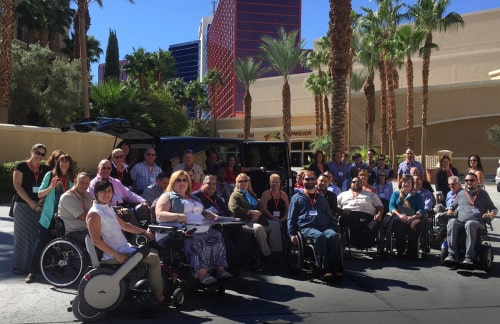
Chapter Leadership Meeting: Leaving Las Vegas
What happens in Las Vegas is usually supposed to stay in Las Vegas, but when United Spinal held its annual Chapter Leadership Meeting there Oct. 22-24, the goal was exactly the opposite. With 53 leaders and representatives from 33 different states and numerous chapters on hand, the goal for the three-day gathering was to share as much information as possible about what different chapters are doing, and take that knowledge back to the represented communities and use it to improve the way the chapters run and how they affect quality of life for people with spinal cord injuries and disorders.

United Spinal chapters are independent organizations that share the goals of United Spinal Association and support them within a specified geographical region. Chapters support the SCI/D community by promoting health and well-being, fostering inclusion and independence, organizing local events and projects, advocating for rights and accessibility, and offering information and resources to their chapter communities.
“The National Chapter Leadership Meeting offers United Spinal’s key staff and chapter representatives the opportunity to collaborate on future initiatives to enhance our organization’s mission,” said James Weisman, United Spinal’s president and CEO. “We are fortunate to have so many dedicated people who utilize each other’s skills and talents to support what we do.”

The meeting kicked off with an evening welcoming reception outdoors under the neon lights of the Rio Hotel and Casino. Attendees got a chance to mingle with staff and sponsors over drinks and heavy appetizers before the following day’s intense schedule of discussions and presentations. The meeting wrapped up Saturday morning with more discussion and planning for the future.
Topics highlighted at this year’s event included building community relations and membership and ways in which chapters can utilize a variety of resources provided by United Spinal to enhance their outreach efforts. United Spinal chapter representatives also had the opportunity to share their program success stories with one another to generate new ideas for the upcoming year.
“Networking with the other chapters and learning about their ideas and what they do is empowering for us as a chapter,” said Reggie Bennett, head of United Spinal’s Las Vegas chapter.
Joseph Pierce, from United Spinal’s Rio Grande chapter said, “Hearing how other chapters do things more formally and approach things like a business helps me to see the benefits of having more structure and organization.”

“Our chapters may have different programs, yet all share the same dedication to enhancing the lives of people with spinal cord injury/disease, their families, and those who provide their care,” said Nick LiBassi, United Spinal’s director of chapter relations.
This was the first year the event had been held in Las Vegas and the consensus was the new site was a success, as was the meeting. “I’m totally impressed with the amount of things going on,” said longtime board member Marty Ball. “It’s amazing all the things that are happening. There is no other organization like it – we’re the cream of the crop, we’ve just got to keep it that way.”
International Photographer Donates Work to United Spinal
Barbara Gracner, a documentary photographer from Slovenia, recently spent time with Ronnie Ellen Raymond, a United Spinal board member who has primary-progressive multiple sclerosis, to raise awareness of issues facing people living with disabilities. Gracner, a recent graduate from the photojournalism and documentary photography program at the International School of Photography in New York, captured an intimate portrait of Raymond, a New York resident and dedicated disability advocate, as part of her thesis and final long term project. The result is a highly personal, revealing, and beautiful look at Raymond’s life, which was shared with the public through an exhibition at the International Center of Photography, titled “Tipping Point”.
“Though the disease has drastically limited her mobility, Raymond still finds a way to remain independent and enjoy the art and culture of her city. I approached this project not looking at her but trying to understand the way she sees and functions in the world,” said Gracner.
Raymond, who was diagnosed with MS 26 years ago and uses a power wheelchair, met Gracner at a United Spinal meeting and became good friends with the aspiring photojournalist. “Barbara is an amazing photographer and an incredibly nice person. I was honored that she wanted to profile me for her project,” said Raymond. “For many of us living with disabilities, we often overlook how interesting our day-to-day lives may be to those unfamiliar with the challenges we face. Through her work, Barbara shares a personal perspective not often seen by the public. She was so unobtrusive during my time with her, I forgot she was a photographer,” Raymond added.
Gracner even got on the good side of one of Raymond’s pet cats that isn’t so friendly or affectionate. “She was the only person I have ever seen who was able to pick him up and pet him,” said Raymond.
The Tipping Point exhibition features work by advanced students in the 2015 one-year certificate program at ICP that provides these students an opportunity to strengthen personal vision, teach professional practices, and explore the many disciplines informing media and art today.
In mid-September, Gracner visited United Spinal’s headquarters in Kew Gardens, N.Y., with her parents to donate four framed archival pigment prints from her project so that they can be displayed in the main entrance for all to see.
Gracner’s work has also been exhibited in several collective showings worldwide, including the Floating Exhibition River in Ljubljana, Slovenia; International Center of Photography, New York; Fifth Annual Exposure Award at the Louvre, France and Pingyao, China.
She is currently based in New York City. You can check out her photos of Raymond and more of her work at www.barbaragracner.com.
Van Donation a Success

Donating an adapted van to someone who will be able to benefit from it seems like the kind of thing that should be easy to do. That’s what Don Brown, a retired NASA engineer, thought when he set out to help a widowed friend find a place for the van her husband, an amputee, had used. What Brown found was that all the charitable organizations that wanted the van had planned to sell it immediately, instead of giving it to someone in need. Frustrated, he started Googling relevant terms until he came across the page for United Spinal’s Resource Center. He called Bill Fertig, the director, and explained his desire to donate the van. Fertig connected him with Rafferty Laredo, the director of the Houston chapter of United Spinal, and Laredo knew just what to do. Only days earlier, Pedro Reyes, the father of a new quadriplegic, had been talking with him about how his family desperately needed a vehicle. His son Nick, 24, had been paralyzed the day before Valentine’s Day, and his older son had recently been in another accident and his car had been totaled, too. Laredo connected the two parties and after a month or so of paperwork and back and forth, the Reyes family picked up the van. “This van was a blessing,” explains Pedro. “We wouldn’t have had a car, or any means to get around.” He reports that Nick, a C3-6 quad, is progressing well and regaining function in his arms. Brown is happy with the outcome. “I’d never heard of United Spinal Association, but things sure seemed to work out well.”
Fight for Your Right to Complex Rehab Technology
United Spinal is fighting the good fight, as always, to protect your access to the right wheelchairs and components. As you have read from previous issues, the Centers for Medicare and Medicaid Services is planning on making wheelchairs more expensive and harder to obtain with a ruling that goes into effect January 1, 2016, that will reduce how much they pay for customized wheelchairs or complex rehab technology.
United Spinal facilitated a successful call at the end of October with Congressional champions, leading consumer and provider groups such as the ALS Association, Muscular Dystrophy Association, National Multiple Sclerosis Society, Christopher & Dana Reeve Foundation, Paralyzed Veterans of America, National Coalition for Assistive and Rehab Technology and the American Association for Homecare as well as advocates, including many of you, to help highlight the importance of CRT and essential CRT components such as seating and positioning equipment and wheelchair cushions for people living with SCI, multiple sclerosis, spina bifida and other conditions.
Congress needs to hear from you so they can tell Medicare to change this rule now! For more information from United Spinal and to send a note to your Member of Congress, go to: www.unitedspinal.org/essential-crt-components
Support New MobilityWait! Before you wander off to other parts of the internet, please consider supporting New Mobility. For more than three decades, New Mobility has published groundbreaking content for active wheelchair users. We share practical advice from wheelchair users across the country, review life-changing technology and demand equity in healthcare, travel and all facets of life. But none of this is cheap, easy or profitable. Your support helps us give wheelchair users the resources to build a fulfilling life. |


Recent Comments
Dick Crumb on Adapting Recreation To An Aging Body
Karen on The Everlasting Saratoga Cycle
Ted Kilroy on Handcycle Gear Guide