


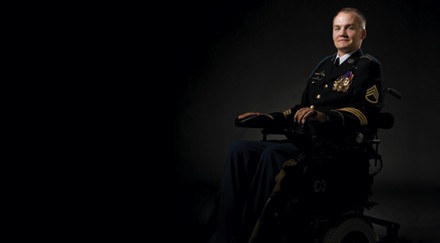
The twin wars we are now fighting, known in military parlance as Operation Iraqi Freedom and Operation Enduring Freedom, are stealth wars. They are distant, confusing, complex, have no dramatic shape, and are being fought entirely by volunteers. I’m old enough to remember coming home to Walter Cronkite leading off the CBS Evening News with Vietnam War updates every single night of the week — there were rolling body counts, military maps, long descriptions of ongoing battles, and unfiltered footage of dead and wounded soldiers. Writer Michael Arlen aptly dubbed Vietnam “The Living Room War.” The whole nation tuned in nightly to experience the drama.
They’ll probably end up calling the OIF/OEF conflicts “The iPod Wars.” Everyone now walks around with ear plugs, oblivious to the outside world. Other than military families and cable news pundits, it seems no one is paying much attention. They are thumbing on their BlackBerries or watching YouTube videos of squirrels on jet skis. Who has time to think about war when you are blogging your own life story every day? I guess that’s why every Iraq-themed movie has been a box-office bust and comic-book fantasies abound. A majority of Americans decided a couple of years back that invading Iraq was a bad idea, so they’ve just tuned it out like last season’s Dancing With The Stars.
But these wars slog on, with only vague time “horizons” to offer any hope, and they are altering the fabric of the culture in an equally stealthy way. They are certainly altering the profile of disabled people in America. According to a Veterans Affairs progress report in April of 2008, 513,000 troops have been assigned to Iraq alone since 2003, almost 200,000 of whom have had more than one tour of duty. Over 31,000 troops on both fronts have been injured, and many of those seriously.
As one expert put it, the signature wound of these wars is traumatic brain injury. In Iraq, there have been over 5,500 TBIs as of February 2008. That’s only the severe TBIs, I’m pretty sure, not all the ear-ringing and chronic headaches that follow the triggering of every improvised explosive device. Nonetheless, if those stats are only generally correct, devastating brain injuries make up about 15 to 20 percent of all injuries in these wars.
Amputees are the next significant category of long-term physical disability. All the mental disabilities — from depression to PTSD to 2,100 suicide attempts in Iraq alone in 2007 — are a whole other story. The number of Iraq war amputees, in one DOD review, was 1,013, as of February 2008 — 730 involving major limb removal. Like the brain injuries, most of these occurred from IED explosions. You’re riding down a road in a troop vehicle, an insurgent punches a number on a cell phone to explode a 500-pound bomb loosely buried in the dirt, and the first thing to go are your arms and legs.
Spinal cord injuries, on the other hand, are way down in OEF/OIF, surprisingly down if you haven’t been paying close attention. The updated figure is hard to find, but all sources report the numbers of SCIs in the hundreds, not the thousands. The Annals of Neurology, in late 2006, list a VA figure of 250 cases. Revise that for the last 18 months of fighting and you’re probably only up to 350-400, max.
This is good news, of course, and speaks to major advances in field care and safety since the Vietnam era. Most experts credit two causes for this low count: advanced head gear and body armor covering the chest and back areas, and a field medical response that is almost uncanny in its efficiency. One soldier with SCI you’re about to meet was severely wounded by a sniper shot in the abdomen and went from a bullet slicing through his kidney to a fully-staffed operating room in 27 minutes! Oh, yeah, and he also had an Army surgeon deployed with his unit that day.
* * *
No matter the injury, the speed at which most Iraq soldiers are anesthetized, medivacced out of the fighting zone, stabilized, and shipped off to Landstuhl Medical Center in Germany is astounding. And a lot of young men and women are alive because of it. The death rate in Vietnam was about 21 per 1,000 soldiers. The death rate in Iraq is less that four per 1,000. The flip side of this is not so rosy — the wounds of those who do survive are often much more severe.
Given the purview of New Mobility, we decided to profile a few of the newly-minted SCIs, specifically from the Iraq front, and hear their stories first hand. We reached these vets, some only a few months away from combat, through VA contacts in Florida and Southern California, and through various Paralyzed Veterans of America regional offices. This is a sampling of how some soldiers from this era are dealing with paralysis and attendant impairments, but certainly not a statistical cross-section.
At least two soldiers I tried to contact wouldn’t talk to me because they were too messed up to talk to anyone. This is hardly surprising, given the reticence of combat vets from any war to re-live traumatic experiences, but it does tend to exclude the seriously angry, depressed, or embittered from a snapshot like this.
According to Art Lyles, president of the California PVA, a C6 quad himself, three out of the four guys he’s worked with recently from Iraq handled it pretty well. The fourth was deeply depressed and suicidal. And some just hate the war in every respect. For that view, we’ve included a brief account of a recent potent documentary, Body of War, about Tomas Young, an anti-war vet with SCI from Kansas City.
It’s unclear how the entry of these many thousands of men and women into the ranks of disability will change the state of things, from improved technology to improved public attitudes. Given that most are young, active, and proud, even proud of their disabilities, the impact could be positive, and it could be big.
‘The New Normal’
Matthew Keil, Staff Sgt., 3rd Platoon,
Able Company, 1-9 Infantry Regiment,
2nd Infantry Division, U.S. Army

I was 25 at the time, born in Toledo, Ohio, and had planned to make the military my career. I really loved what I was doing in the Army. I was injured Feb. 24, 2007. We were doing combat patrols into the Mulaab district of Ramadi, about 60 miles west of Baghdad. We had just left our patrol base when an IED inside a cinder block wall exploded and injured 11 soldiers in another squad going in beside us — one guy came out missing both legs beneath the knee, another lost one leg. There was smoke and debris and guys were screaming and I ran over to help. We use a chemlight marking system in the field, individual light sticks of red, yellow, and green, so if something like this happens, the sticks go off so you can locate people. After that IED blew up, the whole scene looked like a chemlight Christmas tree.
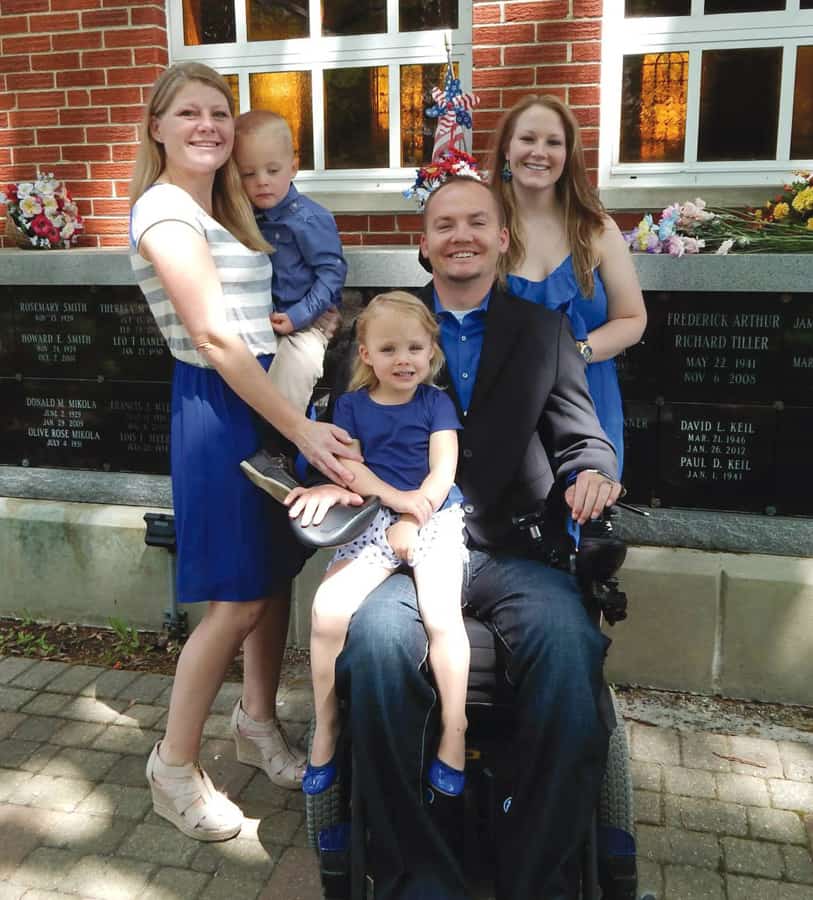
We finally got those guys evacced and got back to the mission. We moved into a house and I went to the highest point of the roof to set up a camouflage net, called a camo net, to protect our movements. I thought I was safe. I wasn’t. A sniper shot me right through the neck. It hit me like a ton of bricks. It felt like somebody had kicked me in the back. I was semi-conscious the whole time and knew what was happening. The bullet, it turned out, entered my neck, nicked my right femoral artery, and ricocheted off my spine, C3 going in and C5 going out.
I passed out during the helicopter ride out and don’t remember anything until I woke up at Walter Reed in Maryland three days later. I was still kind of out of it, but Tracy, my wife, remembers a doctor coming in and kind of letting it slip that I had a Christopher Reeve type injury and was going to be a quadriplegic. When he said that, Tracy’s mom grabbed her and caught her before she fell to the ground. Tracy remembers seeing Christopher Reeve on television and that he couldn’t move but still had done all of this stuff. That was good, I guess.
I wasn’t as bad off as Christopher Reeve. I was eventually able to breathe on my own and I can move my left arm. The biggest problem right away was I had an aneurysm on my right artery, which was extremely life-threatening. And a very severe infection. Every one in Iraq contracts some serious bacteria once they get there. It lives in the dirt. In any case, when they finally filled me in on my condition, I guess my attitude was, it could be a lot worse. I had my wife there the whole time and I was alive. I’ve met a lot of people with worse injuries — TBIs and people who are vegetables — so mine was definitely a lucky injury.
When they finally gave me a trach and I could talk, the first thing I asked my wife was, do we have enough money? She said, it’s no big deal, everything is taken care of. We first went to the VA Polytrauma Center in Tampa, but we were really far from home, so we ended up fighting pretty hard to get the VA to send us to Craig Hospital in Denver, a private facility. Four weeks to the day I got there, I got off the vent. Ninety percent of the left side of my diaphragm works, but only 10 percent of the right.
Going home was scary and exciting at the same time. A whole new chapter of our lives was opening up. We were both a little anxious to go out in public. The way I looked at it, I was in a chair because I was injured fighting for my country. I’m proud of the way I was injured and people can think what they want. Early on, I was with my older brother in some place and this kid and his mom walk by. The kid asks his mom, “Why is that man in that chair?” The lady looks right at me and tells him, “Well, honey, he’s retarded.” I wanted to chase that woman down.

People definitely act weird. They give me that pity look and then they give my wife the pity look. When they look at me like that, I wink at them and it brings them back to reality and they realize what they’re doing is rude. Because some people have seen me on the news, they just come up and start hugging me. I’ve had hugs and kisses from some of the weirdest strangers I’ve ever met.
As opposed to other disabled people, I totally get special treatment. A great volunteer group called Homes for Our Troops stepped up to build a specially adapted house for us. Because I have a very visible injury and I’m in a power chair, people in public want to come up and have their picture taken with me. “There’s a hero,” they say.
Both Tracy and I took jobs with the Wounded Warrior Project, based in Jacksonville, Fla., a nonprofit group that helps wounded service men with outdoor sports and the like so that they know they can live a normal life. I’m actually going on a hunting trip soon. They have sip-and-puff rifles where the mechanism is attached to the trigger housing. I plan to learn to shoot with my left arm.
Five years from now, I’ll probably have a little kid running around. Maybe two. The way Tracy and I look at it is, I came home alive. It could have been much worse and I could have died, but this is our new normal, with the injuries. We knew we had to move on, and this is our new normal, and we’re fine with it.
‘Everybody is in Big Denial…’
Felipe Adams, Sgt. Charley Company,
423rd Infantry Regiment,
172nd Stryker Brigade, U.S. Army
I’m from the east side of Los Angeles, around 104th Street, just north of Watts. I’m half and half — my mom is Mexican, my dad is black. I graduated from high school, went to Cal State Santa Dominquez, dropped out a month before graduating, lived on the beach in San Diego for about a year, then one day decided I wanted to join the military. I just wanted to experience a different culture, go somewhere where chances are nobody else would be willing or needing to go at that time.
Our outfit was deployed to Iraq in August 2005. We spent nine months in Mosul, in northern Iraq. We were very fond of the Kurds up there, but the Iraqi police and the Iraqi military were from two different sects and would shoot at each other. It was a little awkward. When our first tour was up in August 2006, we had just landed back at our base in Alaska when we found out we were extended. We turned around and flew back to Baghdad. The second tour was supposed to be four months. I got injured two months in.
It was the middle of summer and it was like 140 degrees outside and we got orders to drive around and clear houses. They didn’t tell us where we were, which turned out to be Sadr City, the worst part of Baghdad. We were in a Stryker vehicle and we got shot at by what looked like a 13-year-old kid. We ran into an alleyway looking for this kid and there were buildings to my right and buildings to my rear and all of them had open windows. It was pretty scary. I knew something was going to happen. About two minutes later we walked right into an ambush.
I was the only one that day to get hit. AK-47 bullets were going right above people’s heads, steaming up their helmets, but I was slightly away from the group and they got me. I was in denial at first because I was still standing for a second or two. Then I started to take a step but my legs weren’t working. My body fell to the ground. Two others carried me to a safe place, but they couldn’t tell where I was hit. I could only tell them that I couldn’t feel my legs. They took off all my gear and I saw this guy’s eyes light up and he went, “Oh, shit.” Then I saw a bunch of blood gushing out of my left side. The bullet had entered my left side, like a quarter of an inch below a side plate I was wearing, hit my spine, and came out on my left side.
I lost a kidney and my spleen and my spine was pretty much severed. I now have a titanium rod structure in there to keep it together. In Vietnam, I wouldn’t have made it. I can’t tell you much about what happened after they pulled me away. I got injured on a Saturday and I woke up on Monday in Germany.
At first I wasn’t really scared. I had hopes that I’d walk again since I saw Steven Seagal get shot in a movie, go into a coma, then all of a sudden he woke up and an hour later he was walking. Science works wonders, I thought. It didn’t really start kicking in until I was back at Walter Reed and they did sensation tests and nothing happened. That’s when I was, like, wow, maybe I won’t walk again.
I think everybody who goes to Iraq is in big denial. They deny the fact that they’re going to get hurt when it could really happen. And if they showed their true feelings, someone else might get hurt. I was like that. Anyway, later when my mom came to see me in Germany, they briefed her that I might not be able to recognize her and I might be talking crazy. But my nickname for my mom is “Crazy.” When she walked in, I said, “What are you doing here, Crazy?” The doctor said, “See, he’s talking crazy.” My mom said, “No, that’s what he calls me!” She thought I’d be missing some limbs, so when she saw I was whole, she was very happy.
I don’t think I went through a state of depression. I still to this day get frustrated because of my situation. But it never really stopped me. I mean, I don’t stare out the window all day when I’m home. I still go out and do stuff. But it does hit me that I’m in a chair and I’m limited in what I can do. I can’t drive yet because I have severe nerve pain. When people ask me about the war, I always say that I support the troops, but don’t support the war. Even so, my opinion is no soldier should blame what happened to them on the war because each soldier volunteered to go. I’m not bitter. When I get angry and frustrated, it’s just about being in this condition. If I had been in a car wreck, I wouldn’t boycott cars.
I was 28 when this happened. I’m 30 now. I recently filed for divorce. We got married in July 2003 and I went into basic training in September 2003. We were apart pretty much the majority of my military service. It was a mutual thing. My big thing is travel. Now that I have the time and money to travel, it’s just a little different. I also hope to enroll in school. I want to study physics.
‘Oh, You’re That Soldier …’
Andrew Pike, Spc., 2nd Platoon,
Charley Company, 1-505 Parachute Infantry Regiment,
82nd Airborne Division, U.S. Army
I’m from Kimberly, Idaho, just outside of Twin Falls. It’s about 3 or 4 thousand people, tops. I had just turned 19 when I got injured in Iraq. Going in the Army was just something I wanted to do ever since I was a little kid. I trained in the airborne infantry — we do all the parachuting from helicopters, C-17s, and the like — and we were deployed to Palaji, Iraq, between Tikrit and Baghdad. I was there for eight months. We did a lot of counter ambush missions. I’m not really sure who the enemy was – probably a mix of insurgents and Al Qaeda. We saw a little of both.

On March 26, 2007, we were coming back to our facility in the city when I took a sniper shot through the left abdomen. It hit right below the steel plate I was wearing, called the IBA, for Interceptor Body Armor. It was either a good shot or a lucky shot. The bullet passed clean through me, cut off my left kidney and 31 centimeters of my small intestine but didn’t actually touch my spinal column or cord. It was the shock wave of the bullet that destroyed the blood flow through the cord and the cord itself.
We happened to have a surgeon on patrol with us that day, for the first time. From all the reports I’ve heard, he’s the reason I ended up being alive. For instance, he wouldn’t allow them to give me pain killers because it would have stopped my heart. It took 27 minutes to get me from the second I was shot to the second I was on the operating table. My blood pressure was 80 over 40 when I got there.
I honestly thought I had stepped on a land mine and that my legs weren’t there. When I found out they were still there, I had a pretty good idea that I was paralyzed from the beginning. Why did it happen to me? It’s kind of the luck of the draw, I guess. It was my time. I mean, if you know that every day you go out with the mind-set that you could die, and you just get injured, it’s different from someone who expects nothing to happen on a normal day driving to the store. Even before I went to my first rifle range in basic, a woman trainee died when her chute didn’t open coming out of a plane. It happens. These are the risks you signed up for.
The thing about a small town is that everyone knows you. From day one, I received so many letters and packages. People see me on the street and say, “Oh, you’re that soldier. …” The local pizza place put up a sign to keep me and my family in people’s prayers. The school put my name on their automatic billboard. That’s probably something you get in a small town and not a big city. They had a benefit dinner for me when I got back to raise money to help build our home. A lot of people, especially young people, were curious but didn’t want to offend me, so I said in my speech at the dinner that they shouldn’t be afraid to come ask me about what happened. It doesn’t hurt me to bring up my story. I don’t get emotional about it.
It just depends on the person, I guess. A lot of people at the VA, some with brain injuries along with spinal cord ones, didn’t take it as well. I found out at Walter Reed that my soon-to-be wife was pregnant. I was going to have a kid! I’m in a wheelchair, but I don’t have to go back to Baghdad. I won’t miss any of my kid’s life or my wife’s life. Personally, I think that’s a pretty good trade.
My daughter’s name is Brynlee. I’m getting ready to go back to school to get my realtor’s license. Then I’m going to start working.
‘The Medical Staff Told Me I’m Weird …’
Nick Orchowski, Cpl.,
984th MP Company, 89th Military Police Brigade, III Corps, U.S Army
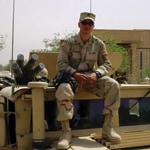
I’m from Colorado Springs. I wanted to stay for the full 20. I wanted full retirement from the military. My dad did 21 years. I wanted to do the same thing. I volunteered right after September 11th. A couple of buddies from high school got together one night, we were depressed about what was going on, so we all decided to join up. Two went into the Marines and four of us went in the Army.
I was in the military police and our sole mission was to train Iraqi police officers in Baghdad. We were in a place called Camp Cuervo, now called Camp Muleskinner, right in the middle of things. It took a toll on me. Some of the guys that were shooting at us at night were the same guys we were training that day. They knew exactly where we were going to be. A lot of them were just wanna-be insurgents in T-shirts and jeans. They like to spray and pray. Spray a bunch of AK-47 bullets and pray they hit you.
We’d been out for 72 straight hours guarding an Iraqi police station when we got a call to transport some weapons. We were on this road called MSR Tampa that was one of the nastiest areas for IEDs, and when we got to the crest of a hill, an Iraqi vehicle came out of nowhere and slammed right into the side of us. It had explosives but they didn’t go off. I was thrown out of the gunner turret and when I hit the ground, I landed directly on my head and broke C1 and C4-5-6. I was out like a light switch. The truck attack triggered an ambush, but I wasn’t around to see it.

When they got me to the hospital in the green zone, I asked for my best buddy to come along and I told him something along the lines of “Please take care of my wife and my daughter.” At that point I thought I was going to die. It was rough, you know – 20 years old and I didn’t even know what the world had to offer.
But it all kind of worked out. I’m actually mobile now. Just with the thing at C1, I should’ve been dead. I’m considered an incomplete quad. The only thing the medical staff has told me is that I’m weird. Once they went in and rearranged the bones and put in titanium plates and screwed everything together, some nerves started firing the way they were supposed to. I have nerve damage in the bladder and have no use for my right arm — I hate to say it, but it’s just dead weight to me. I got a cane and I got a chair. If we’re going to the mall or something, I definitely have the chair with me.I’ve met a lot of people who are completely negative about their injuries and those are the ones who aren’t recovering. Those are the ones you see at the VA every month, refilling prescriptions for painkillers and everything else. I’m always the first one to tell them, “Oh, you’re missing a leg, come on, that’s nothing. I got a buddy who’s a complete quad and he does absolutely everything you could possibly do.” There’s no excuse. When you think you have it bad, there’s always somebody else out there who’s got it 10 times worse.I love to hang out with other soldiers. It’s a brotherhood and there’s that respect, you know. I’m going to be one of the guys down at the American Legion Hall, reminiscing about Iraq. I look forward to those days.
‘I Was Dead in the Field’
Pete Herrick, Petty Officer 3rd Class,
Seabee Construction Battalion, U.S. Navy Reserve
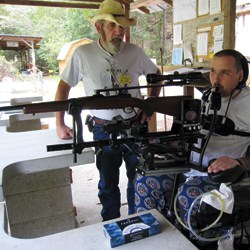
I joined the Navy Reserve at 34 years old. I think it was my first mid-life crisis. I should’ve bought a sports car. I joined the reserves about six weeks before 9/11. At the time I told my wife we really don’t have to worry about me getting called up because the world’s safer than it’s ever been. Then 9/11 happened. Actually, inside I had a secret desire to see war and combat one day anyway. It was just my day.
Our initial deployment as Seabees was to help build power plants and things like that, but the situation was so dangerous in Ramadi, where we were, that I ended up being a 50-caliber gunner on a convoy transporting men and materials to different projects. One night we were hit by an IED and for the actions I took with the 50-cal, I was awarded a V Marine Corps Medal. V means valor in combat. One Sunday morning we did a number of missions and were back for lunch at our camp. As we were leaving the galley and heading to the motor pool, a mortar round hit the motor pool. Just one mortar. Five guys were killed and 33 were injured. I was one of them.
The shrapnel from the mortar hit me in the right thigh — it almost took my right leg off — and in the right wrist and shoulder. I ended up losing my left leg above the knee from the explosion — the bone and everything was bad. But the worst thing was the shrapnel hit my vertebrae around C3, C4 and bruised the whole area. It scrambled my spinal cord. Actually I later had a piece of shrapnel resting on my spine removed because it was causing me intense pain. I made a necklace out of it. It’s about the size of a dime.
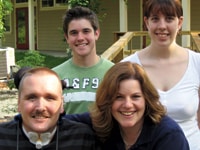
I actually died on the field, is what they told me. My heart apparently stopped and they gave me CPR and got me out of there and it was touch and go for at least the first month. When I got to Bethesda [Naval Hospital], my body was swollen up from edema, or water retention, after the injury. I was blown up like Chris Farley. My first reaction was, “All right, I made it home.” Then it started sinking in. I had tubes coming out of every single part of my body from different wound bags and I was wearing a neck brace and I was intubated.
I think the reason I never really went into depression about my injury or paralysis is the fact that I was in such trauma for probably the first four months, and I was just happy to be alive. The whole first year wasn’t that hard because my wife was there every single day and we both have strong faith in Jesus. Plus, I was older. For a lot of young guys, they think, okay, my life’s over, I can’t use the lower half of my body. At the point of my injury, I had a wife, two kids, and had already lived a full life. So I actually looked at it as a blessing for a while, probably still do, that I get to live two different lifestyles. You don’t have a choice. You just adjust.
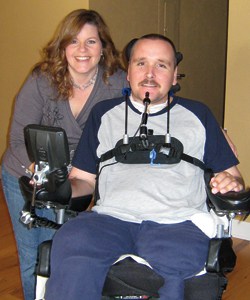
I’m now considered an incomplete C3 or C4, because my spine wasn’t actually severed. I’m paralyzed from C3 down. I can move my shoulders a little bit and move my head just fine. I’m not vent dependent but I do go on the vent at night just for treatment. You know, if I hadn’t gone to the VA Center in Tampa, I know I’d still be on the bed. They really pushed me. They wanted to see me breathe alone and that sucked, I mean, that hurt, but we got it done.
I have no regrets about going. I didn’t realize that the military was for me until I got over there. The camaraderie is absolutely amazing. My best friend died over there. He was standing right next to me when the mortar round hit. I knew him about six weeks and I was closer to him that I’ve probably been with anybody. I knew that if something happened, he would take care of me. You don’t get that anywhere in civilian life.
I have no interest in going back into the work force. They hooked me up with a computer and I play poker online. They have an infra-red camera that sits on the top and there is a reflective sticker that they put on the end of my nose. It serves as my mouse. My wife sticks it on. I am interested in politics. If I could drive myself around and not put all the burden on my wife, I would definitely run for a political office.
Body of War
Review: Body of War, documentary (to find out where the film is currently playing, visit www.bodyofwar.com).
“Body of War,” a 2007 documentary by Ellen Shapiro and Phil Donahue, currently available on Netflix and elsewhere, is must-see viewing for anyone interested in the human fall-out of the Iraq/Afghan wars, but be forewarned — it is disturbing on many levels. The story of 25-year-old Tomas Young, a member of the 1st Cavalry Division, U.S. Army — shot and paralyzed at T4 after being a soldier in Iraq for a mere five days, before he’d shot a single bullet — is short on stiff-upper-lip optimism and the psychology of denial. Young is bitter about the war, uncomfortable in his own paralyzed skin, unsure of his future, often churlish and withdrawn, perhaps due to PTSD. In other words, he’s kind of a normal guy dealt a really shitty hand of cards.
With the fervent support of his mother, and despite the fact that his younger brother is off to Iraq, Young joins up with Cindy Sheehan and groups like Iraq Veterans Against the War to denounce the agenda of the Bush administration. He ends up on 60 Minutes explaining his “unnecessary” mission to Mike Wallace. On one occasion, addressing an anti-war gathering in Brooklyn, he has to stop talking every other beat because of light-headedness. You flinch and applaud at the same time.
His young marriage falls apart in the course of the film, not an unusual life turn for returning vets, but doubly disheartening because of the physical and mental turmoil he’s already dealing with. The film ends with a beautiful sequence of Young in the office of the Lion of the Left, nonagenarian Senator Robert Byrd, as Byrd lauds the 23 senators with enough courage to oppose the mandate for war. As the old politician and the young vet wander down a Senate corridor together at the end, you have a feeling that despite all odds, both wounded warriors will survive to fight another day.
Volunteer Organizations for Vets
♦ Paralyzed Veterans of America, www.pva.org
♦ California Paralyzed Veterans Association, www.calpva.org
♦ Wounded Warrior Project, www.woundedwarriorproject.org
♦ Homes For Our Troops, www.homesforourtroops.org
♦ Veterans Against the Iraq War, www.vaiw.org
Support New MobilityWait! Before you wander off to other parts of the internet, please consider supporting New Mobility. For more than three decades, New Mobility has published groundbreaking content for active wheelchair users. We share practical advice from wheelchair users across the country, review life-changing technology and demand equity in healthcare, travel and all facets of life. But none of this is cheap, easy or profitable. Your support helps us give wheelchair users the resources to build a fulfilling life. |


Recent Comments
Dick Crumb on Adapting Recreation To An Aging Body
Karen on The Everlasting Saratoga Cycle
Ted Kilroy on Handcycle Gear Guide