


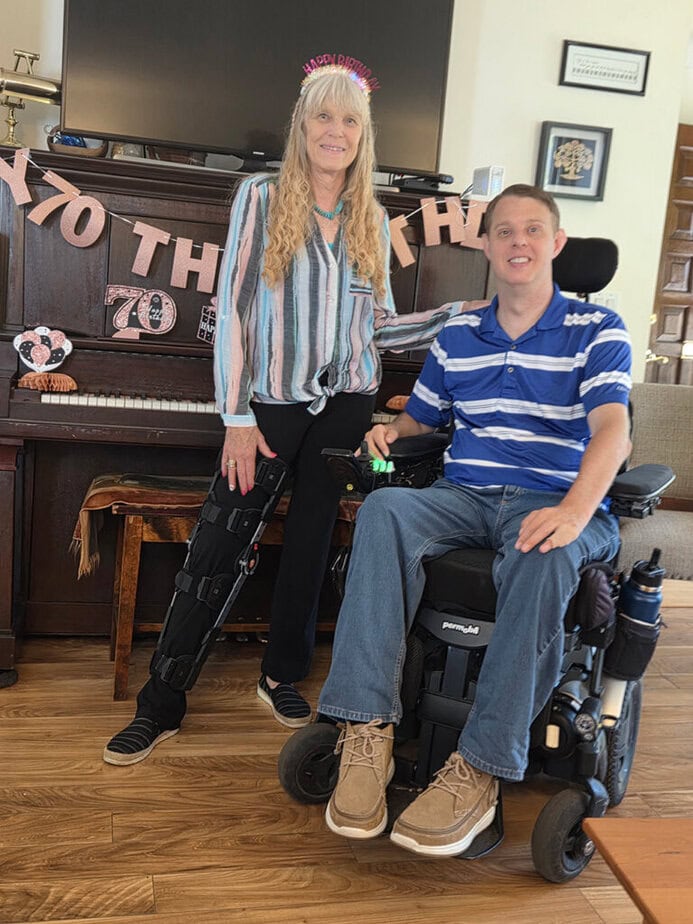
After 17 years of depending on his mom, Margaret, for daily care, Jake French suddenly found their roles reversed. A serious knee injury and four unexpected ER visits sidelined Margaret, and Jake, 39, had to step up — caring for his 70-year-old mom while juggling his own complex needs as a C6 quadriplegic, including help with his bowel and shower care. He had handled temporary lapses in her care before, but this string of events — and her growing reliance on him — forced him to rethink their setup.
“I realized once things calm down here in the next month or so, Mom and I need to figure out some more processes so that as life changes, it’s more of a smooth hand off,” he says. “It’s so hard to see someone slow down and hurt, but then selfishly it turns towards yourself. I found myself wondering, shoot, how am I going to do this?”
Lazaro Gutierrez, a C4-5 quadriplegic, faces the same tough questions as he prepares to transition away from relying on his mom, Teresa, who has supported him as his primary caregiver for over three decades.
“I’m very terrified,” says Lazaro, 54. “Having my mom as my caregiver all these years has been great, but the ball has been rolling, and I’m trying to deal with it now, a little too late, and I’m hoping it doesn’t roll me over.”
As a C5 quad who once leaned on his parents after his spinal cord injury, I remember the pressure of that looming ball. While hiring new caregivers may sound like an obvious solution, the emotional, financial and logistical hurdles make it anything but easy. Changing long-standing caregiving routines — especially those built on deep, personal bonds — is hard.
The ‘Obvious’ Choice
There was never any question about who would assume the role of primary caregiver when Jake was paralyzed at age 23 in 2008. Margaret had just retired as a teacher and had experience caregiving for her father. “We never really even talked about it,” he says. “We lived in a ghost town of 600 so far out in the middle of nowhere. It would have been really hard to find anyone. And Mom was there, like, ‘Hey, I can do it!’”
Lazaro didn’t exactly welcome Teresa’s hands-on involvement in his care as a newly injured 18-year-old, but he adapted quickly. “It just happened. It’s almost like, this is what it is. She took over the role. I accepted it, and I moved on,” he says. “Then it became the norm, like it was supposed to be that way.”
Teresa, 69, has been with Lazaro through all the stages of his life post-SCI, not only covering the majority of his care needs, but his emotional needs too: the grief after his injury, finding the motivation to return for his GED and college degrees and eventually marrying the love of his life.
Each milestone required both mother and son to adjust. “I don’t want to say it’s been easy or perfect, but it has worked,” says Lazaro. “My wife has adjusted, my mom has adjusted, and I have my role.”
“I’m very terrified. Having my mom as my caregiver all these years has been great. But she said to me, ‘I can’t do this anymore.’ I cried because I’m like, man, I can’t do anything about it. I’m breaking my mom down where she doesn’t even have a life.”
Navigating the balance between caregiving and family became even more complex when Lazaro married and became a father to his wife’s two children. “It was like, OK, you got me, and my mom comes with me,” he says. Teresa lived separately and came to help with Lazaro’s care. “Not having my wife have to be a full-time caregiver helped our relationship, and with all the experiences … looking back, I’m not sure it would have lasted as long as it has if my wife had to do all my care.”
Jake and Margaret’s relationship has also evolved the longer they’ve worked together. Two years after his injury, Margaret became his business partner when he started a career as a motivational speaker. In addition to providing the assistance he needed to travel, she helped him manage his events and hone his craft. “She was a godsend,” he says. “Logistically I couldn’t have done it without her.”
Unlike Lazaro and Teresa, Jake and Margaret live together. The convenience can be good for caregiving and camaraderie, but tricky elsewhere. “It definitely was a bit awkward trying to date at first,” says Jake. “I’ve always just tried to address it right out of the gate, like, ‘My mom and I are an awesome team.’ … It’s no more awkward than some of the other conversations about being a quadriplegic.”
Maintaining the Balance
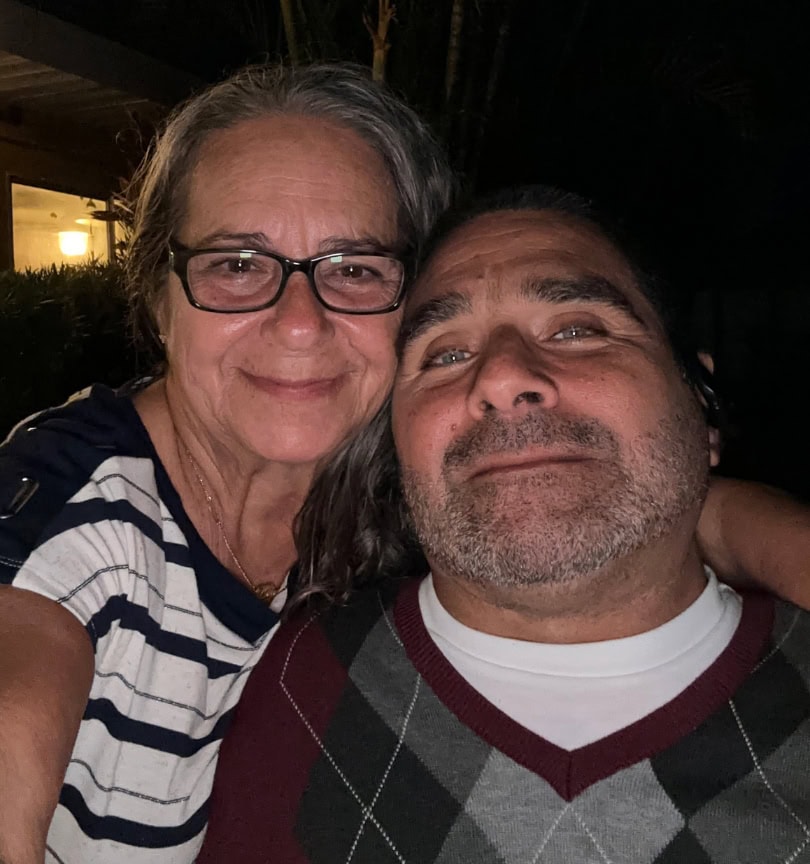
Lazaro has weathered plenty of challenges in the 36 years since his injury, but the past six have proven especially tough. As he, his wife and Teresa age and face new health issues, maintaining their delicate balance has grown harder. “My wife does a lot to help, but because of health issues and full-time employment, anything with heavy lifting tends to fall on my mom,” he says. “I see the frustration and the stress it’s bringing my mom — and the stress it’s causing her physically.”
A recent bout of back pain for Teresa brought the issue to a head for Lazaro. “It’s hard. She said to me, ‘I can’t do this anymore,’” he says. “I cried because I’m like, man, I can’t do anything about it. I’m breaking my mom down where she doesn’t even have a life.”
Margaret’s string of ER trips and recent health setbacks have been keeping Jake awake at night worrying about their mutual health, finances and what the future holds. “Our relationship for the first dozen years was easier than it is now,” he says. “She started having health issues about five years ago, then she was good for a couple years, and then it started again this year. It’s also becoming more stressful, because you’re tied to someone in more than one way.”
Their financial connection is especially difficult to unravel. Margaret depends on the state and Medicaid money she receives as Jake’s caregiver, and because they live together, Jake does too. “We’d love to hire other caregivers,” says Jake, “but for every hour I pay for one, that’s money directly out of our pocket. Our finances are essentially tied.”
Lazaro and Teresa’s finances are less entwined, but with limited hours covered by the state, Lazaro has to be judicious. “I don’t have the funds to be able to just call someone and pay for help,” says Lazaro.
“It’s scary. I’m nervous. I don’t think I realized how much she does until she couldn’t do it anymore.”
When Jake is forced to hire someone to fill in for Margaret, as he was during her recent setbacks, he makes sure they understand that he needs help fulfilling the household tasks his mom usually does, along with his caregiving necessities. Inevitably, more of the chores fall on his shoulders. He is glad to help but knows there will be an added cost because of the neurological pain he battles constantly. “I only have so much time I can sit, small blocks of time the pain allows me to ration throughout the day,” he says. “I’m happy to do more for myself and my mom, but it takes me a lot longer and leads to more discomfort.”
During one of those fill-in stints, he injured his shoulder. “After going through this, I also see how much she helps me just prevent injury,” he says. “She touches literally every aspect of my life.”
Despite the complexity, both men know that they need to work with their parental caregivers to find a new balance that allows them all to lives their lives to the fullest. After numerous hires that didn’t pan out, Lazaro has found a reliable caregiver to help him at night. He’d like to find a competent caregiver who could handle his morning care to free up Teresa from the overwhelming responsibility and allow her to live her own life without worrying about his needs.
With her recent recovery, Margaret is eager to return to caregiving, and Jake appreciates having her back. But he’s also thinking differently. He’s turning down trips he would have jumped at before, afraid that overcommitting will wear her down again. “I’m really trying to place myself in her shoes and just temper how much I ask for,” he says.
Additionally, Jake and Margaret are reevaluating everything, from how Jake could travel without Margaret, to where they live and what their living situation looks like. “It’s scary,” says Jake. “I’m nervous. I don’t think I realized how much she does until she couldn’t do it anymore.”
Finding Solutions
Changing routines and managing caregivers are two of the most difficult tasks to master when it comes to living independently. Figuring out how to transition from aging parental caregivers combines both of those obstacles and adds in the emotional complexity that comes with family. In short, it’s frickin’ hard.
The more time we spend working intimately together, the stronger the connection becomes — and the more difficult it is to sever. For good and bad, our parents know us more intimately and more deeply than any hire can.
“My mom allows me to feel like a man,” says Lazaro. “I feel like I have my arms and legs all the time around me, because as soon as I need something, or as soon as I think about it, she will be there to help.”
For good and bad, our parents know us more intimately and more deeply than any hire can.
The idea of replacing something that you know can work with a series of unknowns is daunting. “Having one consistent person has been really good,” says Jake. “It takes so much time and energy to train new folks, and it can be dangerous if they don’t know what they’re doing.”
Despite constantly thinking about and discussing the transition with my parents over the decade they helped me as caregivers, I ran into a number of problems including multiple flaky caregivers and one who packed up all her belongings and ghosted me in the middle of the night. There were moments where I wondered whether I’d ever establish a sustainable caregiving setup, but I always knew that I had to keep trying. I owed it to my parents, and I owed it to myself.
Having a caregiving setup that allows me to live my life the way I want is invaluable, but seeing my parents enjoy their golden years without having to be intimately involved with my care is right up there in terms of value.
Jake and Lazaro are confident they will figure out a way forward, and both realize how fortunate they are to have such caring and supportive parental caregivers. “I know not everyone has that experience with family,” says Jake. “I definitely appreciate that and don’t want to take advantage of it.”
Support New MobilityWait! Before you wander off to other parts of the internet, please consider supporting New Mobility. For more than three decades, New Mobility has published groundbreaking content for active wheelchair users. We share practical advice from wheelchair users across the country, review life-changing technology and demand equity in healthcare, travel and all facets of life. But none of this is cheap, easy or profitable. Your support helps us give wheelchair users the resources to build a fulfilling life. |


With Medicaid funding being so drastically cut, this especially a problem. Waiver PCA services are sure to suffer. But if you depend upon a parent or even spouse for caregiving you need to think about letting them retire at some time and develop a back-up plan for other caregivers. Service connected Veterans should also look at services they may be eligible for. I know in my state, you cannot give more money to an IHSS worker (and they are hard to find with a significantly increased hourly rate now), but you can offer services in kind such as lodging and meals, even transportation.
My mom always did my bowel program but she passed away a few months ago. My sister has been helping me get up in the morning for 20 yrs & did my bowel program off & on but now she’s stuck doing it all the time & I feel bad because her & her husband can’t go on vacation. Only for 2 nights at the most.
It is one of the hardest things to find someone that’s willing to do it and that I trust.
It keeps me up at night worrying about it
I’ve been a C2/3 quad for 40 years and can really relate to this. I’m very fortunate that I do have several caregivers, but they don’t cover 24/7. I live with my parents and they cover evenings, weekends, and any open shifts. However, as we all age, it is getting harder for them to do my cares. My caregivers are also getting older and having their own challenges.
With help, and funding, extremely hard to find, I fear a nursing home is in the near future. I’m active with speaking at various places and running a web development business, but most of that will need to stop if I lose independence.
Alex has Cerebral Palsy. When he was 15 I built a house for him complete with a lift system (sure hands lift system) that runs into every room. I made it easy for his care… and because of that I am able to find great caregivers. I have also save my own body from injury. It was expensive 20 years ago but it has paid off! I am 74 and have not one back issue or health issue up to this point. I do struggle with what happens when I am gone. My husband and ex husband are 100% willing to step up… but they are also my age … so this is not a long term solution. It is also difficult to identify someone who would take over in 10 years… who know where anyone will be in 10 years. I do have a trust and trustee. Alex has been learning to advocate for himself and know what to do if something is not right with his care… we have only had to handle an issue once but Alex did learn from this. Sorry no solutions here on my part… just a lot of ‘what if”. thanks for letting me express myself on this platform