



Spiritual connection can be found anywhere, whether in a church, synagogue, at the top of a ravine or in a Facebook post. These four wheelchair users share where they find it, how they recognize it, and how it sustains them.
It All Works Out
Traveling through New Zealand was like moving through a dream, says Ashley Lyn Olson, a T12 para. She explored the island’s national parks in 2020 for her website, wheelchairtraveling.com, and missed the start of the pandemic. “I was oblivious to COVID,” she says. “I was so happy to be there I wasn’t paying attention to the news.”
The day before she left, she picked a random lake to explore in her rented car. This serendipitous choice led to danger and a profound spiritual experience.
After an hour bouncing along a one-way rutted dirt road, Olson reached her destination, and it was lovely. “As I left the lake, the road curved down and to the right. There were no tracks, only slick rocks, and I didn’t have 4-wheel drive,” she says. The car slid back and forth, and she struggled to avoid the deep ditches on both sides of the road.
Eventually, she hit the left-side ditch, lost control, and rolled to the bottom of the ravine. “I remember flying in the air and feeling very calm, thinking, ‘OK, this is happening.’ Then I blacked out momentarily and came to with the car still rolling and the passenger window above my head.”

I think about the dirt, worms, drops of water, our sun, solar system, and the universe. Life is unfathomably infinite, and we must appreciate all of it to really see it.”
Once she stopped, she did an inventory. She seemed uninjured, the car still worked, and the airbag didn’t deploy. There was no cell reception, and she was alone. “I screamed for help a couple of times just for kicks but knew I had to get myself out of there.”
After a harrowing search for a way out of the ravine, Olson left her chair and vehicle behind and crawled up using the deeply rooted grass as a rope. On the summit, “I said a little prayer of gratitude, looked up and saw two hawks circling above me. I think of my dad when I see hawks, so I knew I would be OK.”
She realized no one could see her through the road-side brush, so she crawled toward the road. She saw a shed and a barn and knew that someone would eventually find her even if she had to spend the night. Thankfully it didn’t come to that.
“I was almost at the road when I heard a car, so I screamed, ‘Help! Help!’ and waved my bag in the air. The car stopped, and four people came running over. I didn’t want them to worry I was injured since I was crawling through a meadow, so I yelled, ‘I’m OK! I’m paralyzed, but I’ve been paralyzed for 20 years, and that’s why I’m on the ground!’” With their assistance, she made it back to her hotel and saw a doctor the next day before catching her flight.
Olson was filled with joy and trust that everything would work out after what could have been a terrifying ordeal. She credits her wide-ranging approach to spirituality that includes a life-long connection with nature, Eastern mindfulness philosophy, Christ’s love and even quantum physics, among other influences, for her positive reaction to a dangerous situation.
“The strongest thing that someone can do sometimes is not do anything. Be completely still,” says Olson. “Just be silent and see what comes up. Don’t get stressed about it. If you have to go to the bathroom or a test is around the corner or a job, see these thoughts, accept them and allow them to pass and to float away. Whatever you’re in is what is meant to be. There is a purpose for all.”
Olson stresses she is not advocating to accept platitudes like “this, too, shall pass” at face value. She heard that a lot from well-wishers after becoming paralyzed at age 14. “I knew I was going to be OK, but I wasn’t OK at that moment, so these words provided no comfort or insight.” But years later, while hospitalized due to pressure sore surgery, she read A New Earth by Eckhart Tolle, and realized this phrase means that everything will pass, bad and good. This resonated. “Reflecting on these words lying in a hospital bed, not able to do anything but think, opened me up to a new level of appreciating life.”
Understanding this fundamental truth about the nature of change helped her focus on positive moments. “I chose to see the good, no matter how small or seemingly insignificant,” she says. Eventually, that difficult period in her life did, indeed, pass. “Oddly, though I was ready to go home, a part of me was also sad to leave. I saw the good in the experience of being hospitalized.”
It sounds paradoxical but knowing even deep joy is transitory allows Olson to feel it more intensely. A flower may cause her to spontaneously laugh with pleasure and meditate on all that must happen to make that one plant grow. “I think about the dirt, worms, drops of water, our sun, solar system, and the universe. We are spinning on a rock of fire and water surrounded by countless other galaxies filled with forever-evolving rocks. Life is unfathomably infinite, and we must appreciate all of it to really see it.”
Holy Coincidences
Sure, it’s kind of funny now, but back when Aaron Broverman was in college, he passed as being ablebodied enough to participate in a Birthright Israel tour. That’s a free trip for Jews between 18 and 26 who want to connect with their roots in the Holy Land. There’s a Birthright for disabled Jews as well, but Broverman, a journalist with cerebral palsy, didn’t know that. And he didn’t want to miss his shot at using his cub reporter skills to get to better understand Israel’s relationship with Palestine.
First, Broverman had to prove his Jewish credentials, which was easy. “People can go even if they think they’re Jewish but are not quite sure, so they want to know how are you Jewish,” he says. Then he had to demonstrate he could walk independently. “So, I dropped my forearm crutches and walked to the end of the room, and they were satisfied.”
He made it to Israel and thought he was doing well keeping up with his nondisabled peers when he realized an Israeli soldier about his age was nonchalantly tagging along with him. The next day one of the Birthright leaders pointed out that he was the last person to get everywhere, and they needed to keep things moving.
“Are you kicking me out?” he asked. “No, no, it’s totally fine,” they said.
“They were saying, ‘You’re too disabled,’ without saying it. They got a guy, Isaac, and he became my buddy for the rest of the trip. He was the Aaron minder, and he pushed me around in my manual chair that fit under the bus. I should have been on the disabled trip, but I was proud I snuck through. I didn’t crack the case of peace in the Middle East, but it was a really cool experience.”
“I don’t think of God as a dude in a robe in the cloud. I think of God as positive energy pushing you toward good things in your life.”
The trip brought Broverman closer to his religion, although he calls himself a liberal Jew who only observes high holidays. “The thing I like about Judaism is that it seems founded on debate. It is self-aware enough to realize it doesn’t have all the answers. Jews are much more into keeping their circle small and special rather than, ‘let’s get as many people as possible to believe what we believe.’ I like that way better,” he says. “It’s not a weapon to be used against people. It’s a very Jewish thing to think, ‘Ehhh, maybe you’re right. I don’t believe what you believe, but I’m not going to fight about it.’ It’s a much more peaceful thing than, ‘No, you’re wrong!”
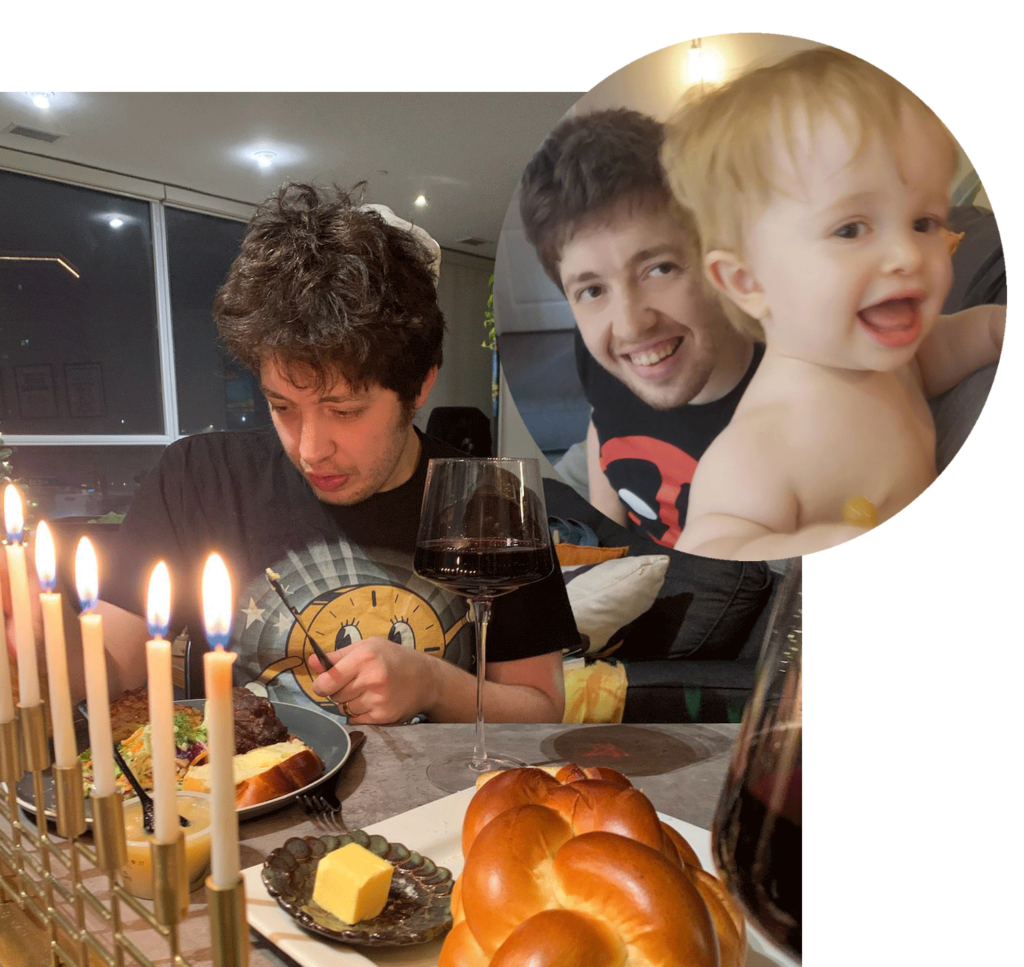
Recently Broverman moved his young family from Toronto, Ontario, to nearby Waterloo, so his toddler son, Wells, would be close to his wife’s parents. “There’s a Jewish community here, but it’s really small. During the pandemic, they had Zoom-style meetings, and I introduced myself to them. Being a dad changes what I think because now that I have a kid, do I want to introduce him to Judaism? If so, how much? My wife’s an atheist, so if he’s introduced to any religion, it’s going to be mine.”
So, what does he believe? “I pay attention to what people call coincidences, and I don’t think of them as coincidences. They are little, small moments that I take as symbols — ‘oh, that’s of God. It wouldn’t have happened without some divine intervention.’ I don’t think of God as a dude in a robe in the cloud. I think of God as positive energy pushing you toward good things in your life,” he says. Broverman notices that often when bad things happen, they tend to lead to something down the line that he’ll get a lesson from, or perhaps to something good that wouldn’t have materialized if the bad thing hadn’t happened first.
“Even though we have free will, there’s a force guiding us in a generally positive direction,” he says. “It’s having faith that there’s something more out there, that we’re not just going to die, and it’s lights out. Maybe that’s naïve, but I’d rather that than thinking your life means nothing.”
Those Moments of Joy
Shameka Andrews is a busy woman. She’s a community outreach coordinator for the Self-Advocacy Association of New York State and a volunteer for what seems like a myriad of other projects, including her state’s Ms. Wheelchair program. She stays grounded by taking time each day to create and post a gratitude list she calls “Today’s Favs,” like so:
Remembering to stay hydrated
Working on getting rid of inflammation
Stress Less Workshop
Boneless ribs
Home delivery
Coming upon Andrews’ list in a newsfeed is a nice break from the doomscrolling so many of us engage in. Yes, remembering to drink a glass of cool water is restorative. And truly, home delivery has saved us all during these pandemic-cursed days.
Andrews’ list evolved from a gratitude journal she kept when she was in her early 20s and lived in her parent’s inaccessible home, located in an inaccessible neighborhood.
“The year I decided to move out of that neighborhood was one of the hardest,” says Andrews, 43, who has spina bifida. “I moved into a residential community with nine other people of various ages, which was a challenge in and of itself — 20-somethings and 50-somethings in the same house.” She also enrolled in college and got her first job.
Today, Andrews lives in an apartment in downtown Albany, New York. She reconnected with the spiritual discipline of practicing gratitude when she turned 40. She’d joined a daily celebration Facebook group and decided to celebrate her birthday for 40 days. “It turned into a year,” she says. As part of that celebration, “I looked at how I go about my day and noticed that I tend to shift my attitude or energy depending on who was around me, and I was allowing negative energy to affect me. My favs list is how I snapped out of that.”

Photo by Colleen Ingerto
Andrews
“It brings me joy when I’m able to notice the simple things and the different ways that God moves in my life.”
She loosely structures her list around the five senses: things seen, tasted, heard, smelled or touched. “It just brings me joy when I’m able to notice the simple things and the different ways that God moves in my life,” she says.
Perhaps gratitude comes naturally to Andrews since she understands spirituality is not about a place or specific activity. “I can have a spiritual experience in a church or sitting in my living room barefoot listening to Bon Jovi,” she says. “It’s all about the energy of the activity, and how it affects me is my spiritual connection to God, the universe, love, whatever it is you want to call it.”
She especially finds God in moments of joy. “And they can look like many things … getting an unexpected check in the mail or watching birds outside my window appear every morning. Seeing those little birds makes me forget I’m in a big, huge city.” That joy bubbles up when she sees a rainbow or children playing in a park and distracts her from becoming weighed down by violence happening somewhere in the world or shootings closer to home or discrimination she may face. “Those moments are when I can realize there is beauty under all the things we might perceive as ugly in the world.”
Don’t mistake Andrews’ positivity for naivete — she knows who she is, what she believes and plots her own spiritual course. “I’ve had a few experiences in religious settings where healing circles and similar things made me feel ‘less than’ at the time because the outcome that people in the room wanted didn’t happen,” she says. She’s learned she doesn’t need to adopt anyone else’s views of spirituality, religion or success. “It’s OK for me to have my own path and live my own life. I know what my relationship with God is and the messages I get from him daily, and I don’t need anybody else’s approval.”
Andrews attends a Unity church, where many in the LGBTQ community find a spiritual home. “I like the Unity tradition because it has different views than the stricter Bible readings found in many other Christian denominations,” she says. For example, the Unity tradition teaches that if God is omnipresent, then that means God is within each of us as well, and that bit of the divine seeks to be expressed.
Perhaps this underpins Andrews’ recognition that people will believe whatever they believe, and it’s not for her to change their mind. “There are better ways to use my energy. I just want to live my life and be an example of a person that is living with a disability,” she says. “I don’t need anybody’s approval of what that looks like.”
We Are One in Spirit
When our editor emeritus Tim Gilmer was 14, he began acting out. He and his friends ran around in their small hometown of Wasco, California, breaking windows and generally being menaces. Eventually, their moms roped them into taking a confirmation class at their church in hopes of taming them. Which is how young Gilmer found himself plopped in the pews on Maundy Thursday, a ceremony commemorating Jesus’ Last Supper.
“I was a terrible Bible student, and I was surprised during the confirmation ceremony when this peaceful feeling came over me. I wasn’t expecting it,” he says. “It was an extreme calm, a feeling that everything was right, and I was where I was supposed to be.” He didn’t have that feeling again until he was 25, five years after the 1965 airplane crash that took his friend’s life and caused his T11 paraplegia. He had become filled with bitterness, and before he realized it, he was deep into an addiction-fueled paranoid psychosis. Trapped in his parents’ home, he had nothing and couldn’t imagine a future. He felt God was distant and indifferent to his suffering — if God existed at all.
Finally, desperate, he let it all go and pleaded for relief.
“I broke down and cried and prayed and begged God to help me. I felt totally lost and thought I was dying or maybe had already died, maybe even trapped in a hell of my own making,” says Gilmer. “All of a sudden, this calm washed over me, the same calm as when I was 14 but hadn’t felt since then. It felt like God was telling me everything would be OK. I could only attribute it to the Holy Spirit, and for me, it came from Jesus; his presence was with me. That helped me get through that terrible time, and it has always stayed with me.”
He feels that presence in times of profound joy as well, like when he and his wife, Sam, adopted their daughter. “When we brought her home, just one day old, we were overjoyed because the adoptive mom who couldn’t care for or provide for her baby had chosen us to raise her as our own. That was tremendous joy when she came into our lives, and we thought God was part of that process.”
A peaceful joy will also come over him sometimes when he is in a special place in nature, like the ancient redwoods or seeing a formation of geese flying over. “A lot of it has to do with nature for me, I connect it to God’s creation. It’s not just this wonderful place in the forest or birds chattering. This is what God created, and he wants us to enjoy it and take care of it. That fills me with joy.”
It’s not about being devout, as Gilmer doesn’t think that label fits him. It’s about recognizing how all creation is interconnected — including you and me. “The older I get, the more I think we are connected, all of us, in a spiritual way. But some of us are not aware of it. I know I wasn’t for a long time. Just how that shared spirituality works is beyond me to understand.”
“The older I get, the more I think we are connected, all of us, in a spiritual way. But some of us are not aware of it. I know I wasn’t for a long time. Just how that shared spirituality works is beyond me to understand.”
In college he was attracted to the essays of Ralph Waldo Emerson and the idea of the Over-Soul — that every individual is eternally connected with every other living thing in the universe, and also to nature. Now he likes to focus on a calligraphic work of art hanging on his wall created and given to him by the wife of his pastor, using the words of Teresa of Avila: “Yours are the only hands with which He can do His work. Yours are the only eyes through which His compassion can shine forth upon a troubled world.”
Gilmer has honored this interconnection by organizing a local church group and others to establish a Habitat for Humanity chapter in their area. These days he is involved with his church’s latest project, an international mission to address the need for better health care in a poor nation. “Right now, I’m helping write a fundraising brochure to help build a hospital in Sierra Leone. “My pastor, my friend, asked me if I could take something he had written and maybe make it better. It fills me with joy and gratitude just to be involved.” They will use the materials to raise money from both inside and outside the church to accomplish its goal.
Following Jesus and belonging to a church is Gilmer’s path, but it’s not for everyone. He recognizes there are many roads to spirituality but cautions against getting lost in relativity – or the idea that there’s no absolute truth. “If there’s one thing that’s absolute to me, it’s that God is Love,” he says. “And if we lose that, I don’t think I want to even be here.”
Support New MobilityWait! Before you wander off to other parts of the internet, please consider supporting New Mobility. For more than three decades, New Mobility has published groundbreaking content for active wheelchair users. We share practical advice from wheelchair users across the country, review life-changing technology and demand equity in healthcare, travel and all facets of life. But none of this is cheap, easy or profitable. Your support helps us give wheelchair users the resources to build a fulfilling life. |


Excellent piece/stories, timely, beautiful and full of Love. Thanks.