



Back when my son, Ewan, was still flopping around in diapers, I remember a quad-dad friend of mine who likened parenting to playing a video game. “Just when you start to get better at it, the difficulty level keeps going up,” he joked, and he was right. Compared to the intricacies of managing an adamantly independent 4-year-old who’s suddenly turned functional enough to be dangerous, newborns are pretty simple.
Something my friend wouldn’t have known because he and his wife had twins and never delved into baby round two is that the second time you have a kid, it’s like going back to level one on that video game you already learned how to crush — everything’s just easier.
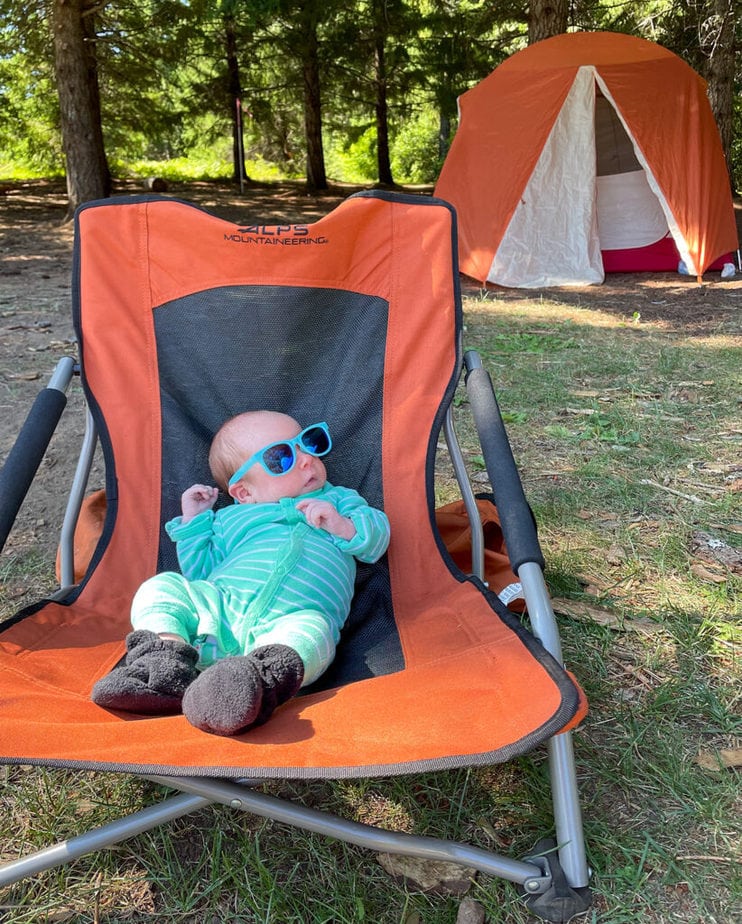
Enter Lou, our beautiful girl/bundle of gas, who is objectively a more difficult newborn than Ewan was while simultaneously being easier for Kelly and me to manage. Which is how, when Lou was 3 weeks old, we found ourselves straddling the line between ambition and stupidity and loading up the pickup truck for our first family-of-four camping expedition.
The realities of taking a newborn and a preschooler out into the woods made us rethink how we typically do things and helped us realize that simplifying the whole process can make camping a little easier for everybody.
The One Night Expedition
One thing we learned with Ewan was, don’t push it. Sure, spending a few nights out in the middle of nowhere is great, but know what’s even better? Making it home before everybody starts to hate each other. And from a disability perspective, one-night camping has its benefits. For starters, it simplifies bowel routines, which for a lot of wheelchair users, can be one of the biggest deterrents to camping. Simply poop before you go, take some Imodium if you’re really worried about it, and most likely, you won’t have to think about getting back on the pot until you get home.
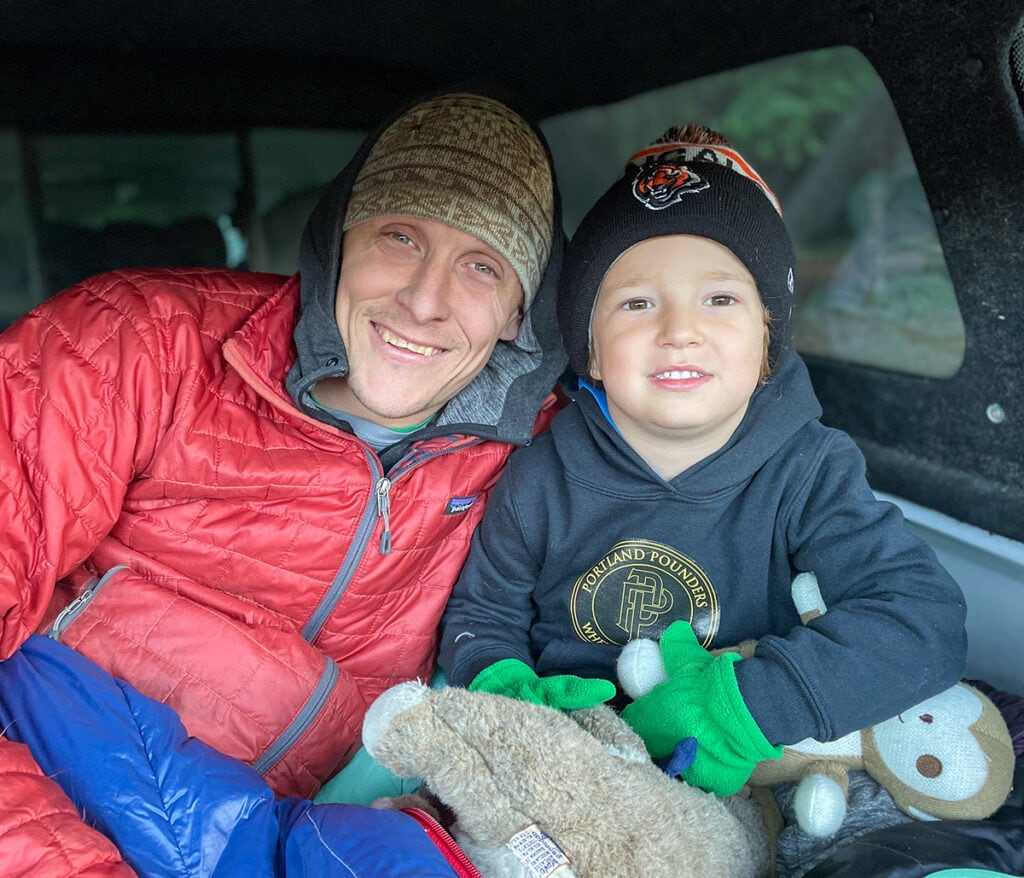
If you pack up as much as possible the night before you leave and pick a camping spot close to home, you can get two days of camping in, with only one night of sleeping hassle. That’s just enough to make the packing effort worth it. Plus, if you go for a single night, you don’t really need to do any dishes, which is always annoying when you’re out in the middle of nowhere. Just dirty what you need to dirty and save the clean-up for when you get home. If you’re camping somewhere with critter worries, pack the dirty dishes in a sealable tub.
Sleeping Matters
We have a tent, a big one. But somehow, with two adults, two kids, a wheelchair and a dog, that tent is no longer big enough for our whole family. Since setting up a tent is generally a hassle if you use a wheelchair, and Kelly certainly didn’t need one more thing to do, we simply decided to go without a second one. Kelly and Lou, and Lou’s changing station, filled up the tent while Ewan, Kenai the dog and I took the truck bed. We blew up a generic queen-sized air mattress that fit perfectly with the back gate of the truck lowered. I had to transfer up from my wheelchair, but that was easier than transferring back up from a tent floor. If you don’t have a truck, the back of a station wagon has served me well in the past and generally makes for an easier transfer.

Similarly, a camping cot, available for around $100 from various retailers, makes for a good sleeping surface up off the dirt. Often between 17-20 inches high, they allow a near-level transfer for many manual wheelchair users. Since many cots are only 36 inches wide, though, you’re probably better off cutting up a memory foam mattress cover to use as a sleeping pad than buying a fancy, ultralight blow-up sleeping pad, which also tends to be ultra-slippery. Many companies sell wider versions if you need one. Coleman offers a camping cot that comes complete with a queen-sized air mattress and integrated battery-operated pump for about $160.
If you are camping in the summer, when most people go anyway, you won’t have to worry about getting too cold sleeping out in the open. Pack a warm sleeping bag, or if you don’t have one, there’s nothing wrong with sleeping in multiple layers, your jacket and an old blanket you don’t mind getting dirty. Bugs can be a nuisance, depending on where you’re camping, but whiskey helps, as does staying around the campfire smoke until a few hours after sunset when prime bug activity typically dies down. If you live in a region where Lyme disease or the West Nile virus is a concern, be sure to pack bug spray. You can get a cheap, string-up mosquito net, but you’ll likely need a nondisabled helper to make any use of it. Rain? Pick a clear night and risk it. Worst case scenario is you’ll have to scramble back into your car, and at least you’ll have a good story to tell.
Cath Hacks
If you have a tent, waking up to pee in the middle of the night can be a pain — and same with the back of a car or a truck bed. Bottles work in a pinch, but spillage is an issue, and washing the pee smell out of tents, sleeping pads and bags is no joke. My preference is for a closed system. You can buy closed-system catheters for a few dollars each, or you can make your own reusable one. Simply connect an extension tube to your intermittent cath, then connect the extension tube to a disposable leg bag. Now you can pee inside the tent or car without worrying about it.
Success!
As for our expedition? Well, Ewan and I slept great in the back of the truck. The only poop or pee problems we had were with Lou, who decided to blow out her diaper four times between when she and Kelly went into the tent and when Kelly tried to go to sleep. We may have only spent a single night away from home, but we all got to spend two days out in a field on the side of a mountain, riding mountain bikes and playing camp bocce, or in Lou’s case, passing out in a baby dome under the trees. We’ll call it a win.
Support New MobilityWait! Before you wander off to other parts of the internet, please consider supporting New Mobility. For more than three decades, New Mobility has published groundbreaking content for active wheelchair users. We share practical advice from wheelchair users across the country, review life-changing technology and demand equity in healthcare, travel and all facets of life. But none of this is cheap, easy or profitable. Your support helps us give wheelchair users the resources to build a fulfilling life. |


Recent Comments
Neil on A Safe, Effective Reusable Catheter System
Richard Crumb on A Safe, Effective Reusable Catheter System
Richard Crumb on A Safe, Effective Reusable Catheter System