


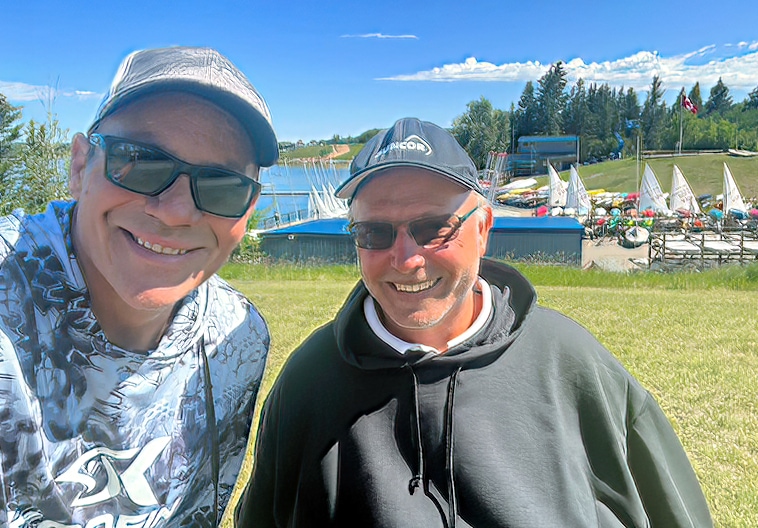
I’ve always loved the water. As a kid I explored it with floaties, and then as I got older, canoes, rowboats, powerboats, water-skiing and scuba diving. As an adult, a fortuitous flight over a tropical island added fuel to my dreams when I saw people jumping off several sailboats anchored in a circle in a lagoon.
I phoned my brother to brainstorm how two brothers from the Great White North could possibly make sailing part of our lifestyle. We talked money, time and location. Over some beers, we formed a plan to make our aquatic dream a reality.
Around a year later, my brother and I were driving and talking about our plan when we got into the accident that made me a quadriplegic and gave my brother a severe head injury. We crossed sailing off the to-do list, penciled it onto the lengthy can’t-do list, and forgot about it for a long time afterward.
“By the end of the afternoon, I was able to approach the dock heading into the wind and just kiss it while pulling up parallel.”
Over the years, I’ve had a couple of sailboat rides, but I never had the opportunity of controlling one. I purchased a radio-controlled sailboat back in my radio-controlled-aircraft days, and spent hours learning the basics, including how to trim the sails for different wind speeds and angles. It was interesting and fun, but real onboard sailing remained on the can’t-do list.
In early spring this year, I remembered hearing about the Disabled Sailing Association of Alberta and sent an email to see if they were back in operation after being shut down by the pandemic. I was thrilled to get a reply saying they were.
I called my buddy Dave and told him the sailing club in Calgary had boats designed for disabled people. “Do you want to learn to sail?” I asked. Knowing how much he loves the outdoors and water sports, I already knew his answer.
“You bet, sounds like an adventure!” he said. We booked a boat.
The day arrived and we started on the 2 1/2-hour drive early in the morning, allowing extra time to scout out the area and check over the boat to see how I could control it. The boat is a Martin 16, a 16-foot sloop designed specifically for sailors with disabilities by Don Martin of Vancouver, British Columbia. It has an adjustable molded seat that holds even us quadriplegics safely in place — in my case akin to making an octopus sit up — and a joystick for control. All lines are routed to the cockpit so it can be completely controlled from the seat.
The boat is made mostly from fiberglass, with a double hull filled with foam to make it unsinkable even when fully flooded, and a 300-pound bulb keel that makes it untippable. It is very safe and has optional power assist.
Dave and I arrived at the club an hour early. The staff greeted us, and we introduced ourselves. The place was operated by a handful of college-aged kids. We went over my disability, what adaptations I’d need and what my goals were. We determined that I would need the power-assist system installed, and that I could use a joystick for control. We checked the joystick, and they allowed us to replace the ball on it with the taller one from my wheelchair.
For higher-level quads they have a mouth-controlled sip-and-puff system allowing full rudder and sail control. We were blown away by the staff’s friendly attitude and savvy working with disabled people. They understood transfers and balance issues — they even reminded me to put my seat cushion in the boat when I forgot. The treatment and attention to detail was second to none.

Two Daves and a Dude
One of the staff informed us our instructor was named Dave, making our crew: myself, Super Dave (my buddy) and Sailor Dave. Super Dave and I went out for a walk while the staff installed the electric control system in the boat. When we arrived back at my assigned time, everything was ready to go. Super Dave had a life jacket and sling on me in seconds, and with the help of the staff, I was in the boat in no time. I tested the joystick, left and right for steering, back and forth to tighten and loosen the sails. The staff pushed us away from the dock, the wind turned us around and away we went.
“So do you want help or advice from me, or just to learn on your own?” asked Sailor Dave.
“We want to learn as much as we can,” I responded. “Tell us everything we’re doing wrong.”
“We want to get to the point where we can take the boats without instructors,” added Super Dave.
Sailor Dave gave us our first orders, directing us to head for a distant oil derrick and to “stay on target no matter what the wind does.” He had me practice following a course, staying in straight lines in different winds. I learned to steer the course with the rudder and tighten and loosen the sails to get the most power out of them. When going against the wind, or “tacking,” you need the sails tight. When running with the wind, you let the winch out to loosen the sails. You can still travel forward in a headwind about 45 degrees off the bow, but any less and you are in “irons,” a no-go zone where your sails develop little to no thrust.
Sailor Dave had me practice tacking upwind in a zigzag pattern, being careful to turn quickly through irons so I wouldn’t stop and lose control of my path. We also practiced docking to a buoy out in the lake. We approached from a few boat-lengths downwind and turned directly into the wind toward the buoy, trying to time it so the boat stopped just as it touched it. After a few tries everything became much easier. By the end of the afternoon, I was able to approach the dock heading into the wind and just kiss it while pulling up parallel.
Now, I’m totally hooked on sailing. I’m passing the cold winter months using a sailing simulator called Sailaway to keep learning and honing my skills. I can’t thank the great crew at the Disabled Sailing Association of Alberta enough, and I can’t wait to go back.
Support New MobilityWait! Before you wander off to other parts of the internet, please consider supporting New Mobility. For more than three decades, New Mobility has published groundbreaking content for active wheelchair users. We share practical advice from wheelchair users across the country, review life-changing technology and demand equity in healthcare, travel and all facets of life. But none of this is cheap, easy or profitable. Your support helps us give wheelchair users the resources to build a fulfilling life. |


Great article Kary – DSA should hire you as a recruiter! Your description of the boats features, especially the safety aspects is bang on.
See you in the spring.
Can’t wait!! Super Dave and Karen are ready too! I’ll recruit if I can!
As an adaptive sailor who sails a Martin 16 at Pleasant Bay Community Boating in Chatham, MA, I can only echo and validate everything Kary said. The Martin 16 is a wonderful boat for adaptive sailors. Easy to sail, and very intuitive to learn.
A very inspirational story! If you want to sail on the beautiful Chesapeake Bay, make plans to sail at Chesapeake Region Accessible Boating (CRAB) in Annapolis, Maryland. The premier adaptive boating center in the country will open in April 2023. http://www.crabsailing.org