


ARC-EX Transcutaneous Stimulation Device Delivers Real-World Results
August 14, 2025
Cheryl Angelelli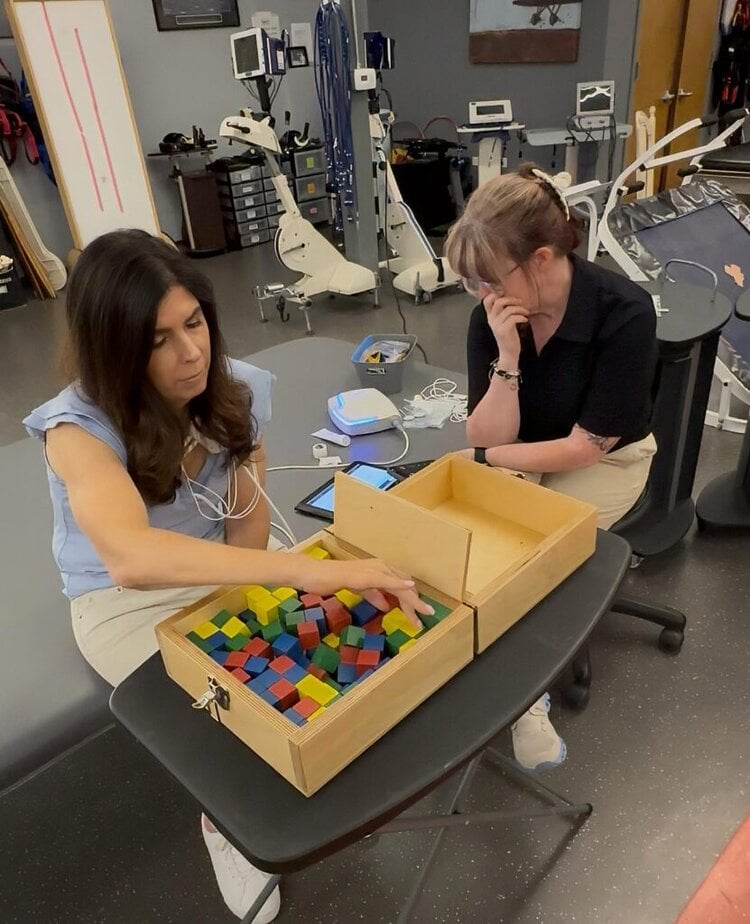
Twice a week, Matt Ludolph, 31, makes a four-hour roundtrip drive from his home in Freeport, Illinois, to Willow Springs, Illinois, to try a revolutionary, non-invasive therapy that is forcing people to rethink what is possible when it comes to neurorecovery. His destination is Next Steps Chicago, one of a handful of clinics around the country with access to the ARC-EX transcutaneous stimulation device.
Approved by the FDA in December 2024, ARC-EX by ONWARD Medical is the first and only FDA approved technology proven to improve hand strength and sensation in people ages 18-75 years old with incomplete cervical spinal cord injuries. For Ludolph and some others, the promising therapy is also contributing to additional gains that are helping them achieve greater independence and function.
Different from functional electrical stimulation devices that activate specific muscles, ARC-EX delivers electrical pulses to the spinal cord by placing external electrodes on the back of the neck above and below the person’s level of injury. The electrical pulses are designed to stimulate dormant nerve pathways affected by the SCI, potentially improving function and sensation in effected limbs.
ARC-EX is intended to be used in combination with activity-based therapy in a clinical setting. Overtime, with repeated use, the stimulation can promote neuroplasticity – the nervous system’s ability to form new pathways and strengthen existing ones. Some gains can persist even when the device is turned off, due to the strengthening of neural circuits that were previously dormant or underactive.

“What I have been seeing is that there is carryover to non-stimulation times after about four weeks of treatment, and if patients continue to use that pathway, the effects continue to be in effect. It’s the ‘if you don’t use it, you lose it concept,’” says Mary K. Jones, executive director of clinical operations at Next Steps of Chicago
In January 2025, Next Steps Chicago was one of the first to receive ARC-EX. Jones is excited to be able to offer this technology to her patients with cervical spinal cord injuries. “Statistics show the most SCI injuries are in the cervical level. But yet, if you look at research, [cervical injuries] have the least amount of investigation,” says Jones. “ARC-EX is one of the first that really focuses on upper extremity recovery. This technology could change lives by offering new avenues for recovery that were previously unimaginable.”
More Function, Less Pain
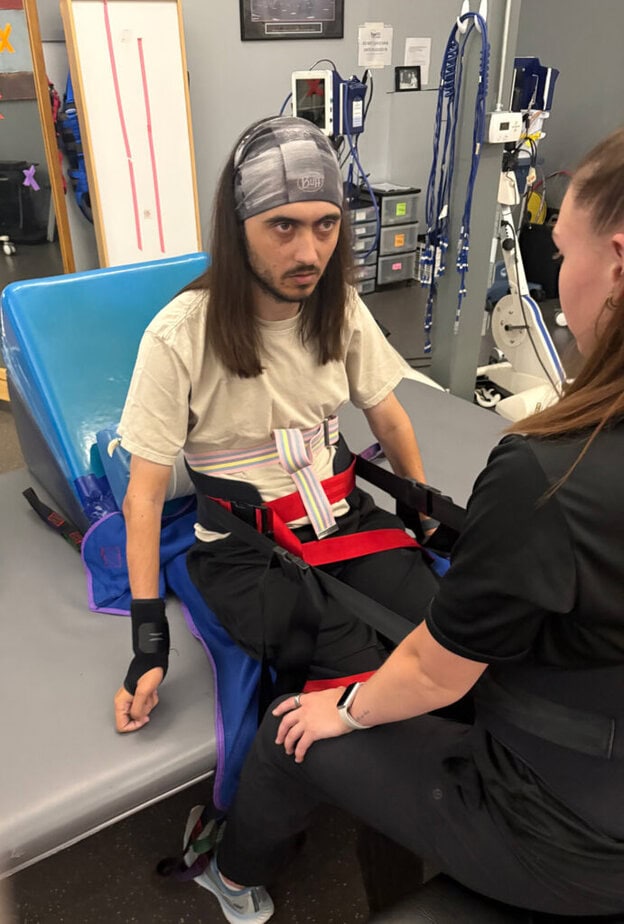
Ludolph, who sustained a C4-5 SCI in 2012, has been using the ARC-EX since April in combination with his twice weekly, one-hour physical therapy sessions. In just a few short months, he is already experiencing some positive gains. “I distinctly remember sitting at my desk and leaning forward to reach something. I have no trunk control, so usually when I attempt to do this I fall forward and someone has to help me sit back up in my chair, but this time I did it and didn’t tip forward. It kind of startled me. I sat there doing it repeatedly by myself, so that was a cool moment,” says Ludolph. He is also seeing a reduction in shoulder pain. “On a pain scale of 1-10, I was at a four pretty consistently, and as high as a five or six. Now I don’t even notice it most days,” he says.
Roman Dzyubinskyy, 28, of Northbrook, Illinois, has been using ARC-EX and FES together during his weekly, one-hour physical therapy sessions at Next Steps Chicago. Dzyubinskyy sustained a C5-7 SCI six years ago, and says that since he started the new therapy approach, he has seen an improvement in his trunk muscles, abs and scapula. “I’m feeling 100% stronger — everything like my transfers are getting easier. I’m literally flying over now from my chair to the bed when I am transferring,” he says
As a clinician and researcher, Jones says “the medical field always looked at adaptation or an assistive device to help persons with SCI accomplish a task, but with ARC-EX the device helps the patient actually recover the physical ability to do the task or physical ability to feel again.”
She’s encouraged by how ARC-EX is making impactful changes in the lives of the patients she treats. “I have had one gentleman decrease his bowel program by 30 minutes, another gentleman is now able to remove the caps on his medicine bottles independently, and one woman has been able to feel her feet again for the first time in years,” says Jones.

And Jones’ patients aren’t the only ones seeing progress. Results of ONWARD Medical’s Up-Lift study published in Nature Medicine examined 65 participants with chronic, incomplete cervical spinal cord injuries over a two-month period in which they received one month of rehab followed by one month of rehab using the ARC-EX. Highlights of the study include:
• 90% showed improvement in upper limb strength or function
• 87% reported enhanced quality of life
• Upper extremity sensory scores improved significantly with device use
• Improvement was demonstrated in participants up to 34 years post-injury
Additionally, researchers in the United Kingdom conducted a year-long study of 10 SCI participants who received 120 sessions of ARC-EX and rehab. Besides finding substantial functional gains, the study showed ongoing improvements and there was no plateau seen after 12 months.
Seeing for Myself
Having heard so much about this promising technology, I decided to travel to Next Steps Chicago to try the ARC-EX for myself. At 42 years post injury, I would be one of the longest post-injury quadriplegics to use the device. I went in with guarded expectations.
My session started with a brief physical assessment and medical history performed by Jones. The level of my injury is C6 incomplete, so Jones placed electrodes at C4 and C7. Before turning on the device, Jones had me do some baseline testing. As an incomplete quad, I can use my upper body strength and tone to get into a standing position, but my balance is a bit shaky.

For the first test, while sitting on a therapy mat, I was asked to stand from a seated position and back down again five times in a row. Without the device turned on, I completed the task in 31 seconds. Jones then turned on the device. I began to feel the prickly sensation of the electrical stimulation, but it was very comfortable compared to FES devices I’ve tried. At one point I asked Jones if she had turned down the intensity, but she said she hadn’t, it was just my body getting used to the electrical stimulation. A few minutes after completing the sit-to-stand exercise, I was asked to do it again with the ARC-EX device turned on. My legs felt lighter, my balance was not as wobbly and I was able to complete the task in 22 seconds.
The second baseline test focused on hand function. I was asked to pick-up small wooden cubes from one box and place them in another box, using one hand at a time. Using the device with my left hand, I was able to pick up almost double the number of cubes as I was without it. The device gave me a slightly better pinch grip between my thumb and fingers to help me grab the cubes.
Typically, Jones does 60-90-minute clinic sessions with her patients using the ARC-EX with activity-based therapy. I saw progress just using the device one time for ten minutes. I left feeling encouraged about what gains I might be able to achieve doing longer, weekly sessions.
The ARC-EX is currently available in over 30 rehabilitation clinics and academic research centers in the United States and that number continues to grow. While the ARC-EX System is currently only authorized for clinical use, ONWARD Medical is working on a home unit that could be ready by the end of the year. Additionally, the company is developing an investigational spinal cord stimulation system called ARC-IM, designed to address blood pressure instability and other symptoms in people with SCI and the ARC-BCI, a brain-computer interface to restore thought driven movement.
To learn more about the ARC-EX, or to find a facility using the device near you, visit onwd.com.
Support New MobilityWait! Before you wander off to other parts of the internet, please consider supporting New Mobility. For more than three decades, New Mobility has published groundbreaking content for active wheelchair users. We share practical advice from wheelchair users across the country, review life-changing technology and demand equity in healthcare, travel and all facets of life. But none of this is cheap, easy or profitable. Your support helps us give wheelchair users the resources to build a fulfilling life. |


I am really glad that this exists and is benefiting some users, as any progress is good news… However I totally disagree with the claim about “if you look at research, [cervical injuries] have the least amount of investigation” – I see loads of research studies looking for C-level injuries, and even greater numbers (basically all the medical studies) looking for traumatic injuries…
Try looking for iatrogenic (doctor caused) non-traumatic injuries and you won’t find much of anything… We are the really forgotten population! In my more bitter moments I feel frustrated that I was done in by a doctor instead of a horse….