



I’m in my sleeping bag on a warm September night, gazing at stars moving against a backdrop of 1,000-foot-high cliffs surrounding a secluded, peaceful oasis situated deep in the Havasupai Reservation, in Havasu Canyon, Ariz. The sound of gentle rapids from Havasu Creek and an occasional whisper of warm breeze drifts through the cottonwood trees. My mind juxtaposes this with a scene 19 years earlier, when I was looking at the ceiling of a rehab hospital room learning to deal with T10 paralysis. The idea that I would ever be able to revel in a family vacation in such a remote and magnificent wilderness seemed impossible. Yet thanks to some cool technical advances, a stubborn streak and some adventurous in-laws, here I am. And it feels great.
Havasu Canyon, a side branch of the Grand Canyon, is the heart and soul of the 185,000-acre Havasupai Reservation. The Havasupai tribe, 650 members strong, is the smallest Indian nation in America. They have inhabited Havasu Canyon for the past 800 years. The area is famous for its beauty — lush green oases, stunning waterfalls and emerald blue swimming holes. “Havasupai” means “people of the blue-green waters.” My wife Joanna used to go there as a kid with her family, so when they planned a reunion, I was invited. Since my in-laws thrive on adventure and outdoors, and are strong enough and willing to lift me, I decided to join them.
To get to the Havasu campground, you must negotiate a 10-mile trail with descending switchbacks hewn into the side of a rocky 3,500-foot cliff that funnels into a hot, rocky, dusty narrow canyon. To get to the campground, you can backpack, rent a horse, or buy a seat on the helicopter service that flies on alternate days. I figured 10 miles downhill on horseback would present too much of a pressure sore risk. Because I clung to an outdated “you have to earn the right to be in the wilderness” way of thinking, I didn’t like the idea of a helicopter whisking “just anybody” into a wilderness paradise. Stubborn — and sometimes not too bright — person that I am, I decided to ride my One-Off Titanium hand-peddle mountain bike and hire a packer — many Havasupai Indians run supplies, mail and tourist gear up and down the trail by horseback and mule train. Joanna would hike, carrying our 3-year-old daughter Sarah in a child backpack. The online photos of the trail didn’t look too tough, and Joanna’s memory from 20 years ago had smoothed out the trail, so I figured it would be an easy 10-mile cruise. Never believe photos or old memories!
At daybreak I wheeled over to the trailhead and saw a steep jagged path cut into the side of a cliff. I hopped on my bike and we checked our gear with the Havasupai packers. One of them looked at my wheelchair, then at me and my bike and said, “Have you ridden that on rough terrain?” I said yes. Then he said, “Do you have somebody to help you if you get stuck?” I said yes again, expecting I might have to argue my way onto the trail. He said, “Have fun, the people in Supai (the Havasupai village two miles before campground) will be impressed when you ride through.” Joanna and the rest of my in-laws started hiking while my brother-in-law Scott and his wife Barbara stayed behind to shoot photos and pick me up if I fell over or got stuck. One hundred yards down the trail I realized this would be much tougher than I imagined. The trail was just wide enough for my bike, with treacherous cliffs on the side and big boulders and water bars to negotiate. Picking the right line and getting bounced around on the boulders reminded me of skiing steep icy moguls — only these moguls would remove skin if I fell. In between shooting photos, Scott and Barbara kept asking if I needed help. My ego answered, “No I’m fine, I have it.” As we passed hikers in groups, their looks of amazement and disbelief boosted my ego and gave me energy.
An hour later we reached the bottom of the descent and broke out of the shadows into a sweltering, dry canyon — still eight miles to go. I was already getting fatigued, but just being in this desolate place on my own terms made me think, Right now there is no other place I’d rather be. But the sight of a para on an adaptive bike was very spooky for the pack animals. At Barbara’s suggestion I started talking to the pack animals to let them know I was human, and not out to eat them.
By noon we were only a third of the way there, but a welcome cloud cover had moved in. Within an hour the cloud cover had turned very dark, and for the first time I noticed we were descending into a narrow flash-flood canyon. I mentioned this to Scott and he nonchalantly said, “Unless we get thunder and lightning, there is nothing to worry about.” Which made me feel better — until a few minutes later when it started to thunder and the first raindrops fell.
As I started to pick up the pace, my fatigue showed — I occasionally fell or got stuck. Absent ego now, when Scott asked if I needed help, I responded with an old line from Blazing Saddles: “Oh — need all I can get.”
Birth of a Legend
By the time we reached the village of Supai, it was 3:30 p.m. and Scott had picked me up or gotten me unstuck 10 or 15 times. In Supai we caught up with Joanna and Sarah, who was now proudly hiking on her own, grabbed a quick snack and made the final push to the campground. Supai itself was the way I dreamed it would be — a quiet village, green, peaceful, with sandy paths and locals hustling back and forth on horseback, finishing up hauling the day’s supplies.
The final descent into the campground was stunning. The trail crosses Havasu Creek via bridge many times and culminates with a final 200-foot descent next to Havasu Falls. We arrived about an hour before sunset, had a welcome swim in the crystal-clear blue waters of the creek, a quick dinner and dropped off to a deep sleep. While Joanna and the in-laws set up their tents, I self-righteously put my sleeping pad on the ground, tossed my sleeping bag on top and made a comment about enjoying the view under the stars like I used to do in my backpacking days — a move that would come back to haunt me.
The next day we were up early and exploring. Scott, blessed with boundless energy, grabbed a huge branch that was blocking my chair on the trail. All of a sudden he let out a bloodcurdling scream and grabbed his ring finger. I had forgotten this was scorpion country. Scott had been stung, which presented me with one of the Catch-22s of accepting help. I was grateful for all his help but felt responsible that he got stung trying to help me. Within an hour Scott’s entire body felt like it had millions of needles stuck in it. He went to the pack station at the campground and they radioed the village. A short time later a doctor on horseback rode up, gave Scott a shot of Benadryl and said, “This will probably make you sleep all day, but you will be fine by tomorrow.” For Scott the shot simply knocked his energy level down to that of a normal human. After the incident we made our own “Indian name” for Scott — “Ouchitstingsalot” — brother to the scorpion.
Once Scott was safe, the family hiked up to swim in the emerald blue pond under Havasu Falls. Getting there was more cliff than trail and there was no way I could make it in a chair or my bike. This is one of those times it helps to have a wife who is very strong. Joanna wanted me to see the pond, so she lifted me out of my chair, piggyback style, and hiked me up, over and down the quarter-mile technical trail to the pond. I was grateful — the area was stunning. The hot day was cooled by a gentle mist coming off the roaring falls, and the currents made by the waterfalls created an amazing “fun ride” in the currents of the deep blue pool.
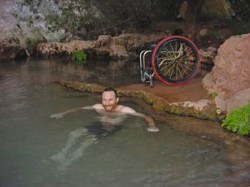
Later that day we were swimming next to our campground when three Havasupai Indians, about 12 or 13 years old, came by for a swim. The locals refer to themselves as Indians, and the kids that were swimming with us proudly announced to Sarah, “You are lucky, you get to swim with real Indians!” I was already out of my chair and dragging my butt across the sand to the water. The kids asked about this and I explained that I was paralyzed, then rolled in and started swimming. Sarah, as usual, charmed the kids and they asked her if she wanted a Havasupai (their native language) name. They gave her one that means “Mommy Coyote” in Havasupai.
I asked if they would give me a Havasupai name and they said sure. Only this time they swam to the other side of the creek, spoke amongst themselves in Havasupai, finally came up with something, started laughing and swam back to me and told me the name. When I finally pronounced it correctly, they started laughing. I asked what it meant and they said the name means “Soars with Eagles.”
After they left I got a bit suspicious and told Joanna, “I know when I was 13 years old I would play tricks on any adult, and by the way they were laughing, I’d say my Havasupai name probably means “Drags Ass in Sand.” Oh well, if the butt print fits …
What Goes Down Must Come Back Up
That night we were all turning in, the rest of the family was zipping up their tents and I was sitting on my sleeping bag — still out in the open — in my shorts. Just before I turned out my light, I glanced down and saw a scorpion walking on my sleeping bag toward my legs. I FREAKED OUT! — and did the fastest ground-to-chair transfer in history. Moments later, with a serious case of the willies, I begged Joanna and Sarah to move over and let me sleep in their tent. So much for being Mr. Back to Nature. Drags Ass in Sand does not like scorpions!

The following day the rest of the family decided to attempt the 10-mile trek down to the Colorado River. Getting carried on Scott’s back and lowered down 100-foot cliffs was more than I was up for. I opted to spend a quality father/daughter day with Sarah going on a slow hike — a chair in sand and rocks travels about the same speed as a capable 3 year old walks — to see the 200-foot Mooney Falls. Along the way we passed a couple who stopped and said to me, “You’re the guy.” I said, “Um — I’m what guy”? They replied, “When we got to the trailhead we asked the packer how difficult the hike in was because we weren’t sure if we should hire a horse or take the helicopter or hike. The packer smiled and said, “it’s not too tough — a couple of days ago a guy did the hike in a wheelchair.” They had made it fine, but every time their blisters hurt I’m sure they were cursing that Drags Ass in Sand guy.
After a week in paradise, it was time to return home. The idea of riding my bike up the 3500-foot trail was out of the question; it would have taken days. We booked a pack horse to haul my bike and our gear, and another horse to take Sarah and I to Supai, and then a helicopter to fly us to the trailhead.
The next morning the rest of the family was up and hiking by 7 a.m. A couple hours later Sarah and I were met by our packer and guide Dave Bartholomew. None of the Havasupai area is accessible, but the locals are happy to help where they can. Dave was great. After loading up our gear, he put my ROHO saddle cushion on Crow, one of the best-trained horses I had ever ridden. Dave then hoisted me up onto Crow’s saddle, put Sarah in the saddle in front of me and tied my chair to the back of his saddle. We were off.
This was the third time I have ridden horses since I got hurt, but it won’t be my last — it’s like walking again! As we ascended the steep rough trail to town, I couldn’t believe I had ridden my bike down the same path.
Resources
- Havasupai Tourist Enterprise, Supai, AZ; 520/448-2121, fax: 520/448-2551; www.havasupaitribe.com.
- Havasupai Lodge, Supai, AZ; 520/448-2111; lodge@havasupaitribe.com.
- Custom Saddle Cushions: The ROHO Group, 100 N. Florida Ave., Belleville, IL 62221; 800/851-3449 or 618/277-9173, fax: 618/277-9561; www.therohogroup.com
Support New MobilityWait! Before you wander off to other parts of the internet, please consider supporting New Mobility. For more than three decades, New Mobility has published groundbreaking content for active wheelchair users. We share practical advice from wheelchair users across the country, review life-changing technology and demand equity in healthcare, travel and all facets of life. But none of this is cheap, easy or profitable. Your support helps us give wheelchair users the resources to build a fulfilling life. |


Recent Comments
Neil on A Safe, Effective Reusable Catheter System
Richard Crumb on A Safe, Effective Reusable Catheter System
Richard Crumb on A Safe, Effective Reusable Catheter System