



It was toward the end of the evening at Contento — after the ceviche and the panisse with uchucuta sauce, midway through my second glass of Alvarinho, as I decided between seaweed speckled deviled eggs or a Peruvian causa for my third course — that I realized something remarkable. I wasn’t in the way.
I had been savoring the cuisine at this small restaurant in Manhattan for an hour or more, and I’d yet to be jostled by a single elbow or have my wheels tripped over by a server. My back-end wasn’t protruding into the arterial flow of the room, nor was I stuck in a corner, unable to escape for a pee. “Excuse me, sir, can you squeeze in a little so I can get by? Oop, just a little more?”
No, here I hadn’t dealt with any of that. When I arrived, I rolled up to the front door via a wide, gentle concrete ramp from the sidewalk. Before I had a chance to think about opening the door, it opened for me. Mara Rudzinski, one of the restaurant’s managing partners who was serving as the host that night, greeted me and showed me to my spot at the lowered bar counter. Even as a party of one on a weeknight, I had needed a reservation. I quickly understood why Contento has rarely had an open table since it opened.
Opening With a Bang

Contento was the brainchild of two wheelchair users, Yannick Benjamin and George Gallego. It opened in June 2021, staking itself as a restaurant opened by and for people with disabilities, and it immediately became one of the most talked-about new establishments in New York City. The New Yorker and New York Times both reviewed it glowingly. Eater and Timeout both put it on “best of NYC” lists.
Most of the early coverage focused on the restaurant’s commitment to inclusivity. But then the awards kept coming. The New York Times named it one of its 10 Best New Restaurants of 2021. The World of Fine Wine deemed Contento to have the best micro wine list in the world for 2021, and Wine Enthusiast tapped Benjamin as its sommelier/beverage director of the year. Esquire listed Contento as one of the best new restaurants in the country. “In the most positive way … it was really overwhelming,” says Benjamin.
Benjamin is a sommelier who was New Mobility’s 2017 Person of the Year alongside Alex Elegudin, his partner in the disability-services nonprofit Wheeling Forward. Gallego worked with Benjamin at the Axis Project, a community and fitness center for people with disabilities in New York City. Gallego also runs a nonprofit that transitions New Yorkers with disabilities out of nursing homes. Accessibility and inclusivity are not buzzy marketing terms for these two men, rather concepts that have been a driving force throughout their post-injury lives.
Benjamin had the idea of opening his own restaurant since he started using a wheelchair, the result of a car accident when he was 26. He’d already worked in some of the finest restaurants in NYC, but when he went for interviews as a wheelchair user, the conversation always seemed to focus on the physical demands of working the floor. Benjamin eventually found a job at Le Du’s, an iconic wine shop in the West Village, and then worked the floor at the University Club in Midtown Manhattan. Still, he never stopped dreaming of opening a space where access was a given.
It wasn’t until Gallego found a space in East Harlem — small, needing a complete build-out, but inexpensive and “an empty canvas” — that the pair decided to go for it. They didn’t know what the restaurant was going to be yet, just that it would be “as barrier-free as possible” for customers and employees and have a reasonable price point.
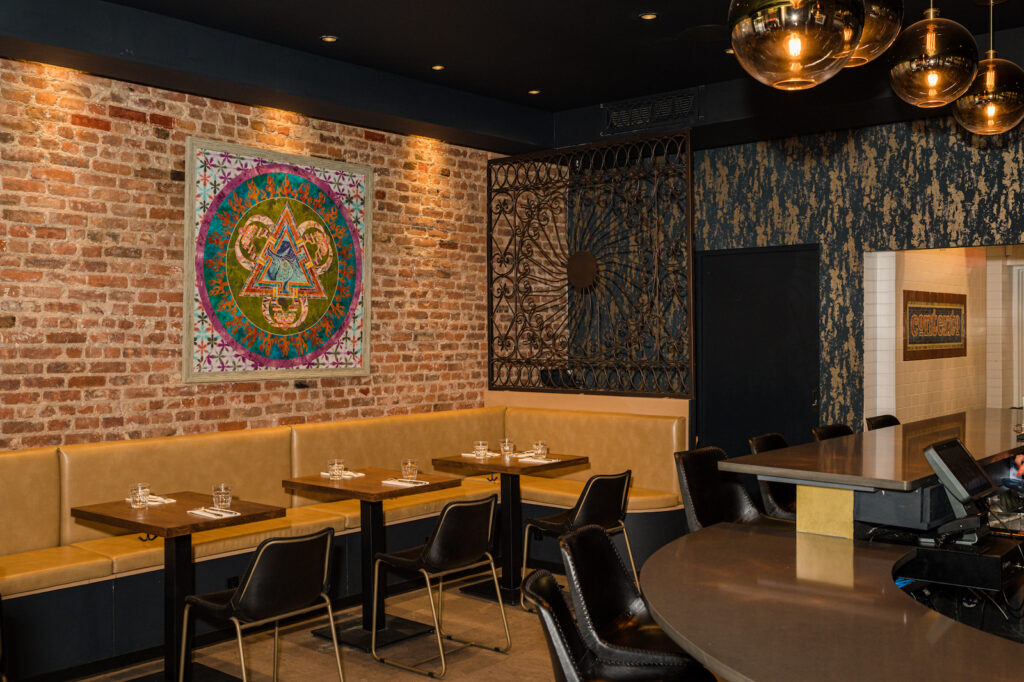
“Contento” means content in both Italian and Spanish, a nod to the feeling they intended to evoke and to the history of the neighborhood in which Contento is located. East Harlem — often called El Barrio or Spanish Harlem — was predominantly Italian throughout the 19th and early 20th centuries before transitioning into a Latino neighborhood in the ’40s and ’50s. Benjamin says it was important that the name paid homage to the immigrant groups that had made the neighborhood what it was. “I didn’t want to be known as the person who’s going to come in gentrifying a neighborhood that I already had such a deep respect for,” says Benjamin, whose parents emigrated from France. “I don’t want to change a thing about it. I just want to be a part of it.”
Benjamin and Gallego, who lives just down the block from the restaurant, wanted Contento to be a place where people from the neighborhood would feel welcome and be able to afford coming in for a drink and a bite. From my single-night sample size, it appears that they have succeeded. Next to me at the bar sat a (very chatty) postal worker, originally from the Dominican Republic, who lived a few blocks away.
The Fare
The menu isn’t cheap — Benjamin says the average dinner tab is $80 per person — but relative to other New York hot spots, it’s a bargain, and the menu is wide-ranging. The ceviche is $23, while the dry aged cote de boeuf (for two) will set you back $175. Everything is Peruvian-influenced, thanks to chef Oscar Lorenzzi, who grew up in Lima before working his way up through the New York kitchen scene. The food is creative — think of a risotto-style dish made from the Andean grain quinoa, fries made from yuca, a South American tuber, or octopus with a chimichurri sauce and cauliflower gazpacho.
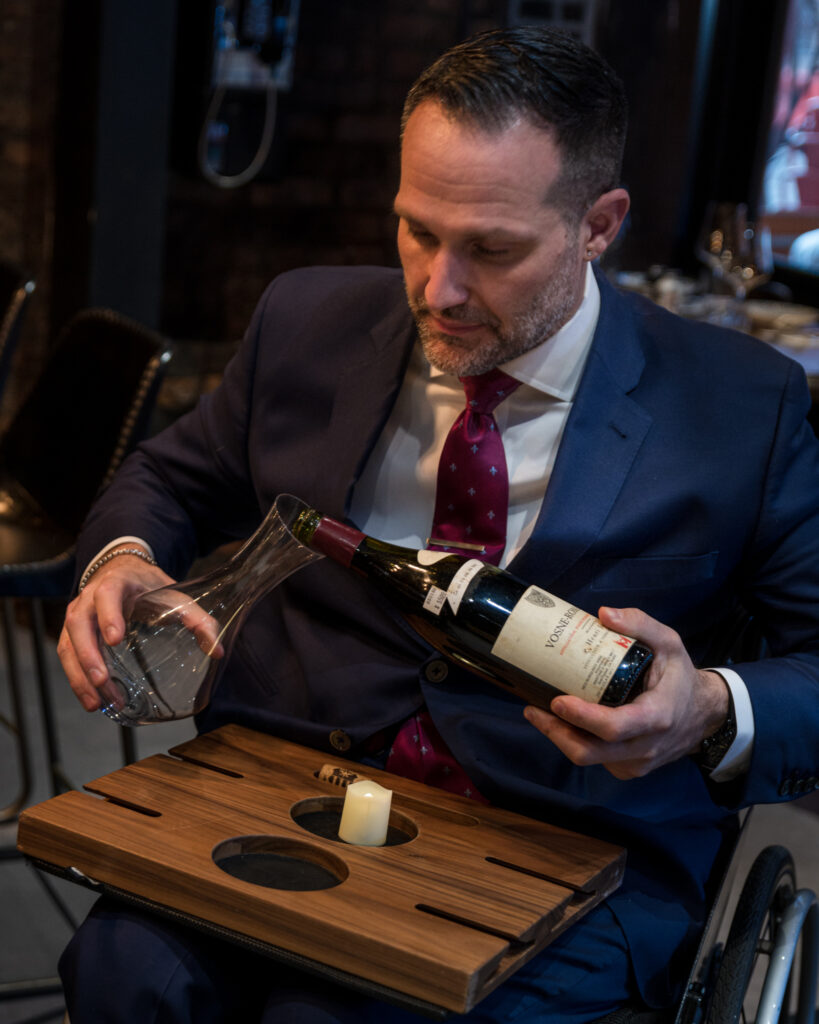
Benjamin put together the wine list, with a section sourced from wineries with social and environmental impact. There are bottles and glasses to fit every budget and palate. You can get a $13 glass of Spanish Grenache or a $290 bottle of Domaine Roulot chardonnay and everything in between (or above). The postal worker and I stuck with the sub-$15 glasses, while behind us, a guy who had enough money to not feel out of place wearing a T-shirt and jeans kept the bottles flowing.
Maybe expensive T-shirt guy learned something, though, as the 11-page wine menu has disability facts and explainers peppered throughout. If he found himself contemplating a Uruguayan Marselan, which apparently has flavors of blackberries, tar, hot stones and violets (yum?), he may also have learned that in 2020, “29% of workers with a disability were employed only part-time, compared with 16% of [workers] without a disability.”
Benjamin and Gallego were prepping for catering an event for the Mayor’s Office for People with Disabilities the night I was at Contento. But Benjamin is often working the floor, rolling from table to table, checking in with guests, recommending, serving and typically treating everyone he talks to like they’re the most important person in the room.
Beyond Physical Access
Perhaps the most exciting thing about Contento is that it manages to make its physical accessibility an afterthought. My night there reminds me of a conversation I had with the architect Karen Braitmayer, who described accessibility as a framework within which good design can flourish. At Contento, accessibility is a framework from which you can fully experience great food, drink and service.
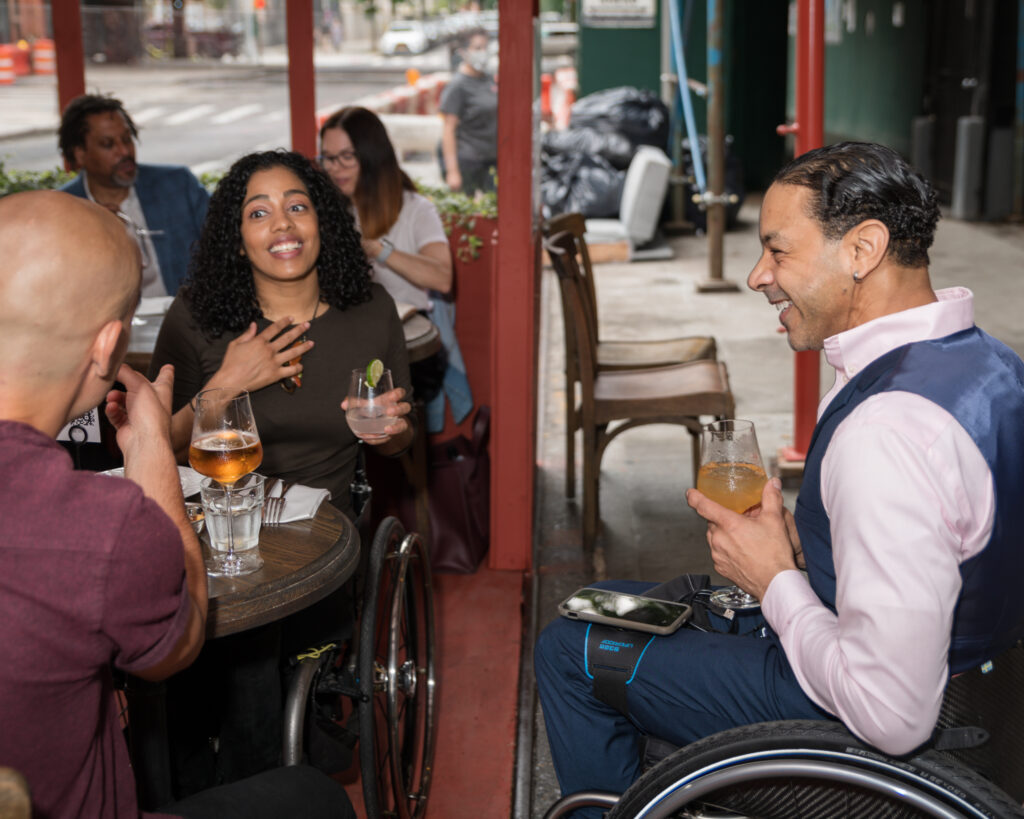
Don’t get me wrong, Contento does physical access as well as anyone. Tables are spaced around the edge of the restaurant, and wheelchair users have enough space to fit at every table without staff having to move things around. All tables are set at a height that can accommodate most manual and power wheelchair users. The bar is split evenly, with one section at typical height and the other set low. The outdoor seating is level and as roomy as the inside. There is one bathroom, and it has enough space for a power wheelchair user to turn around and recline if necessary. A server will bring you adaptive utensils if you request them, and menus are available in braille or via QR code and a screen reader if you need.
But what sets Contento apart is the attitude of the staff and the ambiance formed by the regular presence of customers with varying types of disabilities. As a disabled person, you are meant to feel welcome here. Benjamin says they regularly bring in educators from different disability groups — low vision, deaf and hard of hearing, cognitive and sensory disabilities — to train staff on culture and etiquette. “I’m still learning,” says Benjamin. “We’re not claiming to be the end-all be-all. … Teach us. Give us some feedback. How can we do better?”

The goal is to create an environment where people with disabilities feel comfortable being themselves. Benjamin tells the story of a lawyer who came into Contento not long ago. She has arm and hand weakness, and typically brings an attendant to restaurants to help her eat. But at Contento, she dined the way she does at home: by bending down and eating directly off her plate. “That’s the greatest compliment,” he says. “That’s exactly the way we want people to feel.”
The Full Experience
Contento made a name for itself because of access and inclusion, but tables stay full because the team does everything well. The service is so good it can be unnerving — servers seem to appear only at the precise moment you need something. The effect is that you’re always taken care of but never feel like you’re being rushed.
As I sat at the bar, I noticed a woman in a wheelchair rolling up to one of the outdoor tables. In a few minutes, a few more wheelchair users joined her. I looked again, and sure enough, I recognized all of them from my work with New Mobility.
“There’s no better place in the country for a wheelchair user to have a meal, sip a drink and catch up with friends,
or make new ones.”
It was a bit of a surreal moment. They had all been featured in the magazine, but I had never met any of them. The “disability community” often only exists online, a collection of individuals with shared understanding and experience stitched together by social media posts, Facebook groups, blogs and websites. Yet here we all were on a Tuesday night because there’s no better place in the country for a wheelchair user to have a meal, sip a drink and catch up with friends, or make new ones.
My meal finished with the fancy deviled eggs. I didn’t have to think about an exit strategy through a gauntlet of patrons. I just unlocked my brakes, went to the bathroom and rolled back to the front door. Rudzinski offered to call me a cab, but it was a crisp fall night and rolling a few miles through the city back to my hotel seemed as good a nightcap as any.
Support New MobilityWait! Before you wander off to other parts of the internet, please consider supporting New Mobility. For more than three decades, New Mobility has published groundbreaking content for active wheelchair users. We share practical advice from wheelchair users across the country, review life-changing technology and demand equity in healthcare, travel and all facets of life. But none of this is cheap, easy or profitable. Your support helps us give wheelchair users the resources to build a fulfilling life. |


It would be even better if you had dietary accommodations such as pureeing the food someone orders.
Wow 🤩 this is WONDERFUL
I had the overpowering feeling of wanting to weep when I read this. As a short person, using a w/c for 2 yrs and limited abilities due to EDS, other medical diagnoses and a C1,2 fusion by a criminal “Dr”, I am so exhausted and sad by the number of facilities who cannot make the simplest of accessibilities happen. Examples? putting soap dispensers too high, paper towels across the room from the sink, doors that won’t open for a w/c user, having to leave the RR stall door open so I have room to leave the chair partway through the door, thresholds too high for my arms to be able to make my chair cross, waiting rooms with no open space for me to wheel back against the wall like other chairs so I can converse with the person helping me, small dr patient exam rooms, restaurants without room to move around, restaurants with all hard seats so there is no point to transferring to a regular chair for those with spinal column pain, the list of the way facilities make an obligatory attempt to be accessible and fail to be is endless. I have been told to “Go around back, there is a ramp back there and just go through our storeroom up to our store.” To have to go behind a building and realize the ramp is disgustingly filthy and put there so the store can receive product with a wheeled cart/dolly is disheartening and I admit- sometimes it affects my selfworth.
Even though I am careful to frequent businesses and facilities ONLY if I need or want something from their business, when the business does not make even basic or reasonable accommodations, the message is clear: “If you cannot walk into our business and use it or shop like all of our other customers or patients, You do not deserve to be here, nor should you be here. We only tolerate you b/c it is the law. We resent the laws put in place to accommodate you, because it costs money that we don’t want to spend.”
Those attitudes? They hurt so much. Getting around as a person who uses a wheelchair, or who needs some modifications to accommodate our needs is hard enough! We did not choose to not walk. We did not choose to have limited use of our bodies!
We all, able-bodied or not, need other people to help us at some point in life. Many of us do have a level of empathy where we are conscious to the needs of others. Unfortunately that empathy is only applied to a select few, and this is wrong. That cute sick child will hopefully live into adulthood, and they will still need help. But chronically ill adults or adults with accessibility issues are not popular so there are fewer resources and the world does not care if they can get around.
Since Covid, the world has changed so that people can access most goods and services remotely.
Schools closed and remote classrooms opened up. When our children were in school, our dtr’s medical conditions kept her home most of the time. We asked the school if they would be willing to set up cameras in the classroom so she could learn while lying in bed. The answer was a horrified, “Definitely not! That would be a huge invasion of privacy for others in the room and it would be too expensive!”
Employees can now work remotely from home. Remember how companies required people work at the physical location? Suddenly accommodations were possible after all.
My point is when these things became needed by many others, the entire world got on board and they were put into place. But previously these accommodations were needed by those who were not “able-bodied” and this entire population of people were denied the right to learn from teachers’ live instruction and they were not given the options to earn a living in a way which would accommodate their abilities.
We live within ever-growing circles of communities. From the family unit, to churches and schools, to suburbs, towns, cities, states, nations. We all need each other to make our lives better.
This restaurant has done what the world thought was impossible prior to a pandemic.
These two men made their corner of the world a better place for those who needed a bit of help.
Will others now step up and do this, too? It does not need to be on a grand scale.
Some people need help. It is Every persons’ opportunity and even responsibility to provide it.
We all need to Do Better and Be Better.
Excellent
I have heard only good things about this restaurant and look forward to trying it in the future.
My comment here is in reference to two things about this article:
In the section “Opening with a Bang,” the first picture shows the restaurant founders in front of The Vessel at Hudson Yards. This structure is closed to the public now because of safety concerns. I am perplexed why the editor/author chose to use this as a background. Even when the structure was open, it is not an accessible space. There is an elevator that takes you almost to the top, but all of the levels between there and the ground are accessible only by stairs. (The elevator can make emergency stops at other levels, but we were told that this was not for use by the visiting public.)
In the section “The Full Experience,” you referred to “a woman in a wheelchair.” The woman is in the restaurant and uses a wheelchair as an assistive device.
I love your magazine and look forward to each issue, online or in print.