


Having to ask for help draining a leg bag can be one of the most frustrating and embarrassing everyday tasks of life as a higher-level quadriplegic. As soon as I was paralyzed in 1986, I was on a mission to come up with a better solution to independently manage my bladder. Almost 40 years later, I’m still tinkering. Here are three solutions I’ve found along the way.
A Leg Bag Drainer

Back in the ’80s, the only option I could find for a leg-bag- drainer was an electric 24-volt valve that connected to your wheelchair batteries. It cost over $400. I sprung for the unit and enjoyed the freedom to be alone for most of the day — but within a year it quit working.
If only I’d had my beloved 3D printer. Ever since I got my first little Anycubic in 1997, I’ve used it to print simple, affordable solutions. Instead of wasting a lot of money on an imperfect product, my friends and I work to identify a problem, brainstorm a solution and then print it, right in my own home. Sometimes it takes a few iterations and some tinkering, but time and again, we’ve come up with unique products that worked better than anything I had seen for sale. That’s exactly what happened once I decided to devise a better leg bag drainer.
“I’m not a medical expert, just a guy living in a partially functioning body trying to increase my quality of life and extend my visit to this planet.”
I wanted the drainer to be easy to use and reliable. I’m nervous about fire hazards, so I focused on a solution that would be manually operated instead of tapping into my wheelchair’s batteries. Instead of inventing a new valve, I searched the internet. I found a cheap manual plastic fuel valve for about $10, and scrolling down farther on the website there were 20 valves for $20. I didn’t really need 20 of them — but coming from a long line of professional hoarders, I figured there’d be a use for the other 19 at some point, right?
After some tinkering on Tinkercad.com, I had a 3D-printable design that would house and allow me to operate my $1 bargain valve. My buddy Dave came over for our weekly “tinker-frick-day,” and in about an hour he had it glue-gunned together and mounted. The main housing that holds the valve is printed thick and solid, with the valve glue- gunned in place. A lever is attached to the valve, making opening and closing of the valve easy. I needed a way to open and close it, a string would work for pulling the lever up, but after extensive testing we realized string isn’t very good for pushing. A glance around the room revealed a broken fishing rod.
Attaching it to the lever proved that it worked great for pushing and pulling the lever. Now after a couple of years of flawless operation, it appears that I have a lifetime supply of plastic fuel valves.
Dealing with Bladder Sores
A few years ago, I was at my yearly urologist checkup, and he was explaining what he saw in my bladder as we watched it onscreen in real time.
“What are the red spots on the bladder wall?” I asked.
“Those are sores, your catheter touches the wall and rubs on it, making a sore,” he replied.
I use an indwelling catheter and was previously advised that it wasn’t the best for long-term health. “Is there a solution?” I asked.
“Intermittent catheterization is better — then there won’t be sores.”
I enjoy being relatively independent during the day, and having to rely on an attendant to catheterize me every few hours had always been unappealing. I used a condom catheter, but after tiring of having accidents, I switched to an indwelling catheter. Still, I understood that using an indwelling catheter would eventually lead to my bladder shrinking, as the constant draining robs the bladder of its elasticity and makes the catheter more likely to rub the bladder walls and create problems. So, I figured mimicking the way my bladder was designed to work — allowing urine to build up before draining en masse — made sense.
Dave and I got to work brainstorming a solution that would do just this. We found a simple hose clamper that I could manually block and release the flow from my catheter. I clamped it off for an hour or so at a time. My bladder tells me when it’s getting full with mild tingles up my neck. Then I open the clamp. I did this daily for the next year, about two to four times per day, or whenever I remembered. My bladder infection frequency reduced from every couple of months down to a couple of times per year. The next year I went for my bladder check. We once again looked at the computer screen in real time.
“How long have you been on an indwelling catheter?” asked the urologist.
“About three or four years,” I said.
“Your bladder looks perfectly normal, no sores or any- thing,” he said.
Sure enough, there were no red sores. I told him what I was doing.
“I don’t recommend that,” he said. “But based on the way it looks, I think, keep doing what you’re doing.”
Computer-Aided Drainer
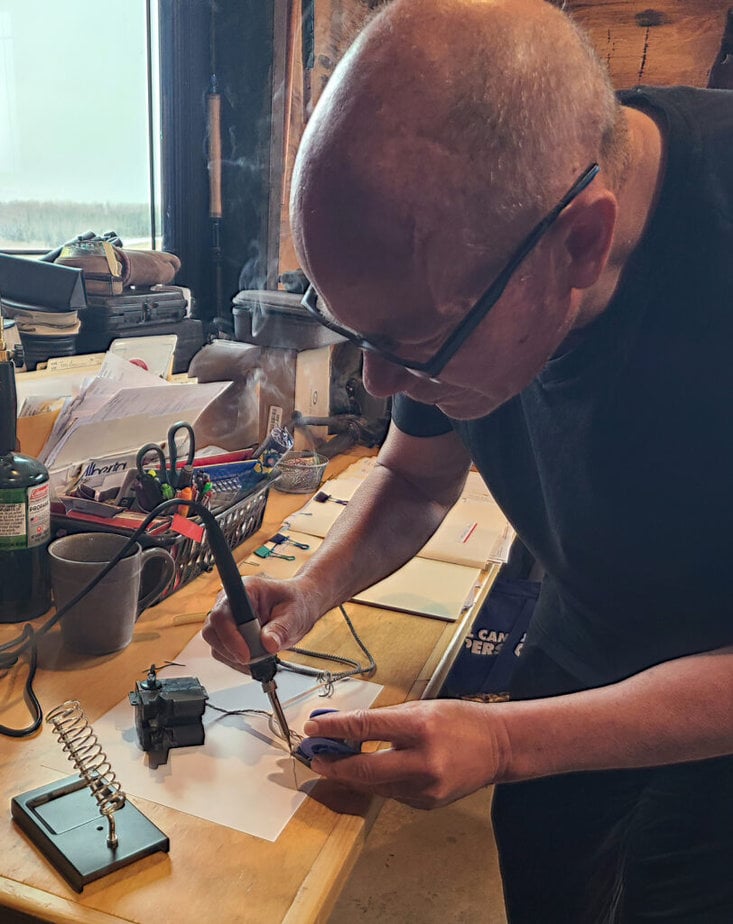
I did, until recently when my friend Landon, also a quad, got me interested in Arduino computer boards. They are programmed from a PC and can take inputs and send a result to outputs. At my age, without programming experience, learning C++ (computer language) is a bit of a stretch, but fun. After realizing that these can run a servo, the hamster in my head started running on its wheel.
I programmed an Arduino on Tinkercad.com’s Arduino simulator to make a servo turn its motor to a specified degree of rotation and hold the position for a set time. You know where I’m going with this: I started thinking of building an Arduino-controlled clamp that would allow my bladder to fill, then empty, all automatically. In my thinking, the faster fluid flow should reduce bladder sediment buildup; mimicking normal bladder behavior should help with sores and improve overall bladder health.
I bought an Arduino, and Landon suggested an Arduino Micro Pro for the finished product. Some radio-control enthusiast friends donated servos. With the 3D printer, I designed a servo-operated pinch valve and set up the Arduino to open and close it. After some tweaking, it blocked a rubber tube on command, and opened it. It is powered by a USB and uses about 1 amp for the servo. I turned it on and programmed it to open and close every 10 seconds for a few days to test reliability. We had to glue a pin that worked loose, and Loctite a screw on the servo, but it otherwise proved durable.
On our next “tinker-frick-day,” Dave soldered the wires to a Micro board, and we loaded the code into it. We made a power cord out of a high-speed USB cable and soldered it to the board, powering the servo directly as the board isn’t designed to power more than a few milliamps. We plugged the USB into a phone-charger-battery and let it run for a day. The unit used very little power and seemed reliable.
I’m the Guinea Pig. I’ve been blocking my bladder for 15 minutes and letting it flow for 15 minutes in the evenings. After a few days of use there seems to be much less sediment, and I drain a lot of fluid during the day and have less foot swelling. Long term? I don’t know yet, but it would seem mimicking normal bladder function should be good, and hopefully there’ll be long-term benefits. I will keep testing and monitoring for infections. If nothing else, we created a first-class computerized plant waterer and learned some new programming skills!
Now remember, don’t ever take any medical advice from me (I wouldn’t), and I don’t give any. I’m not a medical expert, just a guy living in a partially functioning body trying to increase my quality of life and extend my visit to this planet.
Support New MobilityWait! Before you wander off to other parts of the internet, please consider supporting New Mobility. For more than three decades, New Mobility has published groundbreaking content for active wheelchair users. We share practical advice from wheelchair users across the country, review life-changing technology and demand equity in healthcare, travel and all facets of life. But none of this is cheap, easy or profitable. Your support helps us give wheelchair users the resources to build a fulfilling life. |


I think your thinking is responsible and thoughtful. I have a bladder disease called Interstitial Cystitis and know a lot about bladders. It seems your ideas about making sure your bladder is able to function more normally so that it’s not losing its elasticity is of vital importance, especially for someone who is paralyzed (my mom was a quad), and being able to make sure that you’re getting as much urine and sediment out each time as well as protecting the bladder wall from any damage from the catheter is really vital. (My form of IC includes Hunner’s Ulcers which don’t feel great when I have a flare so any place there are sores on the bladder wall will cause great discomfort.)
Keep thinking of solutions because there is no box.
Great article!!! I have been doing this for myself, using both Supra pubic catheter and condom catheter, using a clamp on the Supra pubic catheter and using a condom catheter so I don’t piss my pants accidentally. Also working on trying to transition over to using condom catheter instead of suprapubic catheter so I can make my body function normally again.
Doctors say they disagree and that this is dangerous, however it’s common sense and all it takes is using your brain for a few minutes to solve a problem to come up with this sort of an idea. Your article confirms my plans, thank you very much. I would sincerely love to get access to your 3-D printer plans so I can give them to a friend to print my own. Please let me know if that’s possible, thank you very much.
I am looking for something that I can urinate independently when I am out. I use a power chair and I have limited coordination. I am not interested in a catheter and leg bag. Is there a small device with a handle and a tube for draining the urine directly in the toilet? How well does it work for you?