


Could Paralympian and ‘Prairie Populist’ Josh Turek Be Iowa’s Next Senator?
November 7, 2025
Ian Ruder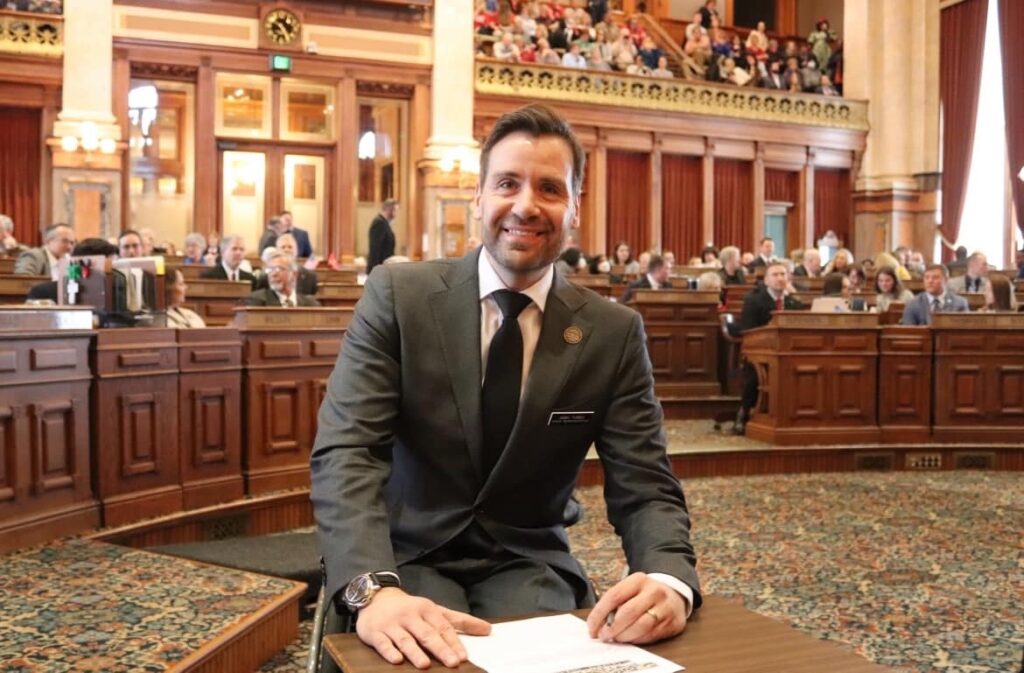
The featured video on Iowa Representative Josh Turek’s campaign page shows Turek pushing his manual wheelchair up a steep hill as his voice recounts the underdog route that he has taken to become one of the Democratic Party’s most promising hopes to turn a Senate seat in 2026’s midterm elections.
“A whole lotta folks are going to look at a guy like me and say, man, that is a real long shot,” he says. “Well, in Iowa, we love an underdog. So, if you are ready to push for change, join me.”
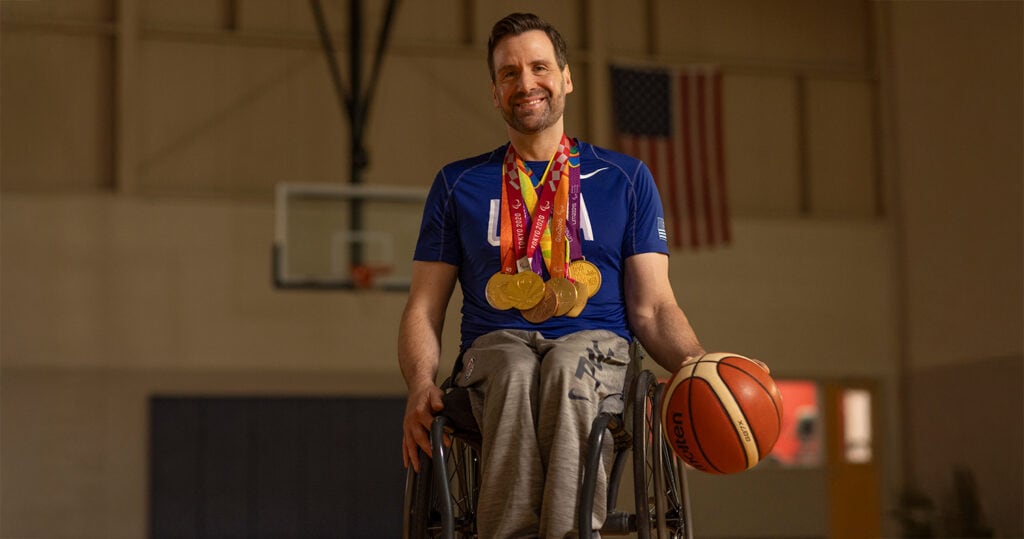
Born with spina bifida, Turek credits growing up poor and disabled for helping instill the mental strength and character that eventually helped him become a two-time Paralympic gold medalist and get elected to Iowa’s House of Representatives as a first-time candidate in 2022 at the age of 43. The 20th District seat he won had been held by Republicans for the previous three elections, but Turek “climbed, crawled and dragged” his wheelchair to 14,000 doors in the district and eked out a win by six votes. The victory burnished his credentials as the rare candidate who can communicate across party lines in these highly partisan times.
Now, as one of a handful of Democrats vying for the U.S. Senate seat that opened when Republican Senator Joni Ernst announced she would not run for reelection, Turek is facing his biggest challenge yet on the campaign trail. He has eight months before Iowa’s primary election to convince Democratic voters to give him a chance to become the first permanently disabled U.S. Senator from Iowa.
New Mobility spoke with him about how he is crafting his message to voters as a proudly disabled candidate, how he believes getting out the disabled vote will be “one of his superpowers” in the race and much more.
New Mobility: I know it’s early, and maybe the answer is different in a few months, but if you had to rate the difficulty of preparing for and competing in three Paralympics versus campaigning for federal office, what has been harder?
Josh Turek: This is harder, and I didn’t think I would ever say that. I thought that the most challenging thing that I would ever do in my life would be preparing myself to win a gold medal. This is a different challenge — I’m not as physically tired at the end of the day, but I’m certainly mentally exhausted at the end of each day.
NM: What do you do to take care of your body during this grueling time?
JT: This campaign is a marathon — a 16-month marathon at a sprint pace. I’m doing everything I can to take care of myself physically— drinking water, intermittent fasting, trying everything I can to do to avoid pressure sores and urinary tract infections. There are days where I start at 5:30 or 6 o’clock in the morning, and there’s days where I don’t get to bed until one or two o’clock in the morning. This is an unbelievable Herculean task to pull this off, and the additional challenges of doing this with a disability are significant. But the work is meaningful and it’s important.
NM: With recent assassination attempts and personal attacks against political figures on the rise, running for political office seems more fraught than at any time in recent memory. What motivates you to run for national office and put yourself out there even more?
JT: It’s a terrifying moment, but we need to have courage. We need to have representatives who are willing to step up and fight for people and fight for social safety nets like health care and Medicaid and Medicare and Social Security that have benefited all of us.
Something that gives me a lot of inspiration every single day is representing disabled Iowans. I’m the first permanently disabled member of the Iowa legislature, and being able to represent the one in five Iowans who are disabled has really been one of the great honors of my lifetime.
NM: A few years ago, disability representation and awareness really seemed to be on the rise, but over the last year the tide has turned. Has the recent crackdown on DEI changed the way you are campaigning, and how do you work to create a more positive perception of disability and a deeper understanding of our community’s needs?
JT: I’m not asking people to vote for me because I’m disabled. I’m asking people to vote for me because I’m the best man for the job. I don’t want to be defined exclusively as “Josh the disabled legislator,” or the “guy we only need to come to on disability issues.” But I realize that people are going to see my disability immediately, and to some degree, they are going to define me by that. So the challenge for me is to prove that I’m articulate and competent and well-versed on all these issues.
NM: What is your message to disabled voters who may be scared or feeling disenfranchised right now?
JT: I think my message to disabled voters is that we have been so siloed that there has almost been what I would define as a famine mentality that has taken over the disabled population. We’re all fighting over the same handful of resources in these nonprofit organizations. What we haven’t seen is disabled Americans coming together behind one cause to fight for the handful of issues that are raising the tides for all boats — affordable and accessible healthcare, social safety nets, the cuts to Medicaid, the cuts to services and the direct care worker crisis. This is the thing that we’ve got to come together and fight for.
NM: In this era of hyper-partisan politics, I see a lot of people saying that critical issues like health care shouldn’t be political when I think they mean they shouldn’t be partisan. How do you help people see beyond partisan rhetoric and begin to understand that almost everything is political?
JT: It’s been kind of fascinating to me that the only issue that I have found that has been unanimously supported when I’m knocking on doors is that our health care system is broken. Yet there is a complete disconnect with individuals not realizing how going to the ballot box and voting is directly related to their healthcare options. We have to do a better job making sure that people understand that when you’re going to the ballot box, it’s not just these culture war issues that affect a handful of people, but your livable wage, whether you have affordable housing or not, whether you have affordable pharmaceuticals, affordable health care, whether you have clean drinking water infrastructure, functioning schools— this is all directly related to the individuals that you vote for.
NM: You clearly had success doing getting that message across when you flipped a traditionally Republican seat in the Iowa House of Representatives. What was the messaging that allowed you to crack through where other people haven’t?
JT: I’m a Democrat, and I represent the reddest district in Iowa. Trump won my county by 20 points. I was able to win by nearly six points [Turek’s 2024 reelection campaign], 50% more than any other Democrat in Iowa.
My message is that I’m common sense and I’m willing to work across the aisle when it benefits the middle class, and when it helps Iowa workers and Iowa families. I think what people want more than Republican or more than Democrat, is someone that is genuine, authentic and actually cares. They want someone who cares about the people, understands what they’re going through and is willing to do the hard work to provide legislative solutions to the problems.
I have that.
NM: You are frequently described as “a prairie populist.” What is a prairie populist?
JT: A prairie populist is someone that is fighting for the middle class, fighting for working families, fighting for small businesses, fighting for family farms, fighting for the little guy. Somebody that is, is looking out for the average American and not just looking out for billionaires and large corporations and the big donors, which far too many of our legislators and leaders are doing now. Someone like my hero, the father the American with Disabilities Act, [Retired Iowa Senator] Tom Harkin. Honestly, it’s only because of the work that he did in the United States Senate that I’m here.
NM: What was the most important thing you learned from going door to door for your previous campaigns?
JT: The value of having a conversation with the average voter and the importance of listening as a legislator. I’ve learned so much from going out there and talking to individuals. I learned what they care about and what they’re struggling with. The only way I could do that would be going out there every single day and having conversations. I think that’s the way the Founding Fathers intended this operating. You had representation to the point where every single person that you’re representing has the ability to get directly in touch with you. I’ve tried to do that, not only on the doors, but I try to respond to every single phone call that I get, every single message, every single email, because that’s what this is about. It’s not easy to go out there every single day, rain or shine, particularly for those of us who are disabled. It’s humbling to go out there and crawl up the stairs and drag your wheelchair up there and have a conversation over and over and over, but the hard work pays off.
NM: What do you say to disabled people who want to get involved in politics when you meet them on the campaign path?
JT: At the very least, we are 15% of the population. That is even more than the African American population, yet, we’ve had governors and mayors and congressmen and senators and even a president from the African American population. Then you look at the lack of representation from our population. It’s one of the reasons why we’re seeing all these barriers, we don’t have someone up there fighting for us. We need to come together and get behind a handful of issues like Medicaid cuts and healthcare that raise the tide for all of us. We are a large enough portion of the voting block that we can swing any election.
I would love to see more of us get engaged, turn out and vote. Start low. Run for your city council. Run for your school board. Run for your local mayor.
Support New MobilityWait! Before you wander off to other parts of the internet, please consider supporting New Mobility. For more than three decades, New Mobility has published groundbreaking content for active wheelchair users. We share practical advice from wheelchair users across the country, review life-changing technology and demand equity in healthcare, travel and all facets of life. But none of this is cheap, easy or profitable. Your support helps us give wheelchair users the resources to build a fulfilling life. |


Excellent interview! Ian Ruder asks the right questions that bring out how unique Josh Turek is as a politician. In fact, Turek’s answers reveal that he is not a politician at all in the traditional sense. He is a true representative of his state, his fellow Iowans, and he is working his butt off to gain their respect and support. Imagine how effective he will be along with Tammy Duckworth in the Senate, not only in disability issues, but also in working for better healthcare more broadly, and in all the issues that are so concerning to voters today. Vote! Our future quality of life is in our hands with leaders like Josh Turek.
Good to see Josh doing well. I played hoops against him many years ago when he was in college. I knew even then he was a high powered individual. Josh sounds more like an independent than a party affiliated person, which is a good thing.