


Nobody wants a colostomy but, if you are spending too much time on your bowel program, you may be dialing your GI doc after you read this.
The idea of a colostomy is viewed narrowly by most because of negative body image connotations. Still, people we talked to say–and studies reiterate–that quality of life improves after a colostomy.
While there can be complications related to surgery and the resulting stoma, most say the surgery gave them back their freedom–and they wish they had done it sooner. Those we spoke with traded bowel programs lasting two to six hours a day involving laxatives, medicines, digital stimulation, enemas–or all of the above–for a process that takes about 15 to 20 minutes a day.
Get Off the John
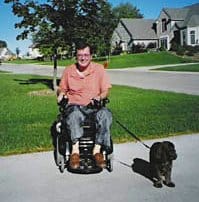
Diagnosed with MS 18 years ago, Steve Solsyk, of Menomonee Falls, Wisc., was spending hours every day on his bowel program. The progressive disease was making chair-to-toilet transfer dangerous–especially in bathrooms not his own–and timing had become a complicating factor.
“I tried desperately to establish some kind of regular program for the bathroom,” Solsyk says. “But the need would always hit me late afternoon or at night when my energy was down.”
After spending two to three hours on the toilet, an exhausted Solsyk fell to the floor many times while trying to transfer. He worried constantly about leaving his home and getting stuck in someone’s bathroom or falling in public restrooms–which happened twice when he was alone–and he lived in total fear of medicinally induced constipation. After exhausting all other possibilities for a healthy bowel program, Solsyk’s GI doc suggested a colostomy. Solsyk resisted until his routine included calling police once or twice a month for lift assist. He and his wife decided it was time for the surgery one year ago and now he says he wouldn’t think twice about the decision. Still, the ex-cyclist and runner admits there is an issue with body image.
“I won’t take the company line and say it’s no problem, nobody will notice and you won’t feel unattractive,” he says. “Yeah, you do. But, on the other hand, what’s the alternative? I didn’t see one, I was too busy getting stuck in the bathroom and not being able to get out. That was no way to live, there’s no quality of life there at all.”
Is Image Everything?
Olga Rosito, psychology Ph.D. candidate from San Jose, Calif., conducted a study in 2000 titled “The Effects of Colostomy on the Quality of Life in Patients with Spinal Cord Injury: a Retrospective Analysis.” The study included 38 veterans with spinal cord injuries who had colostomies and was performed at Stanford University/VA Palo Alto Health Care System.
Of the participants, only one–who had not yet experienced bowel problems–was dissatisfied with his qualify of life after surgery; another participant, a C3-4 quad, saw no noticeable change. The remaining participants, who had chronic bowel problems for at least one year, said their quality of life drastically improved post-surgery. Plus, because they had already made adjustments in their body image–as does anyone disabled–another body image adjustment (stoma formation) was relatively minor.
“People don’t do well with permanent changes to their bodies,” Rosito says. “The general public also takes for granted their bowel programs. Cancer patients [typical colostomy recipients] don’t have the ability to wrap their minds around it as well as the SCI population: These people have really been put through the boot camp of bowel problems and to them, surgery is a godsend. More than 50 percent of study participants said they would prefer to have this done earlier, at the onset of their bowel problems.”
Chronic bowel problems aren’t just annoyances, they involve life-threatening health risks such as pressure sore infections resulting from fecal matter, and bowel obstructions–both of which can be deadly. Colonic obstruction or perforation, stool impaction, major abdominal infection, anal trauma causing bleeding and enlarged hemorrhoids are all problems associated with individuals who have chronic neurogenic bowel. In addition, repeated rectal manipulation can worsen chances of autonomic dysreflexia.
Still, reluctance comes not only from people who can or should have a colostomy to eliminate bowel problems or improve their quality of life, but also the medical field. It’s the last resort for people with SCI, yet one of the first orders of treatment for people with cancer. Doctors usually suggest medicine or other programs before surgery.
Fiberoptic Surgery
“To my surprise, when I first started here five years ago, I discovered there is not much known about what is the appropriate [colostomy] surgery for people with SCI,” says Dr. Bassem Y. Safadi, assistant professor of surgery at Stanford’s VA Health Care System. “We don’t understand why the colon stops working for people with SCI,” he adds. “There’s a lot of theories but the only thing clear is that the rectum loses function and can’t contract and expel feces.” The tightness or looseness of the sphincter depends on the level of injury.

Safadi has developed a laparoscopic surgery that brings the left side of the colon (large intestine) to skin level and removes the portion of the colon called the sigmoid. He says by leaving the sigmoid after colostomy, as is normally done, you run the risk of developing inflammation in that part of the colon. As with other colostomies, the colon is sewn to the outside skin, resulting in the stoma, which looks like the tied end of a red balloon.
Stool moves passively through the stoma and into the appliance pouch, which is adhered to the skin via an adhesive faceplate. Safadi’s surgery involves small incisions and reduces risk of infections or hernia. It takes about one and a half hours, and people who get the procedure are back on food right away and to their regular activity level in a few days. General colostomy surgery takes the same time but recovery is two weeks or more, depending on overall health.
As with any major operation, potential complications include problems with anesthesia and blood pressure control, excessive bleeding, need for blood transfusion, infection, blood clots or pneumonia. Safadi thinks that this fact coupled with the thought of surgery are reasons for patient’s reluctance to have it done.
“But the second main concern or fear of this surgery is with distortion of body image,” he adds. “Regardless, people still say ‘I wish I would have done this earlier.’ It’s almost a uniform response.”
Safadi says people typically put up with bowel problems five to six years before having colostomy surgery. He adds that general surgeons have not yet adopted his surgery because they aren’t familiar with SCIs, but adds, “If anyone wants to have this done [SCI or not], any general surgeon with laparoscopic skills can do this without much training. Or, they can come here.”
Regardless how the colostomy is performed or how important your body image is to you, everyone we talked to suggests talking to others who have had the surgery.
Not Everyone’s Answer
“It is known as fact that colostomies frequently will cause the onset of depressive episodes and create a severe body image issue,” says licensed mental health counselor Michael Brennan, of Miami Beach, Fla. “It usually takes some kind of counseling for recipients to understand that their life hasn’t ended. You’re the same person, and yes, you have a new body image, but it doesn’t mean you can’t live your life.”
Brennan had a colostomy 30 years ago but, as a C4-6 quad, he found changing pouches difficult because he lacked dexterity. He had his surgery reversed and stresses to anyone thinking of colostomy surgery to get counseling and talk to other veteran colostomy recipients.
“After you have a colostomy, you’ll probably cycle through an anger and depression episode,” Brennan says. “Seek others who’ve been through this surgery to hear about their experiences and process of phases that they’ve been through. Talk to someone who’s had a colostomy for a few years and has accepted this new lifestyle and body image so you know that you can have a normal life.”
Contrary to Brennan’s experience, there have been no problems–emotionally or otherwise–for Teri Lehner, of New Berlin, Wisc., since her colostomy in March 2004. Lehner, T4, says to have the surgery as soon as you start to have constipation or other bowel problems. She wishes she had hers 15 years ago.
Prior to surgery, Lehner had a bowel movement only once every three weeks. Her program consisted of taking nine laxative tablets, digital stimulation and sitting on the toilet for six hours while her head dropped to her lap in slumber. She still dragged her red-ringed butt to work every day. Since surgery, she is having regular bowel movements, has more time for her two small children, ages 4 and 8, and eats whatever she likes, including her favorite spicy foods.
“Before, if I ate anything with MSG or sour cream, it’d make my bowels move and I’d be in crap up to my waist,” says Lehner. “Then, not only would I have to sit on the toilet for a couple hours, but I’d have all this extra washing to do. Now I can eat anything I want and if I have a little diarrhea, it’ll just go into the bag.”
Lehner credits the surgery for bringing about a huge improvement to her life. “Don’t fiddle around,” she stresses. “As soon as you start having bowel problems, go ahead and explore the colostomy picture.”
Taking Care of the Business End
According to wound, ostomy and continence nurse specialist Chuck Mathison, appliances and products have improved considerably since Brennan’s surgery 30 years ago.
“There are primarily two types of pouches, and depending on your personal needs, one of them will work for you,” says Mathison, who works at Froedtert Memorial Lutheran Hospital, Milwaukee, Wisc.
The one-piece closed-pouch system has an attached self-adhesive piece, called a faceplate, which sticks to your skin; pouches are disposed after each use. The two-piece drainable pouch is attached to a separate faceplate via a flange; pouches are cleaned, reused and discarded as necessary.
“The system you choose depends on your ability to change pouches and your discharge program,” Mathison says. “Any of the product manufacturers are very willing to send you free samples until you find the best system.”
Solsyk uses the disposable system and says his insurance pays for 60 pouches and 20 faceplates a month (Medicare’s coverage is similar). Depending on his diet, he goes through as few as 20 to 30 pouches a month or as many as 60 to 65 a month.
Lehner prefers the two-pouch system: She empties and washes the pouch every night before going to bed to alleviate leakage during the night. Pouches last two weeks. Both Lehner and Solsyk say they wear loose-fitting clothing so the pouch is not noticeable.
The closed disposable pouches feature a filter that absorbs gas and odor. With her reusable system, Lehner says she occasionally has to open her pouch to expel the gas (odor is absorbed by charcoal) but notes that like anybody, gas problems are related to diet.
“Of course, we suggest maintaining a sensible diet to keep your bowels in working order and to alleviate gas and odor problems,” Mathison adds. “That includes eating fiber and avoiding spicy foods.”
Stomas needs to be monitored carefully. Complications can include: death of stomal tissue, visible 12 to 24 hours after the operation (may require additional surgery); stoma retraction, caused by insufficient stomal length–can be revised or managed by use of special pouching supplies; prolapse, or increase in stoma above abdomen surface (surgery is required when blood supply is compromised); stenosis, or narrowing at the stoma opening–may require minor or major surgery; parastomal hernia–usually due to placement of the stoma at weakened abdominal wall (can use ostomy support belt or special pouching supplies–if severe, surgery is warranted).
Not Just for the Bowel-Challenged
Just days after we first spoke to him, Dennis Galvin, of Reno, Nev., was headed for an elective colostomy surgery. Galvin has a T5 incomplete injury as a result of transverse myelitis, a neurological disorder he sustained at 5 months old.
“I celebrate my 43rd anniversary with this [paralysis] and have been using my shoulders all my life,” Galvin says. “I don’t want to wear them out from transferring so often to and from toilets.”
Four days post-op, Galvin was transferring to his chair and changing his own pouch. He says he’s not as sore as he thought he’d be, expects to be back to work in three weeks and so far, everything his doctors and nurses told him to expect has been true.
“People need to stay extremely involved in their own care and extremely aware of what is available,” Rosito says. “You have to ask, ‘Do I make a good candidate for a colostomy?’ If no, then why not? Research shows the curative rate is very high for those colostomies that are done to relieve chronic bowel problems.”
Roxanne Van Duzee Furlong is a Minneapolis-based freelance writer who, along with her husband, Bill, lives with her own little chronic bowel challenge: a Dalmatian named Galloway.
Support New MobilityWait! Before you wander off to other parts of the internet, please consider supporting New Mobility. For more than three decades, New Mobility has published groundbreaking content for active wheelchair users. We share practical advice from wheelchair users across the country, review life-changing technology and demand equity in healthcare, travel and all facets of life. But none of this is cheap, easy or profitable. Your support helps us give wheelchair users the resources to build a fulfilling life. |


Recent Comments
Neil on A Safe, Effective Reusable Catheter System
Richard Crumb on A Safe, Effective Reusable Catheter System
Richard Crumb on A Safe, Effective Reusable Catheter System