


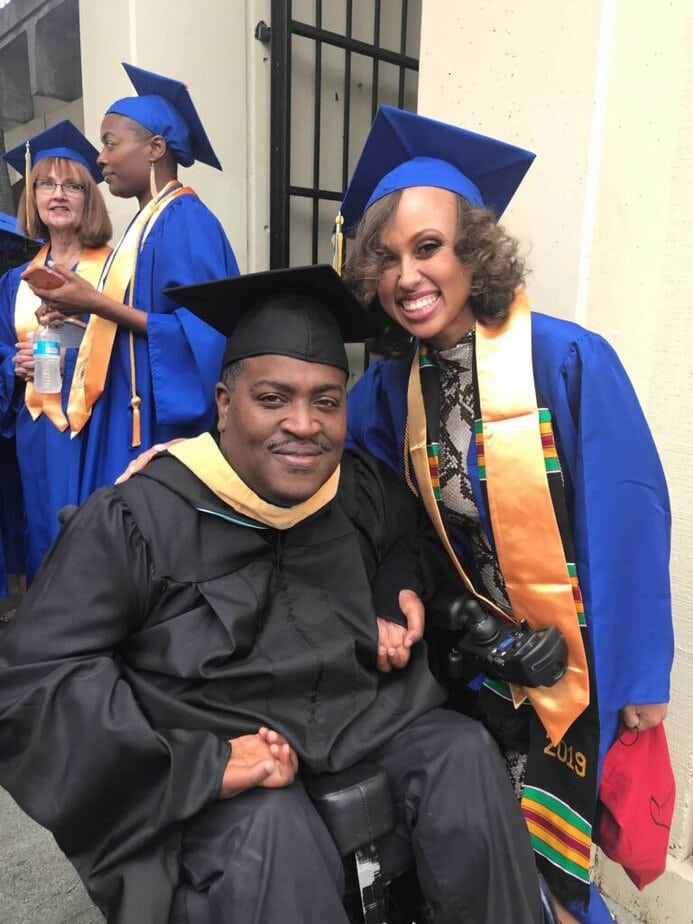
As an academic counselor and an instructor at Merritt College in Oakland, California, Derrick Ross strives for one primary goal. “I want to see other people succeed. Forget everything else,” he says. “I know it’s possible. I did it, and if I can play any role in helping someone else do it, I’m happy.”
Ross, 60, focuses on relieving students’ anxiety about college and life, and instilling the basic skills and tactics they need to succeed in and out of the classroom. He is guided by a simple motto: You can’t be what you haven’t seen.
For proof of his motto’s validity, Ross needs to look no further than his own life. Shot and paralyzed at 19, he found his way as a C4-5 quadriplegic with the help of a series of role models, mentors and colleagues who pushed him out of his comfort zone and towards something greater.
From the psychologist who helped him see past his post-injury anger, to the social worker who asked if he had considered going back to get his GED, to the disability counselor who urged him to go to college and later helped him land a counseling job, Ross has seen first-hand how caring individuals can make a difference and change someone’s life.
All of those people and all of those experiences led him to his current job, working just miles away from where he was shot, with the community he grew up with. “I never would have thought I’d end up back in that community, but when the opportunity came, I said this is where I need to be. This was supposed to be.”

Ross works full-time, four days a week. Since the pandemic, he splits his work week between campus and his home, an hour-and-a-half away in Vacaville. To make the long commutes more enjoyable and to help maximize his efficiency in both offices, Ross is fortunate to have his wife, Lakesha. She is paid by the college to be his full-time assistant. “She makes me a better counselor,” he says, “She knows what I need to be successful and does the little things so I can be more focused on the students.”
The happy couple just celebrated their 20th anniversary and are proud parents of 16-year-old twins. “I had big dreams,” says Ross, “and I was really blessed to have real good friends and meet a lot of good people,” he says.
Here’s what a typical day on campus looks like for him.
5:30 a.m. My wife usually helps with a quick bed bath and my morning routine. I’m a morning guy. I like to get up and get going. I’ve got a job to do. I’ve got to influence and inspire people. The switch clicks on and I’m happy. I’m ready to go.
6:30 a.m. While my wife and I are getting the kids fed and ready for school, I’m getting my mind together and mapping out my day so I’m all set when I get to work. I try to drink a lot of fluids to flush out my bladder before the busy workday.
7:30 a.m. The long commute to Oakland is time for my wife and me. Sometimes we’ll listen to music or the news, but mostly we just try to keep it positive. We talk about everything — goals, dreams, what needs to be done, or sometimes we just silently meditate.
9 a.m. I start my days on campus with three hours of back-to-back counseling sessions with students. Some years ago, I read that interaction with faculty inside and outside the classroom equates to success. If we build that rapport, they know we want to help them — that we care. I’m trying to figure out what their lives are like. What are they dealing with? What do they want? Then I can help them find a career path they might be passionate about. Once we do that, then we’re on our way.
12 p.m. The class I teach is called College Success, and it’s full of practical lessons and advice. Most of the students are non-traditional college students, whether that is first generation students or people who haven’t been in school for a while. I want to answer any questions they have about what it takes to succeed in college and show them what a successful student looks like and does.
1:30 p.m. After class, I’m back in my office seeing students and answering emails and such. I’ve got Dragon Naturally Speaking and an accessible setup for my computer. Having my wife around if I need anything helps me maximize my efficiency.
3 p.m. On the days I work from home, I’m on the clock for 8-10 hours, but on campus days I’m headed home at 3.
4:30 p.m. By the time we get home, I can feel the long day wearing on me. A lot of times we’ll grab some food on the way and then eat and catch up with the kids. I like hearing about their days and try to share some of my day.
6 p.m. If I need to follow up on any work, I’ve got a good setup where I can work on my computer in bed. After all that time in my chair, being able to relax and get off my butt feels great. On the days I work from home, I’ll often spend the whole day working from bed to help my body recover.
10 p.m. Whether my wife is busy or not around, my kids are always there to help and assist. My brother comes over to help with my night-time care and gets me ready for bed.
Support New MobilityWait! Before you wander off to other parts of the internet, please consider supporting New Mobility. For more than three decades, New Mobility has published groundbreaking content for active wheelchair users. We share practical advice from wheelchair users across the country, review life-changing technology and demand equity in healthcare, travel and all facets of life. But none of this is cheap, easy or profitable. Your support helps us give wheelchair users the resources to build a fulfilling life. |


Derrick Ross is a family member of mine and he truly is an amazing. Man not only to ha students but to our family. He deserves the best life has to offer. He and his wife Keisha are wonderful people