


Disability and Civil Rights Advocates Sound Alarm Over Voting Rights Restrictions
October 8, 2021
Tim Gilmer
It has always been hard to vote in Texas for many wheelchair users, but Toby Cole fears it’s about to get even harder. On Sept. 7 Texas Governor Greg Abbott signed Senate Bill 1, a law that will go into effect Dec. 2 and contains numerous new voting restrictions. Disability and civil rights groups say the new law will unfairly impact minority voters, including wheelchair users and other people with disabilities.
Cole is a board member of the Houston chapter of United Spinal Association and a past president of the Houston Trial Lawyers Association. Harris County, where Cole lives, is Texas’ largest. Many of its 750 polling places have accessibility problems, including non-compliant ramps, walkways impassible for wheelchair users and locked gates along access routes. Cole, a C5 quad, had problems when voting at a church. “I had to wait a long time in line outside. Someone finally saw me, came out and said, ‘Sorry you won’t be able get to where you need to vote from here.’” They took him to a back kitchen entrance. There was a high, 3-inch threshold and no ramp. “Somehow I managed,” he says. “But I wondered what would happen if I had had to wait in line even longer. In Texas we have heat issues, and as a quad I can only sit for a limited time.”
The new law, he says, creates new problems by unnecessarily including complicated processes that discourage voting.
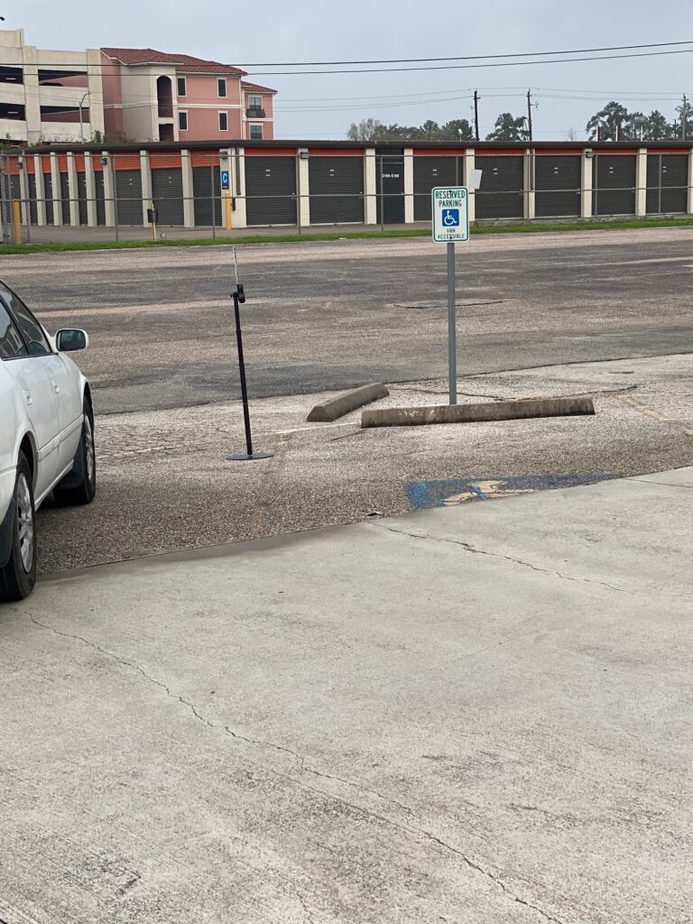
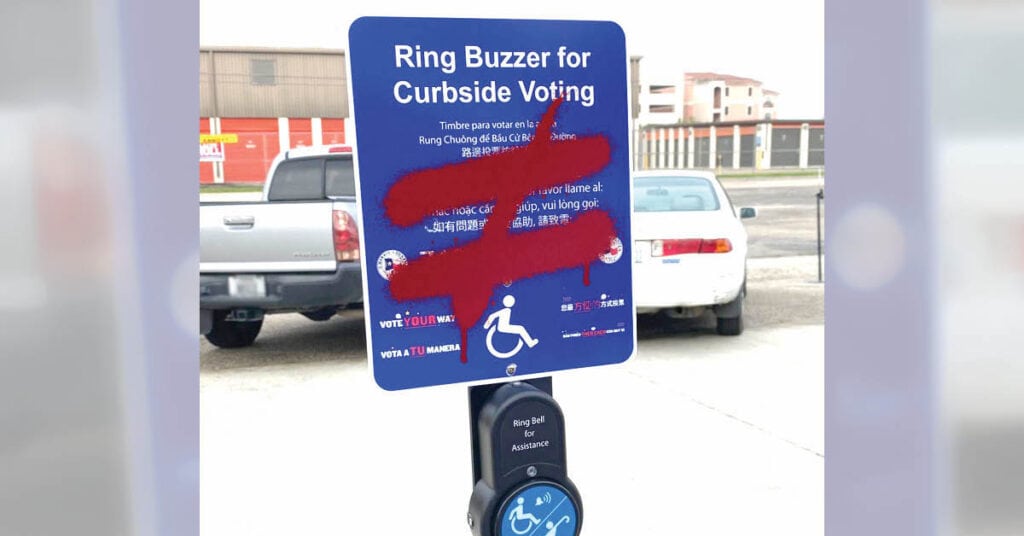
Prior to S.B. 1, Cole helped the Justice Department implement a 2019 consent decree that ordered Harris County to survey and fix physical access issues at polling places and provide effective curbside voting options for people with disabilities. In 2020, he surveyed several curbside voting locations in Harris County. They were intended to provide a convenient way for people with disabilities to vote — you drive up, push a button on a post and an election worker comes out to help. He found them inefficient and some even unusable. “The sites I visited were in parking lots, difficult to see, with no signs pointing to them,” he says. “Sometimes the buttons don’t work, no one will answer, or someone will answer but they don’t know what to do.”
Cole may now have to vote by mail, but the state’s signature requirements create potential problems. “Mail-in scares me to death because of the signature verification process,” he says. Cole uses attendants to help him sign any document. “They are already auditing Harris County and other mostly Democratic counties. It has never been an issue prior to 2020. What happens if some untrained person hired by the audit, who knows nothing about whether Toby Cole is a quad and how he makes his signature using different attendants, looks at my ballot and it doesn’t match with what’s on record and they toss my vote out?”
“Sometimes the buttons don’t work, no one will answer, or someone will answer but they don’t know what to do.”
Then there’s the problem of how to get your mail-in ballot to election officials. You can send it by mail, but considering postal delays, you need to send it a few days or longer before election day. In years past, Harris County had 12 locations where voters could directly drop their ballot. Then in October 2020, Gov. Abbott, himself a wheelchair user, signed an order that reduced drop box locations to one per county. “To force hundreds of thousands of seniors and voters with disabilities to use a single drop-off location in a county that stretches over nearly 2,000 square miles is prejudicial and dangerous,” wrote Chris Hollins, the Harris County Clerk, in a statement after Abbott’s order.
Now, the enactment of S.B. 1 eliminates all drop boxes in Texas.
Another option, drive-thru voting, became available at the onset of the pandemic and was available to anyone, regardless of disability. However, S.B. 1 eliminates drive-thru voting and also does away with 24-hour voting, which Harris County implemented during the pandemic to limit lines and make it safer and easier for residents to vote.
S.B. 1 imposes yet another requirement that could make voting more onerous for voters who need an attendant’s help. Cole says that because Texas provides no public assistance for PCAs, many rely on undocumented workers to keep out-of-pocket costs down. For in-person voting, an application for an attendant’s assistance must be requested, filled out by the attendant and returned prior to voting. The attendant must also present identification at the polling place, as well as recite an oath in front of an election official proclaiming that they in no way influenced the vote or did not “pressure or coerce” the voter to choose them. Undocumented attendants are fearful of being deported. “Many of them don’t want to do it,” Cole says.
A Nationwide Problem
Texas S.B. 1 is the latest of dozens of voting laws passing through state legislatures across the country. Whether these laws restrict or increase voting access is dependent largely on which political party controls the state house. In many Democrat-controlled states, legislators have passed laws that expand and improve mail-in voting, make voter registration easier, expand early voting and restore voting eligibility for people with past felony convictions. In contrast, many Republican-controlled states have passed laws that restrict mail-in and early voting, limit or eliminate drop boxes, impose new voter ID and registration requirements, and erect barriers on people who assist voters.
Republicans say these new voting regulations are meant to ensure election integrity by preventing voter fraud. Before signing the Texas bill, Gov. Abbott made a statement that is representative of Republican rationale for new voting restrictions: “One thing that all Texans can agree [on] and that is that we must have trust and confidence in our elections. The bill that I’m about to sign helps to achieve that goal. The law does, however, make it harder for fraudulent votes to be cast.”
There is no evidence of widespread voter fraud. Research studies consistently find only a handful of cases nationwide in any given year. According to a study by the nonpartisan Project Vote: “A review of news stories over a recent two year period found that reports of voter fraud were most often limited to local races and individual acts and fell into three categories: unsubstantiated or false claims by the loser of a close race, mischief and administrative or voter error.”
Democrats and civil rights advocates say that recent voting restrictions unfairly target Black voters, people of color and other minorities, and that the restrictive voting laws are simply an attempt to suppress the vote among these groups. “This wave of restrictions on voting — the most aggressive we have seen in more than a decade of tracking state voting laws — is in large part motivated by false and often racist allegations about voter fraud,” said the Brennan Center for Justice, a nonpartisan law and policy think tank.
Caught in the middle is the disability community, which, politically, tends to mirror the American electorate as a whole, leaning left by a few percentage points. Whether intentional or not, people with disabilities will most likely be affected disproportionately by laws that restrict voting access, says long-time disability advocate Lex Frieden, a C5 quad and a chief architect of the ADA.
“If the test of differential effect means people with disabilities will be more greatly affected than others, then yes, these bills are a violation of the ADA,” says Frieden. “In addition, we will be more disproportionately affected because our minority set crosses all lines.” Frieden is director of Independent Living Research Utilization in Houston, which runs the Southwest ADA Center, and was appointed chair of the National Council on Disability twice by two different presidents — Ronald Reagan and George W. Bush.
“There are so many things that get cut out of our lives — voting can’t be one of them. It’s the only way to make our voice heard.”
Civil and disability rights groups have filed numerous lawsuits in opposition to S.B. 1, alleging that it violates the Americans with Disabilities Act and the Vocational Rehabilitation Act of 1973, as well as multiple civil and voting rights laws.
Frieden sees numerous difficulties with the new law. “Limits on hours, and on curbside and drive-thru voting will surely affect people with disabilities. Paperwork requirements, especially for people who need assistance voting, will be burdensome if not forbidding,” he says.
Cole agrees. “We need as many options as we can get. There are so many obstacles that we already have. Start with inaccessible polling places — the fixes they put in are still not great. The consent decree was entered in an environment where we had expanded voting. Now they have banned 24-hour voting, drop boxes, put limits on hours you can vote. All this creates long lines, difficulty with assistants and documentation,” he says. “There are so many things that get cut out of our lives … voting can’t be one of them. It’s our only way to make our voice heard.”
As of late July, prior to S.B. 1, 18 states had enacted laws that restrict voter access. Many other states are either considering or already deliberating similar bills. It is likely that by the primary election season in 2022, dozens of states will have enacted similar laws.
The Texas legislature’s enactment date of Dec. 2, 2021 for S.B. 1 makes it doubtful that any of the lawsuits filed recently will bring about a final judgment prior to primary elections in Texas.
“This is intimidating,” says Cole. “Slowly, we are being disenfranchised.”
Support New MobilityWait! Before you wander off to other parts of the internet, please consider supporting New Mobility. For more than three decades, New Mobility has published groundbreaking content for active wheelchair users. We share practical advice from wheelchair users across the country, review life-changing technology and demand equity in healthcare, travel and all facets of life. But none of this is cheap, easy or profitable. Your support helps us give wheelchair users the resources to build a fulfilling life. |


I’ve been in a wheelchair for 37 years, T3 paraplegic secondary to a thoracic aortic rupture. I broke my face into 22 pieces. My right femur went through my pelvis, into my abdomen and caused enough damage that part of my stomach and intestines were removed and my left hand was nearly severed. I voted for Reagan the first time as an able bodied individual and in a wheelchair the second time. Not one time have I ever had difficulty voting. Ever. And I’ve always voted in person. And I’m in Kentucky. There has always been accessible voting for wheelchair users here. Is it different for Texas? Are they constructing steps in front of the voting booths? I mean… What gives? They have to be accessible by law.
Yea and some how, asking for an ID is acceptable for cigarettes & beer, to get on a plane, to get into the White House, to get a bank account, to do absolutely anything. But because Texas doesn’t want the millions of illegal immigrants entering to go and vote without an ID. And because democrats think anything against there narrative is either racist or like this story making people think every ability to vote is inaccessible is ridiculous. it’s your right to think what you want to go, but like this other guy said there is no accessibility issues at the voting booths and I lived in the Woodlands in Houston so I know it’s not a problem.
I am a voter with spinal muscular atrophy. I have never had trouble voting due to my wheelchair. I have voted in every local, state, and federal election since I was eligible to vote. I am not saying that the experiences written about in this article are invalid but they are very isolated and are not representative of a larger systemic issue. Between almost universality accessible voting sites, early voting, and mail-in voting it has gotten easier every year to vote.
I have been in a wheelchair since 1976 and have voted in both Colorado and Oklahoma and have never found it difficult to vote. Voting is extremely important and I will never support unsolicited mail-in balloting or anything that weakens everyone having to prove they are a registered voter. I have always seen reasonable accommodations made for the disabled but those accommodations should only be available to the disabled and not used as an excuse to allow voting rights to be sullied. I am an auditor and my experience is that fraud happens all the time especially when it is easy and there are limited ramifications.
I am an Hispanic T4 paraplegic for 45 years. I live in California. I have voted in person for nearly all those years with no problem, ever. I have been using an absentee ballot, by my choice, for the last 5-6 years with no problem at all. Ballot comes in PLENTY of time to complete and return. This article sounds like its complaints are possibly politically motivated.
ADA requires accessibility to public facilities — this articles sounds political! I’m a C6 Quad and I have never had a problem voting, in CA,TX,NY, TN, and FL!
exactly. It is politically motivated. It’s a slam piece on conservative values.
Unsubscribe me, I didn’t know you were a political motivated rag against conservatives.