New Mobility is the membership publication of United Spinal Association, whose mission is to empower people with spinal cord injuries and related disabilities to lead successful and fulfilling lives.
New Mobility is the membership publication of United Spinal Association, whose mission is to empower people with spinal cord injuries and related disabilities to lead successful and fulfilling lives.
Betty Garza started feeling “electric shock, pins and needles” in her legs about two months after she sustained a T12 spinal cord injury in 2007. As the neuropathic pain got progressively worse, she tried everything from pharmaceutical options like Lyrica, Gabapentin and strong opioids, to an internal spinal cord stimulator, and surgery to replace broken rods and decompress her injury. Nothing helped. By early 2024 the pain had increased to a constant 9-out-of-10. “The pain was not compatible with long-term life,” she says.
Desperate for anything that would ameliorate the pain, she flew to New York to seek the opinions of two top neurosurgeons. One of them told her about an SCI patient with suicidal-level neuropathic pain who got complete pain relief from something called DREZ surgery. He suggested she contact Dr. Scott Falci at Craig Hospital to find out more.
The Rootlets of the Problem
In the fall of 1995, New Mobility editor Barry Corbet interviewed Falci as part of a feature introducing New Mobility readers to DREZ surgery. Corbet eloquently summed up the complex surgery:
“The DREZ procedure derives its name from anatomy. The nerve rootlets in front of the spinal cord conduct motor function, and the ones in back conduct pain and sensation. This zone where the rootlets enter the back of the cord is called the dorsal root entry zone.
The standard DREZ procedure — which consists of burning off these hyperactive areas with a radio frequency probe — is not new, nor does it have a shiny reputation.”
The murky reputation derived from the “marginal” success rate and the likelihood that burning rootlets would result in irreparable loss of function and sensation.
Corbet, who lived with his own neuropathic pain, focused on a newer, computer-assisted approach to DREZ created by Dr. Robert Edgar, Falci’s mentor at Craig Hospital. Instead of simply burning the sensory nerves two levels above the original injury and one level below, the new approach used a neurometer to measure electrical activity in nerves and find distinct differences in frequencies, indicating the source of the pain. Falci and Edgar then burned the “hot spots” and remeasured the electrical activity to confirm it had stopped.
Falci told Corbet the new approach allowed him to relieve all or most of the pain “in about 90 percent of cases.
High Risk, High Reward
Despite the impressive results, the newer approach to DREZ still had limitations and remained risky. Falci explained how neuropathic pain came in “two basic varieties.” C-fiber pain, consisting of burning, sharp, electrical, stabbing pains, and A-fiber pain, consisting of squeezing, crushing, cramping and pressure pains. DREZ only worked on C-fiber pain.
Additionally, Falci refused to perform DREZ on anyone with an injury above T3 because even with sensory mapping, it risked turning a para into a quad. On top of that, the surgery lasted upwards of 10 hours and required a two-week post-op hospital stay.
If you were up for all that and fit all the requirements, you still had to be prepared for loss of function and sensation above your injury level. The new approach offered greater precision and an end to the guarantee that recipients would lose two vertebral levels of function, but it was still unpredictable.
“This surgery is the most dramatically life-improving thing I’ve experienced.”
Betty Garza
“You lose pain and temperature sensation wherever you burn,” Falci told Corbet, “and you don’t know where you’re going to burn until you get in and record hot spots.” He added that loss of pain and temperature sensation could affect as many as five levels. Motor function and touch were normally not affected, but a low, but significant, risk existed that bowel or bladder function would be affected.
While Falci deemed DREZ “the best, last option procedure” for paras who have extreme neuro pain that hasn’t been relieved by medication, he committed to improving it and hoped to make it obsolete. Corbet came away a believer. A month after his article came out, Dr. Falci performed DREZ on him. He wrote about the experience later that year:
“For 27 years, I’d had burning, blossoming pains raking over both thighs. The day after the surgery, that pain was gone. Completely gone. It was just that simple. For 27 years, I’d had a different stabbing and burning in my buttocks.
That pain’s not all gone — only about 80 percent of it — and I cherish every twinge and caress that’s left. After all, you don’t want to forget who you were for 27 years of your life.”
More Data, Better Results
Falci’s DREZ-less future has yet to materialize, but 30 years of research and case studies have helped Falci improve DREZ surgical techniques and outcomes. Data from years of correlating which dorsal root entry zones (pain-producing nerves) caused pain in which areas of the body has aided him in creating a map linking areas of the body to points in the nervous system.
For instance, he now knows that neuropathic pain felt in the upper leg, lower leg and foot is caused by hyperactivity in the T11, T12 and L1 nerves. Likewise, pain in the genital region and butt correlates to hyperactivity in the T8, T9 and T10 nerves.
Data also helped him figure out how and why it is possible to feel pain below one’s level of injury. SCI can cause changes in the spinal cord at or below the level of injury, where the nerve cells that signal pain can become hyperactive and signal pain for no reason. “We see this when recording these nerves on [SCI] patients who are under general anesthesia, where the sensory nerve cells aren’t supposed to fire pain signals, yet many of these sensory nerve cells fire so continuously it almost looks like seizure activity,” he says.
Through careful monitoring, he learned that hyperactive areas of pain signaling nerve cells are able to send their pain signals over the sympathetic nervous system — the one that controls sweating, heart rate and fight or flight response — through a chain of nerves called the sympathetic chain that runs up and down the spine, but is outside the spinal cord and has nerves that go in and out of the spinal cord. These hyperactive nerves send pain signals into the sympathetic nervous system, up the sympathetic nerve chain and bypass the SCI, then route back into the spinal cord above the injury and send pain to the brain.
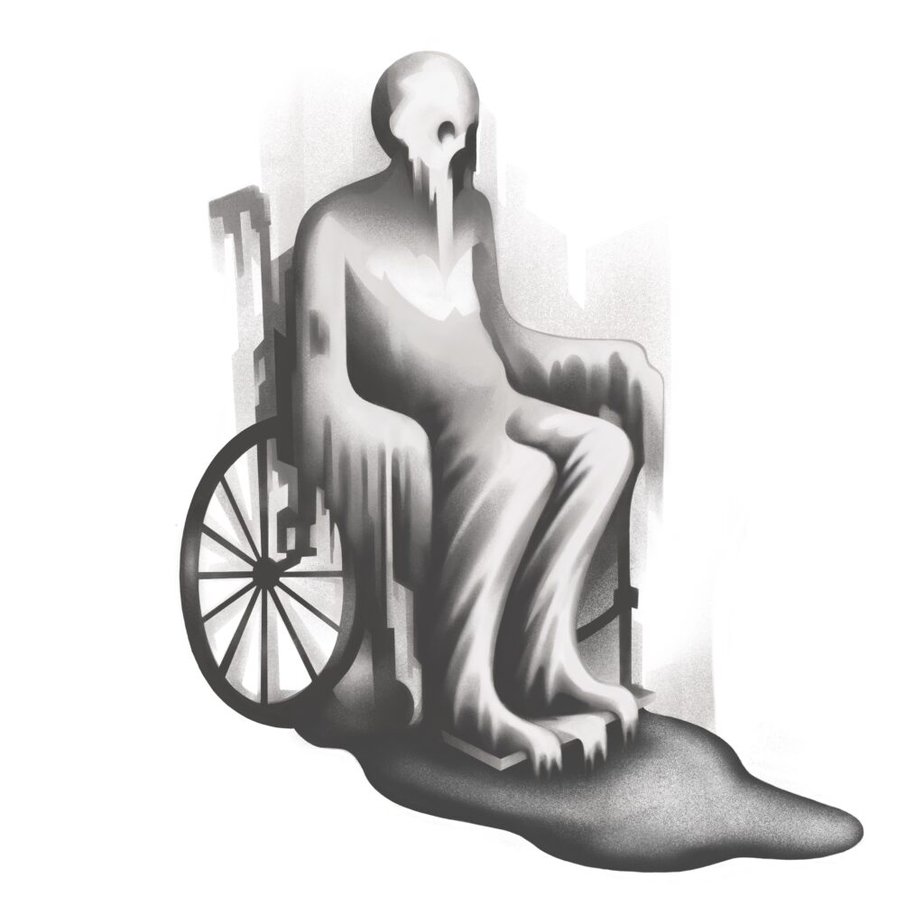
Illustration by Reveca Torres
Falci’s hypothesis was proven when he did DREZ surgeries on three patients who had completely severed spinal cords (something that is very rare) and severe neuropathic pain below their level of injury. Using the map for neuropathic pain, he identified and ablated nerves below the patients’ severed cords that were producing pain. At follow-ups ranging from 1 ½-to-11 years, all three patients had complete or near-complete relief from their below-injury-level neuropathic pain. He published a 2018 paper on the surgeries validating that neuropathic pain can travel via the sympathetic nervous system, and that pain-producing sensory nerves can be below the spinal cord injury level.
“Prior to this mapping, we thought that nothing below the level of injury mattered,” he says, adding that the knowledge of mapped nerves that are causing pain, rather than injury level, allows him to directly target pain, even when it is below the SCI level.
A patient’s description of their neuropathic pain and where they feel it, combined with this mapping system, enables Falci to know where to look for, test, and ablate the pain-producing nerves. Incorporating this mapping system improves overall pain-relief and especially for mid-thoracic-level paras, where, prior to the mapping system, DREZ surgeries didn’t work as well.
This deeper understanding of how neuropathic pain manifests has opened up DREZ as an option for people with T3 and higher-level injuries dealing with neuropathic pain in their lower body. “Before this map and these discoveries [that neuropathic pain can travel on the sympathetic nervous system], doing DREZ on a quad was out of the question, we certainly wouldn’t do an ablation in a cervical area and risk loss of breathing or arm movement,” says Falci. “Now we know that if we treat the area in the specific [corresponding mapped] thoracic or lumbar spine it will treat the pain and we don’t have to go near the cervical area.”
To date Falci has only performed DREZ surgery on two quad patients that had neuropathic leg pain, but it successfully relieved their pain.
Falci also learned that — more thoroughly ablating the hyperactive nerve areas causing the pain — allowed DREZ to eradicate A-fiber pain—neuropathic pain that felt like crushing, squeezing, or pressure—that had previously resisted treatment.
Even with all these advances, Falci makes no bones about the fact that DREZ is a last resort. “DREZ is a lot, you have to be willing to have part of your spinal cord destroyed and that’s a lot, especially if you are young and waiting for a cure to come along, AND there is no guarantee that it will work,” he says. “For the 85% that it works, it is a game-changer for their lives and it thrills me to no end, but in the 15% that it fails, that is the worst surgery that I do because I was their last hope and I hate that surgery. It is one of my favorite and one of my worst surgeries.”
‘I Have No Pain!’
Garza learned all of this and more over several lengthy interviews with Falci to make sure she was a good candidate for DREZ. “He spent a lot of time explaining the potential benefits and risks, including possible loss of motor function and/or sensation and the 15% chance that the surgery won’t help at all,” she explains.
On March 28, 2024, Garza underwent DREZ surgery, which took Falci 17 hours. “When I woke from surgery, I was pain-free!” says Garza. At press time, 1 ½ years later, she is still pain-free.
“When my parents and husband saw me after the surgery, I said, ‘It worked!’” she says. “They were cautious and said I was on so many pain meds I couldn’t tell. I told them, ‘I’ve been on so many pain meds for years and they never made it go away, I have no pain!’”
She did lose a slight amount of sensation in her lower back and lost some adductor muscle control, something she doesn’t even think about unless pressed for details. “This surgery is the most dramatically life-improving thing I’ve experienced,” she says.
Support New Mobility
Wait! Before you wander off to other parts of the internet, please consider supporting New Mobility. For more than three decades, New Mobility has published groundbreaking content for active wheelchair users. We share practical advice from wheelchair users across the country, review life-changing technology and demand equity in healthcare, travel and all facets of life. But none of this is cheap, easy or profitable. Your support helps us give wheelchair users the resources to build a fulfilling life.
When you log in for the first time using the Facebook login button, Facebook shares your public profile information, based on your privacy settings. Once your account is created, you'll be logged in to this account.
DisagreeAgree
I give permission to connect via Facebook
When you log in for the first time using the Facebook login button, Facebook shares your public profile information, based on your privacy settings. Once your account is created, you'll be logged in to this account.
DisagreeAgree
1 Comment
Oldest
NewestMost Voted
Someone who survived
5 months ago
As someone who has neuropathy and has lived with pain that was literally blinding, in a world where assisted suicide is pushed by ab people and the value of life undermined, I’m disappointed to see NM publish this article without the slightest pushback on the quote from Garza about living (or not living longterm) with pain. Life with horrific pain is still being alive and within the realm of touching possibility, which she thankfully did. Unfortunately, there are too many others who are already dead.
Become A Member
Wheelchair users: Join United Spinal and get priority assistance from our expert Resource Center staff.
Stay Informed! Sign up to receive our newsletters.
We're committed to your privacy. New Mobility uses the information you provide to send only relevant content, and you may unsubscribe at any time. For more information, check out our Privacy Policy.






As someone who has neuropathy and has lived with pain that was literally blinding, in a world where assisted suicide is pushed by ab people and the value of life undermined, I’m disappointed to see NM publish this article without the slightest pushback on the quote from Garza about living (or not living longterm) with pain. Life with horrific pain is still being alive and within the realm of touching possibility, which she thankfully did. Unfortunately, there are too many others who are already dead.