


Warning: the following story contains description and discussion of sexual abuse and assault.
In 2019, I ran for Miss Wheelchair Cameroon. To get votes, my mentor had to do a blog post about me on Facebook. I quickly received many friend requests, especially from men and boys. Unfortunately, what I thought was an opportunity to increase my friend list and chances of winning the competition turned into a barrage of abuse and violence. I received about 50 video calls every day. Each time I answered, a naked man or boy was masturbating on camera. I blocked all of these people, though I was aware it would likely knock me out of the competition. I ended up winning runner-up, but the experience left me traumatized.
Women around the world experience all kinds of abuse, online and elsewhere. According to the World Health Organization, one in three women globally is subjected to physical or sexual violence in her lifetime, a problem that has only intensified since the outbreak of COVID-19. For women with disabilities, it’s much worse. Some research says that more than 80% of women with disabilities have been sexually assaulted, most often by family members or other caretakers.
Recently I conducted a workshop on sexual harassment and assault for a group of women with disabilities, and every single one had been sexually assaulted or raped. This left me heartbroken. One of the participants had the courage to open up to me about the physical, verbal and emotional abuse she was facing at home, but after the workshop she had no choice but to return home to the perpetrator.
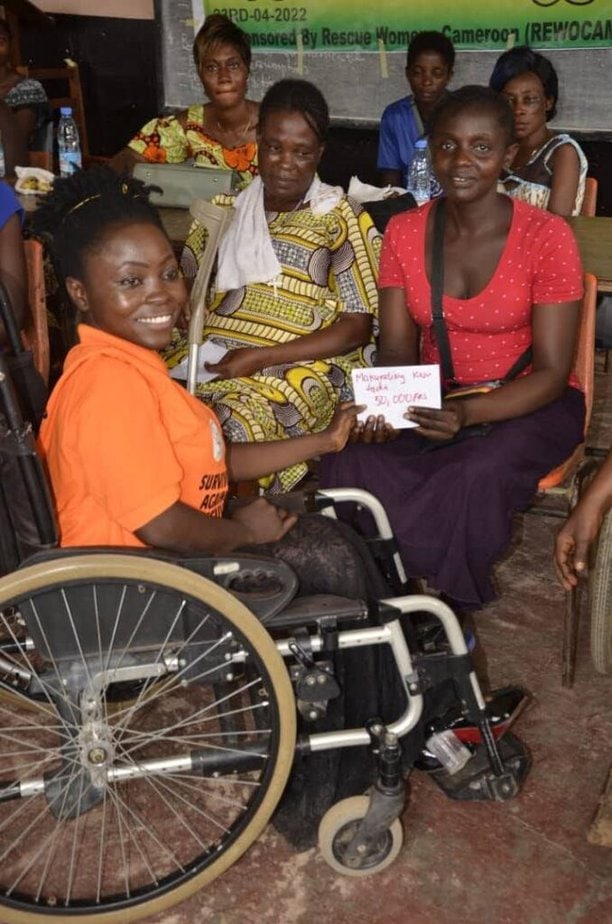
As a polio survivor who has been in a wheelchair since a very young age, I understand what it feels like to be stigmatized, marginalized and forgotten. I have seen well-educated women refused jobs because of their disability, making them further dependent on others — a type of violence in itself. That is why I have dedicated my life to making sure women with disabilities are heard and given the opportunities that they need to become more independent and empowered. But it’s not easy — we are short on resources and there is so much to do.
Violence against women is widespread and brutal in Cameroon, especially in conflict zones. The Anglophone regions in the country’s Northwest and Southwest have been in the grips of a brutal war between government security forces and armed separatists for more than five years. Soldiers all too commonly use sexual violence as a weapon of war. For women with disabilities, it’s especially challenging to flee or fight back. I know of more than one woman in a wheelchair who was abandoned when others escaped to safety. Another made headlines after falling over dead, shot in her wheelchair. We need to do more to protect women and girls from violence.
Fortunately, activists are creating momentum around a new international framework to protect women from gender-based violence. I joined the Every Woman Coalition, made up of 1,700 women’s rights activists from 128 countries, to urge nations around the world to advocate for a new global treaty to end violence against women and girls. Eight years of research with front-line activists, survivors, medical specialists, academics, human rights attorneys, legal scholars, diplomats and policymakers resulted in a first draft treaty, prepared for heads of state and diplomats to use as a starting point for negotiating the new framework.
From the outset, this campaign focused on the expertise and needs of the most vulnerable. The coalition closely examined how a new treaty could best serve indigenous women and girls, women and girls in conflict, and those with disabilities. Importantly, recommendations were made by people with disabilities — not by others for us — who understand the prevalence and the nuances of how this violence affects our community.
Creating a Safe Space — Lilian Dibo’s Story
Lilian Dibo always dreamed of being an accountant. Growing up, she served as the family treasurer, counting money and picturing herself working in a bank or an office building one day.
She lived — and still lives — in Kumba, a town of about 400,000 people in the southwestern region of Cameroon. Dibo, now 28, contracted polio resulting in lower body paralysis when she was 2 years old. Wheelchairs weren’t widely available in Cameroon, especially for children, so at home she crawled.
As one of 11 siblings, she got to primary school by riding on the backs of her brothers and sisters. “It was a team,” Dibo says. “The 10th child would carry me this week. The ninth child would carry me the other week. The eighth child would carry me the other week.” In secondary school, her father bought her a used tri-cycle — a rudimentary handcycle, the most common type of mobility device available in many parts of sub-Saharan Africa. Friends and classmates helped push her to school.
She graduated secondary school and made it to university to study accounting. But once there her dreams of counting money took a backseat to more pressing priorities. The campus was inaccessible and some of the students were hateful. As a woman with a disability she had two marks against her. “I almost gave up. I stayed at home a full week, crying because of my encounters on campus and the way my fellow students used to treat me,” she says.
She pulled herself together and went back to classes. But the experiences taught her there was more to life than finding a good job. “It taught me empathy,” she says. She changed her focus from accounting to advocacy. She dedicated herself to “fighting against violence perpetrated against people who have a similar condition to me, or people with any form of disability.”
In 2017, armed separatists launched a guerilla war against the government of Cameroon. Much of the fighting was centered around southwestern Cameroon, and the conflict forced Dibo to drop out of university. The civil war dragged on.
In 2019, Dibo decided to compete in the newly-organized Miss Wheelchair Cameroon pageant. The pageant was conducted mainly through Facebook. The online abuse she received [see main story] was eye-opening. She won runner-up and traveled around Cameroon meeting other women with disabilities and speaking about disability rights.
She now had a voice and a platform. Three months after the contest, she started the Lilian Dibo Foundation. “We focus on advocacy, education and empowerment,” says Dibo. The organization gives training and entrepreneurship grants to women with disabilities, provides scholarships for disabled parents to send their children to school, sews mattresses to give to people with disabilities, donates mobility equipment, and more. Dibo is most passionate about raising awareness of and fighting against rape and gender-based violence. “We have our sexual rights, and those rights are being violated everyday,” she says.
Dibo now uses a manual wheelchair — she got her first one as a donation from a nonprofit when she was in her second year of university. In addition to her international advocacy supporting the Every Woman Coalition, Dibo is building on her work in Cameroon. She says that if people with disabilities need to evacuate from conflict zones or if women need to flee domestic violence, there is nowhere for them to go. She wants the foundation to create “a permanent safe space for whenever they need to flee any form of violence. The door should be open for them to come and feel safe.”
Find out more about Dibo and the Lilian Dibo Foundation on Facebook.
“In addition to experiencing the same forms of violence as other girls and women, girls and women with disabilities face additional and unique forms of violence, from a broader group of offenders and in a wider variety of settings than nondisabled girls and women,” said the Coalition’s expert committee report. Despite disproportionately facing violence, women with disabilities are too often left out of conversations about anti-violence advocacy and legal reform.
Experts agree that specific solutions used in concert can drastically reduce rates of violence against all women and girls. The new treaty would mandate that governments implement a package of proven interventions — including legal reform, training for police, judges, nurses and doctors, survivor services, prevention education and funding. A clear, metrics-based scorecard will be used to monitor the implementation of these interventions.
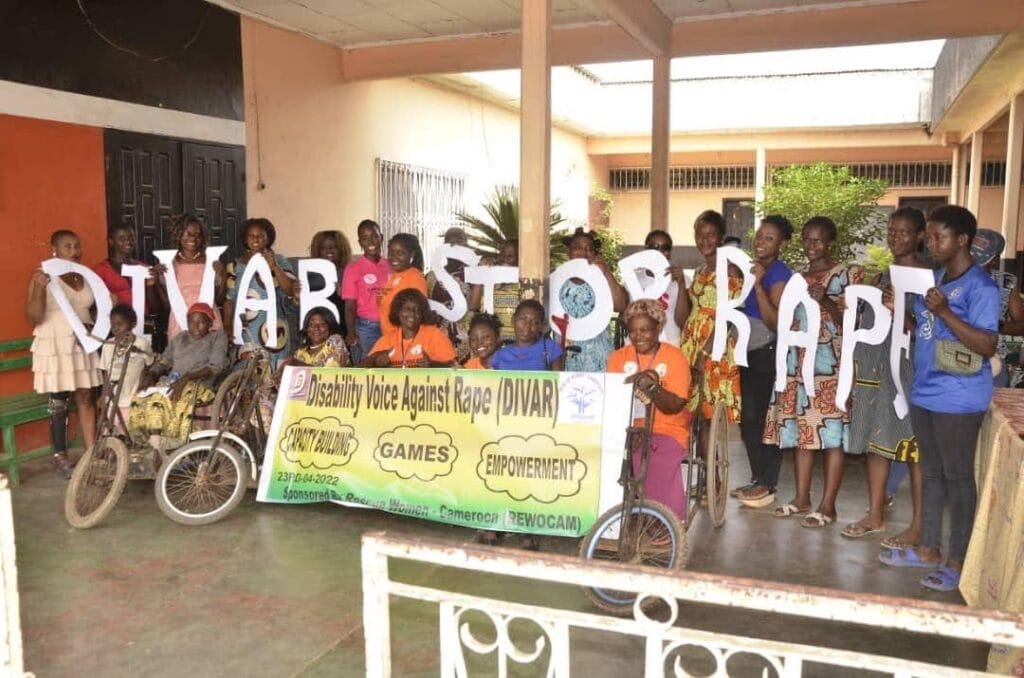
I work locally in Cameroon through the Lilian Dibo Foundation, which I started to provide vocational training, jobs, mentoring and entrepreneurship support for women and girl with disabilities. The goal is to empower women and girls across Cameroon so that they are not trapped with their abusers.
But beyond these local solutions to get women out of dangerous situations, we need a comprehensive new international agreement to address this tidal wave of violence.
I was proud to have won Miss Wheelchair Cameroon runner-up, but what should have been a positive experience has stayed with me because of the online violence I experienced. I want women and girls with disabilities to live free from all forms of violence, whether on Facebook, in conflict zones or anywhere in between. A new global framework is the best chance we have to catalyze a paradigm shift, to pave the path to a future free from violence, for the benefit of women with and without disabilities alike.
Support New MobilityWait! Before you wander off to other parts of the internet, please consider supporting New Mobility. For more than three decades, New Mobility has published groundbreaking content for active wheelchair users. We share practical advice from wheelchair users across the country, review life-changing technology and demand equity in healthcare, travel and all facets of life. But none of this is cheap, easy or profitable. Your support helps us give wheelchair users the resources to build a fulfilling life. |


This is a dream come true. I have always wished to get my story on an international magazine and here we are.
Thank you Every Woman Treaty.
Thank you Shayna
Thank you Seth
Thank you New Mobility Magazine
“My voice is the only weapon I have” Lilian Dibo Eyong