



Exercise is essential to preventing cardiovascular disease and living with a healthy heart, but finding exercise protocols and equipment that meet recommended criteria and work for wheelchair users can be very difficult. As an example, the American Heart Association recommends a “moderate” level of exercise five times a week to prevent cardiovascular issues. But the mainstream definition of moderate doesn’t fit wheelchair users who don’t have large muscle groups capable of burning calories and reaching standard aerobic exercise goals.
As always, wheelchair users need to think differently. Instead of getting lost trying to fit into categories and regimens designed for others, the focus should be on finding ways to achieve the desired physical outcomes, such as regular intervals of higher heart rates and/or increased oxygen levels. Everyone can find a way to achieve this that fits their abilities, time requirements and preferences. Even moderate levels of physical activity can improve mood, lower stress and assist with a good night’s sleep. It’s possible to reap the benefits of a workout routine without the typical hours in a gym, by using a bit of creativity and new training methods.
Breathing and Oxygen Are Key
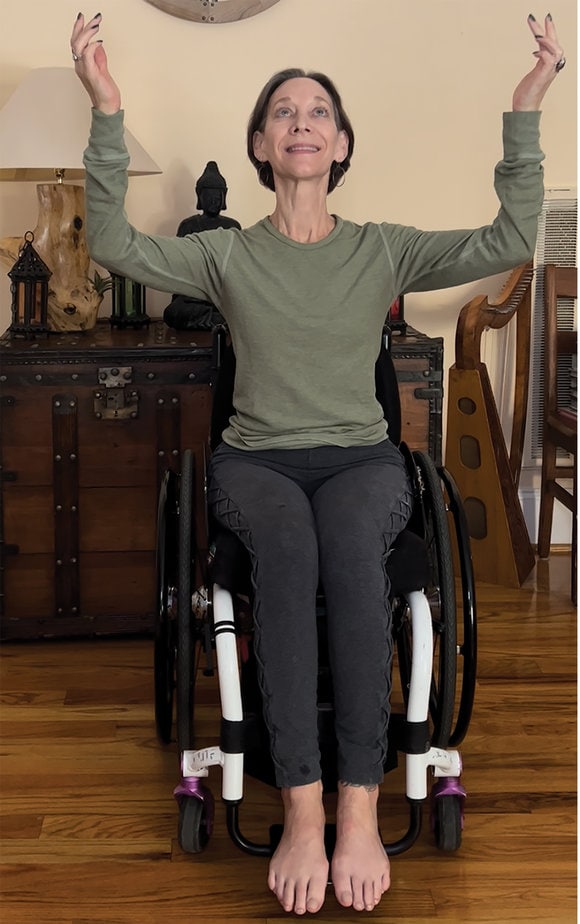
As a dance and yoga teacher, Marka Danielle already had a deep appreciation of the importance of improving her strength and stamina when she became a C3-7 quadriplegic. Her first experience in a standing frame showed her how much work there was to be done. “The first time I tried it in the hospital, I threw up and passed out — it was such an enormous body change,” she says. Danielle refused to let a little dysreflexia keep her away from a vital rehab tool.
She found the breath work and meditation techniques that she had learned in yoga helped her stay calm during her workout. “Rehab taught me to gradually increase my height in the frame,” she says. “I’d do breathing exercises while I sat. I would fit in a meditation for a minute or two. I think the breathing helped me progress in rehab a little more quickly.”
The breathing also helped her associated nerve pain, and the yoga increased her flexibility, which allowed her muscles to release, relieving discomfort from spending time in her chair. With no equipment needed, Danielle was able to find time to make the breathing exercises a regular part of her routine. “I would get on the yoga mat and concentrate on different breathing techniques,” she says. “My respiratory health improved by practicing box breathing, detox lion’s breath and kapalabhati breathing, also called skull shining breath.” (See Resources, bottom)
Most importantly for heart health, research supports yoga breath work as a strategy to lower stress, increase oxygen levels and improve respiratory function. The European Journal of Preventive Cardiology published results finding yogic breathing may bring as much benefit for your heart as power walking. Danielle is a believer. “The whole point of yoga is to connect breath or unite the systems in your body,” she says. “When you learn to breathe more efficiently, you’re taking in more oxygen and nourishing all the cells of your body.”
When the coronavirus pandemic started, Danielle worked to be certified in face yoga, a method that tones and firms the face for a more youthful appearance. When she teaches face yoga classes for the South Carolina Spinal Cord Injury Association, she emphasizes the discipline’s “approachability.” “Face yoga is something anybody can do even if they can’t move their body. Yoga is about moving your energy, not necessarily moving the body,” she says.
Danielle focuses on breathing practices, an integral part of any exercise class she instructs. “I didn’t have the ability to do yoga the way I’d always done, so the appeal of learning more about breathing practices was fascinating,” she says. “I can do face yoga leaning against the wall or from my bed or even if I’m hurting. I feel like it will benefit me and others for as long as I live.”
She is currently developing her own website with classes and a face yoga library that others can access to learn her techniques.


Together Is Better
Even if you find workout equipment or a regime that makes it possible to exercise, motivation can be difficult to maintain, given the difficulties and challenges of access. Paul Hopkins, a C5-7 quadriplegic, and his wife, Angelique, found that working out together was motivating in itself. The couple met after her mom had a spinal cord injury and Angelique turned to an online support group. She posted questions to learn more, citing her job as a flight attendant and asking what could be improved on a plane. Hopkins decided to answer her, but not only because he could help. “She was beautiful,” he says.
The couple married in February 2022. They found that exercise and a healthy lifestyle was something they had in common and began working out as a way to spend more time together. “We have a gym here at our apartment. We’ll go down, and he walks me through a workout. He’s so much better than I am,” Angelique says.
Hopkins has learned to adapt regular exercise equipment, like a SkiErg, using adaptable cuffs. He uses his rugby chair for CrossFit workouts and his TiLite manual chair for high-intensity interval workouts. “I push weights back and forth. I do shoulder presses in the chair, use stretchy bands and the medicine ball,” he says. He believes his high energy workouts contribute to his heart health. “It helps with circulation and my energy level.”
He says he monitors his heart rate using his Apple Watch. He shoots for a rate of 115-120, though he admits no one has ever given him guidelines on what an ideal rate is for active wheelchair users. (See sidebar.)
For Hopkins, marriage is the best motivator to stay committed and healthy. “We want to live for a long time with each other and we want to stay healthy,” he says. “We don’t want any health issues because we’d like a family, and want to be able to see our kids grow and to chase them around the park without getting tired.”
Heart Rate Guidelines and You
Many cardio exercise prescriptions are based on a percentage of “peak heart rate.” For nondisabled exercisers, there’s a simple formula to calculate your maximum heart rate: subtract your age from 220. Using that formula, as a 39-year-old, my maximum heart rate should be 181.
But as a C7 quad, there’s no way I’m getting my heart rate up to 181. It’s well studied that people with spinal cord injuries have lower maximum heart rates than nondisabled peers. But there’s no handy calculator for max heart for people with SCI. That’s because max heart rate varies from person to person, injury level to injury level.
Broadly, there are a few trends. The lower your injury level, the higher your potential max heart rate. The fitter you are, the higher your max heart rate. An athletic low para might be able to get their heart rate within 10-20 beats of their theoretical, nondisabled max. A non-athletic quad might be 80 beats per minute lower, while an athletic quad might be only 30 beats lower. The variability really is that great.
So, the only way to know your personal max is to test it out. Be warned — it’s going to hurt. Find an arm ergometer at a local gym. Warm up on an easy spin for 10-15 minutes. Then do a 10-minute interval. For the first nine minutes, go as hard as you can maintain. Then go all out for the next 30 seconds. When there’s only 20-30 seconds left on your timer, push yourself farther into the pain cave than you’ve ever gone. To get a true max heart rate, you are going to feel like you’re about to black out. Fun, right? As soon as you stop (and before you pass out) make sure to check your Fitbit, Apple Watch or heart rate monitor and see what it says. That’s your max heart rate. Now you have a baseline from which to calculate your percentages.
—Seth McBride
Going All Out With HIIT
Leah Gray, a T5-6 paraplegic, dedicated over 25 years of her life to playing and expanding the reach of women’s basketball. She played collegiately and on men’s and women’s teams before serving as the commissioner of the Women’s Division for the National Wheelchair Basketball Association.
After leaving basketball, she focused on her children as her full-time job. “I took time off to be in mom mode. We would exercise, but my son and daughter played a million sports. So being in two places at one time was hard enough. That was my cardio,” she says.
Almost five years ago, she participated in a study by the Human Engineering Research Laboratory at the University of Pittsburgh that studied the health and fitness effects of High-Intensity Interval Training for people with spinal cord injuries. HIIT relies on alternating short periods of demanding physical activity with less intense recovery periods. The study found that 71% of the participants reported improvements in endurance, function and overall health. Gray was one of those. The study served as a “reintroduction” to HIIT and reinforced its value. “I definitely had more energy. The total health benefits of short spurt workouts helped me lose weight.”
For six weeks enrollees performed two 25-minute workouts per week. They started with a two- to three-minute warm-up, then did 10 high-intensity cycling intervals of one minute each, where subjects were trying to hit 85-90% of their peak heart rate. Each interval was followed with one minute of recovery time. They finished with a cool-down period of two to three minutes.
She was reluctant to use a full-sized handcycle, concerned about getting in and out on her own. The study provided an add-on, made by Quickie, that connected to the front of her chair, turning it into 10-gear, trail ready transportation. “It has two adjustable arms that raise your front casters enough to use on the bike trail,” she explained.
The HIIT study offered her a quick workout with many of the documented results of longer, endurance-type exercise. For Gray’s busy life, it was a benefit. “If you can get a nice workout in 20 minutes, I think that’s great. The interval training uses your arms and uses your body but doesn’t beat you up, I don’t think, as bad as hours of working out.”
Gray currently works out two to three times per week at a local Planet Fitness. She has adapted an old routine she got from an assistant coach on the U.S. Women’s Paralympic Basketball Team for her own high-intensity interval training. “I get a great workout in a lot less time,” she says. “I feel more energized, and I feel better about myself.”
Before trying any new exercise regimen, it’s safest to consult with a doctor. Medications and secondary health complications, disability-related or not, can affect your heart rate and capacity for high-intensity exercise.
Resources
• More on Kapalabhati breathing
• Danielle’s Instagram Live with the founder of Face Yoga
• Yoga and breathing
• Marka Danielle’s site
Support New MobilityWait! Before you wander off to other parts of the internet, please consider supporting New Mobility. For more than three decades, New Mobility has published groundbreaking content for active wheelchair users. We share practical advice from wheelchair users across the country, review life-changing technology and demand equity in healthcare, travel and all facets of life. But none of this is cheap, easy or profitable. Your support helps us give wheelchair users the resources to build a fulfilling life. |


Recent Comments
Neil on A Safe, Effective Reusable Catheter System
Richard Crumb on A Safe, Effective Reusable Catheter System
Richard Crumb on A Safe, Effective Reusable Catheter System