


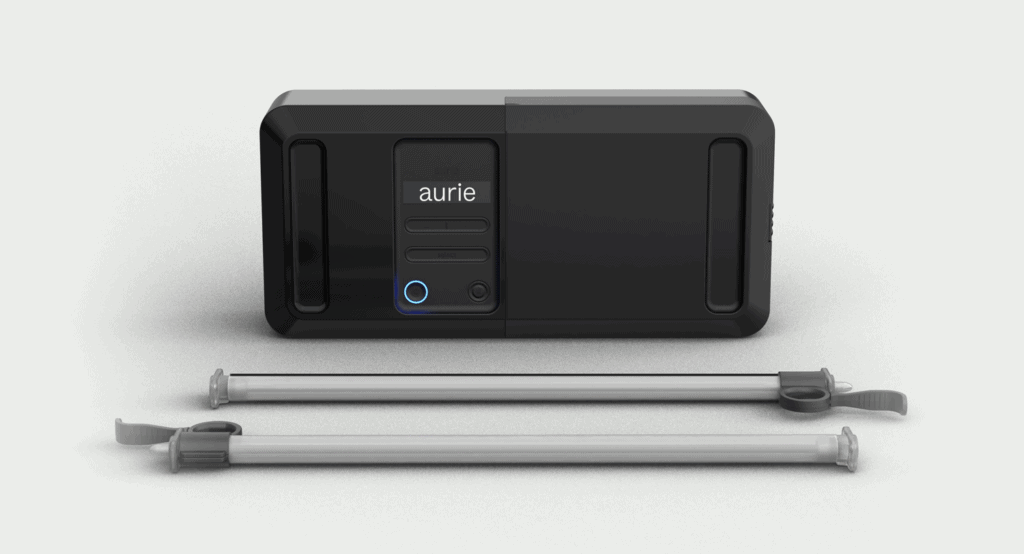
What if you took a handful of the best features from premium catheters and put them into a catheter that came with a small, portable base that allowed you to easily clean, disinfect and reuse the catheter?
That’s the idea behind Aurie, a reusable intermittent catheter system that is looking to disrupt and improve how users get and use intermittent catheters. Earlier this year, Aurie became the first reusable catheter system to receive FDA approval, and it will be available for purchase this fall at select VA hospitals with more availability to follow.
Aurie founder Souvik Paul spent the past eight years developing a product that will result in less waste and less hassle while meeting the high health standards users demand, all at a sustainable price so insurance will cover it.
Instead of having to worry about running out of insurance-provided catheters, or having to travel with large quantities of backups, Aurie provides users two pre-lubricated catheters, each with an introducer tip and insertion sleeve, that can be sterilized and relubricated up to 100 times using a laptop-sized cleaner. With nothing but tap water and small daily supply pods, the battery-powered cleaner can quietly clean, disinfect and re-lubricate the catheter in less than 40 minutes.
Paul got the idea for the system when his sister-in-law was paralyzed in a car accident. He saw how difficult insurance made it to get the number and quality of catheters needed and how not having that directly translated to UTIs and other serious health complications. An award-winning product designer with experience in the health industry, Paul knew there had to be a better solution.
A Better Way
The idea of reusing catheters is nothing new. Whether due to scarcity or ecological concerns or something else, catheter users have been boiling and microwaving used catheters for decades. “There are two problems with that,” says Paul. “One, there was no standardization of the process, so there was no way to make sure that you had a clean catheter at the end of whatever it is you were doing, and two, there was also a really profound impact to quality of life.”
Paul’s research reinforced what many catheter users have found out: better designed, “quality” catheters lead to less UTIs and better health outcomes. Unfortunately, many people don’t have access to them.
“We saw that single-use standard catheters have about a 50 percent annual risk of UTI that worsens every year. These were what 95 percent of the user population is covered for because they’re relatively cheap, at about $6,000 a year,” he says. “Then there are single use, no touch catheters that help reduce infections by up to 62 percent according to recent studies. Because of their features like introducer tips, insertion sleeves, and things of that nature, they help reduce contact contamination and reduce urethral trauma. But they’re about $10 each so they’re only covered for about 5 percent of Medicare patients.”
With a target price point in line with what Medicare already pays for a year of single use standard catheters, Paul says, “The goal is to expand access to this potentially life-saving technology.”
Securing FDA approval was a huge step in the long journey to bringing Aurie to the masses. The approval means Aurie has demonstrate the system is safe and effective and allows them to start selling the device. Currently, the approval only pertains to sales to male clients, but Paul says Aurie is working on a device for women. Initially Aurie will only be sold through VA hospitals and private pay. Paul hopes to be Medicare eligible by 2028.
To find out more, visit Aurie.
Support New MobilityWait! Before you wander off to other parts of the internet, please consider supporting New Mobility. For more than three decades, New Mobility has published groundbreaking content for active wheelchair users. We share practical advice from wheelchair users across the country, review life-changing technology and demand equity in healthcare, travel and all facets of life. But none of this is cheap, easy or profitable. Your support helps us give wheelchair users the resources to build a fulfilling life. |