



I became a father in 2017, when my wife gave birth to our son Ewan. Thanks to wheelchair rugby, I had been around other wheelchair users who had kids. Watching their babies nap courtside while chairs crashed around them showed me that parenting, like everything else in disability life, could be both weird and totally normal.
So when it came time to start my own family, I never really questioned whether I could be a father. Rather my questions were about the things I hadn’t seen. How would I manage diaper-changing with two pancake hands? How would I lift a baby into a car seat with no core strength? And, back it up a minute … how would my wife and I even have a kid if my swimmers didn’t feel like swimming?
If you’re a wheelchair user who’s thinking about starting a family, you’ve probably had a few of the same questions, alongside a thousand others. This newsletter is an effort to answer a few of them, give a fuller picture of the various paths wheelchair users travel to have children, and show what it takes to manage the details of parenting as a wheelchair user.
One Step at a Time
The first thing to know about family-planning as a wheelchair user is that whatever your level of function, it’s possible to be a parent and be a good one. It’s also possible you could be a terrible parent, but that’s on you, not your disability. What your disability might change is how you go about becoming a parent.
In “Knocked Up: So Many Ways to Grow a Family,” Kate Matelan outlines the various ways that male and female wheelchair users conceive, from all natural, to fertility treatments like IUI and IVF, to surrogacy and more.
For men with SCI, anejaculation (the inability to ejaculate during sex) and decreased sperm motility are two of the most common hurdles to conceiving. Mitch Tepper details how vibrostimulation can be used to induce ejaculation and collect sperm for fertility-testing or insemination. Stimulation doesn’t work for everyone though. Other options include electroejaculation and testicular sperm extraction, which some find less painful than other options. “You try to be as easy and natural as possible, and if that doesn’t work, move on to the next step, and the next, and so on,” says Max Woodbury, a C6 quad.
For those who opt to go with in vitro fertilization, even a successful pregnancy can be an emotional roller coaster, as Kenny Salvini explains in his article “Our IVF Journey to Parenthood.”
For others, adoption is the best option. Power wheelchair user Brigham Fordham and his wife tried to conceive before infertility issues caused them to pursue adoption. Fordham goes over the ins and outs of the ever-evolving adoption process, along with some valuable takeaways for anyone who’s considering. “Adopting a child is like falling in love. It is exciting. It is frustrating. It is expensive. … Our adoption journey changed the way I view parents of every type, and it proved that sometimes what you want is not as good as what you get.”
Nutrition Tip

I’m sure some parents can survive without coffee, but I’m not one of them. Fortunately, modern nutrition research confirms that when it comes to your daily coffee consumption, do whatever you need to do to get through the day. According a 2021 New York Times article, coffee and caffeine “consumption has been linked to a reduced risk of all kinds of ailments, including Parkinson’s disease, heart disease, Type 2 diabetes, gallstones, depression, suicide, cirrhosis, liver cancer, melanoma and prostate cancer.”
Welcome to the Thunderdome
Once you get through the hard part of having a kid, guess what? That was the easy part. Before kids, you still had a modicum of control over your world. Now your world just expanded to include the wants and needs of a being with no means of satisfying themselves. Ready? I didn’t think so.
The good thing about being a new parent is that everybody’s in the same boat: just trying to figure it out. Read all the parenting books you want, but nobody really knows what they’re doing at first. And your kids have no idea what you’re supposed to be doing either. Parenting, like living with a disability, is all about adaptation, and failure is part of the process. Being successful isn’t about “being a good parent,” whatever that means. It’s about caring, being willing to admit and course-correct when you mess up, and learning what makes your child tick, what they do and don’t respond to.
As for the technical details of parenting, we’ve got hacks. “Baby on Board: Tips for the First Year of Parenting as a High-Level Quadriplegic” shows how C4-5 quad Josh Basile and C5 quad Angie Hulsebus managed the day-to-day of caring for infants.
Favorite adaptive products include a PRIMO Lapbaby, which allows you to easily secure your baby to your lap; the Chicco QuickSeat Hook-On Chair, a high chair that attaches to a counter or table, allowing wheelchair users to get closer to their infants during feeding time; and the UnbuckleMe, a $15 tool that makes it easier to hit the release button on your child’s car seat.
For bigger-picture questions, Teal Sherer shares how wheelchair users explain disability to our kids, I examine what having children taught me about dealing with the frustrations of disability life, and Stephanie Arrache shares how she kept her toddler safe once he developed the ability to run.
As your kids get older, many parents have to navigate the deflating, often-inaccessible world of day care in America. Just like everything disability- and parenting-related, it’s not easy. But with adaptability and a lot of persistence, you’ll find a way through.
Functional Tip
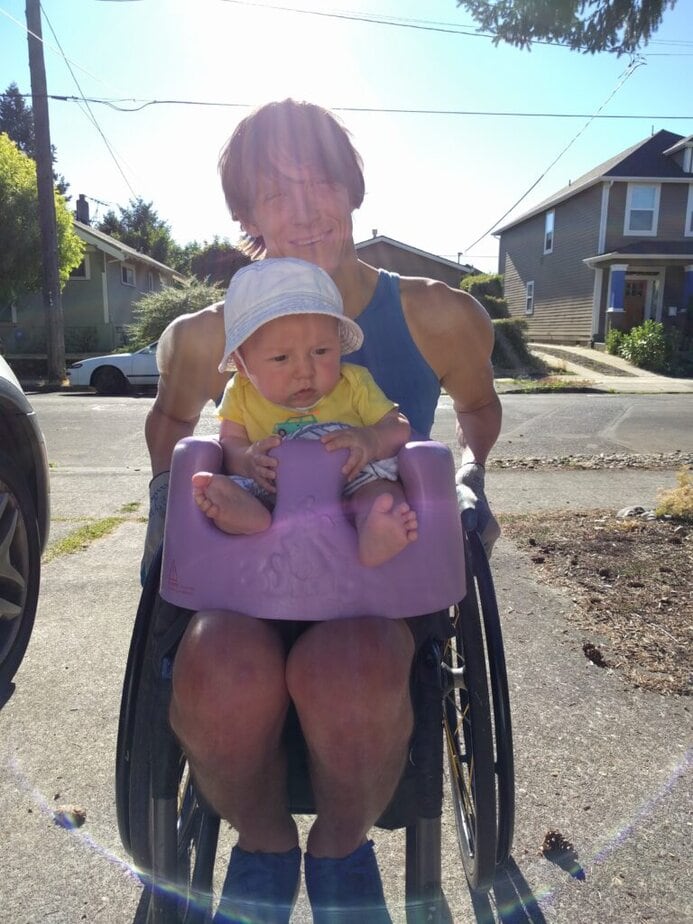
When Ewan was about three months old, I started putting him into a molded rubber seat called a Bumbo seat. I’d set the Bumbo on the table and lift Ewan up into it, then wheel under the table and pull the seat down onto my lap. He would kick his tiny little legs in excitement, and I’d roll the neighborhood with Ewan checking out the view before he was stable enough to sit upright on his own.
Find Your Community
United Spinal Association’s Rolling Through Parenthood Support Group is a safe place to share, gain valuable information, advice and resources, and benefit from the experiences and support of your peers who are living with a disability and are adjusting to parenthood. The group is designed for parents with disabilities raising children from infancy to adulthood and includes spouses and/or partners.
This group meets every first Monday of the month, 7:00-8:00pm ET.
Support New MobilityWait! Before you wander off to other parts of the internet, please consider supporting New Mobility. For more than three decades, New Mobility has published groundbreaking content for active wheelchair users. We share practical advice from wheelchair users across the country, review life-changing technology and demand equity in healthcare, travel and all facets of life. But none of this is cheap, easy or profitable. Your support helps us give wheelchair users the resources to build a fulfilling life. |