


The last time I skateboarded, I was 16 years old. It was preinjury and I wasn’t any good. I would mess around on the concrete behind the Harley Davidson shop where I sold expensive T-shirts to tourists and tried to do ollies until neighboring business owners tired of the racket and yelled over the fence for me to stop.
My nondisabled skateboarding experience was a summer idle, an entertaining way to kill time between cruise ships. Post-SCI, I never even considered getting back on a skateboard until this past winter when I went to an adaptive cross-country ski camp. I wasn’t any good at cross-country skiing either. I was slower than the 60-year-old woman with a bumper sticker on her back that said, “If you can read this, you’re in last place.”
However, I learned what every other person who’s strapped on a pair of Nordic skis has learned: It’s the most efficient way possible to wear yourself out. In my first session I skied for less than 2 miles, and when I was done I could barely transfer back into my car. I loved it. But when it comes to masochism, I prefer to work alone. The physics of going cross-country skiing — navigating snowy parking lots, unloading a ski frame and skis out of a vehicle, clicking said skis into the frame and then back off again — were awful with my lack of function.
So, I started dreaming up ways to get a similar workout but with easier entry. Adaptive cross-country skiers have had summer setups for a long time, usually bolting a ski bucket onto a set of cross-country roller skis. I live in the country though, with lots of dirt, gravel and grass, and didn’t want to always have to drive somewhere to get a workout.
Fortunately, there are lots of humans who are just as silly as I am, and after a bit of poking around on the internet, I found something called a mountain board. It’s basically an oversized skateboard with big off-road tires. Some of them come with hand-operated brakes. People fly down mountain paths and off dirt jumps on them. These people look incredibly dorky, though I’m sure they feel very gnarly. This was the kind of spirit, and gear, that I needed for my project.
The Plan
I ordered a basic Atom 95X Mountain Board, including a V-brake with pads and a lever like on a cruiser bike, from a company called MBS Mountainboards. It cost $200. That’s cheap for adaptive recreational equipment, but it felt like a lot because I had no clue if my idea was going to work.
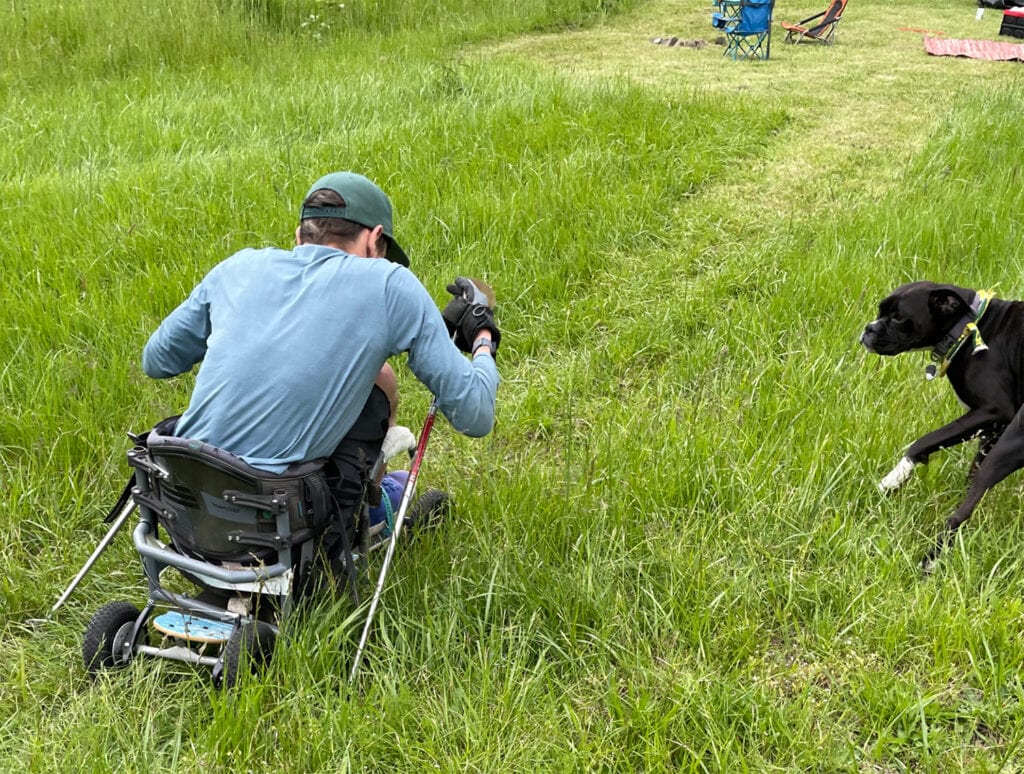
The plan was to pull the foot straps off the mountain board, then have my dad chop up the seldom-used cross-country ski frame that he’d made me a few years ago and bolt it to the mountain board. I would sit in line with the direction of travel, rather than perpendicular like you would on a skateboard, so I could pole myself along, feeling radical, I was sure.
My primary concerns with the project were turning and balance. You turn a skateboard by leaning — not ideal for someone with no core muscles. I knew I’d need to be strapped in securely to even have a chance. I didn’t have a good bucket seat for the frame either, nor the desire to procure one. So I stole the seat upholstery from an old rugby chair and decided to try an old backrest from my Bowhead Reach. That backrest itself is a hack. It’s a kiteboarding harness with thick, padded straps that wrap around your torso, modified with mounting brackets drilled into the back.

The Build
On build day, for possibly the first time in my hacking career, everything went smoothly. To improve balance and limit impact after the inevitable fall, I wanted to sit as low on the board as possible. The crossbars on my existing ski frame happened to be at the perfect height. My dad cut off the lower frame, first using a chop saw, and then, due to the difficulty of positioning the frame on the table saw, he switched to a handheld Sawzall, which worked perfectly.
Then we cut off the foot plate — my feet would sit on the skateboard — but left most of the leg tubing to help contain my knees and to have a place to mount the brake. We used clamps to secure the frame to the board and I transferred down into the seat. With my feet on the board, I was sitting with a lot of dump, which made me feel stable front and back. Side-to-side, the board felt wobbly for sure, but the kiteboard harness gave my lower torso good stability. The skateboard trucks provided some resistance as well, which meant I could use my shoulders and upper body to lean and, equally important, right myself from a lean. Ski poles would further aid in stability. My idea started looking like it might work.
We drilled two holes in each crossbar and bolted the bars to the board. We mounted the brake lever on the tube beside my right knee, where I could press the lever even with my balled-up fist.
For finishing touches we put receivers in the frame so I could mount snowboard-style click straps to keep my hips in place. I used a rubber Titan strap to secure my feet to the skateboard deck. Finally, I found an old pair of downhill ski poles with pistol grips and used a pipe cutter to shorten them down. The grips have hard rubber bases to push off with, and I use Active Hands gloves to secure my quad hands.
Into the Great Wide Open, Slowly
If you call taking more than 20 minutes to do roughly a quarter-mile lap around the fields and gravel driveway of my home a success, then yes, project cross-country skateboard was a smashing success. I started at my house out of sheer stubbornness. The fields are grassy and bumpy with hills and significant cross-slopes. The gravel drive is steep, with racquet ball-sized rocks strewn about. If I could make it around there independently, I was pretty sure I could handle most terrain.
The equipment itself did remarkably well. The mountain board tires handled the rocks and bumps with little complaint. The board turned more or less as I asked it to, though turning all the way around took some Austin Powers-type maneuvering. I was able to slowly, ever so slowly, crawl up hills and traverse the cross-slopes. Stability was decent when I was poling along, although on downhills I had to ride the brake otherwise I got some serious speed wobbles. Shredding the gnar I was not. My wife laughed the first time she saw me trying to descend a hill. Even going 3 miles per hour, I’m sure it looked precarious.
Dorkiness aside, I was able to do all the transferring and gearing up and field tromping independently. I finished my 20-minute lap, exhausted. Somehow, back muscles I can’t normally feel were throbbing, and I could barely transfer out of the seat. I loved it.
Support New MobilityWait! Before you wander off to other parts of the internet, please consider supporting New Mobility. For more than three decades, New Mobility has published groundbreaking content for active wheelchair users. We share practical advice from wheelchair users across the country, review life-changing technology and demand equity in healthcare, travel and all facets of life. But none of this is cheap, easy or profitable. Your support helps us give wheelchair users the resources to build a fulfilling life. |


Recent Comments
Neil on A Safe, Effective Reusable Catheter System
Richard Crumb on A Safe, Effective Reusable Catheter System
Richard Crumb on A Safe, Effective Reusable Catheter System