


How A Trip to the Bathroom Led Me to Rethink Caregiving and Independence
July 30, 2025
Greg Moomjy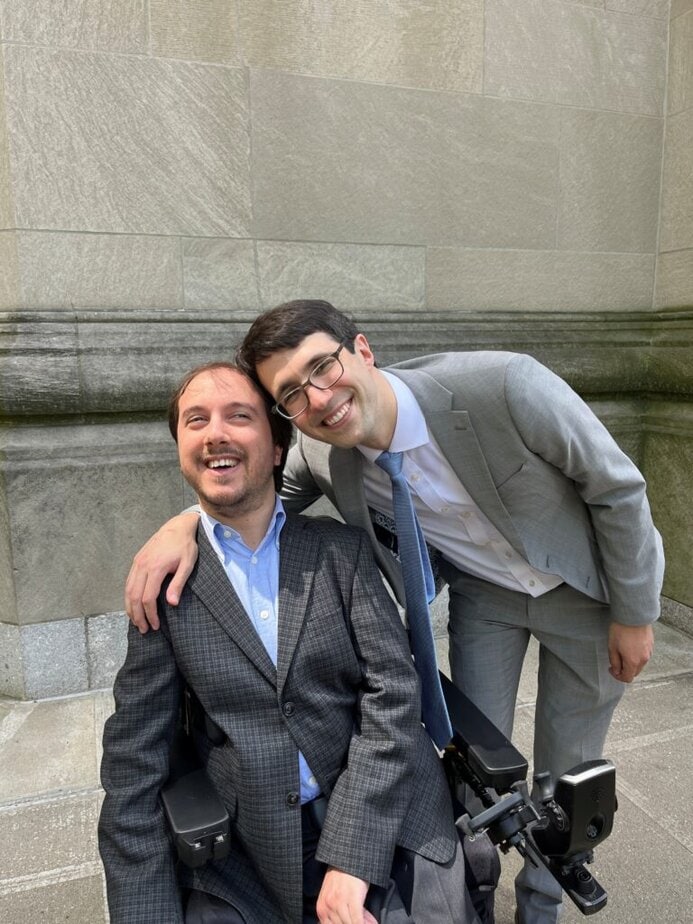
After 28 years of living with congenital CP, my definition of who can be a caregiver and what that relationship looks like for me changed on one memorable trip to the bathroom during a family weekend at a beach house in Queens.
With congenital CP, I need help with all my activities of daily living — including getting on and off the toilet. Until my best friend Wade accompanied me to the bathroom that day, those responsibilities had fallen solely on the shoulders of my family members and caregivers selected by my parents.
When I sat down on the toilet and my body immediately shifted the wrong way, my first thought was, “Oy, this is going to take a while.” As Wade and I then proceeded to spend what felt like an eternity trying to stop my butt from falling in the toilet, my second thought was, “Wait, the music’s wrong, Mozart is too clean for this. We need something a bit more spiky, perhaps even atonal.”
Let me explain. As an obsessed opera fan and musicologist, I have an uncanny ability to associate watershed moments in my life with the music that I was listening to at the time. I hadn’t fully processed it yet, but by singling out the music, on some level I understood that having a friend help me with my daily needs simply because he wanted to, had put me on the verge of entering a new reality and attaining a new level of independence.
The full realization did not occur overnight. It took me two years to figure out what actually happened that day. In the meantime, I had to confront some pretty big feelings — confusion and joy being the most prominent. You see, Wade had taken me to the bathroom because that’s just the kind of person he is. He didn’t even discuss it with me beforehand. While I was overjoyed, I couldn’t help thinking, wait, is he really okay with this? I didn’t want to impose on him. Was this something I could expect going forward, or was it just a fluke?
I didn’t know it then, but that confused, overjoyed, panicky sensation was also a more grown-up form of access intimacy — a term coined by the disabled writer and activist Mia Mingus. Simply put, It’s the intimacy that occurs when someone helps another person achieve their basic needs. It’s why I tell people that working with caregivers is very different than managing staff at an office. Whenever I’m asked to describe that difference, I always have to fight the urge to say, “next time you’re in the office, ask a coworker for help using the toilet and see what happens.”
I understood that having a friend help me with my daily needs simply because he wanted to, had put me on the verge of entering a new reality and attaining a new level of independence.
My parents’ insistence that I always put my caregivers first has been a blessing and a curse. While it allowed me to develop empathy for others, for the longest time I saw my body and the care it required as a burden rather than something I deserve as a human who happens to be disabled.
This is why I constantly check in on my friends again and again when they offer care assistance: I need to reassure myself that they are in fact okay with helping me with my care needs. Consequently, when Wade and I went to the beach that weekend, I also brought along my sister and brother-in-law and another aide, just to make sure there were multiple backup plans. My brother-in-law astutely observed that I didn’t technically need that many people. Furthermore, he remarked that having all those people around might actually get in the way of Wade and me being able to hang out as friends. He was right, and I since realized that caregiving is just part of how I have to show up in the world. It took me awhile to realize this, but looking back on it, that weekend at the beach marks the beginning of that realization.
Additionally, If I could ask my peers for help with my ADL, that meant I could explore my access needs for things that were actually important to me as an adult in my late 20’s. CP, might not be a progressive disability, but that doesn’t mean your relationship to it doesn’t change as your life goals evolve. I know from experience that what I wanted as a disabled man in his late 20’s is totally different than what I wanted as a disabled third grader.
I started to think, if Wade was cool with helping me use the toilet and even showering me and dressing me, maybe I could actually ask someone for help facilitating my love life. As a quadriplegic, I would need extra help to do things like transfer to bed, get undressed, etc. Obviously, whoever that person was would have to know what was going on. That lack of privacy was absolutely terrifying, but if a good friend could do it instead of a caregiver, maybe it wouldn’t be so bad.
Since that fateful bathroom trip, I am only more comfortable asking for what I really need —and I enjoy deeper relationships with the people I care about. Over a recent lunch, Wade and I calculated that we’ve known each other for 15 years. Thanks to him, I’m more independent, and I understand more about myself and how I relate to my CP. I’m excited to see how my independence continues to develop, over at least the next 15 years.
Support New MobilityWait! Before you wander off to other parts of the internet, please consider supporting New Mobility. For more than three decades, New Mobility has published groundbreaking content for active wheelchair users. We share practical advice from wheelchair users across the country, review life-changing technology and demand equity in healthcare, travel and all facets of life. But none of this is cheap, easy or profitable. Your support helps us give wheelchair users the resources to build a fulfilling life. |