


There are many paths to enlightenment. But for wheelchair users the path is often unpaved, with stairs, and filled with a lot of small-minded people. In my early experiences with Christianity, I was continually told that if I just loved Jesus enough, I would walk again. I hoped that when I shifted gears toward Eastern religion, I’d be moving closer to finding enlightenment. Then I attended a silent Vipassana retreat in rural Canada.
Vipassana is the meditation the Buddha practiced after trying all other forms of bodily mortification and mind control and finding them inadequate to free him from the seemingly endless round of birth and death, pain and sorrow. The 10-day silent meditation retreats are offered all over the world at no cost to the participants.
My caregiver, Ruthie, was a seasoned Vipassana practitioner. She had taken the 10-day course eight times and was very keen on helping me take my spiritual practice to the next level by attending a silent retreat.
The Arrival
The first thing Ruthie and I are greeted with when we arrive at the retreat at 3 p.m. is a sign that says “Bear Gate” and a 10,000-volt electric fence around the retreat’s perimeter. Before we’ve even settled in, the facilitators ask us to surrender our keys, wallets and phones. I am ridiculously suspicious and refuse. Ruthie laughs and says, “Why do you need to keep them? So we can sneak away in the middle of the night?”
I smile and bob my head as I remember what Woodrow Wilson said: “Trust, but know where the exits are.” I live by this quote. I eventually agree to put everything in my backpack. A compromise, because I can’t reach it there, but I know it’s close by.
Our first day wraps up with our only dinner, lentils, followed by our first meditation and discourse. Then we go to sleep. Except I can’t sleep because it is like 20 degrees in our room. Thanks to my neuromuscular disease I have very limited mobility. The brain-muscle connection doesn’t work in my body — basically, adult body, baby muscles. Also, like most chair users who are primarily sedentary, I have bad circulation. I am essentially like a frail 80-year-old who needs at least 75 degrees of heat.
Complicating matters even further, because of my limited mobility I can’t pile on layers to stay warm or I become the kid in the snowsuit in A Christmas Story: bundled up and warm, but with no ability to move my body.
Day 2
I wake up nauseous. I’m holding a bag, ready to vomit. I don’t know this at the time but the lentil stew wasn’t fully cooked and everyone is sick. I say something to Ruthie about how sick I am. She tells me to talk to the teacher.
I go to the teacher, who is in line ahead of Ruthie and me. I tell him I’m really sick. He says the first time he sat he was nauseous from his toes up. According to him, that’s part of the detoxing. “It’s good!” he says. “It means the process is working.
“By the way, Ruthie is feeling claustrophobic and so we want her to sleep in another room,” he says. Did I mention that Ruthie informed me she was pregnant the day before the retreat started? “She will be close by if you need her, and we will figure out a way for you to contact her.” As an afterthought, he says, “Oh, and YOU are talking too much to her.”
This is where I begin to lose my mind.
I’m away from my familiar setup and environment, with no ability to leave on my own. When I’m in my power chair or bedroom at home, I’m independent and able to manage. When I am at home, I have everything set up so I can sleep on my own. Traveling, I have none of that. I sleep with a CPAP and use a hair dryer to keep warm. It’s noisy and annoying to listen to.
My biggest fear is that I am a tremendous burden. Helping me all day, away from my familiar setup, would be a lot for any caregiver. It’s even worse because I’m worrying that I’m being a burden on a pregnant lady.
I recognize that bringing out major fears in a place where you are learning a technique to transcend attachment to suffering is the point — but I go into overload. Instead of collectively working through my fears, I go to the emotion I’m most comfortable with: anger. I am angry at Ruthie for not coming to me about her needs. I am angry I didn’t do more research around what the center would be like. I am angry at myself for being in a situation where I am confronted with all the childhood baggage I’d had in storage. Instead of relying on one primary, burnt-out, care-providing parent, I’d built a community of friends and paid care-providers, so that any burden that comes with me is parsed out in a way that no one or two people are crushed under it. Mostly, I am angry that I am disabled and can’t just get in my car and leave.
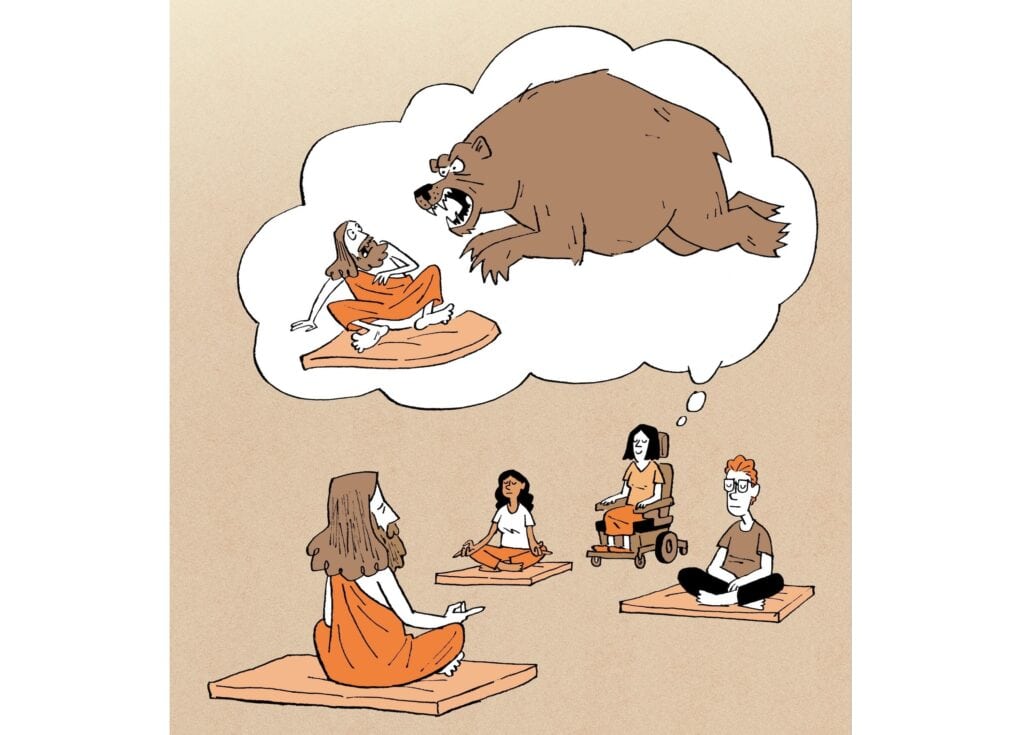
During meditation I’m so mad I imagine a bear eating the teacher so I can go home.
Days 3-5
The next night I get four hours of sleep. I make it through the day but pray hard that night. We are not supposed to engage in any religious or spiritual practice outside of the Dharma, yet here I am praying: “God give me grace, help me to figure out the right thing to do. There was so much flow getting me up here, but now I cannot figure out if this is just hard so that I learn, or if this is hard because I am not where I should be.”
At 1 a.m. I buzz Ruthie because I can no longer sleep on the IKEA wood palette they call a bed. My sacroiliac joint is in flames, my ribs hurt and my shoulders are up to my ears. I decide to sleep in the chair and have Ruthie transfer me. After an hour I move to turn up the dial on the space heater and lose my pillow, then get my seat belt caught in my wheel. I don’t want to call Ruthie again because she is also exhausted — and pregnant. I am awake in the dark cold, running through my options in my head: Can I call the U.S. consulate and tell them I am being held prisoner in Canada? Can I ring the gong and burst into song during the next sit so they kick me out? Can I call the cops and tell them I am a hostage? What is 911 in Canada?
“Can I call the U.S. consulate and tell them I am being held prisoner in Canada? Can I ring the gong and burst into song during the next sit so they kick me out?”
Ultimately, I call Ruthie and say, “How many hours do you need to sleep, because we need to leave tomorrow.” I know her response before she says it: “You need to talk to the teacher.” I don’t know how to respond. It’s 3 a.m. Ruthie gives me my pillow back, and I continue to devise my escape. In the morning my neck is so tired I literally have to hold my head up with my hand.
I go to the teacher. “I think I need to leave and I am trying to communicate that to Ruthie but she will not engage with me, so could you please tell her?” I say. “If I was a nondisabled person I could just go, but I can’t, and I need to be heard.” I will admit I cried, which my father would not have approved of, but I was at my wit’s end … imprisoned … in Canada.
An hour later Ruthie approaches me and says the teacher told her that we should not hold noble silence between us and that she is sorry if she is coming across as not compassionate to my needs. It turns out she never said she was claustrophobic but only that she wanted to read or check her phone and she didn’t want to take me out of my experience. She told the teacher I was chatting too much by saying thank you, and please, and God bless you, which, to her, was me focusing on her and not the process.
Hearing this de-escalates me from full-blown Hogan’s Heroes-escape mode and together we devise a way to try making the bed softer with more pillows between the egg crates. My stomach still hurts but I am keeping down toast and given permission to nap and take ibuprofen.
Day 6
I get up and shower for the second time in six days. My tailbone is in such pain I swear I must be sitting on something, but no. It’s official: I am in pain everywhere. In the bed, in my chair — there is no place of refuge. I calmly tell Ruthie, “I am not here for me. I would have left the night before last if I were nondisabled. I am here because I don’t want to disappoint anyone and that is the wrong reason. I am the one that has to live with knowing I didn’t complete this, and I am OK with that. We are leaving.”
God have mercy, she agrees!
I want to leave immediately and don’t expect a protest, because the previous day the teacher said if I had to go, I would go with his blessing. Instead, he says, “I am going to tell you something that will be hard to hear. You are the way you are in that chair because of past-life bad karma, and death is looming. We all fear death. If you don’t do this now, you will pass on that karma to your next life.”
I don’t cry or get mad. I smile and meet his eyes. “I honor the fact that is YOUR belief system,” I say. “But that type of dogma has been oppressing people with disabilities for centuries. We are told we are disabled because we are being punished or our parents are, or because we sinned or have bad karma. I believe God created me the way I am so I can help my community know they are not outcasts or sinners. You are a lovely soul and I appreciate that you want me to stay for my benefit. Maybe if I stayed I could transcend this physical pain, but I can’t be attached to that.”
“Lots of people leave and get the perspective that they should have stayed,” he says. “You are doing so well.” He asks me to stay the night and decide in the morning. I firmly tell him no, pop some ibuprofen and head home.
Epilogue
Twenty years later I don’t regret my choice. I’m not angry. I have a lot of gratitude for the experience. I consider it an awakening, not just of my soul but of my purpose. Like The Blues Brothers, I’m on a mission from God to transcend attachment and ableism.
Support New MobilityWait! Before you wander off to other parts of the internet, please consider supporting New Mobility. For more than three decades, New Mobility has published groundbreaking content for active wheelchair users. We share practical advice from wheelchair users across the country, review life-changing technology and demand equity in healthcare, travel and all facets of life. But none of this is cheap, easy or profitable. Your support helps us give wheelchair users the resources to build a fulfilling life. |


Im Sorry Christians did a Bad Job of Showing Jesus’ real Love and Miracle Working Power. Dont Give up on Jesus because Others messed up, He IS the Truth, the Only Way To Heaven, your True Source of Peace Love and Hope, and Who we should meditate on/with, every day. He Truly Loves us More then Anyone Else, 🙂 He died for Us, Literally. Buddha, and the rest, did not. Plus Jesus, Rose from the dead, with Hundreds of Eye Witnesses. and. Hell and deception is the other choice. i Choose Gods Love, and the Word, and show Grace to the Very Imperfect Church. Heaven is Amazing, and Forever!
I’m sorry Mike I think you missed the point… of the article.
Amen! I’m tired of people telling me that if I have enough faith I can walk again. And yes, they say it is a generational curse. I’m tired of it too. But I still like to dream and hope that someday I will walk again. Maybe what comes after this place?
As a disabled person I do not understand the fascination with walking. It looks awkward and difficult and exhausting and painful. My electric wheelchair is the bomb!
What a story! I’ve practiced vipassana meditation for some years now and am completely disgusted by your experience. I’m so sorry this happened to you and really surprised by the lack of caring and compassion you experienced. Your response to the teacher’s comment about karma was just brilliant! Also, what a total ableist jerk! Thank you for sharing your story and good for you for doing what you needed to do to keep yourself healthy.
You are so much more enlightened than he was, Always follow your logic and not someone else’s guilt trip.