


“You would love the Camino, but there’s no way it would work in a wheelchair.”
My friend had just returned from a grueling but spiritually thrilling pilgrimage on El Camino de Santiago in Spain when he uttered these words to my husband and me on a quiet Sunday morning. He couldn’t have known he had ignited a fire in me.
Unintended challenge accepted. Quest begun.
The first hurdle: How could I, a paraplegic and full-time manual wheelchair user, experience the wonders of this ancient expedition and grasp what millions of pilgrims have felt so deeply for more than 1,000 years?
I consider myself a highly skilled problem solver. The Camino — with its steep hills, rough bridges over rushing streams, ragged paths studded with roots and rocks, and the sometimes-unforgiving sun and rain — would become my next problem to solve.
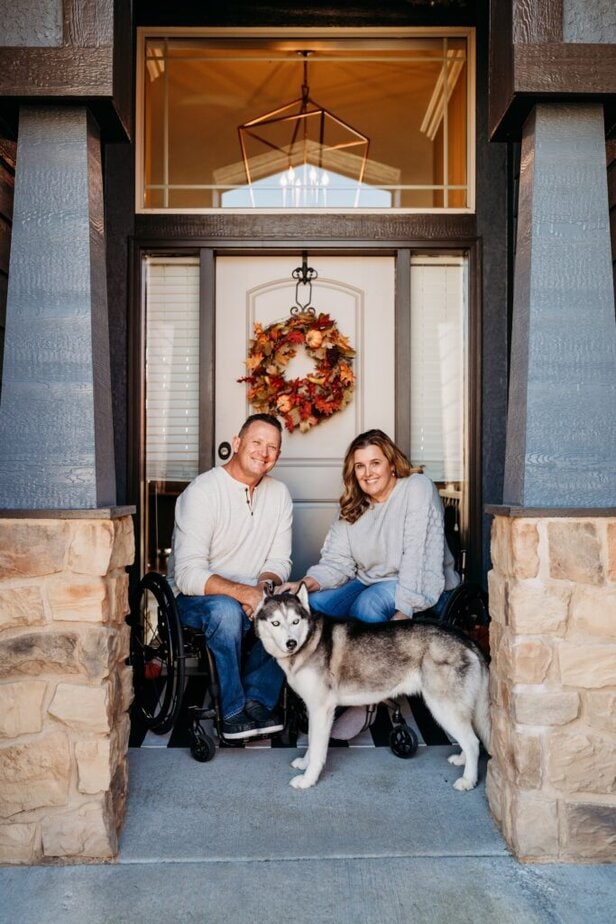
My husband, James, is also a paraplegic. As a couple, we have traveled together across the United States and on four continents. So, while this quest was unlike any we had taken on, it began like many of the others: on YouTube.
As we watched Camino videos, we learned that there are dozens of routes across Europe, some of them hundreds of miles long, and they all converge in Santiago de Compostela in the northwestern part of Galicia, Spain. At the finish line, in the magnificent Cathedral de Santiago de Compostela, the remains of Jesus’ apostle Saint James the Greater lie under the altar.
The routes are infamous for their difficult terrain, even for skilled, nondisabled hikers who embark on this bucket-list adventure. Walkers — or pilgrims as they are often called — must walk a total of 100km (62 miles), collecting daily stamps to earn their Compostela, the official certificate awarded by the Cathedral of Santiago de Compostela to pilgrims who complete the journey.
Our research led us to the discovery of the I’ll Push You accessible Camino group trips. Founded and led by best friends Justin Skeesuck (who has used a chair since his teens due to neuromuscular disease) and Patrick Gray, these trips were inspired by the men’s groundbreaking completion of the Camino Francés (the French Way) in 2014.
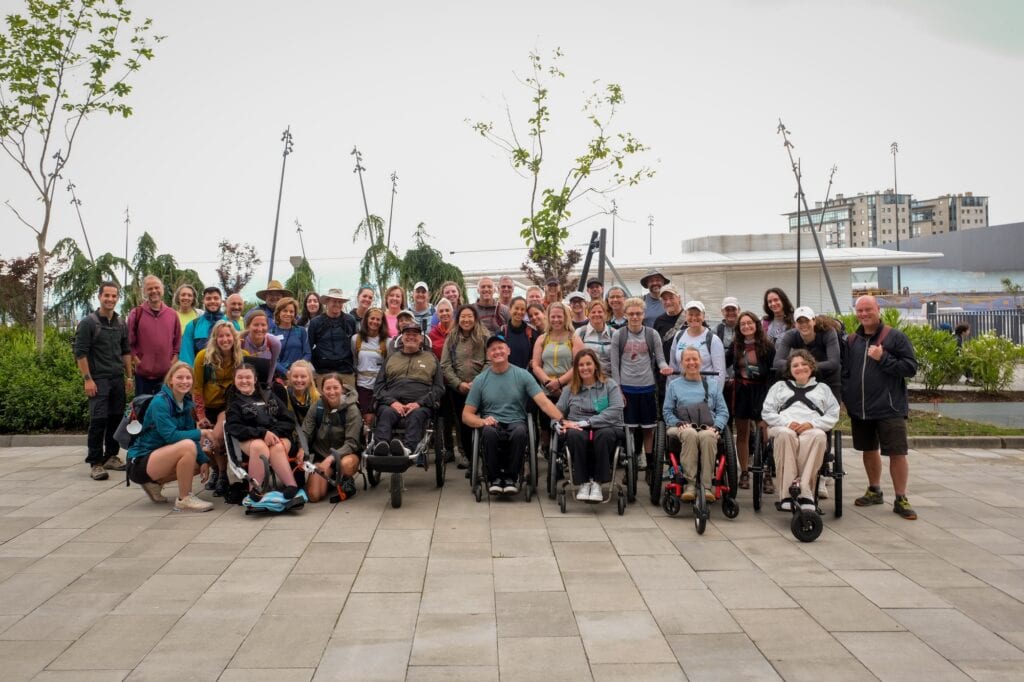
James and I agreed that this program seemed ideal, as it offers a disability-friendly way to complete the Camino and is open to both walkers and rollers. We immediately applied and were elated to later learn that we were two of 42 people selected from a pool of 150 candidates to participate in the June 2024 trip on the Camino Portugés (the Portuguese Way).
Our group consisted of six wheelchair users and 36 “pushers.” The pushers ranged in age from 17-73, hailed from 15 different states and three countries, and held various occupations. Each had completed the application and interview process to join the group with a primary purpose to push, pull and help in any way necessary. We felt both excitement and, let’s be honest, a fair amount of trepidation.
Since becoming a paraplegic 30 years ago, I have strived to live as independently as possible. I knew I would have to rely on the pushers, but wondered whether I’d be able to accept the help I needed. It was another unknown complicating the ultimate question: Were we ready for this monumental challenge?
In short, no. We were not. Even with our solid resumes as wheelchair world travelers and the clear communication we had with the trip team from the start, we couldn’t begin to grasp the extent of the trials we would encounter or imagine the life-changing lessons we would learn.
Preparing for an Adventure
For months we chatted virtually with the other participants and the team leaders. We secured a grant from the Kelly Brush Foundation to cover specialized wheelchair hiking equipment. We prepared physically, and we meticulously curated our packing list. Everything felt under control until the week before we left.
I faced an emergency root canal and severe ear congestion that had to be resolved before our long flights to Madrid. Then, two days before departure, a vandal smashed James’ car window. When we finally made it to the airport, flight delays out of Kansas City cost us our connection in Charlotte by minutes and we were eventually rerouted through Dallas.
Exhausted, we arrived in Madrid. However, we discovered that our luggage, which contained our push handles, leather wheelchair gloves, gear straps, carabiners and FreeWheel all-terrain attachments, had not. In retrospect, it seems as if the universe had begun sharing its lessons on surrender, a theme that would emerge over and over again on the Camino.
After one last flight, we made it to our final destination of Vigo, Spain and collapsed into bed. The next day, with our luggage still MIA, we bought some basic toiletries and clothing at the nearby mall and crossed our fingers that our luggage would find us before we began the first day on the Camino.
We figured our luck had changed for the better when we saw a courier dropping off “our luggage” at the hotel, but relief quickly turned to panic. The bags weren’t ours and the courier insisted in rapid-fire Spanish that we had to return them to the airport. Our pleas in broken Spanish finally convinced her to take them back. Frustrated and anxious, we realized we might not see our bags — or their crucial contents — any time soon.
Still sporting the same clothes we were wearing when we left KC, we freshened up as best we could and went to meet our group for the first time at the welcome dinner. It was exciting to meet everyone, but when I realized that most of the other individuals in wheelchairs had brought family and friends with them to assist, I worried if anyone would want to push me.
With that question burning in my mind, I listened as our leaders explained that each wheelchair user would dictate the method and amount of pushing they desired. This was reassuring and it aligned with the independent spirit that James and I share. However, with a long-term injury to my right arm, I wondered if I had made a big mistake.
Day 1 – Vigo to Redondela (15 kilometers; 9.3 miles)
After a quick group picture near the hotel, the adventure began. My first pusher was a fellow Midwesterner and 911 dispatcher who gamely used the backrest of my chair in lieu of the missing push handles. Excitement and positivity filled the air as we began wheeling over the smooth, paved sidewalk beneath overcast skies. All of us in the group had fastened a matching scallop shell, a traditional Camino symbol of pilgrim status, to our daypacks. The shells swung joyfully as we headed down the road.
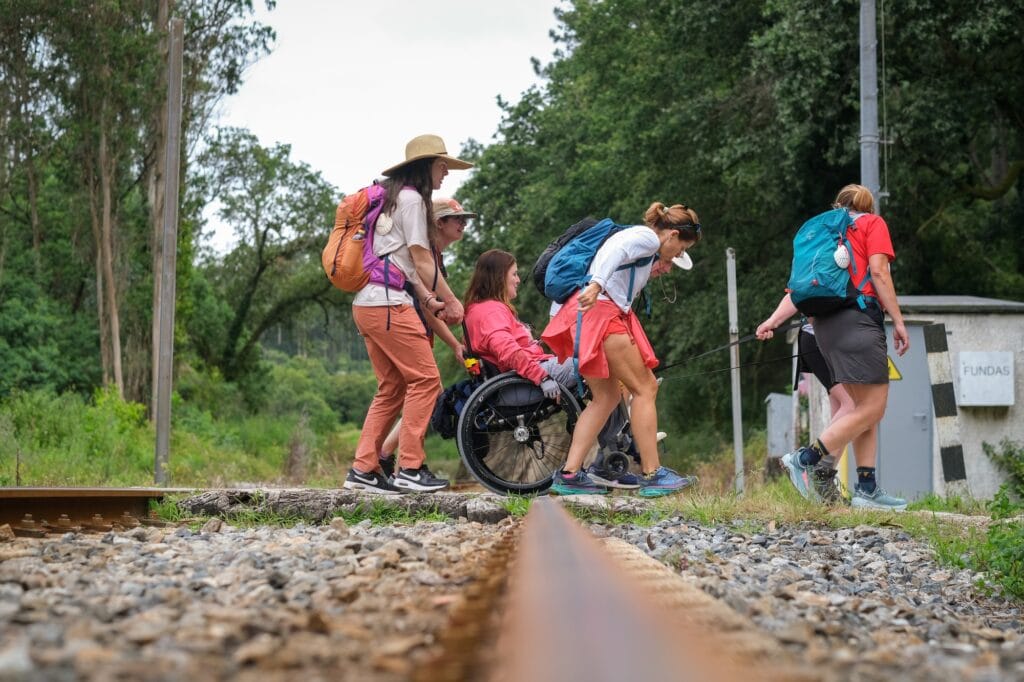
Shortly into our journey, we encountered our first steep ascent. The pushers jumped into action, connecting a gear strap with carabiners to the frame of each wheelchair and using a pushing and pulling combination to roll each of us slowly up the hill. Thankfully, one of the pushers loaned me some leather pushing gloves, and others generously loaned us straps.
I marveled at the teamwork and the generosity of my fellow travelers, but guilt crept in as I considered how difficult it was to push me in my everyday chair that lacked any adaptations. I knew the burden would only increase as the hours on the trail increased.
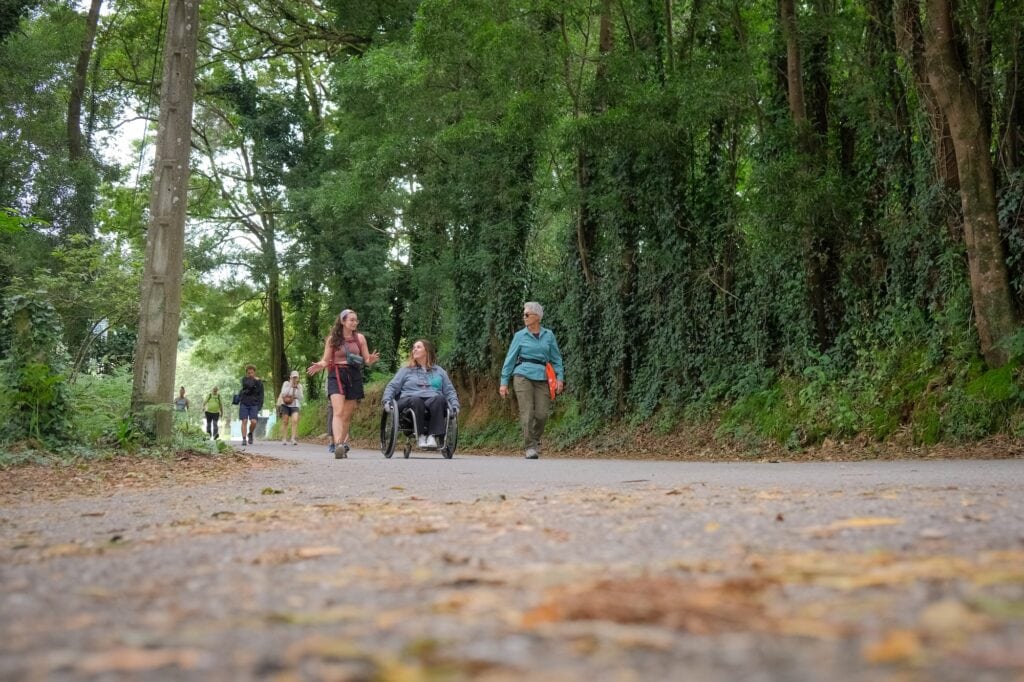
A magical forest awaited us at the top of the hill, and we trekked through towering eucalyptus on a worn dirt path filled with rocks, sticks, and other natural obstacles. The first stamp of the six we needed to receive the Compostela completion certificate came from a woman in a small, garage-like structure on the path. The scenery was majestic with the spectacular Ria de Vigo coast to the west as we traveled, and we stopped to admire a rushing waterfall, smile at a rock outcropping adorned with a whimsical fish mural, and breathe in the lush, colorful flowers.
I attempted to soak in the beauty, but my body ached, and I was worried about further aggravating my old arm injury. James’ hands had already developed blisters, and he had taken a couple tumbles out of his chair when his casters caught on the uneven ground. As we made the descent into Redondela, several pushers joined forces to anchor us, ensuring that we didn’t roll down too quickly.
At the group dinner that night, we ate wood-fired pizza and drank red wine, two of our favorites. Despite the wonderful food and enjoyable company, we left shortly after dessert, anxious to get out of our wheelchairs and put our feet up after a long day.
We made it through day one, but our progress didn’t quiet the nagging voice in my head questioning whether we were physically and emotionally strong enough to complete the pilgrimage.
Day 2 – Redondela to Pontevedra (20 kilometers; 12.4 miles)
Bright and early, our group boarded two buses to return to the spot on the Camino where we had stopped the day before. The previous day’s route may have had its challenges, but this day would be a turning point for me.
We were traversing part of the Roman Road, built around 300 B.C. and now consisting largely of weathered boulders jutting from the ground. This particular section stretched for one brutal mile, punishing for walkers and impassable for wheelchairs.
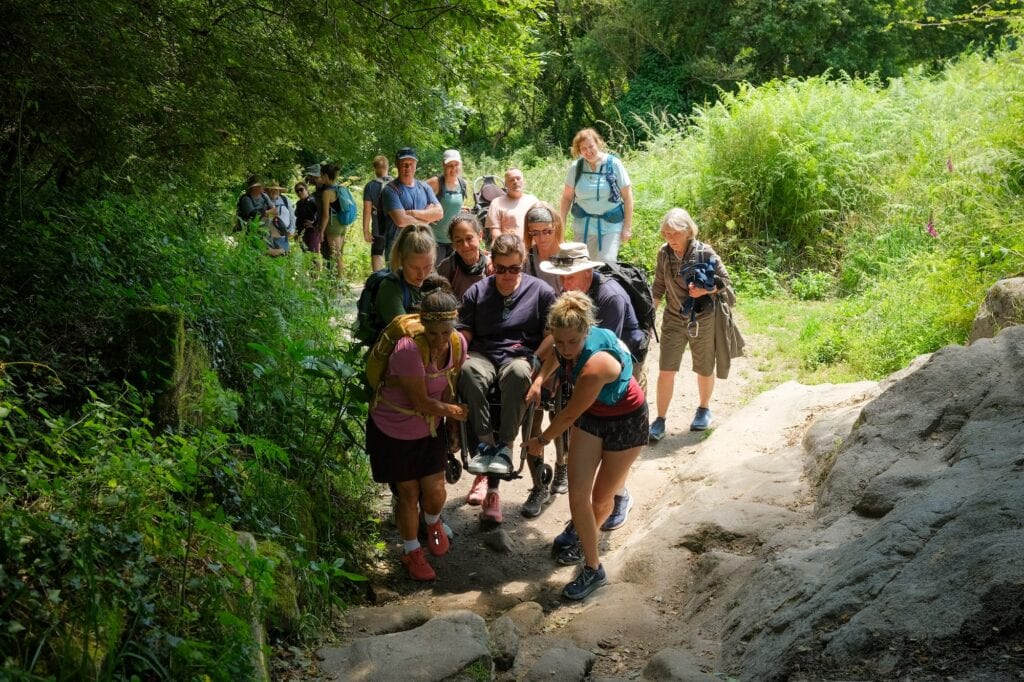
I was worried. Fortunately, a mighty, all-female team assembled and after spotting a resting point a few yards ahead, the women lifted me into the air. And here’s the big surprise: I, the control freak, completely surrendered to them. Instead of feeling powerless, I felt a surge of power rushing through me as their steady, determined energy and strength carried me step by careful step over the jagged stones. Though it was the most dangerous portion yet, I felt an unexpected ease. I was proud for choosing trust over resistance, a challenge I face often in my daily life.
Speaking of women literally supporting women, later that evening in our hotel, we heard a knock on our door and opened it to find a fellow pilgrim bearing gifts and encouragement: a care package that she had put together for us from her own supplies with blister pads, Band-Aids, Tiger Balm muscle rub, and even a fresh pair of underwear for me.
Having those little bits of comfort provided incredible relief. There is a saying, “The Camino Provides,” and on this night it did. Her generosity reinforced that James and I weren’t in this alone. We had others supporting us, physically and emotionally. Buoyed by this act of kindness, I thought, we can make it another day.
Day 3 – Pontevedra to Caldas de Reis (22 km; 13.7 miles)
Day three began in a charming town with the dramatic Santa Maria la Mayor Cathedral rising from the center square. Rolling through the European architecture, the smooth roads felt like silk. At one point in the day, I encountered James waiting for me at one of the makeshift shrines that dot the Camino path. We both cried as he laid one of his late mom’s rosaries on the shrine and we reflected on how she would have loved hearing about this epic adventure. Leaving a little piece of her there offered healing, just as leaving parts of our past selves behind was healing us, too.
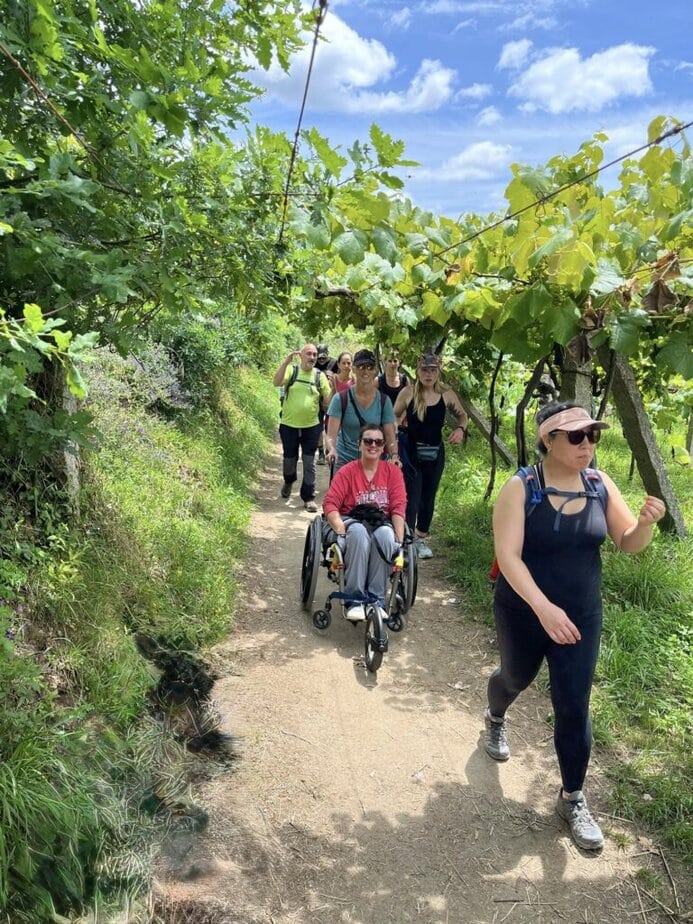
Later, as we rested and ate lunch on a grapevine-covered terrace, we were puzzled when a traditional Spanish almond cake, a tarta de Santiago, arrived at our table with two lit candles. Had someone mistakenly believed it was one of our birthdays? It was better – our suitcase with our FreeWheels had arrived. Tee Travel, our incredible tour company, delivered them directly to us on the path.
With the long-awaited FreeWheels, the freedom of that first solo downhill was exhilarating! For days, we had relied upon others to manually lift our casters over every obstacle. It felt good to give our pushers some relief.
Later, one of the pushers told me she chose to walk the Camino in honor of her dad, who had been killed in the line of duty 35 years earlier, and to pay tribute to her cousin, a single mom that had overcome many challenges to raise two sons who both lived with muscular dystrophy.
It gave me pause as I pondered my purpose on the path.
Day 4 – Caldas de Reis to Padron (18 km; 11.2 miles)
At lunch, we feasted on a local delicacy of dark green Galician peppers, and now that James and I finally had our gear, I could somewhat relax and fully embrace the wonders of this life-changing experience.
A flat tire brought my progress to an unexpected halt. Thankfully, we had brought a spare tube, and James has years of practice fixing flats. With the support of my pit crew, I was rolling again in less than 10 minutes.
Day 5 – Padron to Teo (12 km; 7.5 miles)
In addition to passing delicate, silvery olive trees and stopping for an impromptu dance break when we encountered a joyful bagpiper, day five brought the most impactful moment of the trip.
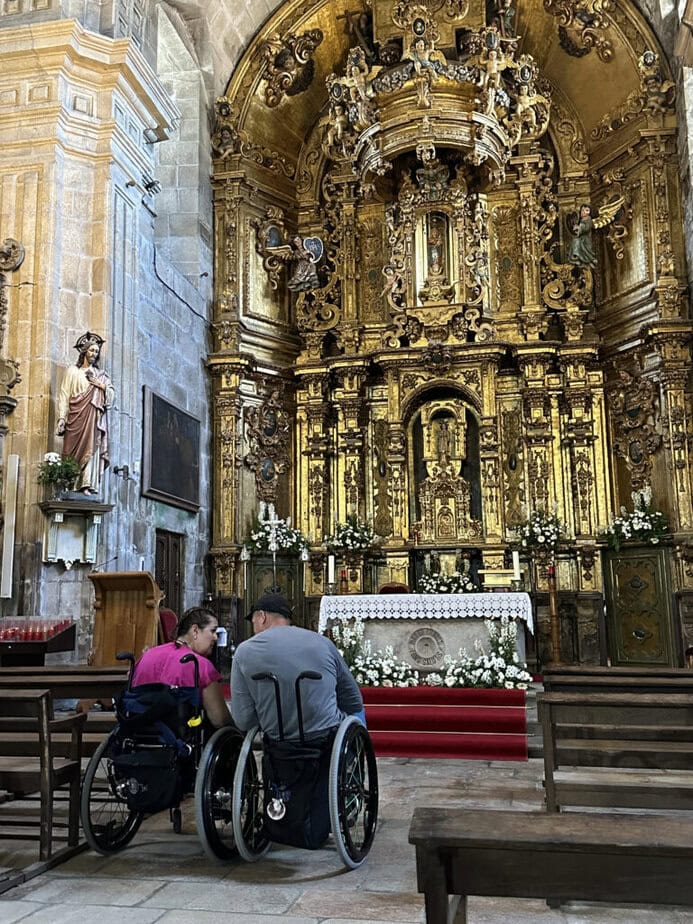
At the ornate Santuario de la Esclavitud, we encountered a huge step to enter the church. I hesitated to enter, unwilling to burden others or deal with the hassle of navigating the step with my chair. I lingered in the courtyard beneath the large shade trees, but I felt a persistent pull on my heart that urged me inside. I knew the group would assist me without pause, and finally, with a mindset softened by vulnerability from all I’d experienced over the last five days, I accepted help and entered.
Immediately, I felt the strong presence of my brother, whom I had lost nine years prior. I knew instantly that it was at this still, sacred place that I would place the stone I had brought in his memory. I had sought the most meaningful spot on the trail to leave this tribute, and that day, I found it. Gratitude washed over me as I recognized that it was only through accepting help, something I had struggled with mightily before this trip, that I experienced this priceless gift.
Day 6 – Teo to Santiago (13 km; 8 miles)
Our final day on the Camino started with a flat tire, and shortly after its repair, I heard the dreaded thwack of yet another. Two flat tires within a couple of hours? I panicked a little, hoping that the bad luck that had plagued us early in this journey had not returned. We were so close to the finish. Thankfully, Tami, a highly-skilled nurse and military veteran, came to the rescue, scouring the inside of the tire until she discovered a minuscule nail that had evaded us.
The markers along the way showed the shrinking distance to Santiago, our final destination. We wound through the Old Town on the narrow stone streets brimming with other pilgrims and locals. As we approached our final few yards, people shouted “Buen Camino!” and applauded our large group.
When one of our group shouted that we were almost there, without thinking, I shouted back. “I’m not ready!”
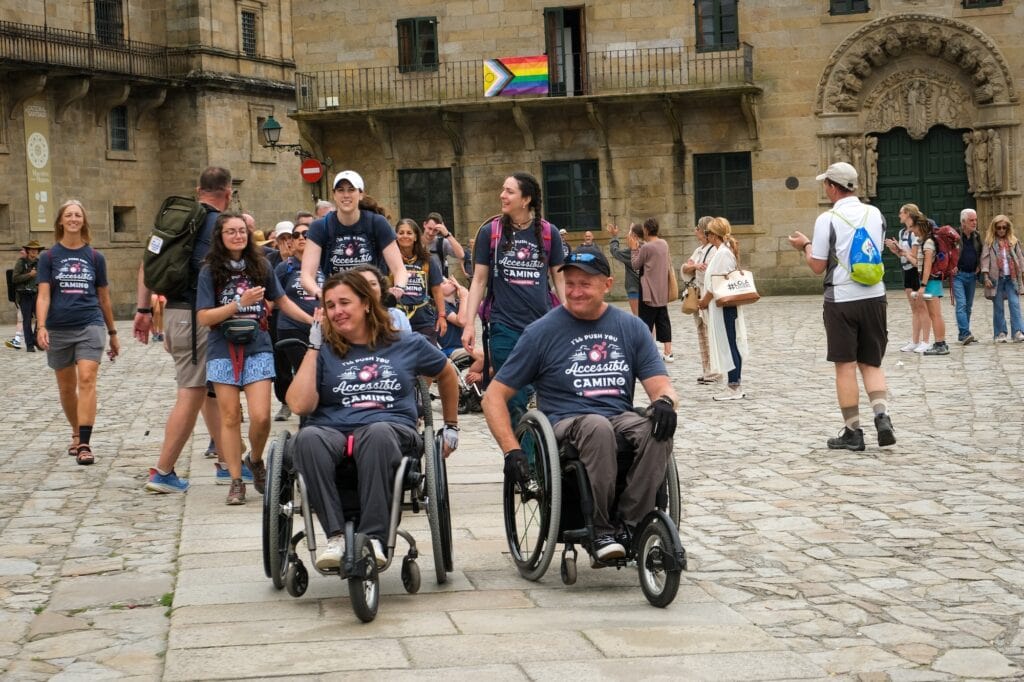
Sure, six days of demanding conditions had left me exhausted and physically ready to be done, but emotionally? That was more complicated.
As we turned the corner, James and I left our pushers and wheeled our way into Plaza del Obradoiro. We entered the square, the majestic Cathedral de Santiago de Compostela looming to our right, but my attention was fully on James.
“Can you believe we made it?” I whispered, tearfully.
Overwhelmed, we shared hugs and sobs of happiness with our fellow pilgrims for the next few minutes. As people peeled off to find lunch in the nearby cafes, I didn’t want to leave the square. I had a massive surge of gratitude for all that I had achieved, not on my own but together with this remarkable team. The long and arduous days had molded our diverse group of encouraging, adventurous, fun people, transforming us from strangers into a loving, supportive, fascinating family.
That evening, we reunited for dinner. We received our Compostela certificates and toasted our accomplishment. The rain that had been threatening to fall all week finally arrived, but it could not dampen our spirits.
Post-Camino Day 1
“Why did you want to do the Camino?” someone asked me the following day. A week earlier, I would not have known how to answer that question. Now, with 100km of struggle and frustration and elation behind me, the tearful response came pouring out of me: I needed to learn how to surrender. My trials, along with the support of our team and my own spiritual growth, had helped me see that when all control has been stripped, I can still be okay. Trusting others to help when I can’t help myself isn’t weakness. It is essential.
We woke before dawn on our last day, and in those quiet moments I prayed I could carry this growth home. Before parting, Tami surprised me with a present: a small jar with a tiny metal object in it. It was the minuscule nail that had led to multiple flat tires. It was the perfect parting gift — a reminder that obstacles, like that nail, can slow us down but they can also connect us to the people who help us move forward. Releasing control and letting someone push me, after 30 years of resisting, had led to an inner peace I hadn’t felt in many years.
Support New MobilityWait! Before you wander off to other parts of the internet, please consider supporting New Mobility. For more than three decades, New Mobility has published groundbreaking content for active wheelchair users. We share practical advice from wheelchair users across the country, review life-changing technology and demand equity in healthcare, travel and all facets of life. But none of this is cheap, easy or profitable. Your support helps us give wheelchair users the resources to build a fulfilling life. |