


A Pioneer Rolls Off the Hill

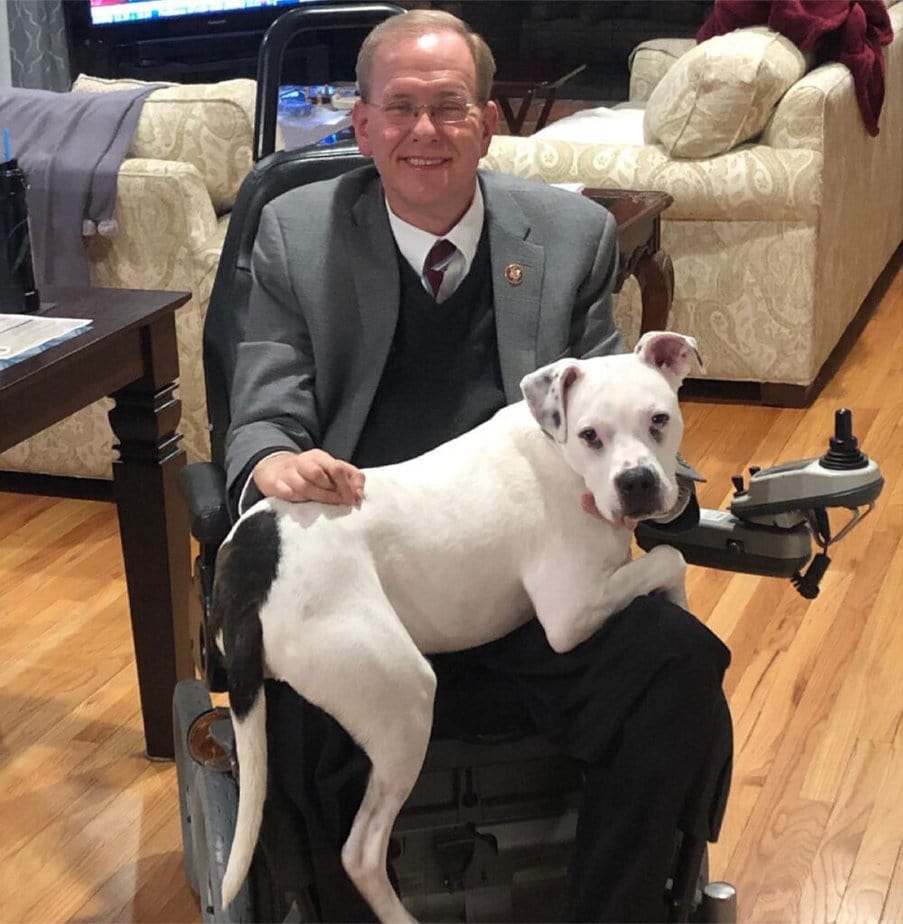
When the people of Rhode Island’s 2nd Congressional District elected James Langevin in 2001, they made him the first power wheelchair user and the first quadriplegic in the history of the U.S. House of Representatives. For the past two decades he has been a consistent, effective and outspoken voice for the disability community.
He was the Outstanding Congressional Leadership Award recipient at United Spinal Association’s inaugural Roll on Capitol Hill in 2012. And this past year, he received United Spinal’s Congressional Lifetime Achievement Award. NEW MOBILITY Editor-in-Chief Ian Ruder sat down with Congressman Langevin as he prepared to retire at the end of his term, to discuss his remarkable career and the road ahead.
NEW MOBILITY: Congratulations on 21 years of service as a congressman. As a fellow quadriplegic who understands the added complications and obstacles that come with a spinal cord injury, I have to ask, what has been the secret to doing such a stressful and demanding job for so long?
Rep. Langevin: Just for the record, it’s 22 years, but who’s counting? (Laughs) Living with a disability, especially being a quadriplegic, is not without significant challenges, as I’m sure you can well appreciate. I really haven’t given it much thought in terms of how I’ve done it. I had this goal in mind — I wanted to run for Congress and serve my community and be the representative who was the voice and the vote for the people of the 2nd Congressional District of Rhode Island — and I never let anything get in my way. I’ve always had a positive attitude and said, ‘I’ll figure it out as we go.’ It hasn’t been without hiccups. There have been times it’s been quite challenging being a wheelchair user and serving in Congress, but with a lot of help and a lot of accommodations, I made it.

NM: As the first quad in Congress, and probably the most visible power wheelchair user in American politics, you’ve been the face of disability for a lot of people. How do you handle that responsibility? And what advice would you give to others who are trying to be leaders and dealing with the same issues?
RL: I have to say that I’ve never made disability the sole focus of who I am or what I do. At the same time, I’ve always recognized the responsibility I’ve had at various levels of government where I’ve served to be a voice for those who are facing similar challenges from the disability community. Having the experience of living with a disability has made me a better policymaker in the area of disability policy. I embrace my disability as part of my identity, but I’ve never let it entirely define who I am or what I do. That’s the advice I would give to anyone that has a disability — you are not defined by your disability. You have interests and hobbies, and passions, just like anybody else. I’ve always tried to embrace mine, and I encourage others to embrace theirs and, whenever there’s opportunity, to leave the ladder down — or the ramp down, if you will — and allow other people to grow, find their path to success and realize their goals and dreams. I’ve always felt I have an obligation to do that, and I’ve always tried to encourage others to do the same.
NM: Of all the conversations and teaching moments about disability you’ve had with colleagues and elected leaders, is there one interaction or anecdote that stands out?
RL: When we were fighting for the rights of LGBT people, I said I live with a disability and I know what discrimination feels like. I encounter it almost on a daily basis, and I don’t like how it makes me feel. I don’t want anyone else to feel that same way. I translated my experience into how discrimination might impact others that had nothing to do with disability. It’s still discrimination nonetheless, and we need to speak out against it and stamp it out wherever possible.
NM: Since 2001, you’ve sponsored over 300 bills and co-sponsored almost 4,000, including countless bills focused on disability. What piece of disability-related legislation that you’ve been involved with are you most proud of? What piece do you feel has had the biggest impact?
RL: One of the most important ones is the Lifespan Respite Care Act. I created The Lifespan Respite Care Program back in 2006, with a Republican colleague of mine. Respite care provides short-term relief for family caregivers, which helps them to continue caring for their loved ones. If the caregiver can’t take care of their own health needs — for example, getting to the dentist or the doctor or doing the shopping for the family — they get burnt out and they can’t do the other things that they need for themselves or the family, and everyone suffers, especially the one that needs the care. We wanted to provide a respite care program, and it’s been very successful. The estimated annual economic value of uncompensated family caregiving is approximately $500 billion, if you had to put a dollar figure to it. Supporting family caregivers helps to keep overall health care spending down. I’m very proud of the fact I passed a bill to reauthorize the program recently in 2020.
As far as the bills that have had the biggest impact, I would say the ADA Amendments Act of 2008, which strengthened the ADA after it had been weakened by the courts through several controversial rulings. And the Affordable Care Act that we passed in 2010, because it expanded insurance coverage for people with disabilities and eliminated discrimination based on preexisting conditions. It prohibited the insurance companies from charging higher premiums because of a disability and it also improved access to long-term care support services.
NM: You mentioned the ADA and ADA Amendments Act; 32 years after the ADA was signed into law, what’s your quick take on where we are with ADA?

RL: The ADA is a monumental law. It opened up so many doors for people with disabilities, myself included. In fact, I’m confident that I would not be here as a member of Congress if it weren’t for the ADA. However, the ADA isn’t an end-all solution. It’s not just one and done. We can’t say we’ve completed our work. We still need to build on its success and there’s so much more that we have to do to take accessibility to all aspects of our society so that people can truly live the American dream and realize the promise of the Olmstead decision: to be able to live in our communities independently.
NM: Is there one disability-related bill that you fought for or sponsored that you didn’t pass that you wonder what might have been had it passed into law?
RL: The Air Carrier Access Amendments Act is the one that comes to mind. I’ve introduced it (every session) since the 115th Congress. We haven’t made enough progress toward making air travel accessible yet. I still have my gripes about airline travel — they could and should do more. But we’ve had some successes with parts of the bill. By way of example, in 2018, we secured language in the Federal Aviation Administration Reauthorization Bill to create an Airline Passengers With Disabilities Bill of Rights, which clearly spells out the fundamental rights of travelers under the Air Carrier Access Act. This Bill of Rights was posted on the DOT website earlier this year, and I’m pleased about that. But there’s so much more that we need to do to make air travel accessible. The remaining parts of my bill are focused on updating accessibility standards and holding airlines accountable for violating the rights of travelers with disabilities. The fight isn’t over. I am confident that my colleagues will pick up the mantle and strong committee advocacy will eventually get this done.
NM: When you took office back in 2001, you founded the Bipartisan Disabilities Caucus in hopes of raising Congress’ awareness about the challenges facing Americans with disabilities. How would you rate that awareness today and the progress we (the disability community) have made over the last two decades?
RL: Congress was aware of disability long before I arrived in Washington, but the Bipartisan Disabilities Caucus is helping to move the ball further forward. It has served as a forum for education and awareness and helped forge relationships between members of Congress on both sides of the aisle to find common ground on disability issues. I believe Congress’ awareness of disability issues is much better now than when I arrived in Washington 22 years ago. But I credit the majority of that progress to the dedicated and tireless advocacy of the disability community. They were the ones that really pushed hard to pass the ADA to begin with, and they continue that advocacy. It’s had a profound impact in countless ways. We still have much more work to do to ensure that all people with disabilities have access to the resources and support they need to live independent lives in the communities, to enter the workforce and participate fully in society. Our work is not yet done.
NM: Your old iBot was an iconic presence rolling around the Capitol, and you recently got one of the slick new models. What is it going to take to get Medicare and insurers to recognize the benefits of complex rehab technology and start covering invaluable equipment like the iBot?
RL: Medicare and other insurance policies have not kept pace with the exciting advancements in Complex Rehabilitation Technology, and they’re going to need to catch up. To get there, it’s going to take persistent advocacy from the disability community and lawmakers. That’s why I’ve been working with United Spinal and other members of the ITEM Coalition to help advance through the requests for Medicare to cover power seat elevation, and power standing systems for power wheelchair users. And I believe that once we succeed with that effort, we have to push it farther. We need to keep pushing until Medicare, Medicaid and other insurance companies cover all forms of Complex Rehabilitation Technology so that the people with disabilities can live more fulfilling and independent lives in their communities. Technology is game-changing — when you can afford it and use it. We have to make sure that it is affordable and covered.
NM: There was a 21-year period after you were paralyzed before you joined Congress, and now you’ve served in Congress for 22 years. What are your plans for the next 20 years? What are you most looking forward to?
RL: I’m still working on what my next chapter will be. Right now, the plan is to come home and take my time to decompress a little bit. I’ll be pursuing a role in academia and there’ll be other things that I’ll be involved with. I want to do something that’s meaningful and challenging. I’ll be working on determining what those things will be over the course of the next several months. Being a member of Congress has been all-consuming — it can be a dizzying pace sometimes. I am so fortunate to have such an amazing staff, and I’m going to miss having them around me and working with me every day.
NM: What advice do you have for fellow wheelchair users who are interested in running for office?
RL: Just do it. Start by being involved in your community, pursuing things that you have a passion for and interest in. That’s what I did, I developed an interest in government politics. I started that way and one thing led to another. It’s important to serve as a role model wherever possible and open up doors of opportunities and break down barriers for others with disabilities so that they, too, can pave their own way to success and realize their own goals and dreams.
Support New MobilityWait! Before you wander off to other parts of the internet, please consider supporting New Mobility. For more than three decades, New Mobility has published groundbreaking content for active wheelchair users. We share practical advice from wheelchair users across the country, review life-changing technology and demand equity in healthcare, travel and all facets of life. But none of this is cheap, easy or profitable. Your support helps us give wheelchair users the resources to build a fulfilling life. |


Very interesting interview of former U S Rep Langevin. He is an inspiration to all of us to do the very best we can, not merely for our own benefit but more importantly for the benefit of our fellow man (or fellow people?). His optimism and zeal is contagious; I’m ready to go out and make a difference in the world! Thank you for this uplifting article.
Becky Smith