



All hail the mouthstick: Simple, direct, affordable — it needs no rebooting. When the Internet of Things goes dead, when batteries are nowhere to be found, the mouthstick stands tall. Tried and true, you just know there’s a cave painting somewhere that was done with a mouthstick. Is there any doubt, then, why we keep going to it, and why the mouthstick may outlast us all?
For 30 years, Dean Altman, of Plover, Wisconsin, has balanced the world on the end of a stick. As a C5-6 quadriplegic and power wheelchair user, Altman uses his mouthstick to control his computer, telephone, garage door opener, automatic door remote and more. Long ago, he found store-bought mouthsticks flimsy and not up to his needs, but he had a great dentist who built him a custom-fitted mouthpiece with a stainless steel stick-holder mounted to the front.
Its sturdy, protective foundation distributes pressure evenly through his mouth while holding a stick made of a plastic coat hanger or lightweight aluminum that is tipped with a bit of rubber catheter as a nonslip grip for buttons and keys. It is the Cadillac of mouthsticks — and thanks to his generous dentist, only cost Altman a copay.
But even the best of all possible mouthsticks will break down eventually. After three decades of use, Altman is mourning its demise like he might a favorite, old car. “It’s finally coming to the end of its life,” he says, worrying that his access and independence are breaking down along with it.
To make matters worse, the dentist has retired and, even though Altman has called dental facilities across the region, he can’t find anyone interested in building another. “Nobody’s biting,” he says.
The Frankenstick

Connecting with Altman got me thinking about my own history with the mouthstick. As hard as I try, I can’t remember when I started using one. I believe it’s because, when I needed it the most, the mouthstick found me — it just showed up.
I was aware of other, “better” accessibility gadgets on the market, but as my MS-affected arm and hand capabilities sped downhill at the same pace as my earnings and savings, things simply needed to get done. Recently, I managed to unearth what was probably my mouthstick 1.0, a white foam grip aid that I’d rammed a pencil into backwards, eraser-out, for a nonslip end. The opposite end of the foam is yellowed with ancient saliva stains and bite marks left by a quadriplegia americaonlineus.
Since then, the mouthstick and I have grown quite close. Like old couples do, we’ve trained each other into what we are today, and now coexist in our own unique environment. On my desk sits the mouthstick holder, made of microwavable thermoplastic pellets heated and molded into a Y-shape. It is mounted on a paint stirrer weighted down at one end by a mortar-shell-sized can of enchilada sauce and propped up to the perfect pitch — 39.6°, to be exact — by a leather wallet and a rolled-up delivery envelope, so that I can reach the mouthstick.
Mouthstick Muscle Mastery
If you use a mouthstick regularly, it’s important to protect your mouth and muscles alike. My dentist says your mouthpiece should cover not just your front teeth, but the entire mouth, or else you’ll risk having problems with your teeth and jaw. He advises mouthstick users see a dentist to ensure their teeth are stable enough to support continued use. Additionally, here are some simple daily exercises to stretch and strengthen the neck, jaw and upper back.
• Jaw protraction, 3 sets of 10 repetitions each: bit.ly/3UQnpqy
• Seated cervical retraction, 10 reps of 10 seconds each: bit.ly/3TbWrc5
• Seated cervical side-bending active range of motion, 5 reps of 15 seconds each: vimeo.com/212681457
• Seated scapular retraction, 20 reps of 3 seconds each: bit.ly/3T1wTxW
The actual mouthstick is a wooden dowel tipped by a rubber thimble. On the other end is a hard mouthpiece custom-molded from microwavable plastic pellets, which is wrapped in a silicon sheet and capped by a rotating stock of covers made from the ends of cotton athletic socks, all held in place with a rubber band. The entire Rube Goldberg setup is a stellar example of the caregiver-engineering that keeps so many of us productive and sane.
This Frankenstick has wrangled light switches, desk phones, thermostats, ceiling fan switches, TV remotes, piles of junkmail and medical bills (same thing), drinking straws, scarves, blankets, piano keyboards, book pages, chess pieces, home automation devices — the irony! — and, of course, computer keyboards. It hasn’t finessed a bra strap yet, but where there’s a will, there’s a way. This dazzling array of accessibility stands unrivaled by any newfangled Bluetooth gizmo for any price. All for around $18, depending on the cost of a can of enchilada sauce.
Over the years, my Frankenstick has covered itself in glory, spoils and drool — way more drool than spoils. It’s a suspect in my worn-down tooth enamel, spinal curve and slumping. At times it falls out of reach and strains my upper back and neck.
Has using the Frankenstick been worth it then? I think so. Like brother Altman above, my mouthstick has been at the center of making my world more accessible. Will I stay with it full time? Part of my writing this article is my working through this question while I learn about alternatives, right along with you, dear reader.
Are mouthsticks, in general, disappearing? Are folks like Altman and me dead-enders, hanging on by the skin of our teeth to a sunsetting artifact soon to be replaced by sleeker, safer mouthtech?
Meet MouthPad, the New Kid on the Block
As I looked into mouthstick alternatives, I was lucky to meet 19-year-old Keely Horch, who lives near Baltimore. As a C2 quadriplegic without neck control, Horch has no need of a mouthstick — instead she controls her wheelchair and computer with her chin. Using her chin setup to control her computer through the wheelchair has been a drag, though, too tediously slow and limiting. But that changed in June 2023, when she began using the MouthPad, a new wearable that’s vaulted her beyond chins and mouthsticks, and into a more independent life.
“Before the MouthPad, I was never able to control a computer on my own. I always had somebody else controlling it for me,” she says. “When I had the MouthPad, I was able to play games that I had played before my injury. Playing with my brothers online was just mind-blowing and really fun for me.”
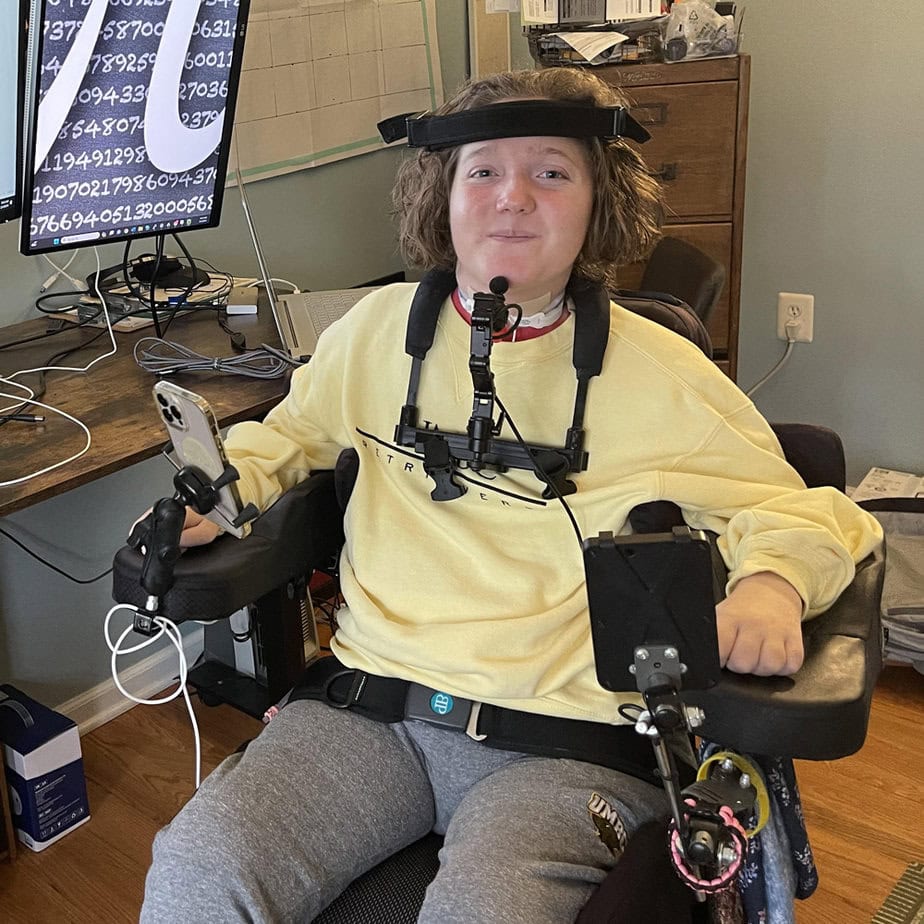
The MouthPad embeds a tiny touchpad in a dental-safe resin retainer, Bluetooth-enabled, for the tongue to manipulate like a finger would. At first it was a challenge grasping the relationship between tongue, touchpad and screen, but now Horch forgets the device is even in her mouth and uses it for five hours a day, controlling her cell phone and more easily editing the papers she dictates with voice recognition, which works alongside the MouthPad without a hitch. Settings are customizable, and she right-clicks by drawing air through her lips: It’s sip-and-puff without the straw.
The device enables Horch to study and research independently for her computer-engineering courses at the University of Maryland, Baltimore County. “Over the summer I took an online class over Zoom. I was able to unmute myself and raise my hand and type questions up, so it was a way to engage during the class,” she says. “I was able to use different software, like graphing, and … it was really helpful for visualizing things.”
To Gabi Munoz, head of business development for MouthPad-developer Augmental, Horch’s newfound accessibility is proof of his team’s vision of creating a “smart mouth” — arrived at after three years of working with almost 100 people with disabilities ranging from high-level SCI to fibromyalgia and injuries from repetitive stress and strains. “The idea was trying to get as many input gestures as possible from your neck up,” Munoz says. “We thought that it would serve those living with the most severe levels of physical impairment [and] help a larger number of people in a larger number of functional situations.”
Other Oral Options
There are several mouth-operated devices on the market that combine joystick control with sip-and-puff technology, and can be configured and personalized. The Quadstick, Quadjoy and Jouse range from $449-$1,369 — considerably more than a $21 mouthstick online — and offer differing degrees of functionality.
A lower-cost option is the open-source, 3D-printed LipSync, a USB mouth-joystick available from website makersmakingchange.com. The LipSync is Bluetooth-enabled to run various devices, and the website can help you connect with a local maker to produce the device for about $183 plus shipping.
For more details, check out newmobility.com/getting-ahead-from-bed.
For example, the MouthPad’s inputs started with the tongue and breaths. Then head gestures were added, and now Munoz is testing the use of bites as signals. “We have plans to add features that will allow dictation and speech by whispering first, and then completely silent [speech] later, which probably means that we’re going to be able to dictate or control voice control by moving your lips only,” he says, suggesting that even MouthPad-controlled wheelchairs could happen down the line.
To get on the waiting list for the MouthPad, sign up at augmental.tech/waitlist. Enrollees agree to cooperate in development of the product and receive a discounted price of $1,500. “Once we launch [in late 2024], it will be significantly pricier,” Munoz says.
I’ve been offered a chance to buy a MouthPad too, and if I do, I’ll review how it works. But whether I go with it or an alternative … somewhere, in an undisclosed location, I’ll be keeping my secret weapon. Long live the mouthstick.
Support New MobilityWait! Before you wander off to other parts of the internet, please consider supporting New Mobility. For more than three decades, New Mobility has published groundbreaking content for active wheelchair users. We share practical advice from wheelchair users across the country, review life-changing technology and demand equity in healthcare, travel and all facets of life. But none of this is cheap, easy or profitable. Your support helps us give wheelchair users the resources to build a fulfilling life. |


Watching my husband Dean Altman using the mouthstick every day gives me much relief from having to be his hands doing things on his computer.being told off for pressing the wrong buttons or getting so bored and irritable because there are other things around the home I need/like to do and dont have time for. Its good to know I can go to the store and be gone an hour knowing he can use the mouth stick to tap the remote that opens the inner Stanley door to the garage and then tap the remote to lift the garage door and be outside and safe if there is a fire. He can give visitors access to come in too or even deliveries. He can also use his mouth stick to call my cell phone to bring him more Star Wars rubbish from the store 🙂