


By Randall Howe
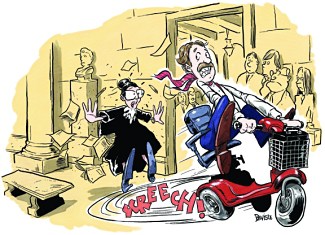
Never run over a United States Supreme Court justice. That would be my advice to all mobility-impaired attorneys who are going to appear before the United States Supreme Court. Just a word to the wise from someone who began the most important experience in his legal career by nearly knocking over Justice Ruth Bader Ginsburg.
I am an assistant attorney general for the Arizona attorney general’s office, and one of my cases was set for argument before the Supreme Court on April 19, 2006. Arguing a case before the Supreme Court is a rare event and one you don’t want to mess up. So a few days before my argument I went to observe an oral argument to see the justices in action and get acclimated to the courtroom. Although I walk with a crutch, I rented a scooter so that I could get around more easily and quickly. I rode the scooter to the Supreme Court building and parked it in the foyer of the lawyers’ lounge — the room where attorneys who are arguing cases wait for court to begin — and then walked to the courtroom to watch the arguments.
When the arguments ended, I returned to my scooter. I had trouble turning the scooter around to leave because I wasn’t familiar with the controls and people were streaming into the narrow space on the way to some meeting in the lounge. When I finally got the scooter turned around and began maneuvering around people, I saw a break in the traffic and sped up to get out the door before the next group of people came in. Just then, the diminutive Justice Ginsburg popped up. I stopped as quickly as I could, and as she stepped back in surprise, I said with as much apologetic good cheer as I could muster, “Oh! Excuse me, Justice Ginsburg!” She smiled at me and patted me on the shoulder as she entered the lounge. I was relieved that my career would not end with the headline “Disabled Attorney Assaults Justice with Scooter.”
Walking the Walk, Talking the Talk
No one ever would have predicted that I would one day be so close to a Supreme Court justice, much less argue a case before the Court. I was born with cerebral palsy, and from the beginning I had spastic limbs and slurred speech. I had innumerable surgeries and nine years of physical and occupational therapy before I learned to walk. When it came time for me to enter elementary school, many people advised my parents to place me in a “special” school because of my disability. This was the 1960s, before the Americans with Disabilities Act, before the Rehabilitation Act of 1973. But my mother saw no reason why I should not attend the elementary school near my house.
School officials would not allow me to enroll in the public school until my mother could prove that I was intellectually capable of performing in school. Of course, no other mother had to prove one of her children was smart enough for public school. The psychologist who tested me was embarrassed to give me the tests because I was obviously capable of learning at school just like every other kid. Even then, the school principal told my mother that they were not equipped to handle a child with a disability. After much wrangling with the school district and threats of lawsuits, I was eventually enrolled in public school at a time when mainstreaming children with disabilities was rare.
Even then, no one would have believed that I would have a career that involved public speaking. I was shy and self-conscious of my disability. Some children made great fun of the way I walked and talked. In junior high school, I had to take a speech class, but speaking before a group of people made me very nervous, and I stuttered and stammered a lot. In high school, a speech teacher saw that I was smart and competitive, and forced me — against my better judgment — to join the debating team. He treated me like any student on the team, and gradually I lost my self-consciousness about my disability. He taught me to speak slowly, calmly, and distinctly, so I could be understood despite my speech impediment.
Even though I left high school with a better ability to speak in public, still no one — myself most of all — would have thought that I would eventually make my living speaking. I went to college and law school with the idea that I would be a corporate lawyer, making deals in offices and advising people on things far from the public eye. I thought so even after successfully participating in my law school’s moot court competitions — competitions much like my high school debates. When I graduated law school, a law firm hired me to draft loan agreements and deeds of trust, things that could be done from an office with minimal exposure to the public. Although I had done work for the law firm’s litigation department during law school and thought maybe I could handle cases in court, the managing partner told me that they could not “see” me — that is, envision me as capable of performing — in the courtroom. He also told me that he would “prepare” any clients of the law firm before they met me. No one had ever needed to be “prepared” to meet me. While none of this sat well with me, I needed a job. So I gave up any thought of being in the courtroom.
Fortunately for me, although I did not think so at the time, the firm had financial difficulties and began laying off attorneys — including me. I found a job in the criminal appeals section in the Arizona attorney general’s office. I represented the state when criminal defendants appealed their convictions and sentences. I wrote briefs and filed motions in the appellate courts. I argued cases in the Arizona Court of Appeals, the Arizona Supreme Court, and the United States Court of Appeals for the Ninth Circuit. Funny thing, no one ever said that they could not “see” me in those courtrooms. After 10 years, the attorney general promoted me to supervising attorney drafting appellate briefs in tort and prisoner lawsuits. I argued cases in court. Six years ago, the attorney general promoted me again to chief counsel of the criminal appeals section. I now supervise 18 attorneys and advise and direct them in handling appeals and arguing cases in court. I can even choose to argue cases myself. In 17 years with the attorney general’s office, I have argued 70 cases, more than any other attorney I know of in Arizona.
Arguing Before the Court
Which brings me back to the United States Supreme Court. Arguing before the United States Supreme Court is a huge deal for any attorney, especially an attorney with a disability, and even more so for an attorney whose disabilities include a speech impediment. I believe that I am the first person with cerebral palsy to argue a case in the Supreme Court. The local Phoenix newspaper ran a front-page article about the event, reporting how much I have “overcome” to get where I am. The Powers That Be at the attorney general’s office certainly considered whether my disability prevented me from being the best advocate for the state on the national stage. My disability has always loomed larger for other people than for me. In the end, however, the attorney general recognized that my talent, skill, and experience as an appellate attorney counted more than my disability and made me the best person to represent the State of Arizona in that august courtroom.
Other than that, my experience before the Supreme Court was pretty much like the experience of any other attorney arguing before the Court. I spent a couple of months writing and rewriting my brief to the Court and had it critiqued and edited more times than I could count. I had multiple practice arguments, where I was repeatedly questioned within in an inch of my life and given tons of advice by experienced attorneys on how to argue the case. I read all the books and articles I could find on arguing before the Supreme Court. None of those books and articles, however, warned against hitting the justices with motorized equipment.
When I went to Washington, D.C., I went to the Court to watch arguments a few days before my argument, where I had the aforementioned encounter with Justice Ginsburg. I then spent two days trying not to be nervous and still think about my case. The night before the argument, I had an inexplicable dinner of a slice of key lime pie and a beer in an Irish pub in the hotel in which I was staying. Like most attorneys, I could not sleep the night before. At 2 a.m. I found myself sitting at the desk in my room reading the materials in my case. Given the bed in the room, however, it was just as well. Although I was in an ADA-compliant room, the bed was chest-high. I had to vault myself into it each night. When I called the front desk to switch to a room with a normal bed, the clerk told me that all the ADA rooms had high beds. So much for accessibility.
The day of the argument, I got dressed in my best suit, had a little breakfast with my friends and colleagues, and rode the scooter to the Court. I waited in the lawyers’ lounge for the Court to begin, and when the session began, my co-counsel and I waited in the courtroom for our case to be called. Watching the justices grill the attorneys in the case before mine, I wondered whether I could actually answer their questions about my case without embarrassing the entire State of Arizona. But when Chief Justice Roberts called my case, I left all my doubts behind me and concentrated on my job.
I was able to answer all of the justices’ questions, and no one had any difficulty understanding me. I did not perceive that my disability made any difference in the argument, although one of the national newspapers reported that the justices had been “alerted” to my disability. Just what that meant, and who “alerted” them to the obvious, I don’t know. Everyone seemed pleased after my argument, including my boss, the Arizona attorney general. I was just relieved that I had survived and done my job well.
In the end, while arguing a case before the United States Supreme Court was a once-in-a-lifetime experience for me and demonstrated that a disability should not stand in the way of appearing in the nation’s highest court, my disability was merely a minor side story. And that’s how it should be. The case I argued was Clark v. Arizona, a case in which a mentally ill defendant murdered a police officer but claimed that he did it while he was insane. The issue was what kind of limits the United States Constitution placed on a state’s ability to define insanity. The Supreme Court issued its decision on the last day of the term, June 29, 2006, and held that Arizona’s definition of insanity and its regulation of evidence of insanity was constitutional. The decision was important for the criminal law of all 50 states. The fact that the attorney representing the state had a disability was irrelevant. Again, that’s as it should be.
I think my next project will be to write an article giving attorneys with disabilities advice on arguing before the Supreme Court. My first piece of advice? Drive carefully.
Randall Howe is chief counsel of the criminal appeals section of the Arizona attorney general’s office.
Support New MobilityWait! Before you wander off to other parts of the internet, please consider supporting New Mobility. For more than three decades, New Mobility has published groundbreaking content for active wheelchair users. We share practical advice from wheelchair users across the country, review life-changing technology and demand equity in healthcare, travel and all facets of life. But none of this is cheap, easy or profitable. Your support helps us give wheelchair users the resources to build a fulfilling life. |


Recent Comments
Neil on A Safe, Effective Reusable Catheter System
Richard Crumb on A Safe, Effective Reusable Catheter System
Richard Crumb on A Safe, Effective Reusable Catheter System