


MARK JOHNSON

Then: 1989, 2001
Any readers who made it to the back of our inaugural issue in 1989 got a sneak peek of the coming disability rights movement, thanks to Mark Johnson. In “Disability Rights: A New Breeze is Blowing,” Johnson, one of the founders of ADAPT, wrote about the “new consciousness” emerging that would culminate in the following year’s signing of the Americans with Disabilities Act.
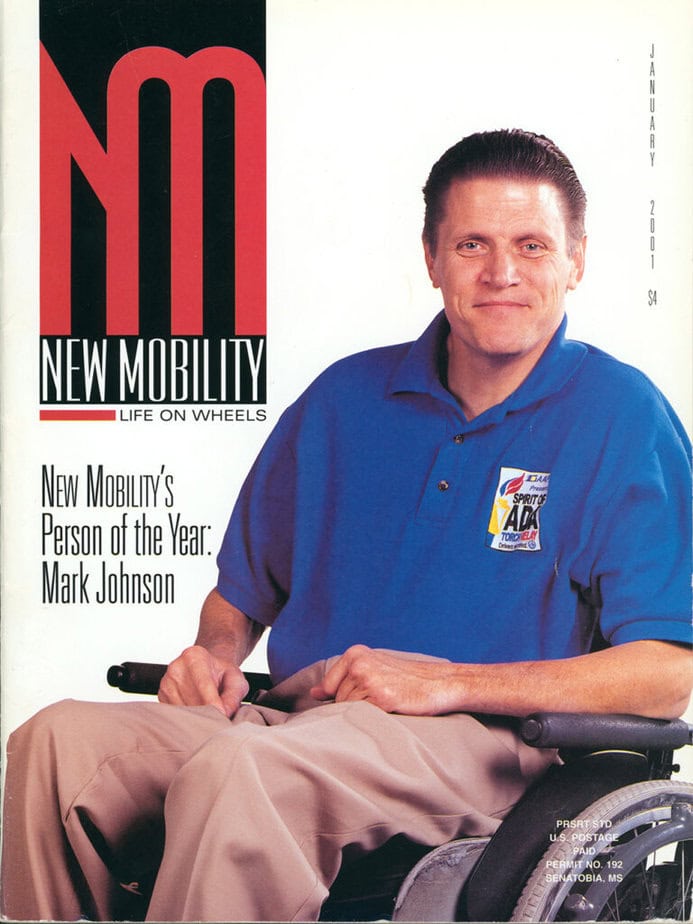
A decade later, we selected Johnson, a C5-6 quad, as our Person of the Year for his efforts organizing a two-month, 24-city torch relay to celebrate and shore up support for the 10th anniversary of the ADA, which was under attack in Congress and the Supreme Court. Even after successfully pulling off the relay, Johnson was adamant that the disability community’s work was far from over. “All along this thing was supposed to be a campaign, not just a relay,” he said. “The flow is continuing — the Rolling Freedom Express, the March for Justice, it keeps going.”
Now
Like the many campaigns for disability rights he has helped launch, Mark Johnson, now 73, just keeps going. Two-and-a-half decades after gracing New Mobility’s cover as the 2000 Person of the Year, Johnson remains a passionate organizer and vibrant voice for our community. And while the years have taken a slight toll on his luscious curly hair, his charming Southern accent hasn’t changed a bit and remains perfectly suited to recounting the rich history of the disability rights movement.

In addition to helping found ADAPT and spearheading the 2000 Spirit of the ADA relay, Johnson created and oversaw Shepherd Center’s advocacy program, chaired the ADA Legacy Project around the Act’s 25th anniversary, and fought relentlessly to improve opportunities for people with disabilities. His efforts have been recognized by numerous organizations and he has won many awards, including a 2015 Viscardi Achievement Award.
“Semiretired” since 2019, Johnson and his wife of 43 years enjoy occasional travel and spending time with their grandson. He can still be found volunteering and collaborating with anyone working to bolster the disability community. He’s currently working with the National Park Service and other disability leaders on an event to celebrate the 35th anniversary of the ADA in 2025.
Asked what message he would give to the newest generation of disability advocates and activists, Johnson said he would encourage them to create an environment where it’s all right to be pissed off. “Channel your energy to create change for yourself and others,” he says. “I’m convinced the sooner you identify as one of us, the sooner you get on with your life.”
JESSE BILLAUER
Then: 1997

At 17 years old, Jesse Billauer was making waves in the surfing scene — winning contests, securing sponsors and working toward going pro. During an average morning surf in 1996, the unexpected happened when he was pulled inside a barrel and thrown headfirst into a shallow sandbar, causing a C6 spinal cord injury. Billauer was already getting back in the swing of things at San Diego State University when we asked him about his goals during our 1997 interview. Atop his list: surfing, marriage and kids. With a positive attitude and support from family and friends, Billauer took the first step in making this dream a reality and got back in the water in September 2001. Soon after, he founded the Life Rolls On Foundation, which quickly emerged as a leader in adaptive surfing.
Now
Billauer is now a three-time world champion and six-time U.S. national champion in the sport he helped create. He has been named one of the most inspirational surfers on the planet and was inducted into the Surfing Walk of Fame. The first International Surfing Association World Para Surfing Championship was held in 2015 and featured 69 competitors from 18 nations.
“I became the first world adaptive-surfing champion in the prone division at the International Surfing Association competition, and it was one of the highlights of my life. I felt so proud of myself, and I accomplished one of my goals, which was to be a world champion in surfing,” he says.
This success didn’t happen overnight though: He had to work hard to adapt this difficult sport to his new abilities. “We had to figure out what adaptations we would have to make on the surfboard to allow me to surf again. Since nobody was really doing it at the time, it was trial and error. We made a board that I would lie down on and put straps by the rails that I wedge my elbows into for leverage. My friends pushed me into a wave and it worked. It was life-changing and it truly gave me so much motivation, confidence, and helped shape the future of my life.”

He also is a father to 7-year-old twin sons, Dorian Blue and Nakoa Reign, whom he calls his greatest accomplishments in life. “I was so scared and nervous to have kids. I wish I could physically do more with them, but I have realized that showing up, giving them love, being there emotionally is even more important than anything I can do physically with them. My kids know nothing but me being in a wheelchair, and they are so supportive of me, and we have a beautiful bond that I cherish every day.”
His experiences have reinforced the importance of community and hard work. “We all learn something new when we go through life. Have an open mind and don’t be shy to ask for help. Try not to dwell on what happened in the past but stay focused on what you can do now and enjoy those moments because tomorrow is never guaranteed.”
MINNA HONG

Then: 2003
When we first spoke to Minna Hong in 2003, she shared how her life changed after she became paralyzed and lost her husband in a car accident. She had to learn to navigate her new identity as a wheelchair user, cultural stigmas around disability in the Asian community, and being a single parent to her then 9-year-old daughter, Megan, and her 6-year-old son, Kristopher. With her “Bring It On” attitude, she found purpose working at Shepherd Center supporting newly injured individuals through their hardest days and connecting them to resources and community. And that was just the beginning of her journey to being a key advocate for the disability community.
Now
Minna Hong supported hundreds of wheelchair users at the Shepherd Center, but after 18 years it caught up to her emotionally. “We work with people that have gone through something very catastrophic. It’s deep. It’s not a situation where you can just leave it at work and go home,” she says.
Before she left, she was recruited for the Delta Advisory Board on Disability, where she has been able to share her personal travel experiences with one of the nation’s largest airlines. “The focus now is on safety and emergency evacuation,” Hong says. “We spoke with TSA and people along the travel ribbon to make sure that they understand what our needs are. It’s the concept of ‘nothing about us, without us.’”
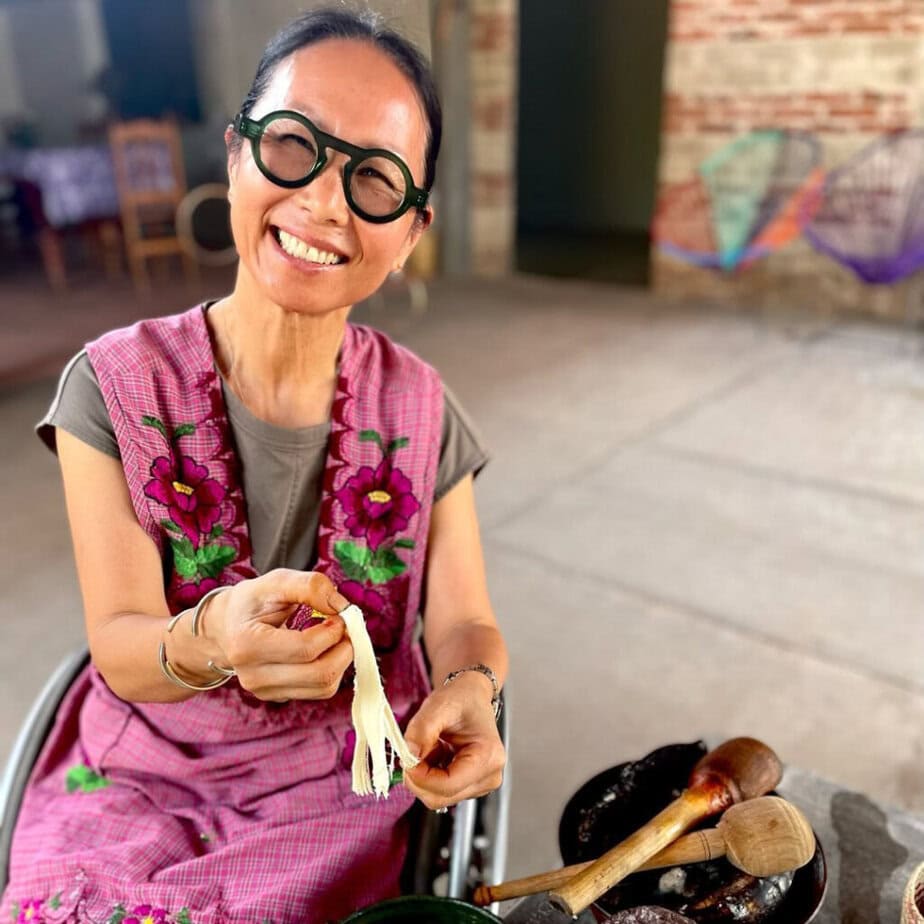
Hong eventually remarried, and her children, now in their 30s, have followed her footsteps in advocacy. “I’m advocating for people with disabilities, my daughter is advocating for animals and their welfare at the Athens Zoo, and my son is working with an older population with dementia as a music therapist,” she says.
She and her husband have eight grandchildren, with another on the way. She says her disability has made them aware of acceptance and inclusion from the get-go. “They don’t think about it as, ‘oh, my Mimi is different.’ They think it’s interesting that certain things aren’t accessible, because they know what I’m capable of doing, since they see me at home,” she says. “It’s about changing the narrative of what disability looks like.”
Art has been, and continues to be, at the center of many of Hong’s efforts. “After my injury, it was a wonderful therapy for me — I started making jewelry a lot,” she says. “My finger dexterity has been such a gift in terms of being able to be expressive.”
She is working with the Santa Fe Art Institute to start a consortium to provide a thematic residency for people with disabilities and remains committed to removing the stigma on disability through art. One of her projects was making jewelry out of her catheters. “I use eight a day and this is something that keeps me alive. So why do I hide it?”
CANDACE CABLE
Then: 1989
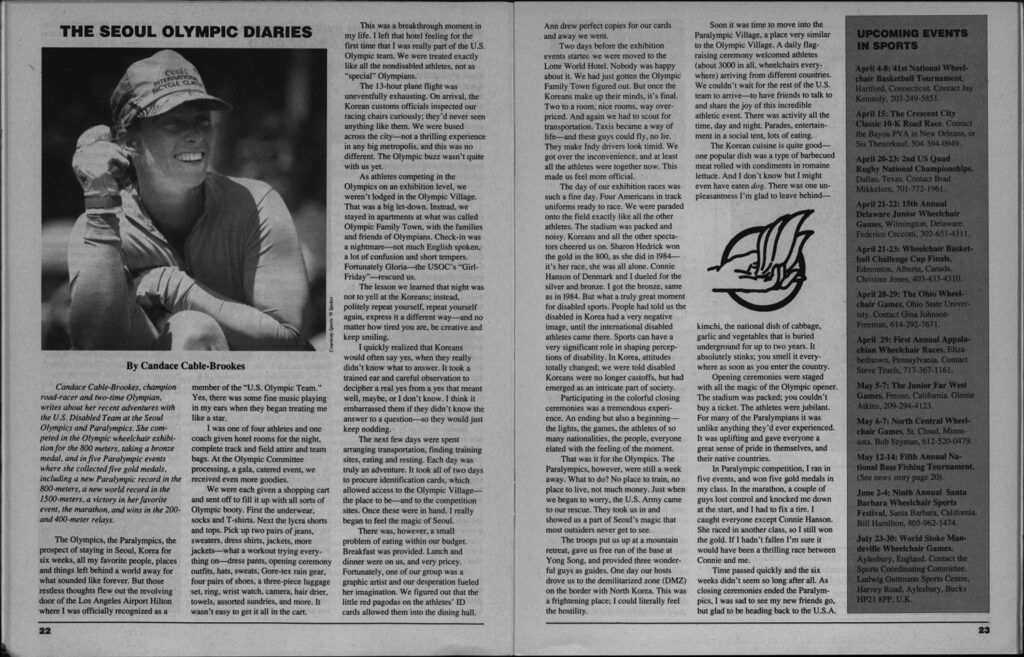
For our first issue, Candace Cable (then Candace Cable-Brookes) documented her adventures in Seoul, South Korea, attending the Olympics and competing in the Paralympics in 1988. She ended up taking home five gold medals and a bronze, setting a new Paralympic record in the 800-meters and a new world record in the 1500-meters, but what struck us was her astute social commentary on the impact the Paralympics had on Korean culture. “People had told us the disabled in Korea had a very negative image, until the international disabled athletes came there,” says Cable. “Sports can have a very significant role in shaping perceptions of disability. In Korea, attitudes totally changed. We were told disabled Koreans were no longer castoffs but had emerged as an intricate part of society.”
Now
Cable’s journey in sports was far from over after the Seoul Olympics. She participated in nine Paralympic Games, in three sports: alpine skiing, nordic skiing and track and field. She was the first U.S. woman to win medals in both the Summer and Winter Paralympic Games and won eight gold medals in her career.
After retiring in 2006, she devoted her time to advocating for the Paralympic Games. She is a strong supporter of Article 30 of the United Nations Convention on the Rights of Persons with Disabilities, which states that everyone has a right to recreation, leisure and culture. “I really wanted people to start to use sport as a catalyst for social impact and real systemic change in the world,” she says.
She was involved in putting together the Olympics’ first council on racial and social justice. “We started lobbying for the U.S. Olympic Committee to change its name to the U.S. Olympic and Paralympic Committee,” she says. This happened relatively recently in 2019 and forced the U.S. Olympic Committee to create access and inclusion in their training centers.
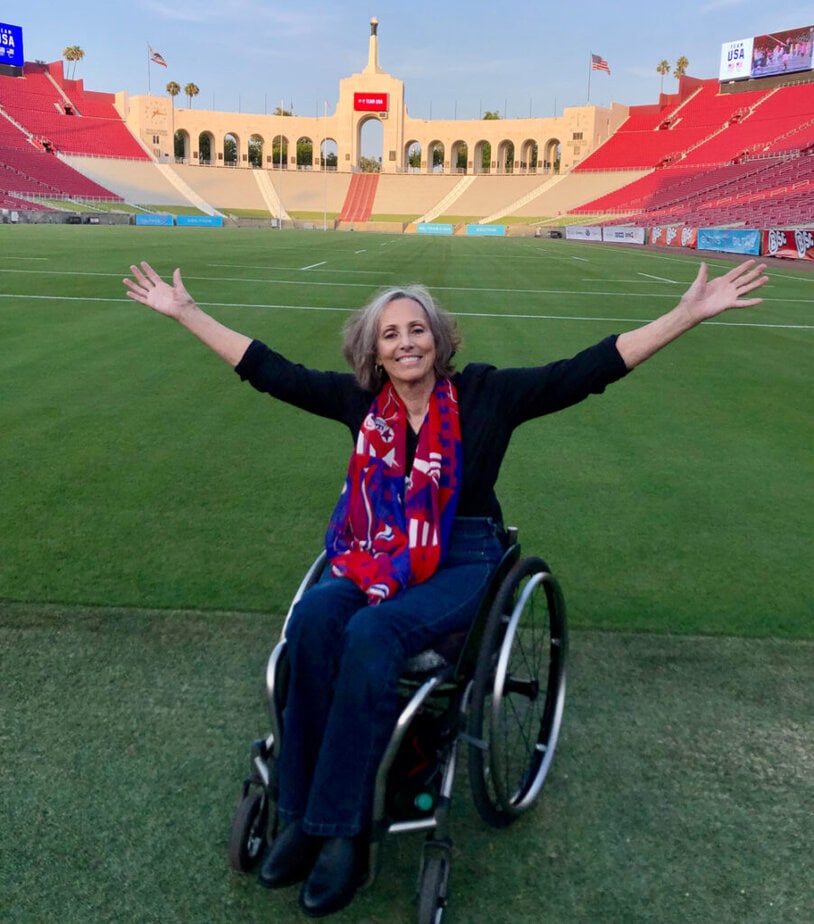
Cable also served on the bid committee from 2015-2017 that fought to bring the 2028 Olympic Games to Los Angeles and is part of a coalition of disabled and nondisabled people working to make sure the Paralympic Games are well received and accessible for all.
Cable hopes to inspire others to join the fight for disability inclusion. “We really need allies that are building up this narrative of not leaving anyone behind and making sure that we look to see who is missing when we create spaces around the world where we gather,” she says.
Support New MobilityWait! Before you wander off to other parts of the internet, please consider supporting New Mobility. For more than three decades, New Mobility has published groundbreaking content for active wheelchair users. We share practical advice from wheelchair users across the country, review life-changing technology and demand equity in healthcare, travel and all facets of life. But none of this is cheap, easy or profitable. Your support helps us give wheelchair users the resources to build a fulfilling life. |


Great looks back on such fantastic people and what amazing things they are doing now. Give us more like this, Peter Axelson and others come to mind.