


Power-Flex Turns Your Manual Wheelchair Into a Compact Power Chair
August 14, 2025
Michael Franz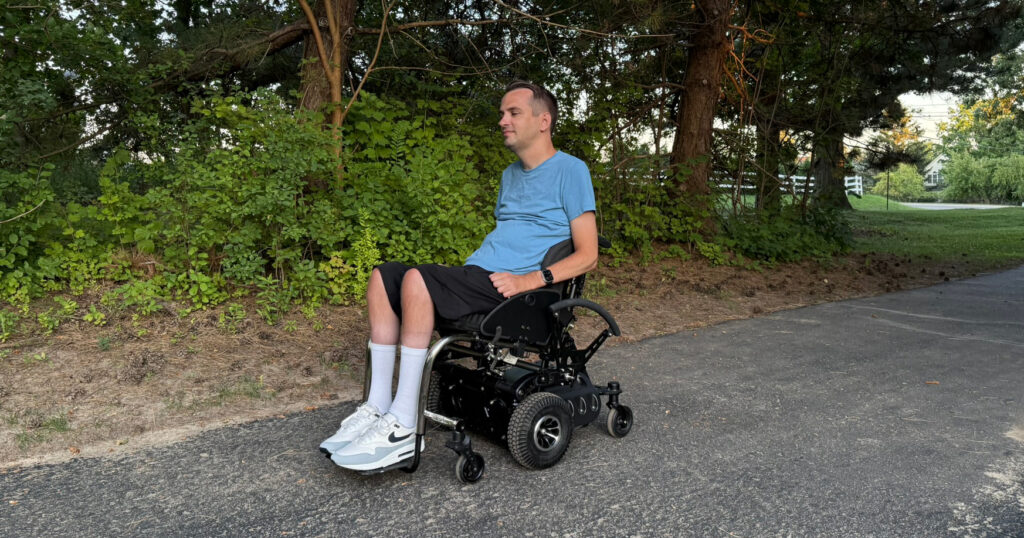
Over my 24 years as a C5-6 quadriplegic, one of the toughest decisions I’ve faced is choosing between a manual and a power wheelchair. Power chairs make it much easier to navigate hills and uneven terrain, but they often limit my ability to access tables, countertops and tight spaces in the community — key aspects of staying independent in daily life. I’ve found a good middle ground using power-assist wheels on a manual chair, which I rely on as my primary setup. However, years of pushing have taken a toll on my neck and shoulders, and the shift to a full-time power chair is on the horizon. That’s why I was excited to learn about a new device from Soul Mobility that aims to bridge the gap between manual and power chairs.
The Power-Flex is a new power-drive attachment that gives manual wheelchairs much of the functionality of power wheelchairs, without the bulk. Mounted beneath the seat of a manual wheelchair, Power-Flex provides a stable, motorized base capable of handling a variety of terrains. It functions much like a traditional power chair, with a top speed of 5 mph and a range of up to 12 miles.
The Power-Flex comes with two armrests that are positioned where the manual wheels would regularly be. The joystick can be installed on either armrest. It sits below your leg, allowing easy access to tables and countertops, something standard power chairs often struggle with. These armrests also provide useful support for transfers, pressure relief and balance.
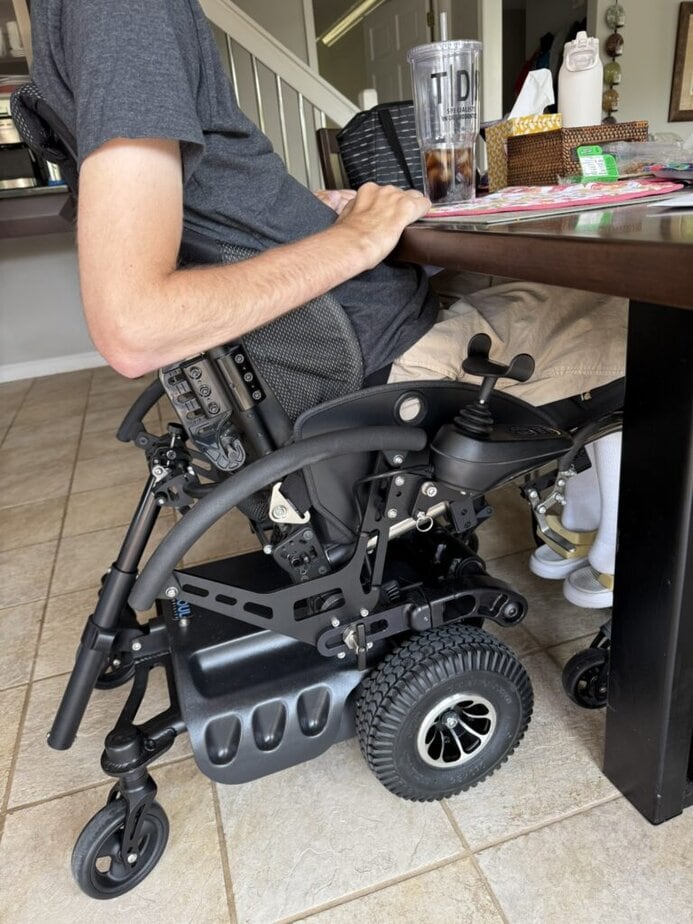
The most unique aspect of the Power-Flex is its manual tilt mechanism. Users can initiate a 30° tilt by shifting their weight backward or pulling on the armrests. This feature enables pressure relief, popping wheelies to clear obstacles, or simply tipping back to relax.
Initial setup of the Power-Flex took me less than an hour. It involved adjusting the axle width to match my manual chair, setting ride height, dialing in the chair’s center of gravity and installing the tilt mechanism, which clamps onto the backrest rigidizer bar. A Soul Mobility rep set up my chair, but it looked simple enough. The company also provides clear instructional videos. Once calibrated, the Power-Flex connects easily to the chair frame. To attach it, you remove the manual wheels and anti-tippers. The axle pins fit into the camber tube like standard wheels, and the tilt arm secures to the rigidizer bar with a clamp.
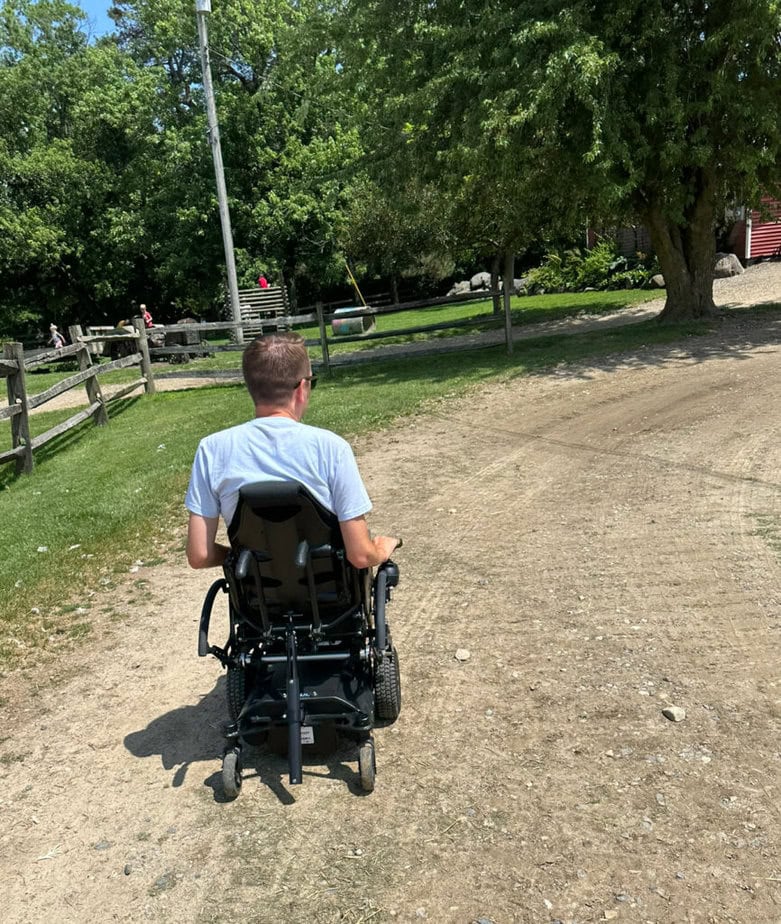
When I received a demo unit, the folks at Soul Mobility advised me not to do anything I wouldn’t normally do in my manual chair. I mostly followed that advice — but with the Power-Flex, I was able to do things I typically couldn’t, even with power-assist wheels. It handled thick grass, rocky paths, and steep, uneven slopes with ease.
One adjustment I had to make involved navigating thresholds. Without popping a wheelie, my manual chair’s smaller casters sometimes got stuck. I found that approaching at a slight angle allowed each caster to clear the threshold individually. Popping a wheelie also worked, but I never quite mastered the timing to do it consistently.
To me, the biggest selling point of the Power-Flex is its compact design. For the first time, I was able to use a power mobility device and still fit comfortably under restaurant tables — a struggle even in my regular manual chair. During testing, I visited several restaurants and fit under every table without issue. Narrow aisles in stores and restaurants that would be off-limits with a full-size power chair were accessible with the Power-Flex. Several caregivers didn’t even realize I was using a powered device until I told them.
At 115 pounds, the Power-Flex is heavy, but it can be disengaged, allowing someone to push it while it’s still attached to the chair. When removed, the armrests fold down for easier storage or transport.
The Power-Flex is a strong option for manual wheelchair users looking to give their shoulders and arms a break without giving up maneuverability. It’s also worth considering for power chair users who want similar functionality in a smaller, nimbler package. I plan to order one for myself to make getting around the community easier without putting extra strain on my body.
The Power-Flex model I tested, with suspension and the manual tilt feature, has an MSRP of $12,500, and is available for $9,375 from several online retailers. It is also approved for billing through Medicare and private insurance. For more details, visit Soul Mobility.
Support New MobilityWait! Before you wander off to other parts of the internet, please consider supporting New Mobility. For more than three decades, New Mobility has published groundbreaking content for active wheelchair users. We share practical advice from wheelchair users across the country, review life-changing technology and demand equity in healthcare, travel and all facets of life. But none of this is cheap, easy or profitable. Your support helps us give wheelchair users the resources to build a fulfilling life. |


Looking good in that power base. I’ve been riding mine for the past five plus years. It’s a game changer. I have my TiLite mounted on it and not only is it a beauty to look at, but it takes me places far and beyond. It was made for us. Todd H. has done it again. Kudos Brother!
Some essentials: The Soul Mobility Power-Flex wheelchair utilizes a 25.9 Volt 10 amp lithium battery, providing a range of approximately 13 miles on a single charge. The battery weighs 5 lbs and is approved for airline travel. The Power-Flex wheelchair itself has a starting weight of 115 lbs.
This is the same concept to the wheelchair add-on I designed back in 2004 and became the inspiration for the ZX-1 which I still use. My design was like this with ability to pop wheelies to get up steps or gutters. Mine died because of aircraft restrictions on batteries, despite Australian, USA, & China patents granted. Weight, including NiMH pack and TiLite frame, was 97lbs.