



Book Review
One More Theory About Happiness
by Paul Guest, 202 pages, published by Ecco, an imprint of HarperCollins Publishers, 2010.
Reviewed by Mike McNulty
The moment is frozen in time and, when remembered, has a quality not unlike a film in slow motion. The car heads toward impact, the swimmer’s body arcs at the wrong angle or is pushed downward by an unpredictable ocean wave. In remembering, the mind slows it down, concentrating as if to will the person away from the impending collision. It never works. The impact occurs, the vertebrae collide, and the spinal cord is squeezed, struck, bruised. Often the loss of sensation and movement is immediate. Paul Guest was 12 years old when he broke his neck while riding a bicycle down the driveway at a teacher’s house. It was an awful and perfect storm of circumstance. …
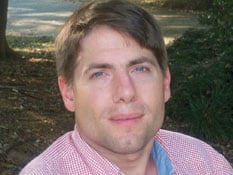
The injury was 24 years ago. In his memoir, One More Theory About Happiness, he describes his mental and physical journey from that moment to now. A published and award-winning poet who teaches at Agnes Scott College in Decatur, Ga., Guest tells his tale using episodes and images rather than a linear recitation of events. The reader is invited to see the confusing and frightening world of hospital and rehabilitation center through the eyes of a shy, quiet 12-year-old who is as much an observer of his life as he is a participant.
He is the central character of his life, but he has a supporting cast. His father, pained by his own grief over his son’s injury, reaches out to him in small and significant gestures. His mother, a woman of humor and determination, provides physical as well as emotional care for him, but also knows when to let go and allow her son to venture out into the world to discover his course and develop on his own.
Injured so young, his adolescence is refracted. His personal development is a longer process for him as he negotiates the already treacherous ground of the shy adolescent turned young man as well as the additional layer of uncertainty added by his quadriplegia. Any relationships have to deal with both realities. He allows us to experience, for instance, his uncertainty about whether a girl kisses him because she likes him or feels sorry for him.
An additional pleasure of his memoir is the insight he provides into his developing awareness of his identity as poet. His personal history is present in his poetry, but the reader gets the feeling that his poetry was present in him before his injury. He has published four volumes of poetry, The Resurrection of the Body and the Ruin of the World, Exit Interview, Notes for My Body Double, and My Index of Slightly Horrifying Knowledge.
He presents the details of his life in flickering moment and shadow. For instance, even though it was his teacher who suggested he and a classmate ride the bikes because they are the only boys at the class party and they are bored, she never discussed the fateful incident with him. There is a moment where he sees her at a distance in public, but they do not meet. Later, he informs the reader that she died of cancer. That’s it. No resolution, just the empty distance between them.
In a chilling detail, he reveals that he read Joni, a memoir by Joni Eareckson Tada, a woman with quadriplegia since adolescence, the night before his accident. This seems too incredible to be true. But there it is, pushing him inexorably down the driveway and into the grass. He describes attending, at his mother’s insistence, an event by Tada. He stayed in the rear of the hall, not joining the autograph seekers who lined up to see her. She waved to him when he was pointed out to her. He was uncomfortable and wanted to leave. He realized that he never wanted to be an example to others, a “symbol,” as he describes it.
This is one of the most refreshing attributes of his memoir. At no point does he attempt to be uplifting or inspirational. He is a person who wants nothing more than what all people want: love, life and vocation.
 His journey from there to here is filled with poignant and ironic characters: the woman hired to take notes in his classes who can’t spell, the attendant who has “feelings” for him and the “doctor” brought in to treat him in the middle of the night who, in a hilarious and frightening moment, wants to put lighter fluid on his leg and light it as a traditional folk treatment. He recalls a time in college before automatic doors when he is left staring at an unlocked door he cannot open, waiting for someone to open it for him — only after they have asked him if he is saved. They are included not simply as stories, but as markers of the absurdity that is encountered when one is at the mercy of others’ foibles to get basic needs met.
In between, he finds cohorts in college and graduate school who help him experience the petty mischief of college, and girlfriends to explore his, tentative sexuality and the mystery of relationships. He examines his old self, the one who was sent to his ruin, and wonders what hold the young boy still has on him. Often people who have sustained an injury feel stuck in time, as if they exchanged their multifaceted pre-injury self for a cliché, a member of a category. Guest finds something more profound than his medical status, a way of touching the past and letting go. In that, he finds a way of touching the present.
One More Theory About Happinessis a satisfying read, a trip into a reality which is hard to put down.
Mike McNulty is a private counselor and writer who lives in the Atlanta area and worked for many years at the Shepherd Center. He is the father of three exceptional children.
Excerpt
From chapter one of the book One More Theory About Happiness by Paul Guest. Reprinted courtesy of Ecco, an imprint of HarperCollins Publishers. Published 2010.
I should have been wary. An adult would have known better than to ride those bikes. Leaned against the wall, festooned with cobwebs, skinned in dust, the 10-speed bikes had not been used in quite some time. Adam took the first and pedaled a few feet forward, stopping. The tires were flat. I looked down to see that mine were flat, too. Back inside the garage, we found a pump hanging on the wall. Adam inflated his tires quickly and then was gone. I began pumping mine back up.
I climbed atop the bike, feeling awkward from leaning out over the handlebars. All my life I had ridden single-speed bikes with 20-inch wheels, dirt bikes, BMX bikes with lightweight steel frames. I felt unsafe but pedaled on slowly.
Jody’s house sat at the top of a long, steep driveway. To either side, green lawns sloped down to the road. I didn’t see Adam anywhere ahead. Already I was afraid I would wreck.
The bike was getting away from me as it coasted down the long incline. I squeezed the right caliper handbrake but it was only mush, a sensation I had felt before on my own bike when the brake cable that ran down to the wheel had frayed or torn entirely. It was a problem I could fix myself but not in motion, not then. My fear began to grow.
I was resigned to the inevitability of crashing, and in those few seconds I had before the bike would be dangerously fast I decided it was better to crash on grass than to land on the asphalt.
I steered to the right, not into Jody’s lawn but the grass between her yard and her neighbor’s. I tried the useless brakes once more. Nothing.
Maybe I can lay it down in the grass, I thought, though I’m not even sure I knew what that meant. I was rolling over the smooth grass, frozen. I never tried to do anything but ride it out.
What I did not know, what I could not see, would be what changed the rest of my life. At the bottom of the slope, a drainage ditch ran beside the road, overgrown with weeds and thick tussocks of grass. I hit the ditch still traveling at speed. I was thrown from the bike, over the handlebars, catapulted, tossed like a human lawn dart into the earth.
Support New MobilityWait! Before you wander off to other parts of the internet, please consider supporting New Mobility. For more than three decades, New Mobility has published groundbreaking content for active wheelchair users. We share practical advice from wheelchair users across the country, review life-changing technology and demand equity in healthcare, travel and all facets of life. But none of this is cheap, easy or profitable. Your support helps us give wheelchair users the resources to build a fulfilling life. |


Recent Comments
Neil on A Safe, Effective Reusable Catheter System
Richard Crumb on A Safe, Effective Reusable Catheter System
Richard Crumb on A Safe, Effective Reusable Catheter System